7 – 21 Test Bank for Introduction to Corporate Finance, Fourth Canadian Edition
54. Atlantic Fishing Ltd. common stock has just paid a dividend of $1.80 per share and
is selling for $34.48 each. The firm expects its dividend to grow at a constant rate of 6.3
percent a year. What is the risk premium associated with the stock if the risk-free rate is
4.25 percent?
a) 7.27%
b) 7.60%
c) 11.52%
d) 11.85%
55. Maple Drinks Corp. has just announced a dividend of $0.80 for this year and $0.835
for the next year. Dividends are expected to grow at a constant rate indefinitely. What
is the current stock price if the required return is 13.1 percent?
a) $8.55
b) $9.35
c) $9.57
d) $10.37
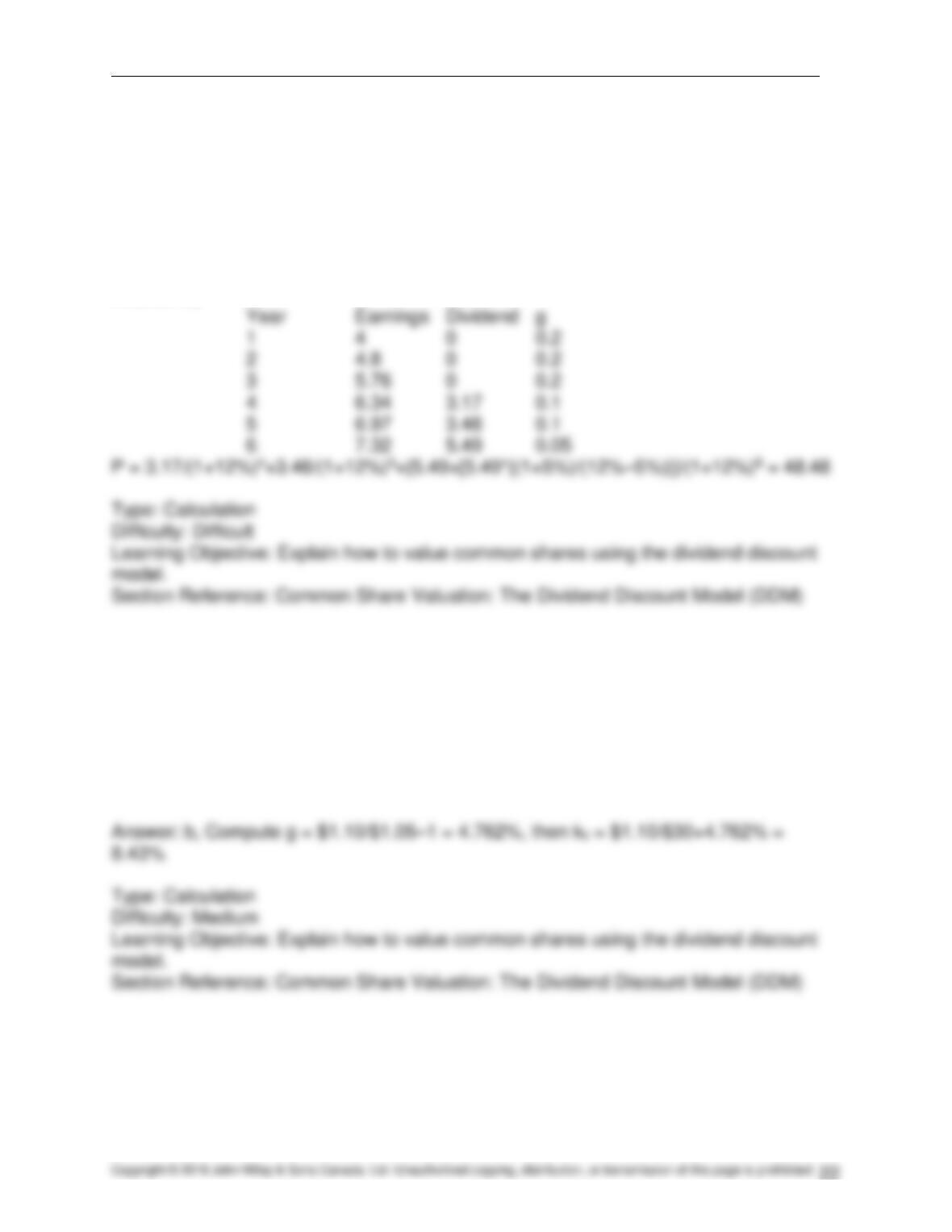
56. Analysts announced estimated earnings per share of $4 for the coming year for
Toronto Skates Inc. The company plans not to pay any dividends for the next three
years. For the subsequent two years, the company plans on retaining 50 percent of its
Equity Valuation 7 – 22
earnings, and then 25 percent of its earnings from that point forward. Retained
earnings will be invested in projects with an expected return of 20 percent per year. If
the required rate of return is 12 percent, then the price is:
a) $48.48
b) $67.30
c) $57.50
d) $59.09
Answer: a,
57. Lac Superior Enterprises has just paid a dividend of $1.05 and will pay $1.10 next
year. Dividends are expected to grow at a constant rate indefinitely. What is the
required rate of return if the stock is selling for $30 today?
a) 8.26%
b) 8.43%
c) 8.60%
d) 8.92%
58. BC Corporation common stock has just paid a dividend of $2.20 per share. Its
dividend is expected to grow at a rate of 5 percent per year indefinitely. The current
stock price is $30 and the risk premium associated with this stock is 8.7 percent. What
is the implied risk-free rate?
7 – 23 Test Bank for Introduction to Corporate Finance, Fourth Canadian Edition
a) 3.63%
b) 3.70%
c) 4.00%
d) 4.42%
59. Zigzag Corporation’s common stock is selling for $22 per share in the market.
Zigzag’s EPS is expected to be $2 next year, and the required rate of return is 12
percent. What is the present value of growth opportunities per share?
a) $5.33
b) $16.67
c) $20.00
d) $38.67
60. Suppose Delightful Inc.’s present value of growth opportunities per share is $6 and
its current share price is $18. What is the firm’s required rate of return if its expected
EPS is $2.25?
a) 9.38%
b) 12.16%
c) 15.42%
d) 18.75%
61. The market value of Monteregie Corporation’s 1 million outstanding common shares
is $22.5 million. The firm is expected to have earnings of $1,750,000 next year. The
90-day government T-bill yields 3.75 percent. What is the present value of growth
opportunities if the risk premium is 8.4 percent?
a) $1.67
b) $8.10
c) $14.40
d) $20.83
62. The market value and book value of Visual Image Inc.’s outstanding 2 million
common shares are $60 million and $30 million, respectively. The company’s recent
net profit was $3,500,000. What is the company’s sustainable dividend growth rate if it
uses a dividend payout ratio of 60 percent?
a) 2.33%
b) 3.50%
c) 4.67%
d) 7.00%
63. DH Corporation had net earnings of $200,000 this past year and paid $80,000 in
dividends on the company’s equity of $1,800,000. What is the growth rate of this
company?
a) 6.67%
b) 11.11%
c) 4.44%
d) 0%
7 – 25 Test Bank for Introduction to Corporate Finance, Fourth Canadian Edition
64. Dream Homes Corporation had net earnings of $200,000 this past year and paid
$80,000 in dividends on the company’s equity of $1,800,000. Dream Homes has
500,000 shares outstanding with a current market value of $5. What is the firm’s
present value of growth opportunities if the required rate of return is 10.08 percent?
a) $0.77
b) $0.84
c) $0.86
d) $0.90
65. DDM Company has an expected profit margin of 15 percent, turnover ratio of 2, and
a leverage ratio of 0.5. The firm had an EPS of $2 and paid a dividend of $1.05 per
share. What is DDM’s sustainable growth rate?
a) 8.125%
b) 7.875%
c) 7.125%
d) 6.875%
66. Ontario Ice Corporation has an expected profit margin of 10 percent, turnover ratio
of 3, and a leverage ratio of 0.50. The firm expects an EPS of $3 next year and
maintains a retention ratio of 60 percent. What should the stock sell for today if the
required return is 15 percent?
a) $13.33
b) $20.00
c) $26.67
d) $30.00
67. Maniac Corporation just paid a dividend of $2 on its current EPS of $6. Its projected
net profit margin, asset turnover, and leverage ratio are 12.5 percent, 2.5, and 0.6,
respectively. What is Maniac’s required rate of return if the current price is $34.60?
a) 12.03%
b) 12.39%
c) 18.28%
d) 19.00%
68. Nunavut Beach Resort has a net income of $330,000 on sales of $2,200,000. The
firm has total assets of $1,600,000, a book value of equity of $1,200,000, and a
dividend payout ratio of 65 percent. What is the firm’s current market value if the
required return is 21 percent?
a) $1.886 million
b) $2.067 million
c) $3.180 million
7 – 27 Test Bank for Introduction to Corporate Finance, Fourth Canadian Edition
d) $8.091 million
69. MacLean Inc. currently pays no dividends. Today, the firm announced that it will
pay its first dividend of $1 per share in four years, then $1.50 in each of the following
three years, and the subsequent dividends are expected to grow at a constant rate of 5
percent per year. What is the stock price today if the risk-free rate is 4 percent and the
risk premium associated with this stock is 6 percent?
a) $17.93
b) $19.40
c) $31.50
d) $34.73
70. Macaroni Inc. announced that it would pay the following dividends over the next five
years: $0.50, $0.75, $1.50, $3, and $4. Afterwards, dividends will decline at a rate of 3
percent per year indefinitely. What is the firm’s current stock price if the required rate of
return is 13%?
a) $30.33
b) $24.25
c) $19.24
d) $17.73
71. Junkies Corporation has just paid a dividend of $0.90. Dividends are expected to
grow at 20% for years one and two, 15% for years three and four, 10% for years five
and six, and 5% thereafter. What is the expected dividend for year 10 if the required
return is 18 percent?
a) $2.40
b) $2.52
c) $2.65
d) $2.78
72. VIP Corporation has just paid a dividend of $1.50. Dividends are expected to grow
at 20% for the first three years and 10% for the following two years. What is the
expected growth rate for the subsequent years if the stock is selling for $24.86 today
and the required return is 17 percent?
a) –1.07%
b) –1.75%
c) 8.00%
d) 8.65%
7 – 29 Test Bank for Introduction to Corporate Finance, Fourth Canadian Edition
73. Price-earnings (P/E) ratios can be estimated using which of the following?
I. The required rate of return
II. The expected growth rate of dividends
III. The retention ratio
a) I and II only
b) II and III only
c) I and III only
d) I, II, and III
74. Which of the following is not true about the P/E ratio?
a) A comparison of one company with its peers also involves a great deal of subjectivity
regarding company-specific characteristics.
b) P/E ratios only work well on companies in the high growth stage of their lifecycle.
c) P/E ratios are uninformative when companies have negative or very small earnings.
d) The volatile nature of earnings implies a great deal of volatility in P/E multiples.
75. Which of the following statements is FALSE?
a) The higher the expected payout ratio, the higher the P/E.
b) The higher the expected growth rate, g, the higher the P/E.
c) The lower the required rate of return, kc, the lower the P/E.
d) The relevant input is the expected earnings, not historical earnings.
Equity Valuation 7 – 30
76. Which one of the following is a limitation of the P/E ratio?
a) Easy way to estimate the price of a firm
b) It compares the performance of stocks
c) Ignores the magnitude or the sign of the earnings
d) One of the most widely used relative pricing methods
77. Which one of the following is not a fundamental factor that affects the P/E ratio
directly?
a) Expected payout ratio
b) Required rate of return
c) Preferred shares dividend
d) Expected growth of dividend
78. Which of the following statements is correct?
a) Companies with higher expected growth opportunities sell for a lower P/E ratio,
assuming everything else is constant.
b) Companies with higher expected growth opportunities sell for a higher P/E ratio,
assuming everything else is constant.
7 – 31 Test Bank for Introduction to Corporate Finance, Fourth Canadian Edition
c) Need additional information.
79. Suppose a firm has just reported an EPS of $2.50 and expects to maintain a
dividend payout ratio of 40 percent. What is the firm’s price-earnings ratio if its return
on equity is 12 percent and the required return is 11.5 percent?
a) 11.50
b) 9.30
c) 7.20
d) 5.97
80. Suppose a firm has just reported an EPS of $2.50 and expects to maintain a
dividend payout ratio of 40 percent. If the firm’s price-earnings ratio is 9.3 and its return
on equity is 12 percent, what is its required rate of return?
a) 13.80%
b) 11.5%
c) 13.35%
d) 12%
81. Suppose a firm’s price/earnings ratio is 16. It has just paid a dividend of $1.80 per
share to maintain a 45 percent payout ratio. What is the firm’s current market price if its
return on equity is 12 percent?
a) $68.22
b) $67.46
c) $66.54
d) $65.78
82. Suppose a firm’s price/earnings ratio is 12. It has just paid a dividend of $2 per
share to maintain a 40 percent payout ratio. What is the firm’s return on equity if its
price is $65?
a) 13.89%
b) 20.83%
c) 34.25%
d) 38.89%
83. Suppose a firm’s price/earnings ratio is 10. It expects to pay a dividend of $1.20 per
share to maintain a 60 percent payout ratio. What is the firm’s required return if its
return on equity is 13.5 percent?
a) 14.10%
b) 13.20%
c) 12.30%