Valuation Basics 6 – 18
46. Which one of the following is not true?
a) A bond issuer’s rating is affected by its default risk.
b) An investor holding the bond until maturity expects to receive its par value.
c) Inflation does not affect the interest rates of bonds.
d) Rating agencies use financial statements to assess the default probability of firms.
47. Marie bought a five-year 4.25 percent annual coupon bond for $974 a year ago.
Today, she sold the bond at the market yield of 4 percent. What is Marie’s approximate
real rate of return if the inflation rate over the past year was 2.2 percent?
a) 1.80%
b) 2.05%
c) 5.76%
d) 5.98%
48. The risk premium of a company would increase with:
a) An increase in the debt to equity ratio
b) An increase in the current ratio
c) A stable interest coverage ratio
d) An increase in earnings
49. Suppose you observed that one-year T-bills are trading at a YTM of 4.35 percent.
The yield spread between AAA- and BBB-rated corporate bonds is 150 basis points.
The maturity yield differential between the one-year T-bills and the five-year government
bonds is 65 basis points. What yield would you expect to observe on BBB-rated
corporate bonds with a five-year maturity?
a) 5.00%
b) 5.20%
c) 5.85%
d) 6.50%
50. Which one of the following statements is not correct?
a) AAA bonds are the safest bond investment.
b) Speculative grade bonds require high yields.
c) Large, well-established companies always have speculative grade ratings.
d) Speculative bonds are also called junk bonds.
51. Suppose you observed that five-year government bonds are trading at a YTM of
5.75 percent. The yield spread between AAA- and BBB-rated corporate bonds is 130
basis points. The maturity yield differential between the three-year and five-year
government bonds is 45 basis points. What yield would you expect to observe on BBB-
rated corporate bonds with three years to mature?
a) 5.30%
Valuation Basics 6 – 20
b) 6.60%
c) 7.05%
d) 7.50%
52. What is the price of a 183-day Canadian T-bill with a par value of $5,000 that has a
quoted yield of 1.1 percent?
a) $4,945.60
b) $4,972.20
c) $4,972.58
d) $4,972.65
53. Suppose you buy 91-day Treasury bill with a par value of $1,000 for 98.125 at the
time of the issue. After owning the Treasury bill for 23 days, you sell it. The bond
equivalent yield you earned is 6.57%. What price did you receive for the T-bill?
a) $986.31
b) $985.31
c) $856.31
d) $1,000
e) None of the above
6 – 21 Test Bank for Introduction to Corporate Finance, Fourth Canadian Edition
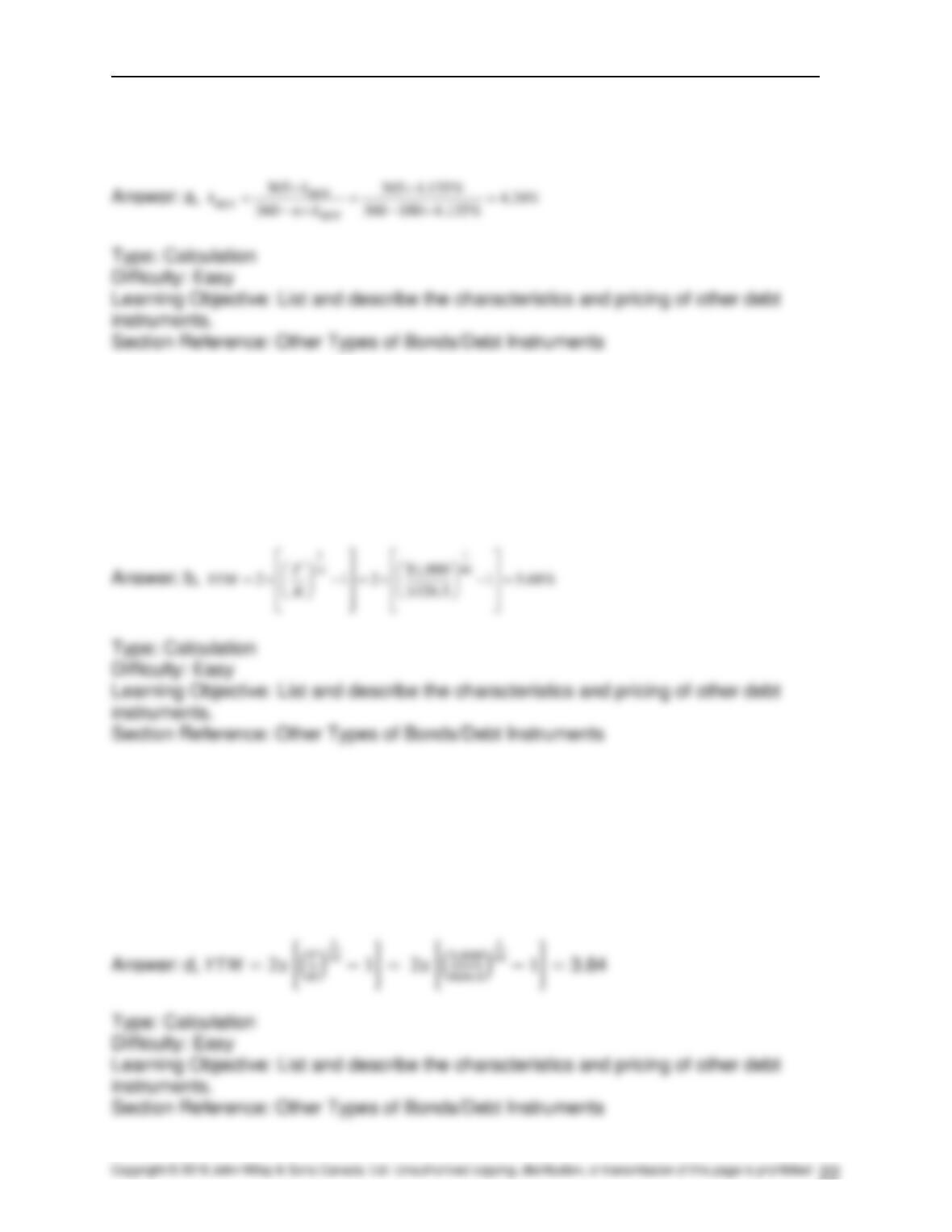
54. What is the yield of a 91-day Canadian T-bill with a par value of $1,000 that is
quoted at 98.735?
a) 5.07%
b) 5.14%
c) 5.22%
d) 5.24%
55. A 182-day Canadian T-bill has a bond equivalent yield of 3.925 percent. What is the
bank discount yield on a 182-day U.S. T-bill with the same quoted price?
a) 3.90%
b) 3.87%
c) 3.83%
d) 3.80%
56. A 180-day U.S. T-bill has a bond discount yield of 4.135 percent. What is the bank
equivalent yield on a 180-day Canadian T-bill with the same quoted price?
a) 4.28%
b) 4.24%
Valuation Basics 6 – 22
c) 4.19%
d) 4.16%
57. A twenty-year zero coupon bond with a face value of $1,000 is currently selling for
$326.50. What is the bond’s YTM?
a) 5.65%
b) 5.68%
c) 5.72%
d) 5.76%
58. A five-year zero coupon bond with a face value of $1,000 is currently selling for
$826.50. What is the bond’s YTM?
a) 5.65%
b) 5.68%
c) 5.72%
d) 3.84%
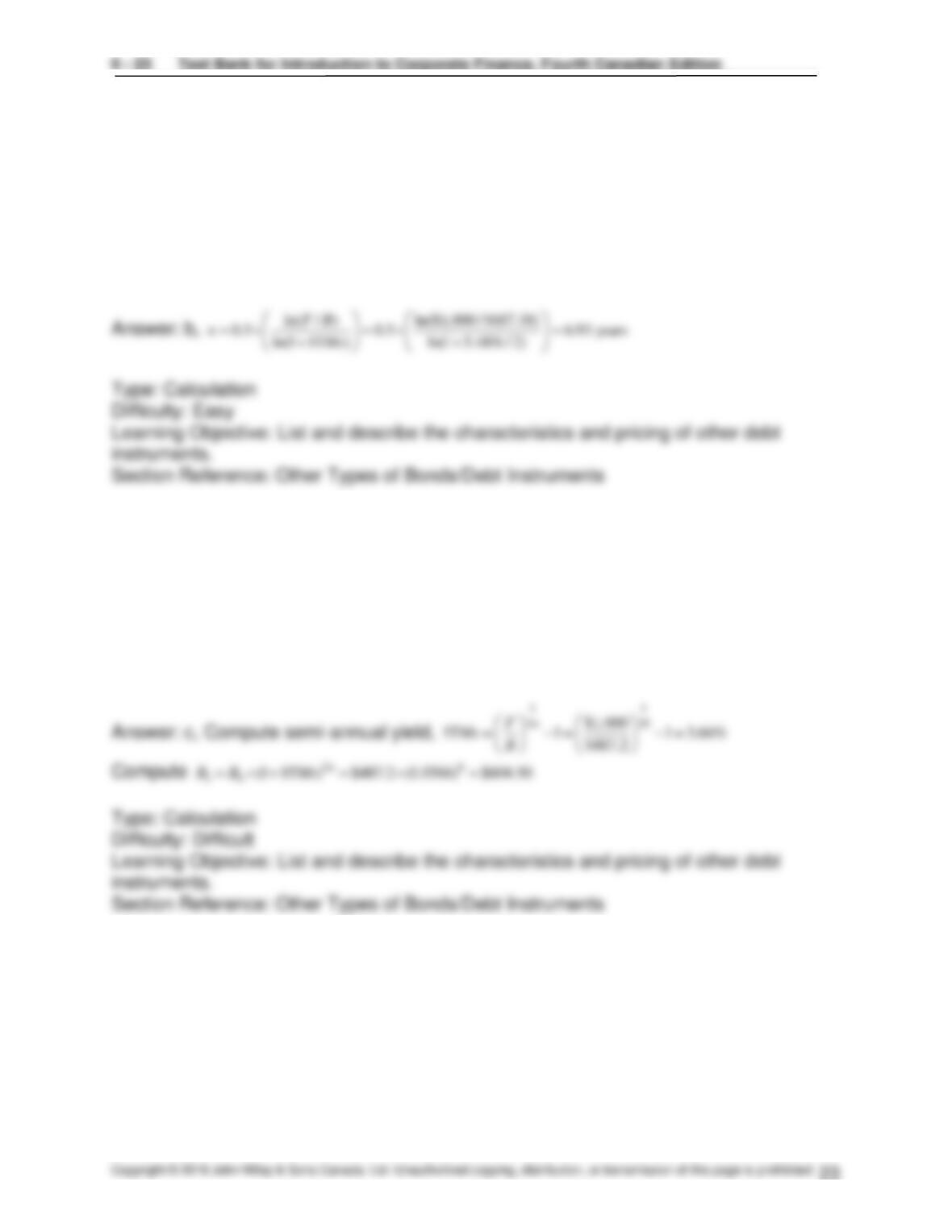
59. A zero coupon bond with a face value of $1,000 is currently selling for $687.38. The
bond has a market yield of 5.48 percent. What is the bond’s term to maturity?
a) 6.62 years
b) 6.93 years
c) 7.03 years
d) 7.42 years
60. A ten-year zero coupon bond with a face value of $1,000 is currently quoted at
48.72. Assume the bond’s YTM remains unchanged throughout the bond’s term to
maturity. What should the bond be sold for three years from now?
a) $542.69
b) $594.19
c) $604.50
d) $641.04
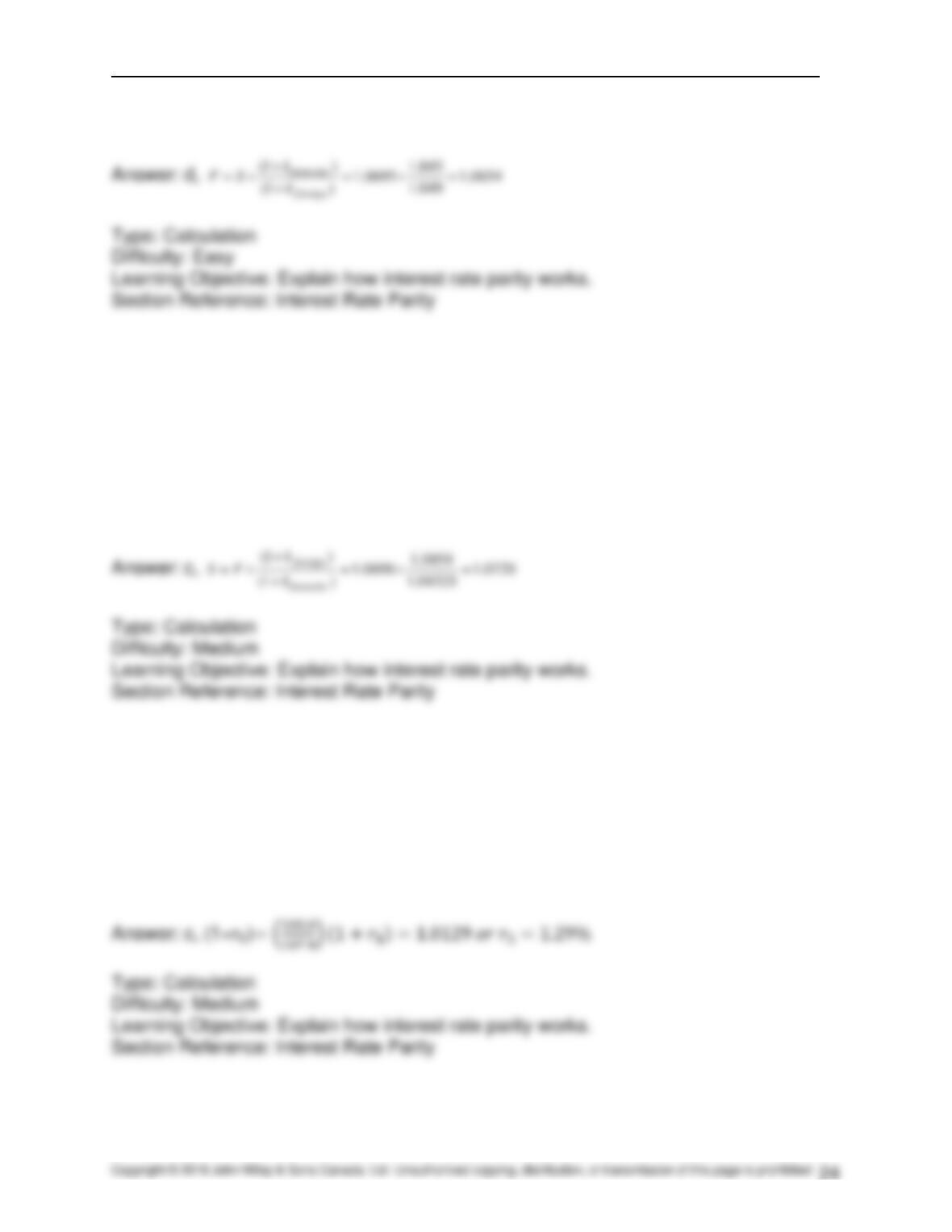
61. Suppose Canadian interest rates are presently 4.5 percent on one-year Canadian T-
bills. Suppose that the U.S. dollar is quoted at US$1 = C$1.0695 and that the interest
rate on one-year T-bills in the U.S. is 4.9 percent. What should the one-year forward
exchange rate (C$/US$) be?
a) 1.0783
b) 1.0736
c) 1.0692
Valuation Basics 6 – 24
d) 1.0654
62. Suppose U.S. interest rates are presently 4.54 percent on one-year U.S. T-bills.
Suppose that the one-year forward exchange rate is quoted at US$1 = C$1.0698 and
that the interest rate on one-year T-bills in Canada is 4.325 percent. What should the
spot exchange rate be?
a) 1.0622
b) 1.0676
c) 1.0720
d) 1.0764
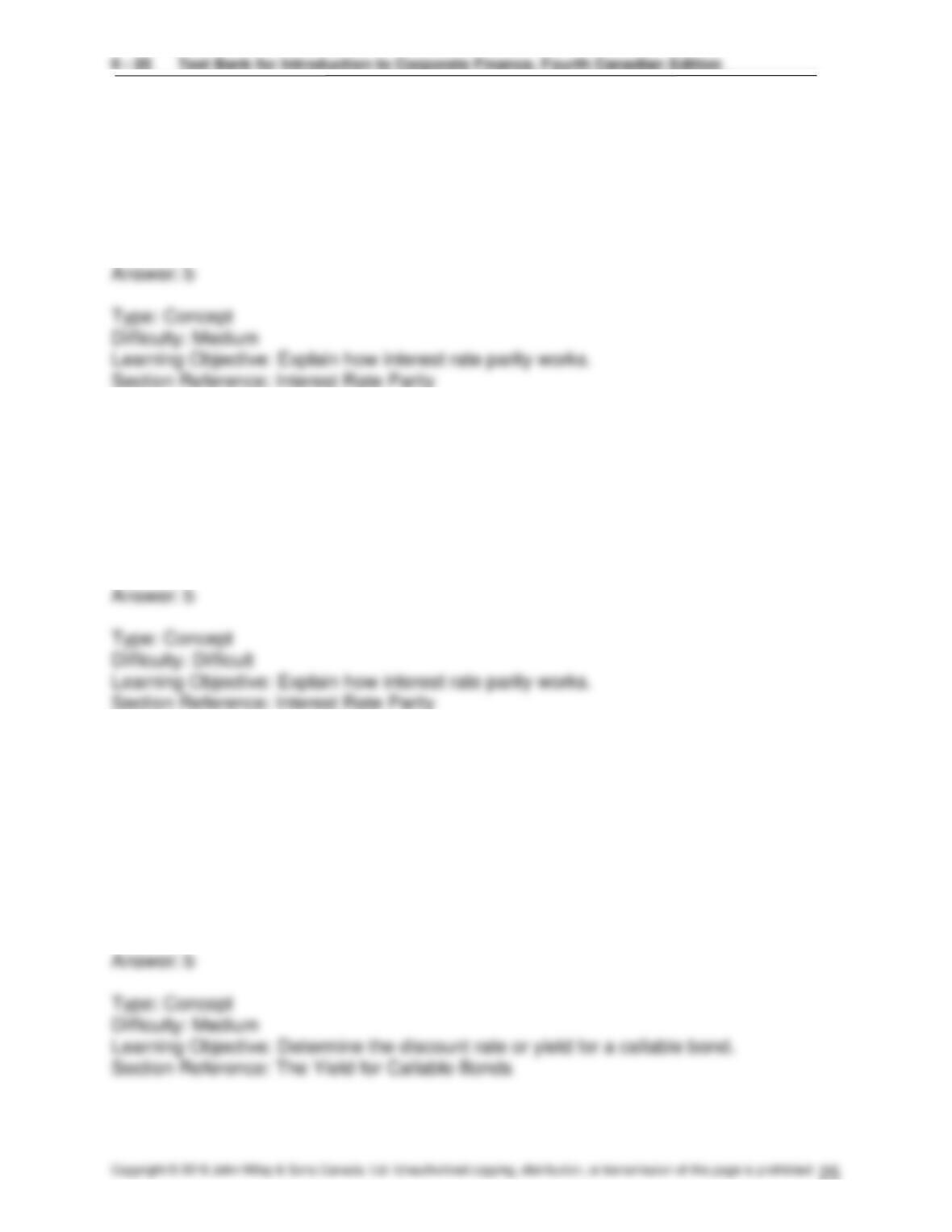
63. The spot ¥/C$ exchange rate is 107.9 and the one year forward exchange rate ¥/C$
$ is 103.6. If the annual interest rate on Canadian T-bill is 5.5%, what would you expect
the annual interest rate to be on Japanese T-bill?
a) 1.4%
b) 3.3%
c) 1.4%
d) 1.29%
64. Suppose the spot exchange rate is C$.75 per US dollar. The forward exchange rate
is C$.80per US dollar. Which of the following is true?
a) The Canadian inflation rate is lower.
b) The US dollar is selling at a premium.
c) The US dollar is selling at a discount.
d) None of the above.
65. If everything else held constant, a decrease in relative expected inflation in Canada
compared with the U.S. would imply:
a) An increase in the Canadian dollar versus the U.S. dollar
b) A decrease in the Canadian dollar versus the U.S. dollar
c) No change in the Canadian dollar versus the U.S. dollar
d) A decrease in the Canadian dollar versus the euro
66. The yield to call (YTC) is:
a) the opportunity cost of forgone coupon payments.
b) the yield that an investor would expect to make if he or she bought the bond at the
current price, held it to call date.
c) the yield that an investor would expect to make if he or she bought the bond at the
current price, held it to maturity, received all the promised payments on their scheduled
dates.
d) All of the above.
67. Which of the following is true?
a) The YTC is greater than the coupon rate, because the call price is greater than the
bond’s current price.
b) The YTC is greater than the coupon rate, because the call price is smaller than the
bond’s current price.
c) The YTC is greater than the coupon rate, because the call price is equal to the bond’s
current price.
6 – 27 Test Bank for Introduction to Corporate Finance, Fourth Canadian Edition
PRACTICE PROBLEMS
68. Explain the difference between the coupon rate and the current yield.
69. Explain the term “yield to maturity.”
70. Explain the difference between nominal and real interest rates.
71. What is the major concern about the liquidity preference theory of the yield curve?
72. Explain the implication of an increase in expected inflation.
73. Discuss the reasoning behind interest rate parity. Why don’t firms always issue
bonds in the country where interest rates are the lowest?
74. What is the term structure of interest rates and the yield curve?
75. Briefly describe three theories of the term structure of interest rates.
Answer:
Valuation Basics 6 – 30
Section Reference: Bond Yields
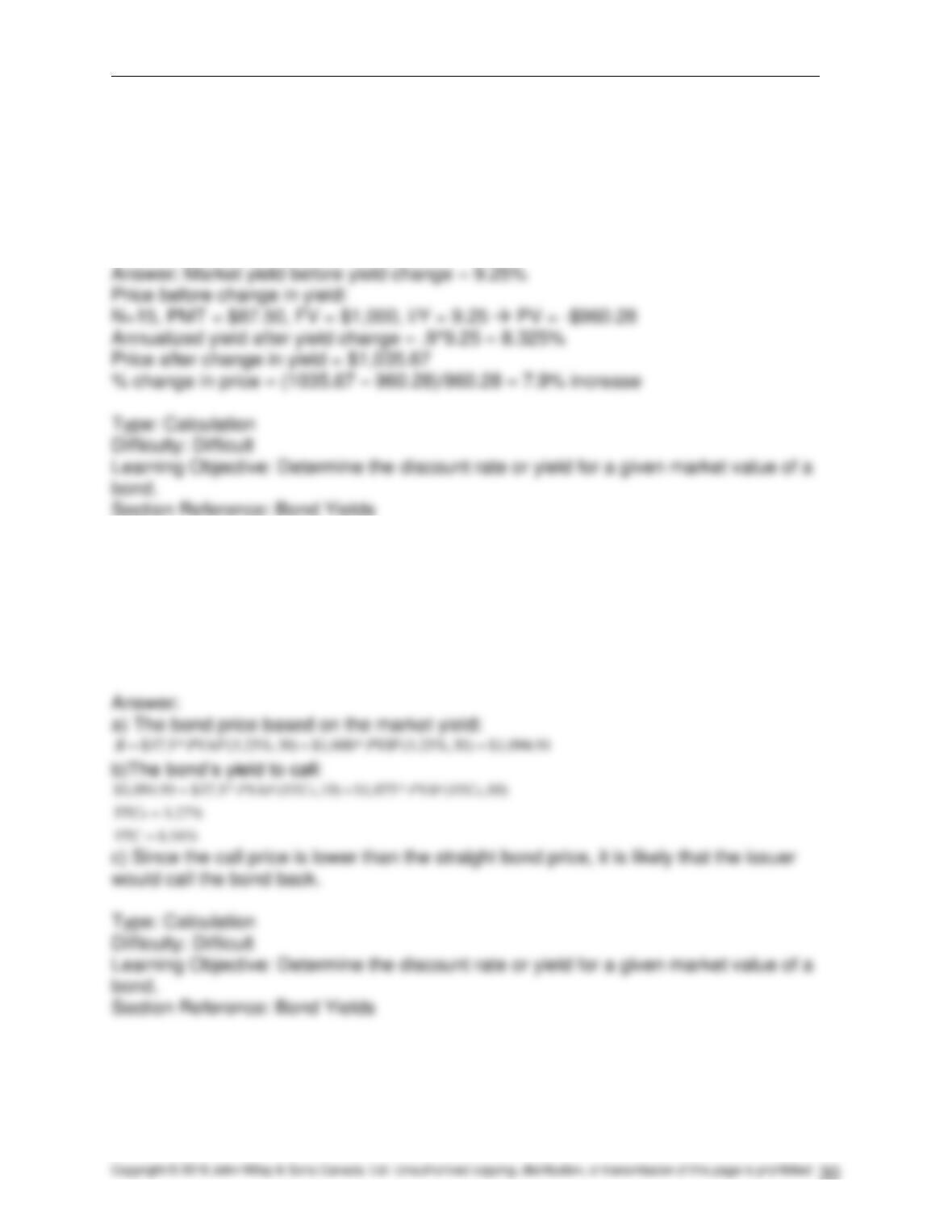
76. J&B Co. has 8.75 percent coupon bonds quoted with a market yield of 9.25 percent.
The bonds have fifteen years to mature and make annual interest payments. What is
the percentage change in price for a 10 percent decrease in market yield?
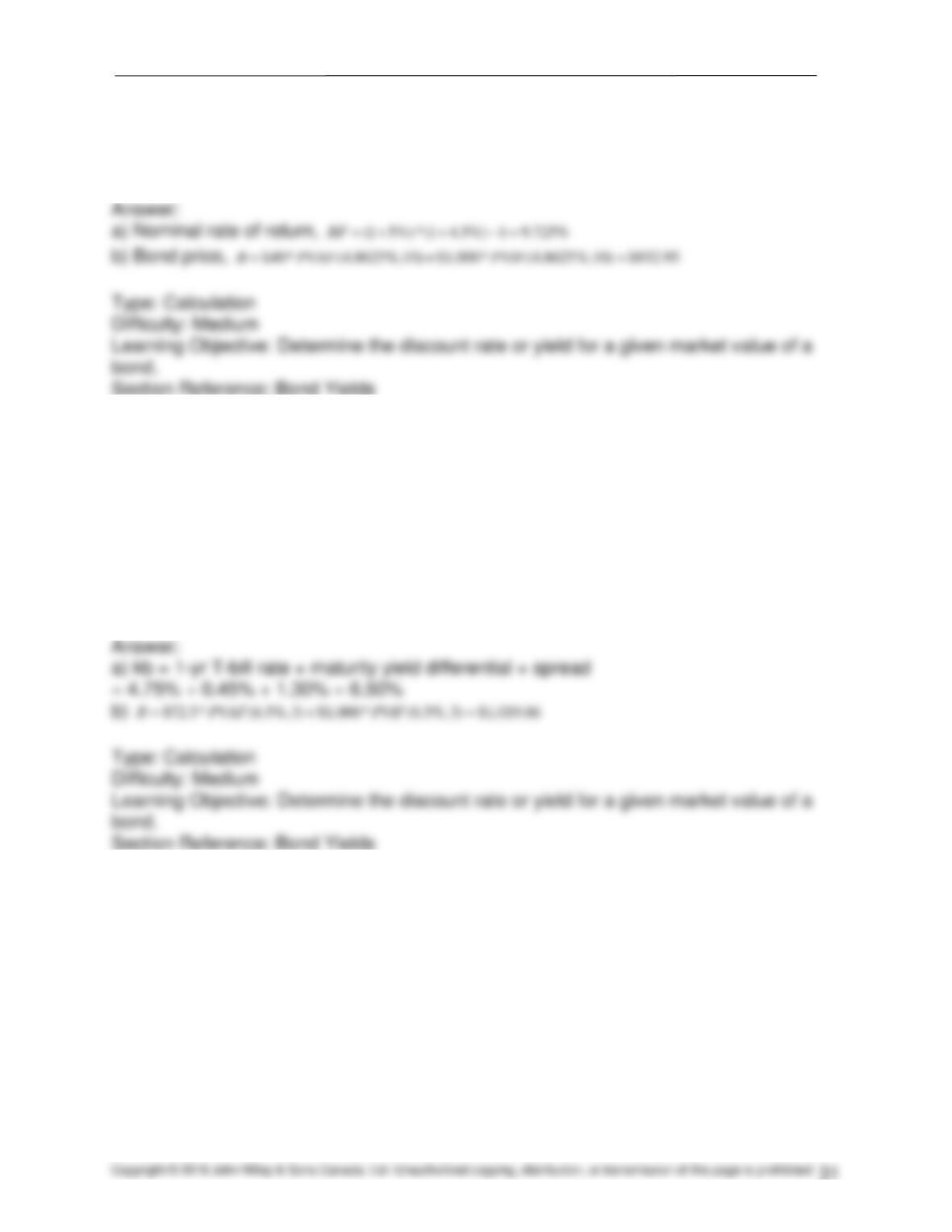
77. The market yield on a fifteen-year 7.5 percent bond is 6.5%. The bond makes semi–
annual coupon payments and is callable in five years at a call price of $1,075.
a) What is the bond price based on the market yield?
b) What is the bond’s yield to call?
c) Is this bond likely to be called? Explain.
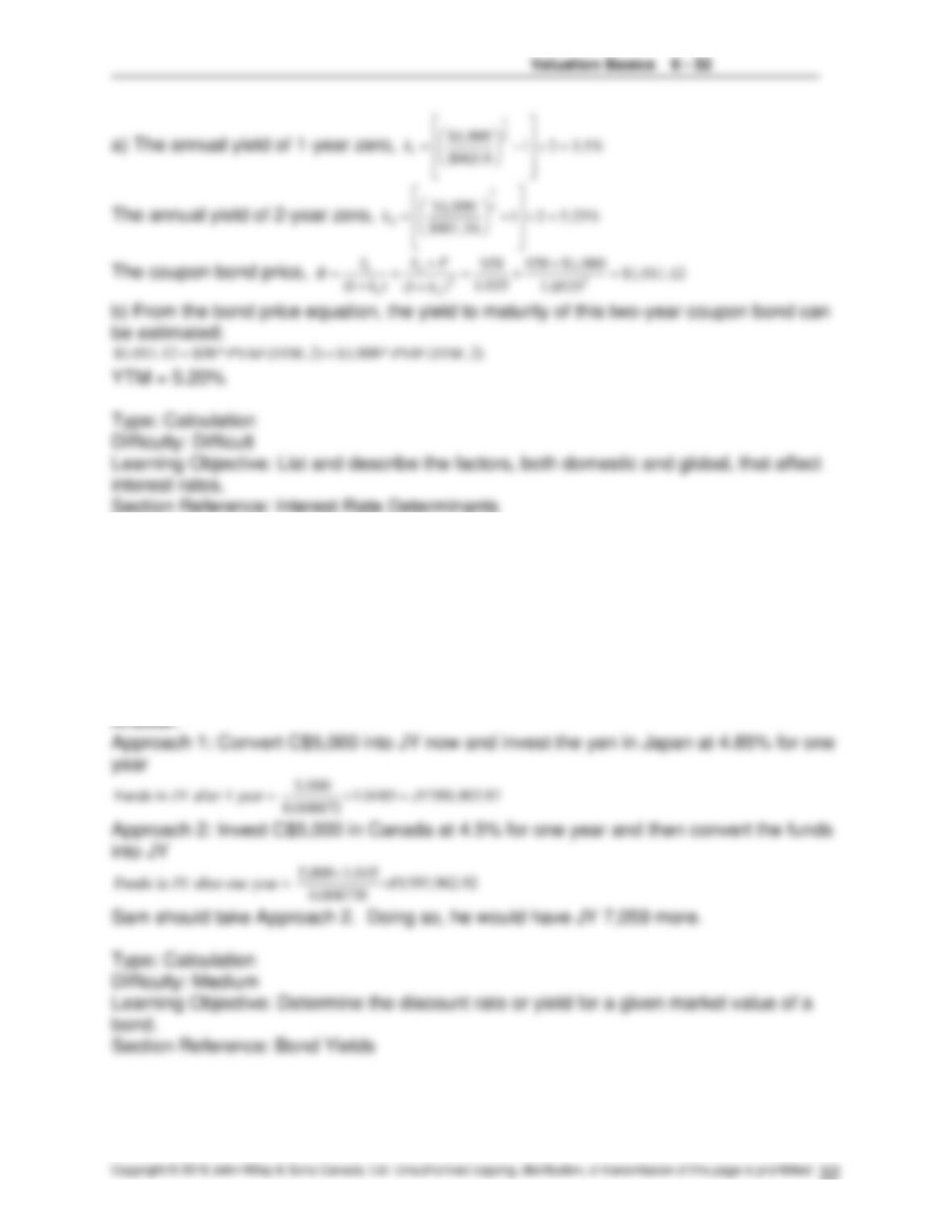
78. Genie would like to receive an exact real rate of return of 5 percent per year on a bond
investment at a time when the expected inflation rate is 4.5 percent.
6 – 31 Test Bank for Introduction to Corporate Finance, Fourth Canadian Edition
a) What nominal rate of return would Genie expect to receive on a bond investment?
b) How much would Genie be willing to pay for a bond maturing in five years if it pays a
semi-annual coupon of 8 percent?
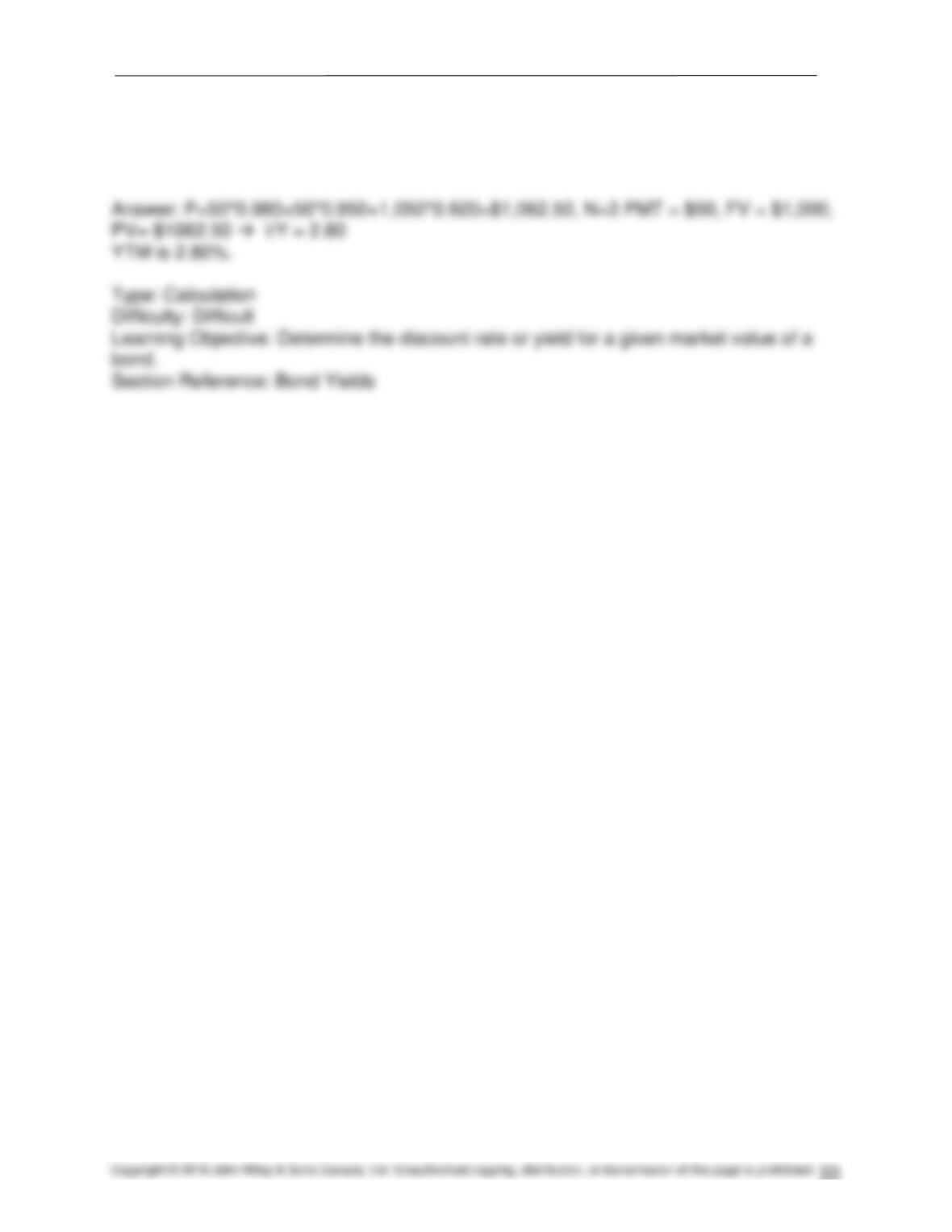
79. Suppose you observed that one-year T-bills are trading with a YTM of 4.75 percent.
The yield spread between AAA- and BB-rated corporate bonds is 130 basis points. The
maturity yield differential between the one-year T-bills and three-year government
bonds is 45 basis points.
a) What is the market yield you would expect on a three-year BB-rated corporate bond
that pays a 7.25 annual coupon?
b) How much would you pay for this three-year BB-rated corporate bond if its coupon
rate was 7.25%?
80. Supreme Investment Co. has observed that the market prices for the one-year and
two-year zero coupon bonds that have no default risk are $965.90 and $901.54,
respectively.
a) How much would Supreme pay for a two-year 5.8 percent annual coupon bond that
has the same default risk as the zeros?
b) What is the yield to maturity of this two-year coupon bond?
Answer:
81. Sam has put aside C$5,000 for his travel to Japan in a year from now. He could
invest the money in Canada and earn 4.5 percent, and then convert it to Japanese yen
when he leaves. Alternatively, Sam could convert the funds to Japanese yen (JY) and
earn a 4.85 percent return on a Japanese investment today. Which approach should he
take if the currency spot rate is C$/JY=0.008872 and the one-year forward rate is
0.008738?
6 – 33 Test Bank for Introduction to Corporate Finance, Fourth Canadian Edition
82. Suppose a one-year zero-coupon bond is sold at $980, a two-year zero-coupon
bond is sold at $950, and a three-year zero-coupon bond is sold at $920. What is the
price of a 3-year 5% annual coupon bond? What is its YTM?
Valuation Basics 6 – 34
LEGAL NOTICE