Part 3 Valuation Basics
CHAPTER 5
TIME VALUE OF MONEY
CHAPTER LEARNING OBJECTIVES
5.1 Explain the importance of the time value of money and how it is related to an
investor’s opportunity costs. Time value of money is the idea that money invested today has
more value than the same amount invested later. This concept helps us to understand how
interest is earned and why investors are indifferent to investment today and future value later.
5.2 Define simple interest and explain how it works. Simple interest is interest earned on the
original principal. The growth in the value of an investment is simply the sum of annual interest
5.3 Define compound interest and explain how it works. Compound interest is interest
earned on the principal amount invested and on any accrued interest. Compound interest can
5.4 Differentiate between an ordinary annuity and an annuity due, and explain how
special constant payment problems can be valued as annuities and, in special cases, as
perpetuities. Annuities are streams of level payments at regular time intervals. An ordinary
annuity has payments at the end of each period. An annuity due has the same number of
payments as an ordinary annuity, but the payments occur at the beginning of each period. The
5.5 Estimate the present value of growing perpetuities and annuities. Growing perpetuities
can be solved using Equation 5-10, while growing annuities can be solved using Equation 5-12.
5.6 Differentiate between quoted rates and effective rates, and explain how quoted rates
can be converted to effective rates. Quoted rates are also called stated rates or annual
percentage rates, which are measured annually and used for quoting purposes. The effective
5.7 Apply annuity formulas to value loans and mortgages, and set up an amortization
schedule. Loans can be valued as an annuity since they meet the three characteristics of an
annuity in that they have equal payments, are for a fixed period of time, and are based on the
same discount rate.
5.8 Solve a basic retirement problem. A simple retirement problem can be solved by equating
5 – 3 Test Bank for Introduction to Corporate Finance, Fourth Canadian Edition
MULTIPLE CHOICE QUESTIONS
1. Charles has $12,000 to invest. Charles’ bank offers him the following investment accounts:
Account Interest rate Minimum balance
#1 1% $0
#2 3% $5,000
#3 5% $10,000
#4 8% $20,000
Assuming that all the accounts have the same risk as the investment, Charles’ opportunity cost
is closest to
a) 1%.
b) 3%.
c) 5%.
d) 8%.
2. If Frank is indifferent between receiving $1,000 today and $1,100 in one year, his opportunity
cost must be close to
a) 1.10%.
b) 10%.
c) 110%.
d) 100%.
3. Which one of the following is/are an example(s) of opportunity cost?
a) quitting your job to go to university
b) using a piece of land that you owned to build a house
c) spending time caring for an elder in your family instead of working
d) All of the above are examples of opportunity costs.
4. Why is a dollar today always worth at least a dollar in the future?
a) because of the risk involved with investing
b) because of the opportunity cost of money
c) because of inflation
d) all of the above
5. A dollar today is worth more than a dollar tomorrow because
a) the dollar can be invested and earn interest.
b) there is a risk involved in investing.
c) there is loss due to inflation.
d) of the opportunity cost of the dollar.
e) all of the above
6. Lottery A pays $1,000 today and Lottery B pays $1,750 at the end of five years from now. If
the discount rate is 5%, I should choose
a) Lottery A, because it is available to me now.
b) Lottery A, because its future value is $1,276.
c) Lottery B, because its present value is $1,371 which is more than that of Lottery A.
d) Lottery B, because it pays $1,750 which is more than $1,000 from Lottery A.
e) Either option gives the same value over time.
7. Earl has invested $12,000 in a security that pays 2% annual simple interest. How much
interest does he earn in the 3rd year?
a) $160
b) $240
c) $720
d) $12,735
8. If I invest $1,000 in a financial instrument paying 10% simple interest payable at the end of
each year, I will
a) not receive any interest for the first year.
b) receive the same amount of interest each year.
c) receive interest only for the first year.
d) receive less interest in year ten than in year two.
e) receive interest on both the principal and first year’s interest in year two.
9. ABC Bank pays 2% simple interest compounded annually on an investment of $10,000. What
is the interest earned in the fifth year?
a) $2000
b) $200
c) $1000
d) $100
e) $500
10. Consider two investments: XPD and PDQ. Each investment pays interest at the end of each
year and the interest rate does not change over time. The interest earned each year is given
below:
YEAR PDQ XPD
1 50 50.00
2 50 52.50
3 50 55.13
4 50 57.88
Which of the following statements is (are) most correct?
a) PDQ and XPD earn simple interest.
b) PDQ earns simple interest, XPD earns compound interest.
c) PDQ earns compound interest, XPD earns simple interest.
d) PDQ and XPD earn compound interest.
11. An equal-payment mortgage is calculated using the interest on the remaining balance of the
capital every month, whereas interest paid on a line of credit is deducted from your account
every month. So, mortgage payments are calculated using ______ where line of credit interest
is calculated using ______.
a) simple interest, compound interest
b) compound interest, simple interest
c) simple interest, simple interest
d) compound interest, compound interest
12. The present value is always ______ the future value if the opportunity cost is ______ zero.
a) less than; greater than
b) equal to; equal to
c) greater than; less than
d) All of the above are true.
13. As interest rates fall, present values
a) increase.
b) decrease.
c) stay the same.
d) cannot be determined; need compounding frequency.
14. As interest rates rise, future values
a) increase.
b) decrease.
c) stay the same.
d) cannot be determined, need compounding frequency.
15. You invested $2,000 at 5 percent compounded annually. Determine the value of the
investment in five years. (Round your answer to two decimals.)
a) $500.00
b) $552.56
c) $2,500.00
d) $2,552.56
16. You invested $2,000 at 5 percent compounded annually. Determine how much interest was
earned in the fifth year. (Round your answer to two decimals.)
a) $100.00
b) $121.55
c) $500.00
d) $552.56
17. The current interest rate is 3.04 percent. If the interest rate increases by 10 basis points, the
new interest rate will be (Round your answer to two decimals.)
a) 2.94%.
b) 3.03%.
c) 3.05%.
d) 3.14%.
18. Franklin needs to have $1,000 in 8 years. If his investment earns 5 percent compounded
annually, how much must he invest today? (Round your answer to two decimals.)
a) $676.84
b) $680.58
c) $1,477.46
d) $1,469.33
19. Eduardo bought a house for $120,000 five years ago. He has just sold it for $180,000. What
annual rate of return did he earn on this investment?
a) 10%
b) 8.45%
5 – 9 Test Bank for Introduction to Corporate Finance, Fourth Canadian Edition
c) 1.08%
d) 3.13%
20. Gianni invested $10,000 at a rate of 6% compounded annually. How long will it take for the
investment to grow to $40,000?
a) 1.33 years
b) 4.00 years
c) 23.79 years
d) 50.00 years
21. Ingrid has invested $10,000 in a Guaranteed Investment Certificate that promises her 12%
per year for the first 5 years and 4% per year for the next 10 years. The interest is compounded
annually. At the end of the 15 years, the value of the investment will be closest to which value?
(Round your answer to two decimals.)
a) $26,086.96
b) $31,721.69
c) $32,425.86
d) $36,372.55
22. The interest earned on both the original investment and the accumulated interest, over time
is called
a) growth rate.
b) compound interest.
Time Value of Money 5 – 10
c) simple interest.
d) cost of capital.
23. ABC Bank offers a return of 9% on a savings account for five years using simple interest
while XYZ Bank offers a return of 9% for five years using compound interest. An investor should
choose
a) the simple interest option because both have the same basic interest rate.
b) the compound interest option because it provides a higher overall return.
c) the compound interest option only if interest is compounded monthly.
d) the simple interest option only if interest is compounded monthly.
e) the compound interest option because both have the same basic interest rate.
24. An investment pays $1,000 per year for the first four years and $2,000 per year for six years
following. If the required rate of return is 8 percent compounded annually, how much is this
investment worth?
a) $12,557.89
b) $10,108.04
c) $9,604.64
d) $9,138.52
25. An investment pays $2,000 every second year for 20 years (a total of 10 payments). Your
opportunity cost is 8% compounded semi-annually. The present value of this investment is
a) $9,322.00.
b) $9,666.46.
c) $13,323.85.
d) $19,636.29.
5 – 11 Test Bank for Introduction to Corporate Finance, Fourth Canadian Edition
26. An investment pays $2,000 every month for 2 years. Your opportunity cost is 10%
compounded annually. The present value of this investment is closest to
a) $43,342.
b) $43,529.
c) $47,405.
d) $48,000.
27. Ellie is considering an investment that will require her to deposit $500 per month for 6 years
with the first payment occurring today. This is an example of
a) an ordinary annuity.
b) an annuity due.
c) a reverse ordinary annuity.
d) a reverse annuity due.
28. At the age of 65 your grandfather decides to retire and use the money he saved in his
RRSPs. He decided to get a fixed amount every quarter starting the day he retires. What type of
payment is this?
a) an ordinary annuity
b) an annuity due
c) a reverse ordinary annuity
d) a reverse annuity due
Time Value of Money 5 – 12
29. Consols are British bonds that were issued during the 18th century that pay a constant
coupon and are irredeemable. What type of payment is this?
a) an ordinary annuity
b) an annuity due
c) a perpetuity
d) a growing perpetuity
30. Montreal Financial Services Company offers a perpetuity of $50,000 per year with the first
payment on January 1 next year. If your opportunity costs are constant over time, the price you
are willing to pay for this perpetuity ______ over time.
a) increases
b) decreases
c) stays the same
d) can’t determine without the opportunity cost
31. Montreal Financial Services Company offers a 50-year annuity of $50,000 per year with the
first payment on January 1, next year. If your opportunity costs are constant over time, the price
you are willing to pay for this annuity ______ over time.
a) increases
b) decreases
c) stays the same
5 – 13 Test Bank for Introduction to Corporate Finance, Fourth Canadian Edition
d) can’t determine without the opportunity cost
32. Montreal Financial Services Company offers a perpetuity of $5,000 per year with the first
payment in one year. If your opportunity cost is 8% compounded annually, the present value of
the perpetuity today is
a) $57,500.
b) $62,500.
c) $67,500.
d) $125,000.
33. Montreal Financial Services Company offers a perpetuity of $5,000 per year with the first
payment immediately. If your opportunity cost is 8% compounded annually, the present value of
the perpetuity today is
a) $57,500.
b) $62,500.
c) $67,500.
d) $125,000.
34. Elvira is considering buying a 20-year ordinary annuity to provide her with retirement
Time Value of Money 5 – 14
income. The annuity will make annual payments of $25,000. If her opportunity cost is 7%, what
is the maximum she should pay for the annuity?
a) $1,096,629.42
b) $1,024,887.31
c) $283,389.88
d) $264,850.36
35. Xiang invests $25,000 per year, starting today, for 20 years at an interest rate of 7%. What
is the value of the investment at the end of the 20 years?
a) $1,096,629.42
b) $1,024,887.31
c) $283,389.88
d) $264,850.36
36. Marie is considering investing a part of her future income in an investment account that
offers 0.5 percent a month. She will start work in 6 months and her contract extends for 2 years.
If the investment amount is $300 a month, what is the present value of this investment?
a) $6,768.86
b) $8,338.22
c) $6,569.30
d) $8,903.62
37. Elvira is considering buying a 20-year annuity due to provide her retirement income. The
annuity will make annual payments of $25,000. If her opportunity cost is 7%, what is the present
value of the annuity?
a) $1,096,629.42
b) $1,024,887.31
c) $283,389.88
d) $264,850.36
38. Xiang invests $25,000 per year, starting in one year, for 20 years at an interest rate of 7%.
What is the value of the investment at the end of the 20 years?
a) $1,096,629.42
b) $1,024,887.31
c) $283,389.88
d) $264,850.36
39. Your mother has just retired. The balance in her investment account is $600,000 and she
wants to receive monthly payments of $5,000. If she receives the payments at the end of the
month, and the current interest rate is 7 percent, compounded quarterly, how many months will
her investment account last for?
a) 98 months
b) 120 months
c) 170 months
d) 206 months
Time Value of Money 5 – 16
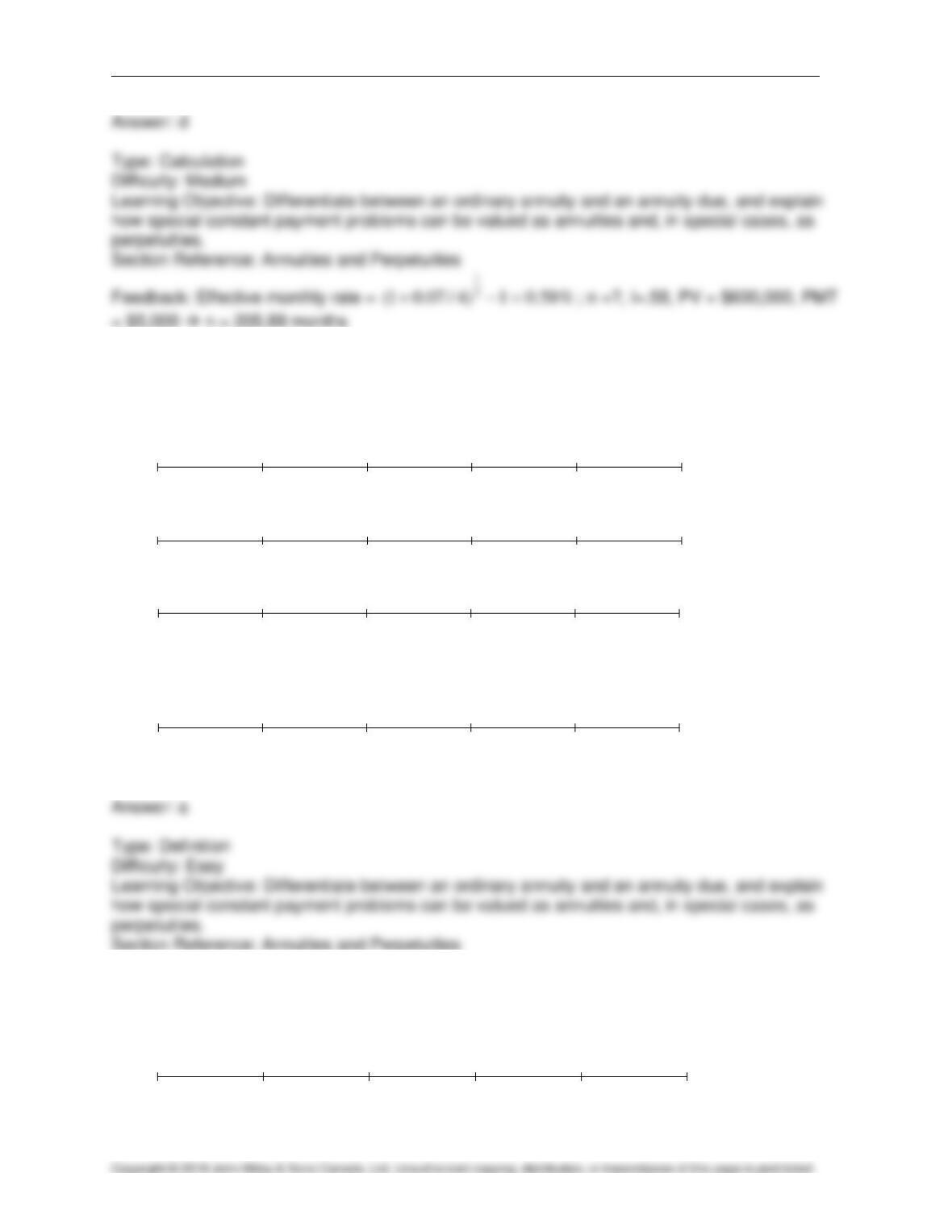
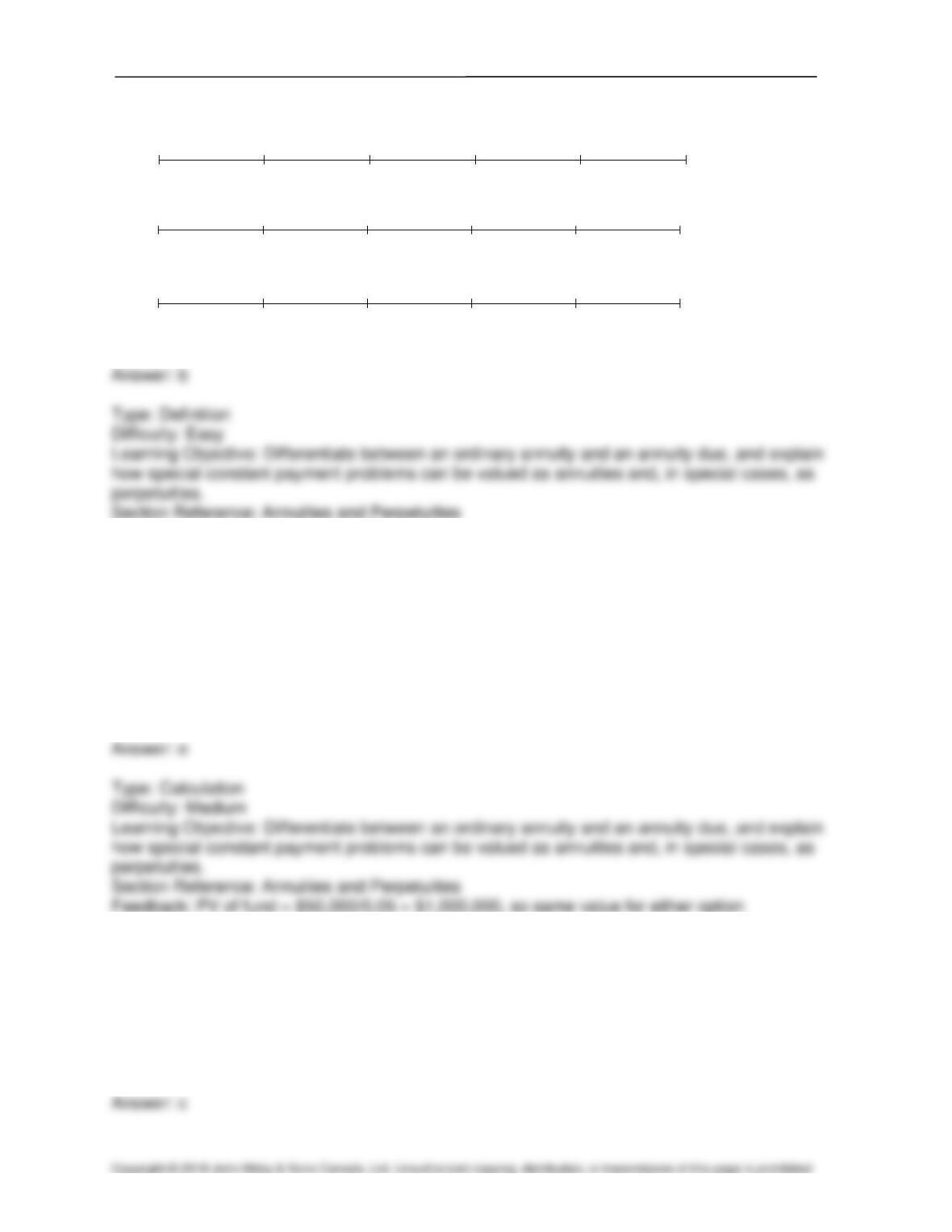
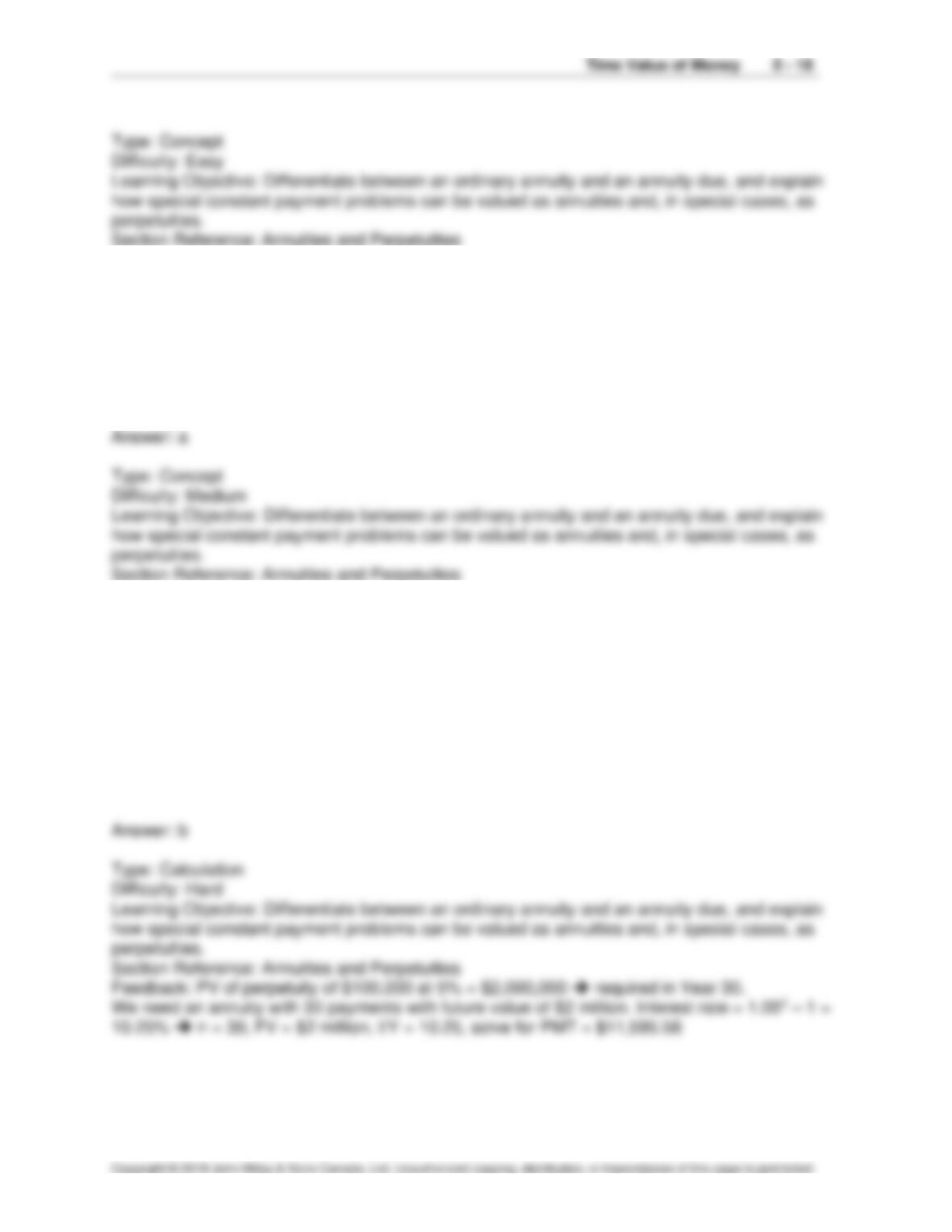
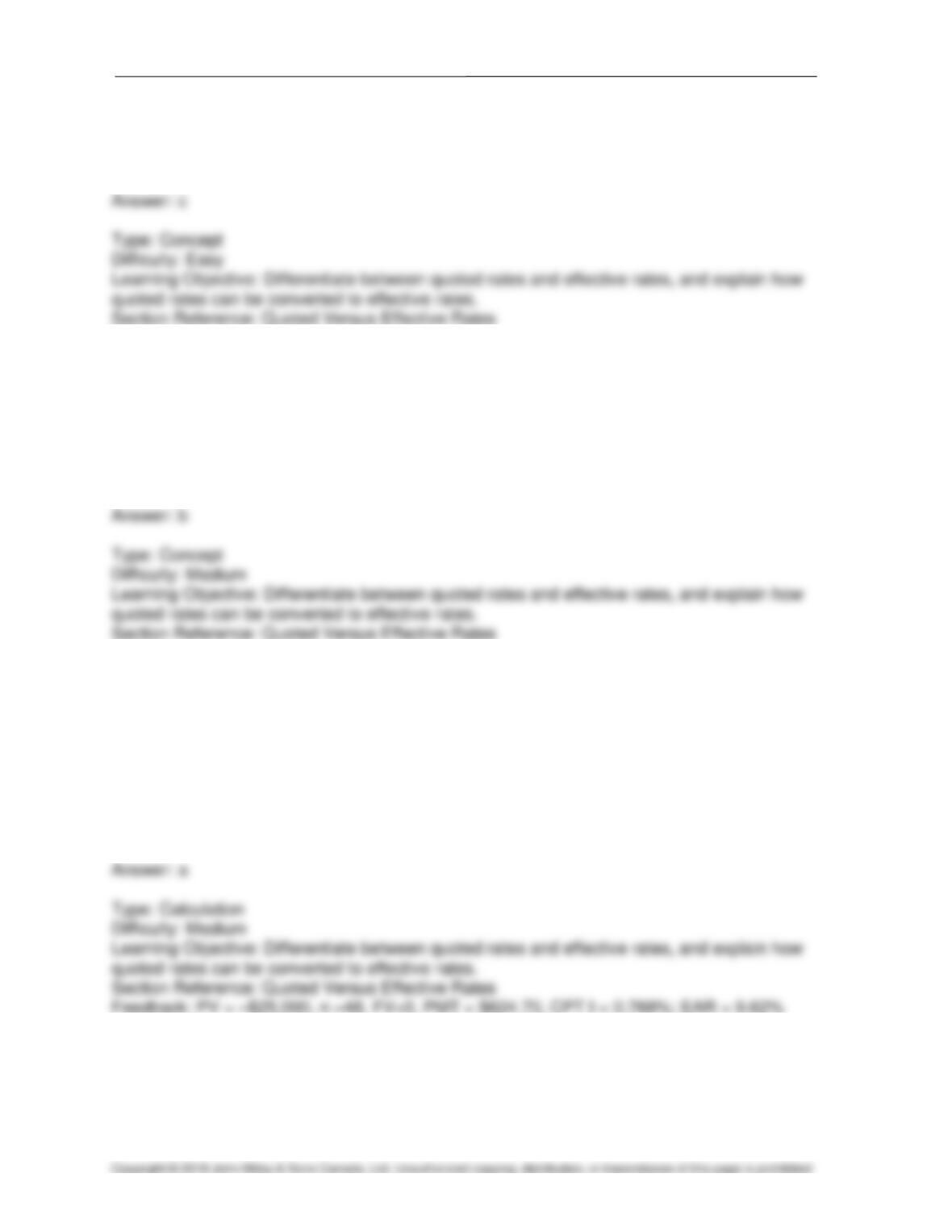
40. Felix has been offered a three-year ordinary annuity with annual payments of $1,500. The
price of the annuity is $2,700. Which of the following is the most appropriate timeline for this
investment?
41. Which of the following is the most appropriate timeline for the cash flows of a three-year
annuity due with annual cash flows of $5,000?
-2,700 1,500 1,500 1,500
-1 0 1 2 3 4
a)
-2,700 1,500 1,500 1,500
-1 0 1 2 3 4
b)
1,500 1,500 1,500
-2,700
————-
-1,200
-1 0 1 2 3 4
c)
1,500 1,500 1,500
-2,700
————-
-1,200
-1 0 1 2 3 4
d)
5,000 5,000 5,000
-1 0 1 2 3 4
a)
5 – 17 Test Bank for Introduction to Corporate Finance, Fourth Canadian Edition
42. A pension fund pays out $50,000 a year in perpetuity, based on a cost of capital of 5%, to
retiring employees. Alternatively, the employee can take out a lump sum of $1 million payable
immediately. The employee should choose
a) the lump sum, because it is available now.
b) the lump sum, because its future value is $25 million.
c) the pension fund, because its present value is $1.25 million.
d) the pension fund, because it offers steady payments in perpetuity.
e) either option gives the same value over time.
43. An annuity due pays out
a) equal payments at the beginning of each time period and continues forever.
b) unequal payments at the beginning of each time period for a fixed number of periods.
c) equal payments at the beginning of each time period for a fixed number of periods.
d) unequal payments at the end of each time period for a fixed number of periods.
e) equal payments at the end of each time period and continues forever.
5,000 5,000 5,000
-1 01234
b)
5,000 5,000 5,000 5,000
-1 01234
c)
15,000 0 0 0
-1 01234
d)
44. Which one of the following will increase the present value of an annuity?
a) lowering the discount rate
b) reducing the cash flow amount
c) decreasing the number of payments
d) reducing the future value of the cash flow
e) lowering the payment amount
45. In 30 years, you plan to set up a fellowship fund for your university that pays out
$100,000/year in perpetuity with an annually compounded discount rate of 5%. In order to set
up the fund in 30 years, how much do you need to save each year (starting this year) assuming
you can get a semi-annually compounded return of 10% on your savings for the next 30 years?
a) $66,666.67
b) $11,595.56
c) $21,215.49
d) $30,744.90
e) $30,000.00
46. To compare interest rates, we should compare the
a) quoted rates.
5 – 19 Test Bank for Introduction to Corporate Finance, Fourth Canadian Edition
b) nominal rates.
c) effective rates.
d) periodic rates.
47. For a given quoted rate, the effective annual rate ______ as the compounding frequency
increases.
a) does not change
b) increases
c) decreases
d) There is no connection between the effective annual rate and the quoted rate.
48. You have been offered four different financing schemes for a $30,000 car. Which one
should you choose?
a) $5,000 down with the rest paid in equal monthly payments of $624.70 per month for 48
months
b) $0 down with equal monthly payments of $960 per month for 36 months
c) $15,000 down and a final payment of $18,550 two years from now
d) have it financed with a bank loan at a quoted rate of 9.5% with loan repayments made
monthly
49. For a given effective annual rate, the quoted rate ______ as the compounding frequency
increases.
a) does not change