Time Value of Money 5 – 20
b) increases
c) decreases
d) There is no connection between the effective annual rate and the quoted rate.
50. The R&M Bank has offered you the choice between two investment accounts:
#1 pays interest at a rate of 12% compounded semi-annually.
#2 pays interest at a rate of 11% compounded monthly.
Which investment account do you prefer and why?
a) #1, 12% is greater than 11%
b) #2, greater compounding frequency
c) #1, higher effective rate
d) #2, higher effective rate
51. The R&M Bank has offered you the choice between two loans:
#1 charges interest at a rate of 9% compounded quarterly.
#2 charges interest at a rate of 9.50% compounded semi-annually.
Which loan do you prefer and why?
a) #1, lower effective rate
b) #2, lower effective rate
c) #1, higher effective rate
d) #2, higher effective rate
52. Your investment account has an interest rate of 10% compounded semi-annually. This is the
equivalent of an effective annual interest rate of
a) 1.1025%.
b) 5%.
c) 10%.
d) 10.25%.
53. Your credit card has a quoted rate of 17% compounded weekly. What is the effective annual
rate?
a) 884%
b) 18.50%
c) 32.69%
d) 17.00%
54. Your credit card has a quoted rate of 18.5 percent compounded daily. What is the effective
annual rate? (Assume 360 days a year.)
a) 66.60%
b) 20.32%
c) 51.39%
d) 18.50%
55. Your investment account pays interest at a rate of 8% compounded semi-annually. If you
deposit $1,000 today, how much will you have in two years?
a) $1,081.60
b) $1,166.40
c) $1,169.86
d) $1,360.49
56. Eloise has deposited $2,000 in an investment account that pays 5% compounded
continuously. How much will she have in her account in two years?
a) $2,205.00
b) $2,210.34
c) $2,105.54
d) $1,809.67
57. Valentino will receive $25,000 in 3 years. His opportunity cost is 8% compounded
continuously. The present value of this cash flow is closest to
a) $31,781.23.
b) $31,492.80.
c) $19,845.81.
d) $19,665.70.
5 – 23 Test Bank for Introduction to Corporate Finance, Fourth Canadian Edition
58. Wilma borrows $10,000 from “Jaw Breaker Joe” and promises to repay Joe a total of
$10,500 in one month. What is the effective annual interest rate charged by Joe?
a) 5.00%
b) 60.00%
c) 79.59%
d) 179.59%
59. The R&M Bank currently offers an investment account with an interest rate of 8%
compounded semi-annually. R&M wants to offer customers another account with interest
compounded monthly. If R&M wants the effective rates to be equal, what interest rate should
R&M quote for the second account?
a) 7.87%
b) 8.00%
c) 8.16%
d) 24.00%
60. How much should a monthly compounded account with an EAR of 10% earn semi-annually?
a) 4.88%
b) 5.00%
c) 4.76%
d) 5.11%
61. How much should a weekly compounded account with an EAR of 10% earn semi-annually?
a) 4.88%
b) 5.00%
c) 5.36%
d) 5.12%
62. How much should a monthly compounded account with an EAR of 18% earn semi-annually?
a) 2.80%
b) 3.00%
c) 2.77%
d) 8.63%
63. The R&M Bank currently offers an investment account with an interest rate of 6%
compounded monthly. R&M wants to offer customers another account with interest
compounded quarterly. If R&M wants the effective rates to be equal, what interest rate should
R&M quote for the second account?
a) 2.00%
b) 6.00%
c) 6.03%
d) 6.17%
5 – 25 Test Bank for Introduction to Corporate Finance, Fourth Canadian Edition
64. When comparing different investment opportunities (each with the same risk) with different
interest rates reported in different ways you should
a) convert each interest rate to an annual nominal rate.
b) convert each interest rate to a monthly nominal rate.
c) convert each interest rate to an effective annual rate.
d) compare them by using the published annual rates.
e) convert each interest rate to an APR.
65. Your bank offers two options: Account A compounds semi-annually while account B
compounds monthly. If both accounts have the same effective annual rate of interest, you
should choose
a) account A as it offers a higher APR.
b) account B as it offers a higher APR.
c) account B because it is compounded more often.
d) account A because it is compounded less often.
e) either since you would be indifferent between the two.
66. Lucy has just obtained a five-year fixed-rate mortgage to buy her first home. The mortgage
is amortized over 30 years. Which of the following statements is most correct?
a) Lucy’s payments won’t change for the next 30 years.
b) Lucy’s payments won’t change for the next 5 years.
c) Lucy’s payments will increase as the term of the mortgage increases.
Time Value of Money 5 – 26
d) Lucy’s payments will decrease as the term of the mortgage increases.
67. As the amortization period of a mortgage increases, holding interest rates constant, the
monthly payments will
a) stay the same.
b) increase.
c) decrease.
d) There is no connection between the amortization period and the size of the payment.
68. As the term of a mortgage increases, holding interest rates constant, the monthly payments
will
a) stay about the same.
b) increase.
c) decrease.
d) There is no connection between the term and the size of the payments.
69. Amir has obtained a $250,000 mortgage. The mortgage is amortized over 25 years and the
term of the mortgage is five years. The mortgage interest rate is 9% compounded semi-
annually. Amir will begin making monthly payments at the end of the month. The monthly
payment is closest to
a) $2,069.94.
b) $2,097.99.
c) $5,169.68.
d) $5,189.59.
5 – 27 Test Bank for Introduction to Corporate Finance, Fourth Canadian Edition
70. Amir has obtained a $250,000 mortgage. The mortgage is amortized over 25 years and the
term of the mortgage is 25 years. The mortgage interest rate is 9% compounded annually. Amir
will begin making annual payments of $25,451.56 at the end of the year. What is the principal
outstanding immediately after Amir makes his third payment?
a) $50,903.12
b) $173,645.32
c) $185,574.60
d) $240,324.46
71. Amir has obtained a $250,000 mortgage. The mortgage is amortized over 25 years and the
term of the mortgage is 25 years. The mortgage interest rate is 9% compounded annually. Amir
will begin making annual payments of $25,451.56 at the end of the year. How much of Amir’s
third payment is interest?
a) $22,500.00
b) $21,944.81
c) $18,470.51
d) $2,290.64
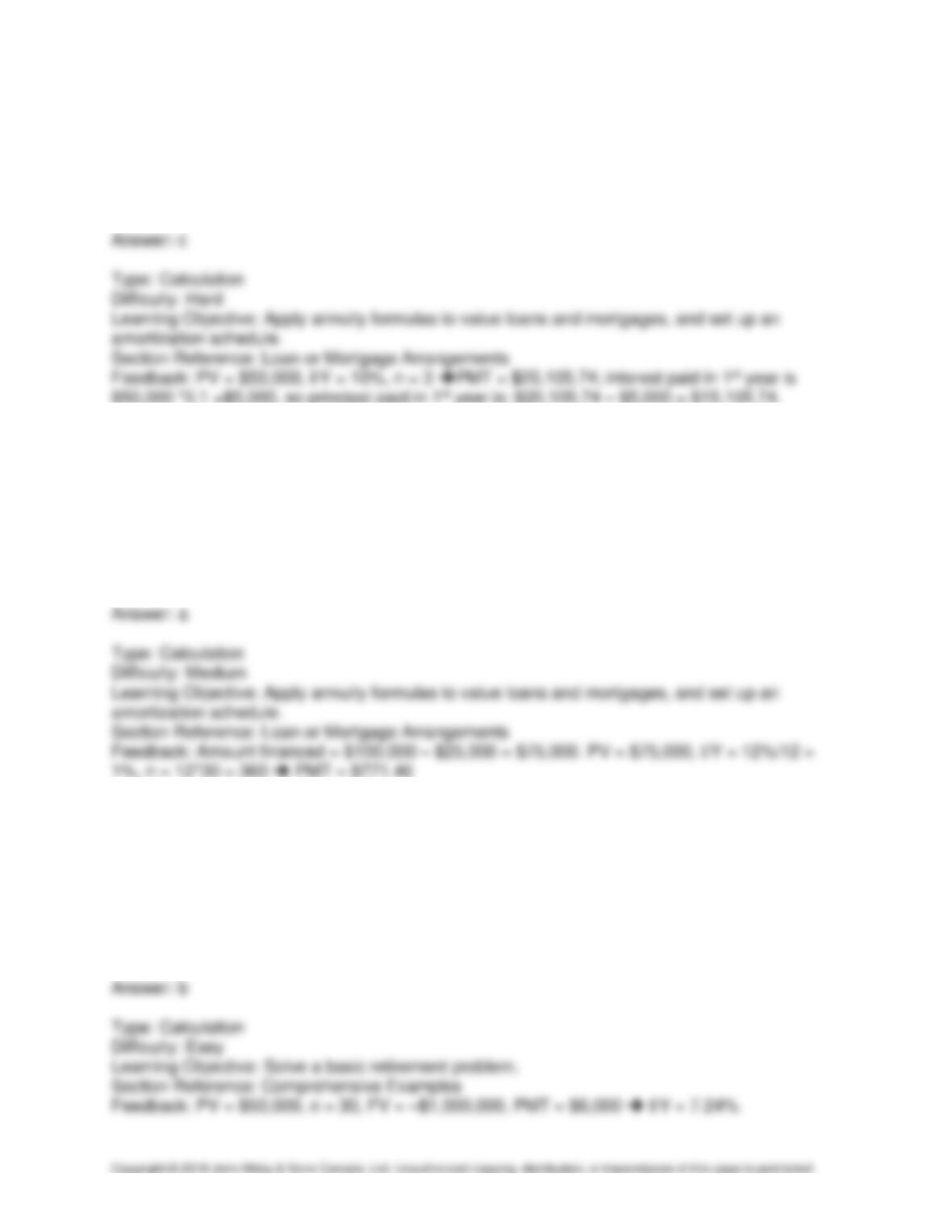
72. You borrow $50,000 on a line of credit to finance your startup company, to be repaid in three
equal, annual payments with 10% interest. Approximately how much of the principal is paid off
Time Value of Money 5 – 28
on the first payment?
a) $5000.00
b) $16,666.67
c) $15,105.74
d) $20,105.74
73. A lakefront cottage is going at $100,000, with a $25,000 down payment, and the remainder
mortgaged at 12 % APR, to be amortized over 30 years. What is the monthly mortgage
payment?
a) $771.46
b) $792.90
c) $931.77
d) $1,906.11
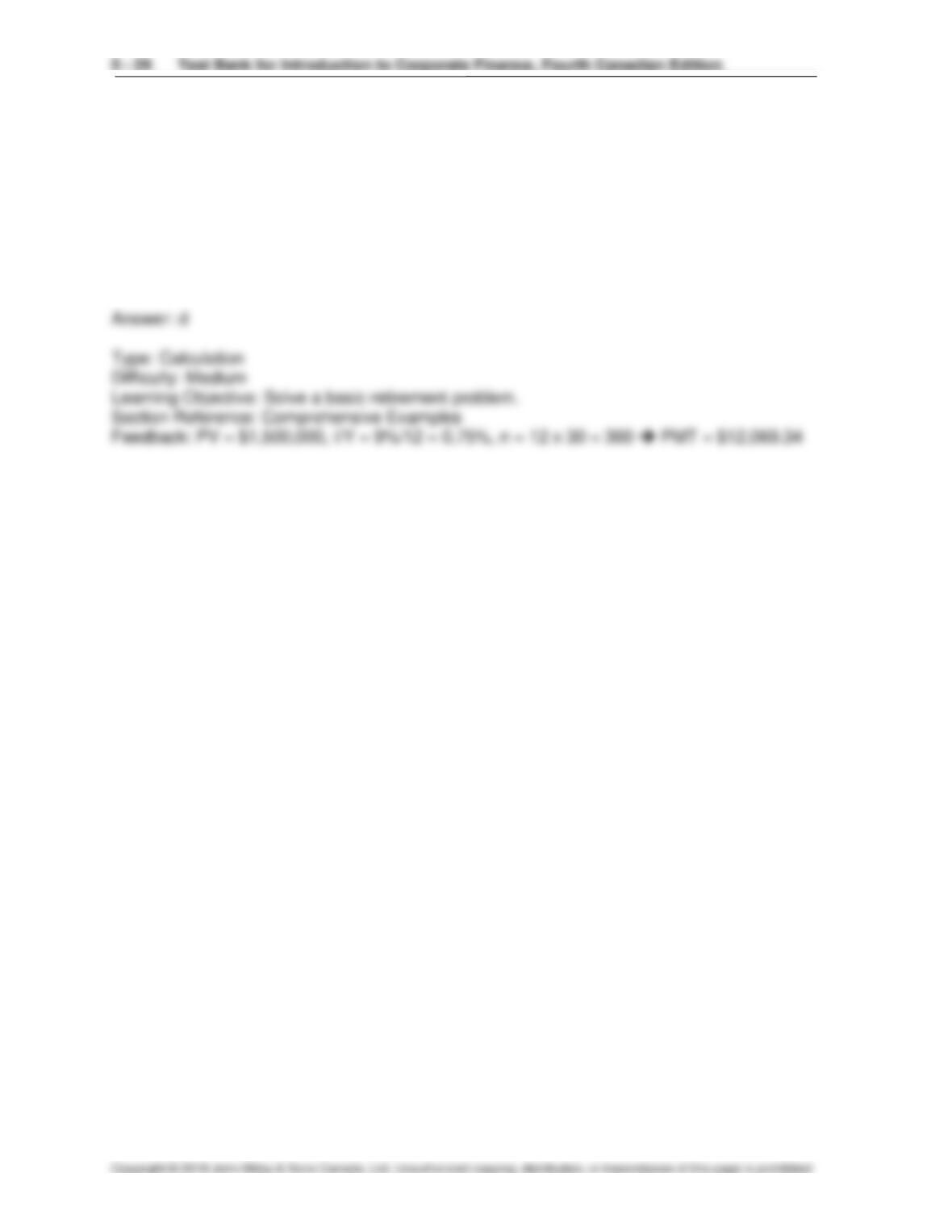
74. You have currently accumulated $50,000 for retirement, and are planning to have
$1,000,000 in 30 years when you retire. If you can add $6,000 each year, what interest rate do
you require of your retirement fund?
a) 6.17%
b) 7.24%
c) 9.04%
d) 10.71%
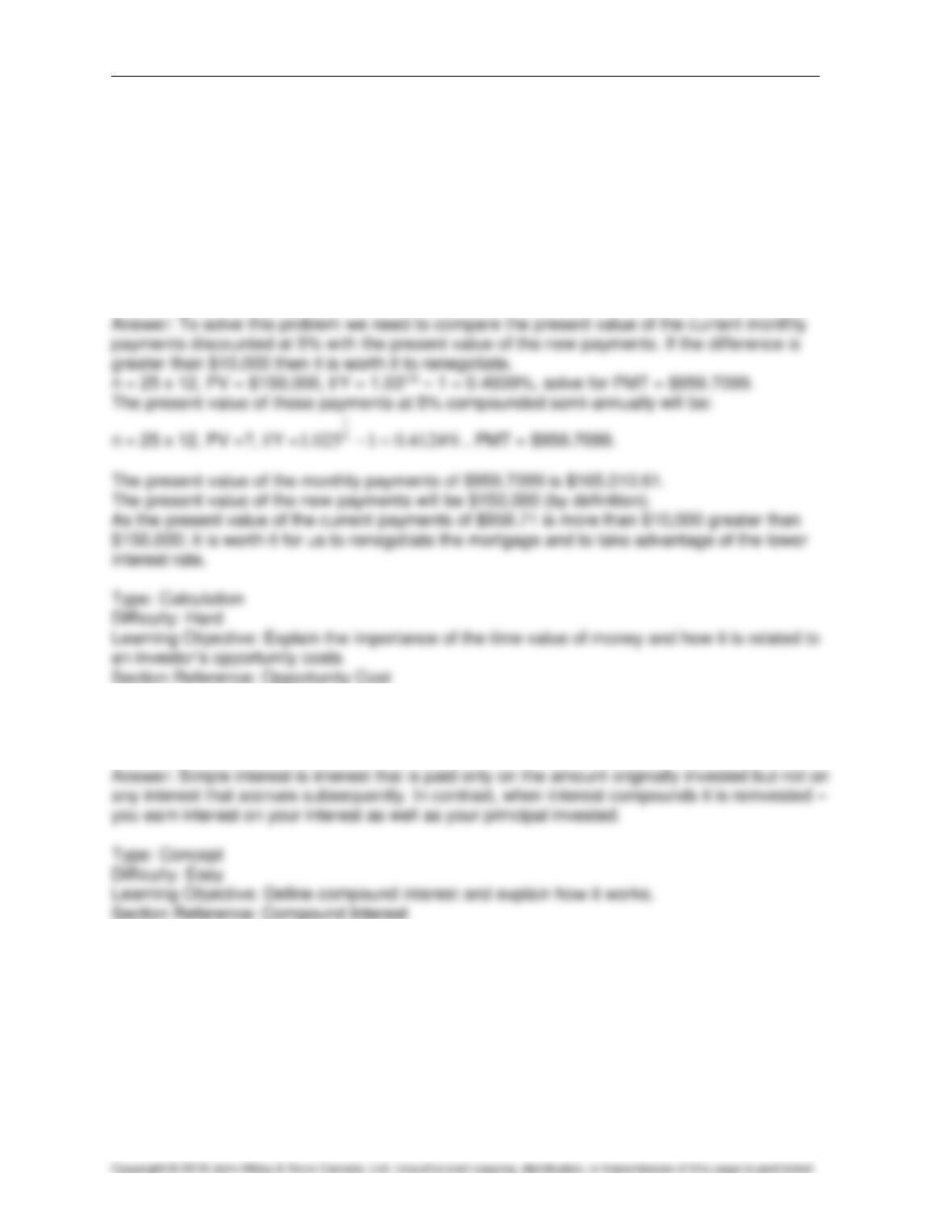
75. Josh Ackerman, having saved up a nest egg of $1.5 million, retires this year and looks
forward to a 30-year retirement. If his nest egg is expected to earn 9% APR and is compounded
monthly, what will be his monthly income during retirement?
a) $50,000.00
b) $17,205.12
c) $14,600.45
d) $12,069.34
Time Value of Money 5 – 30
PRACTICE PROBLEMS
76. You have just obtained a $150,000 10-year 6% fixed-rate mortgage. The mortgage is
amortized over 25 years. The interest rate is compounded semi-annually and you make monthly
payments at the end of each month.
Immediately after you signed the paperwork, mortgage rates dropped to 5%. Your bank has
offered you the opportunity to renegotiate the mortgage for a penalty of $10,000. Should you
take this opportunity? Assume your opportunity cost equals the mortgage rate.
77. Explain the difference between simple interest and compound interest.
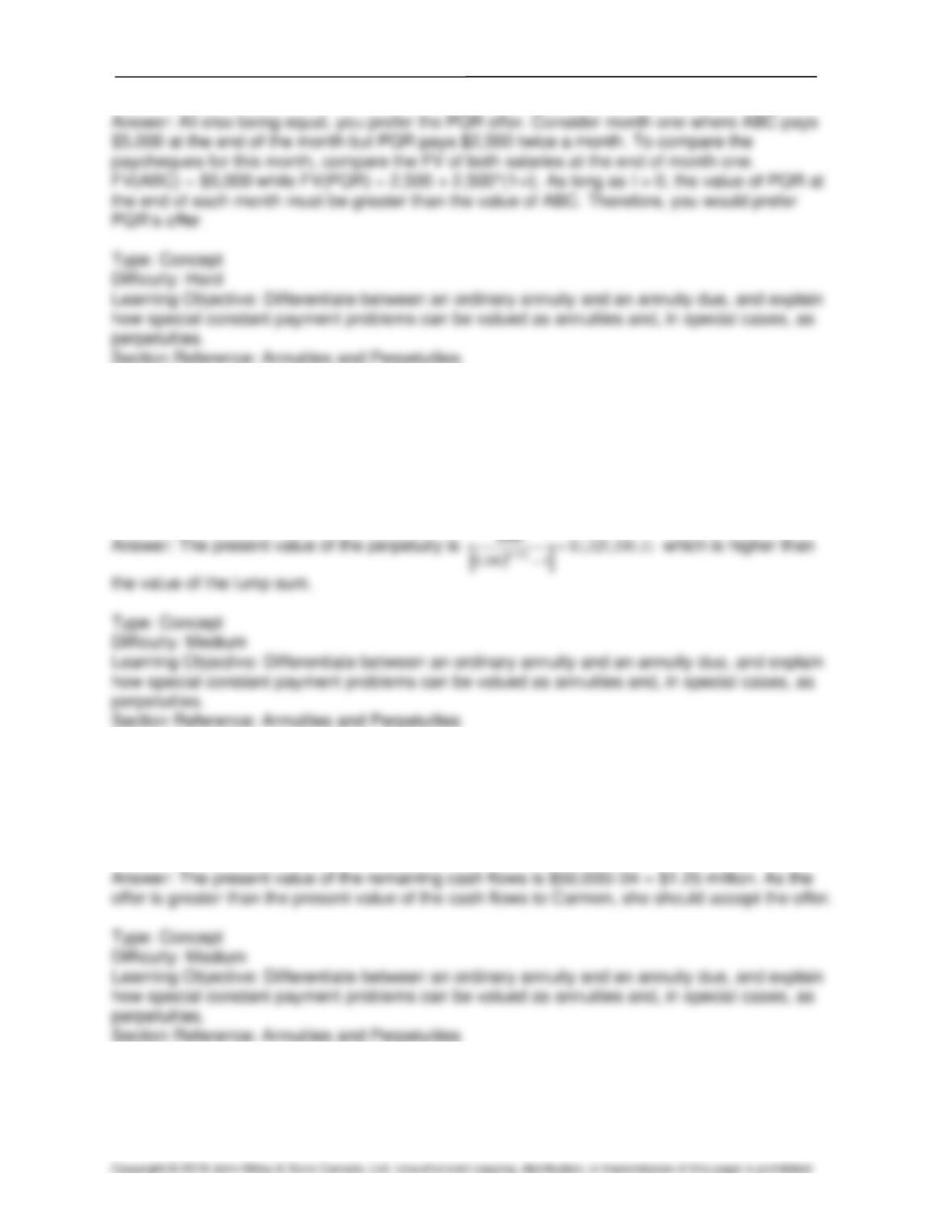
78. You have received two job offers:
ABC is offering to pay you $5,000 at the end of each month for five years and then $8,000 at the
end of each month for the next five years.
PQR is offering you $2,500 twice a month for the first five years and then $4,000 twice a month
for the next five years.
If your decision is based solely on money, which job offer do you prefer? Why? Note: no
calculations are necessary.
5 – 31 Test Bank for Introduction to Corporate Finance, Fourth Canadian Edition
79. You won the lottery and you were asked to choose between two options:
Get $1,000 every week forever.
Get $1,000,000 in a lump sum.
You expect to earn an effective annual rate of 4 percent on your investments. Assuming there is
no risk between the two, which option do you prefer?
80. Carmen’s grandfather died five years ago and left Carmen a perpetuity paying $50,000 a
year. Carmen’s cost of capital is 4%. After receiving the fifth payment, Carmen received an offer
of $1.4 million from The Bizet Hedge Fund for the remainder of the perpetuity. Should Carmen
accept the offer?
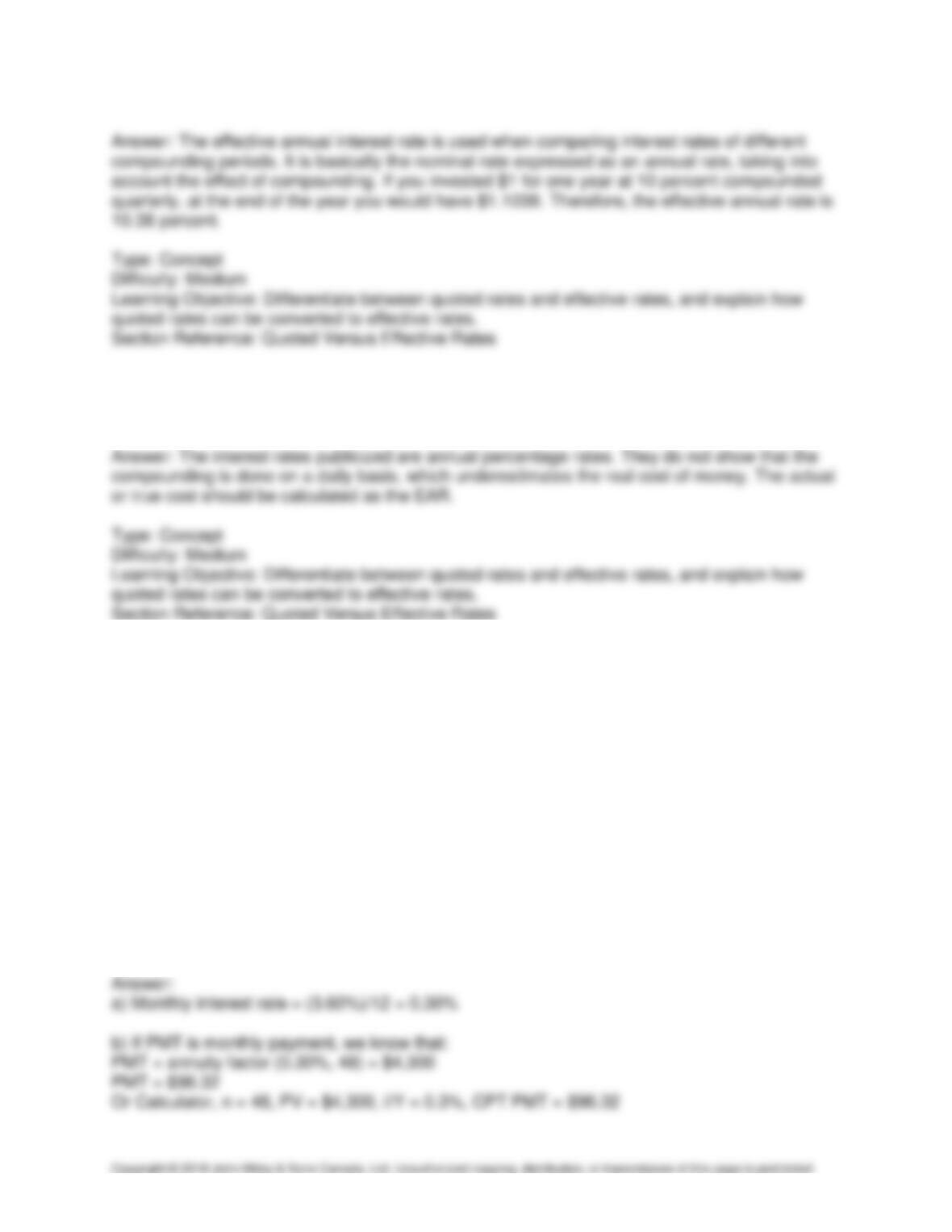
81. Explain what the effective (or equivalent) annual interest rate is and why we use it.
Time Value of Money 5 – 32
82. Explain why the interest rates publicized by credit card companies do not reflect the real
cost of borrowing incurred on the charges to these cards.
83. Kangaroo Motors has a used car for sale at $4,300, which you want to buy for driving to
school. Your parents are willing to lend you the money and charge only 3.60 % APR
compounded monthly. They want the loan repaid equally in 48 months, with the first payment
due at the end of the month in which you buy the car. You estimate that the monthly cost of
operating the car, including gas, insurance, maintenance, and licence fees, will be $160 and
payable at the start of each month. The cost of a monthly bus pass is $95. You expect that the
car will be totally worn out in four years, with zero resale value, when you are finished school.
Your discount rate is 5 percent EAR, compounded annually.
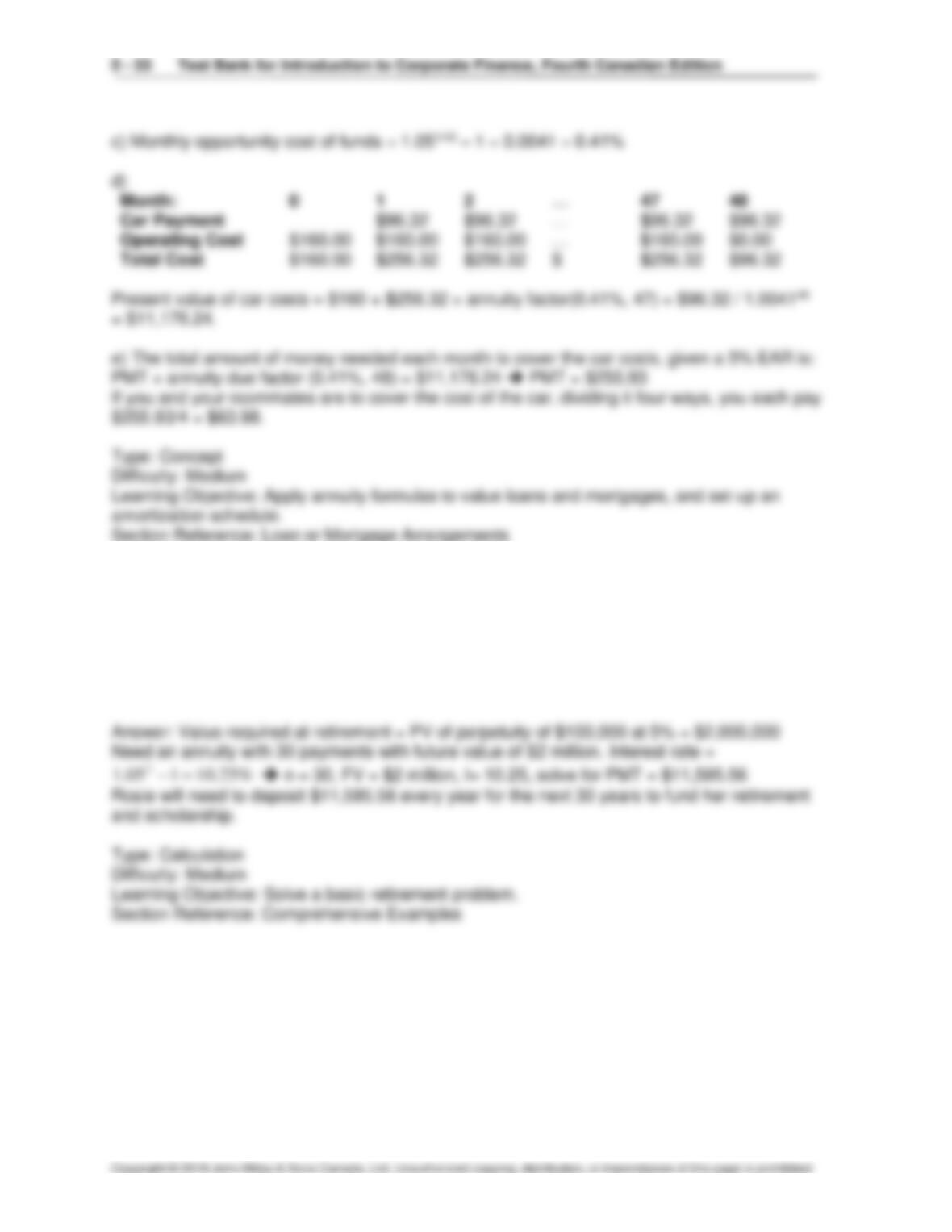
a) What is the monthly interest rate on the parents’ car loan?
b) What is the monthly car repayment?
c) What is the monthly opportunity cost of funds?
d) What is the present value of the car costs?
e) If you have three roommates who also need transportation to and from school, how much do
you and your roommates each need to pay a month in order to cover all your costs?
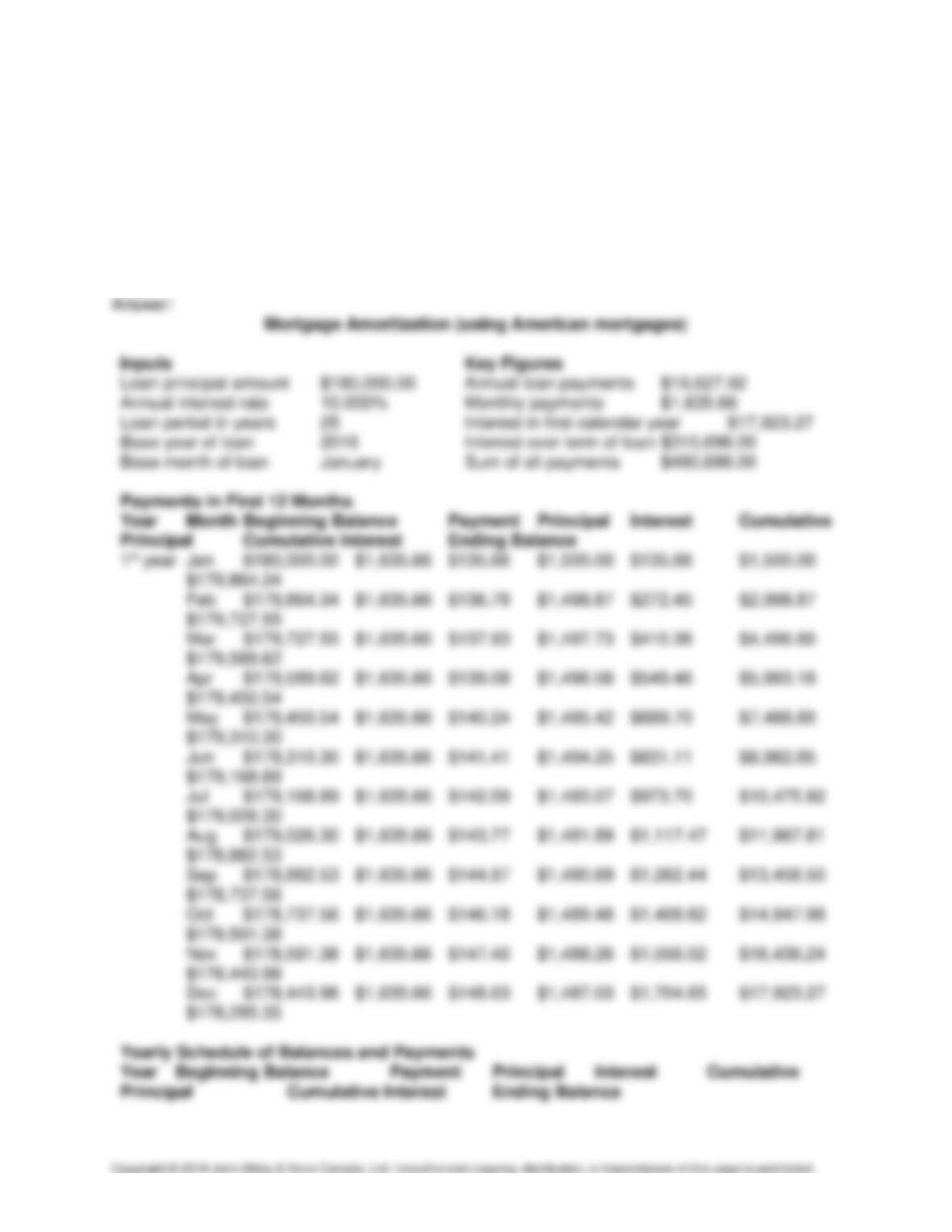
84. Rosie wants to retire in 30 years. At retirement she wants to be able to withdraw $100,000
at the end of each year forever (she plans on establishing a scholarship fund at her local
university after her death). Assuming that her investments can earn 10% compounded semi–
annually prior to her retirement and only 5% compounded annually after her retirement (retired
people and universities are very conservative investors), how much must Rosie invest each
year for the next 30 years? Assume her first deposit will occur in one year.
Time Value of Money 5 – 34
SPREADSHEET PROBLEM
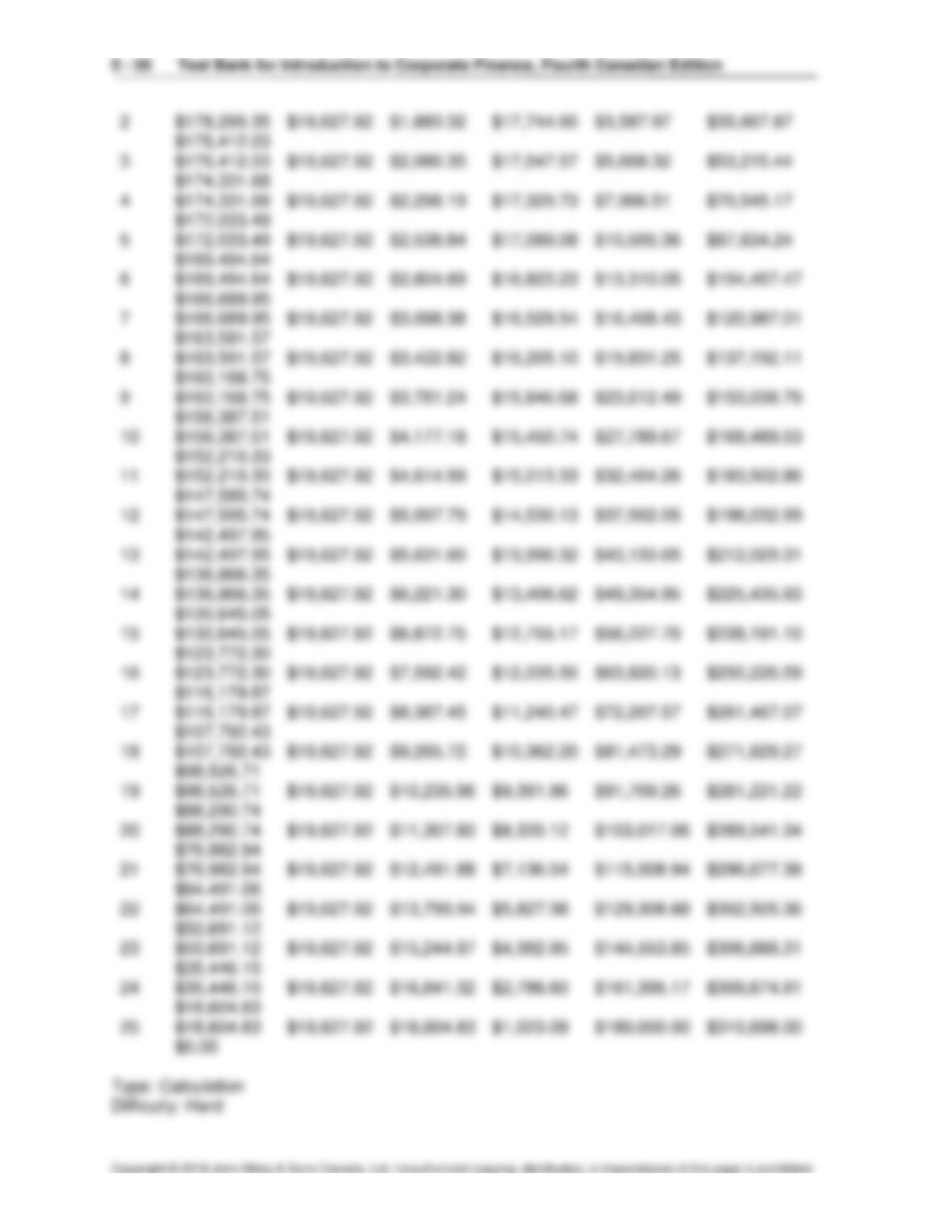
85. On January 1, 2016 your bank approved your mortgage and you bought your first home.
The mortgage value is $ 180,000, with interest compounded annually at a rate of 10%. In Excel,
generate two mortgage amortization schedules for the 25-year mortgage: one showing the
monthly payments for the first 12 months and the other showing the annual payments from the
next year until the mortgage matures.
Time Value of Money 5 – 36
5 – 37 Test Bank for Introduction to Corporate Finance, Fourth Canadian Edition
LEGAL NOTICE