4 – 21 Test Bank for Introduction to Corporate Finance, Fourth Canadian Edition
c) 117,857 units
d) 500,000 units
46. Which of the following is a productivity ratio?
a) Times interest earned
b) Leverage
c) Inventory turnover
d) Current ratio
47. What is the base, or denominator, of a productivity ratio?
a) Revenue
b) An asset value
c) A liability value
d) A shareholders’ equity value
48. When is a productivity ratio less important to analyze?
Financial Analysis Tools 6 – 22
a) There is a definitive historical trend in the productivity ratio.
b) The company’s productivity is very different from its competitors.
c) The company experiences large volatility in the ratio.
d) The company has relatively low levels of the account in the productivity ratio’s
denominator.
49. Inventory turnover can be calculated as:
a) Sales/Inventory
b) Accounts receivable/Inventory
c) Inventory/Cost of goods sold
d) Accounts payable/Inventory
50. UUP Inc. is very conservatively managed and nothing ever changes – their sales
are constant over time, the collection periods stay the same, and the firm has not
invested in any new assets. An investor is puzzled – she has found the fixed asset
turnover rate is changing over time. How can the apparent efficiency with which the firm
uses its assets be changing if all other items aren’t changing?
a) This observation is impossible; she must have miscalculated something.
b) This observation is possible; the fixed asset turnover must increase in this case due
to depreciation.
c) This observation is possible; the fixed asset turnover must decrease in this case due
to depreciation.
d) This observation is possible; she should look at net income and not sales – it is a
better measure of the firm’s efficiency and productivity.
4 – 23 Test Bank for Introduction to Corporate Finance, Fourth Canadian Edition
51. At the beginning of the year a company has $140 in inventory and at the end of the
year the inventory on the balance sheet is $110. If the firm reports cost of goods sold
on the income statement of $400, then the inventory turnover ratio would be closest to:
a) 1.60
b) 2.86
c) 3.20
d) 3.64
52. The following information has been obtained on Alberta Drilling Company for 2015:
2015
Sales $135,000
Accounts receivable$25,000
Inventory $15,000
Fixed assets$1,100,000
The receivables turnover and average collection period for Alberta Drilling Company
are:
a) Receivables turnover: 67.59; collection period: 5.40 days
b) Receivables turnover: 40.56; collection period: 9.00 days
c) Receivables turnover: 9.00; collection period: 40.56 days
d) Receivables turnover: 5.40; collection period: 67.59 days
53. Which one of the following is TRUE?
a) Fixed assets turnover represents the contribution of every dollar of assets to credit
sales.
b) The inverse of the inventory turnover times 365 estimates the number of days to
liquidate inventory.
c) The collection period of receivables and payables cannot be inferred from their
productivity ratios.
d) Productivity ratios estimate the productivity of borrowed amounts.
54. The following information has been obtained on Alberta Drilling Company for 2015.
2015
Sales $135,000
Accounts receivable$25,000
Inventory $15,000
Fixed assets$1,100,000
The inventory turnover and average day’s sales in inventory for Alberta Drilling
Company are:
a) Inventory turnover: 67.59; Average days sales in inventory: 5.40 days
b) Inventory turnover: 40.56; Average days sales in inventory: 9.00 days
c) Inventory turnover: 9.00; Average days sales in inventory: 40.56 days
d) Inventory turnover: 5.40; Average days sales in inventory: 67.59 days
55. In assessing a firm’s liquidity, which of the following ratios would be most helpful?
a) Debt/equity ratio
b) Asset turnover ratio
c) Current ratio
d) Times-interest-earned ratio
56. What is the difference between a liquidity ratio and a leverage ratio?
a) Liquidity ratios do not include debt while leverage ratios include debt.
b) Liquidity has a short-term focus while leverage has a long-term focus.
c) Liquidity ratios use balance sheet accounts while leverage ratios use the income
statement.
d) There is no difference.
57. Why do banks look at the quick ratio in addition to the current ratio?
a) The quick ratio assets are larger than the current ratio assets.
b) The quick ratio is a better measure of how quickly liabilities are coming due.
c) The quick ratio is easier to calculate.
d) The quick ratio assets are more liquid than the current ratio assets.
58. Net working capital represents:
a) The amount of money needed to start the company
b) The difference between assets and liabilities
c) The difference between current assets and liabilities
d) The difference between current assets and current liabilities
59. The following information was extracted from Webb Company’s financial
statements:
Cash $500
Accounts receivable$300
Inventory $200
Current liabilities$700
The current ratio and quick ratio for Webb Company are:
a) Current ratio = 1.4286; Quick ratio = 1.1429
b) Current ratio = 1.1429; Quick ratio = 1.4286
c) Current ratio = 0.7143; Quick ratio = 0.4286
d) Current ratio = 0.4286; Quick ratio = 0.7143
60. Voyage Company is in a very high growth industry while EZgoing Company is in a
low growth industry. Comparing their dividend payout ratios we would expect:
a) Voyage’s dividend payout ratio to be greater than EZgoing.
b) Voyage’s dividend payout ratio to be less than EZgoing
c) The two firms to have the same dividend payout ratio
d) Can’t compare them as they are in different industries.
61. If a company has good growth potential, the market to book ratio should be:
a) Higher than 1
b) Lower than 1
c) Less than 0
d) Not relevant
62. The dividend payout ratio aids investors by:
a) providing information about the sustainability of the dividend
b) providing information about the company’s future revenue growth
c) measuring the company’s dividend yield
d) reporting the company’s net income margin
63. What is the difference between the P/E ratio and the forward P/E ratio?
a) The P/E ratio uses the current share price while the forward P/E ratio uses the future
share price.
b) The P/E ratio uses the current earnings per share while the forward P/E ratio uses
the expected earnings per share.
c) The P/E ratio uses both the current price and earnings, while the forward P/E ratio
uses both the future price and earnings.
d) The P/E ratio uses EPS while the forward P/E ratio uses net income.
64. In 2015, Voyage Company had earnings per share of $45 and paid a dividend of
$15 per share. The dividend yield was 8%. The book value per share is $100. The
dividend payout ratio was:
a) 4.167
b) 3.0000
c) 0.3333
d) 0.1500
65. The current stock price of Bay James Tourism Company is $25. Current earnings
per share are $15 and are expected to grow by 20% next year. Bay James Tourism’s
trailing and forward price-earnings ratios are:
a) Trailing = 1.67; Forward = 1.39
4 – 29 Test Bank for Introduction to Corporate Finance, Fourth Canadian Edition
b) Trailing = 1.67; Forward = 1.20
c) Trailing = 1.39; Forward = 1.67
d) Trailing = 1.20; Forward = 1.67
66. Alberta High Skies Company has net income of $3 million. It issued 500,000 shares
two years ago at an issue price of $20 per share, and the stock is now trading at $35
per share. What is Alberta High Skies’ price-earnings ratio?
a) 1.75
b) 3.33
c) 5.83
d) 9.17
67. GoHabs Firm has assets and liabilities with book values of $65 million and $35
million, respectively. The market value of the assets is $75 million and the market value
of the debt is $40 million. If GoHabs’s EBITDA is $20 million, what is the EBITDA
multiple?
a) 0.57
b) 0.67
c) 1.50
d) 1.75
68. In 2015, Voyage Company had earnings per share of $45 and paid a dividend of
$15 per share. The dividend yield was 8%. The book value per share is $100. The
price-earnings (P/E) ratio was:
a) 4.167
b) 3.0000
c) 0.3333
d) 0.1500
69. Which of the following is not true?
a) In projecting financial statements, the process begins by preparing a projected
income statement.
b) In preparing a projected income statement, start with a sales or revenue forecast
prepared by marketing personnel.
c) The relationship between sales and some costs may be complex, for example sales
and fixed costs.
d) Interest expenses are commonly based on a percentage of sales.
70. What is the difference between invested capital and spontaneous liabilities?
4 – 31 Test Bank for Introduction to Corporate Finance, Fourth Canadian Edition
a) The firm knows who invests capital in the firm, but not the identity of who the firm
owes its spontaneous liabilities.
b) Invested capital is randomly determined, so the corresponding liabilities must be
spontaneous and therefore also random.
c) Invested capital is the amount of equity invested in the firm, while spontaneous
liabilities are the sum of long-term and short-term debt.
d) Invested capital is the result of investor decisions while spontaneous liabilities arise
from the firm’s business operations.
71. When using a percent of sales method for forecasting, which is the most important
variable to estimate?
a) COGS
b) Inventory
c) Revenue
d) Bank debt
72. Which of the following is TRUE?
a) Interest expenses can be predicted with a reasonable degree of accuracy, especially
when the firm uses variable interest rates on debt.
b) Interest expenses are commonly based on a percentage of sales.
c) Depreciation costs are commonly based on a percentage of sales.
d) Forecasting sales is the most important step in financial forecasting.
73. Which of the following is TRUE?
a) Interest expenses can be predicted with a reasonable degree of accuracy, especially
when the firm uses fixed interest rates on debt.
b) Interest expenses are commonly based on a percentage of sales.
c) Depreciation costs are commonly based on a percentage of sales.
d) Forecasting sales is the last step in financial forecasting.
74. Which of the following is not true?
a) The relationship between cash and sales can be determined by estimating the past
relationship between sales levels and cash balances.
b) Interest expenses can be predicted with a reasonable degree of accuracy, especially
when the firm uses variable interest rates on debt.
c) Selling expenses are commonly based on a percentage of sales.
d) A pro forma income statement also has to include projected dividend payments
based on the firm’s established dividend policies.
75. Which of the following is not a step in the financial planning process?
a) Deciding on how additional required assets will be financed
4 – 33 Test Bank for Introduction to Corporate Finance, Fourth Canadian Edition
b) Estimating various cost categories as per the income statement
c) Preparing projected funds-flow statement
d) Ordering supplies in anticipation of future sales
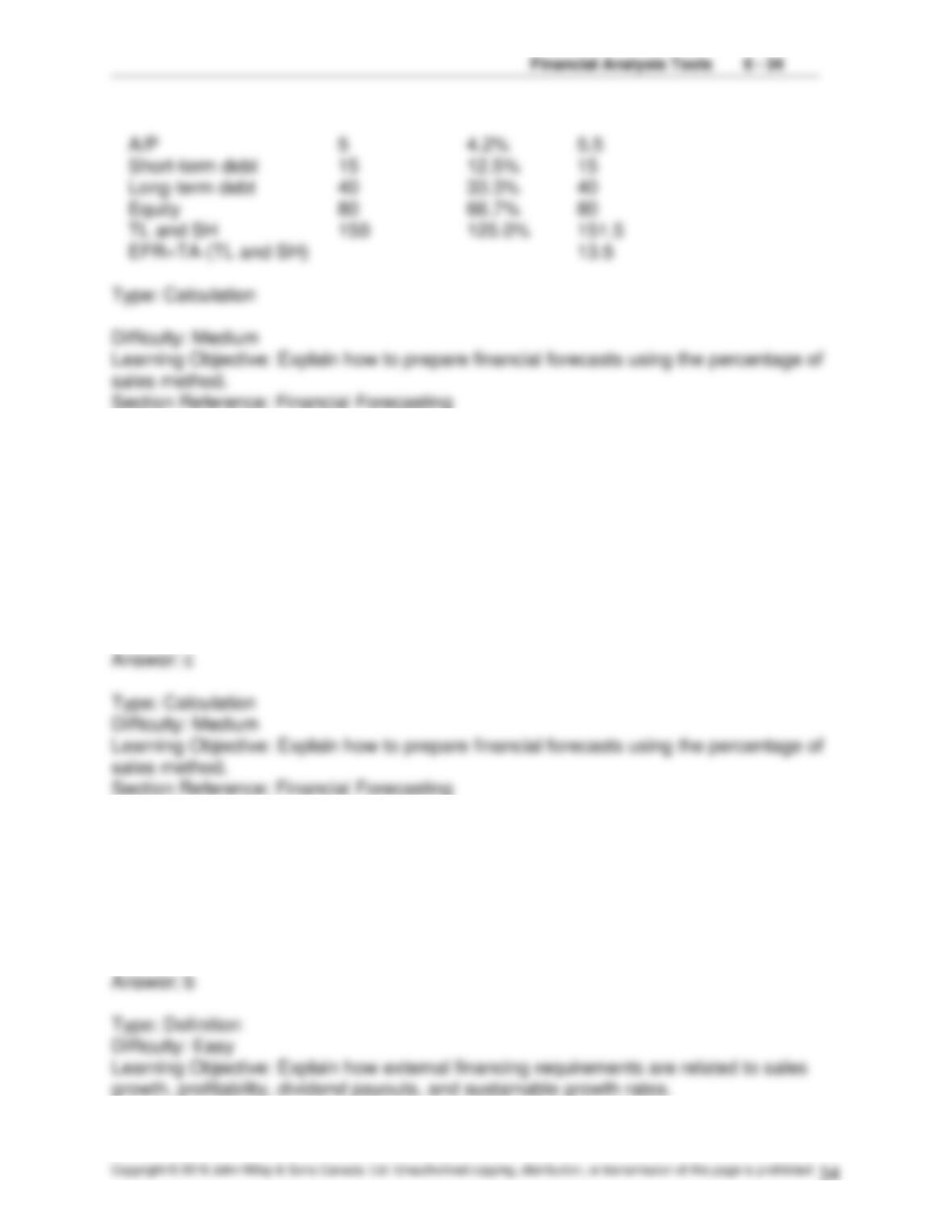
76. Company A’s current sales are $120. The balance sheet is below. Suppose the
sales growth rate is 10%. Short-term debt, long-term debt, and equity do not change.
What is the external financing needed for next year?
year 0
Cash 10
Securities 10
A/R 5
Inventory 25
NFA 100
TA 150
Accruals 10
A/P 5
Short-term debt 15
Long-term debt 40
Equity 80
TL and SH 150
a) $13.5
b) -$13.5
c) $165
d) $151.5
77. On the projected balance sheet for the next year, total assets are $5,000, total
liabilities are $2000, and shareholder’s equity is $1,000. Which of the following is
correct?
a) EFR is $1,000. This firm will have a cash deficit.
b) EFR is $1,000. This firm will have a cash surplus.
c) EFR is $2,000. This firm will have a cash deficit.
d) EFR is $2,000. This firm will have a cash surplus.
78. What does the retention ratio measure?
a) Contribution margin minus fixed costs
b) The percentage of net earnings not paid out in dividends
c) Earnings before tax minus taxes
d) Cash from operations minus cash from investing