4 – 35 Test Bank for Introduction to Corporate Finance, Fourth Canadian Edition
79. Which of the following is true at the sustainable growth rate?
a) The firm sells all of its inventory.
b) The firm’s net income is zero.
c) The firm neither needs nor generates financing.
d) The firm pays a dividend equal to exactly half of its retained earnings.
80. The external financing requirements of a firm are a function of:
a) Sales growth
b) Retention ratio
c) Profit margins
d) All of the above
81. EXLO Company has current sales of $100,000 and projected annual sales growth
of 5%, profit margins of 3%, and its dividend policy is to have a dividend payout of 15%
per year. The forecasted retained earnings for next year are:
a) $472.50
b) $2,677.50
c) $16,222.50
d) $91,927.50
82. EXLO Company has current sales of $100,000 and has projected annual sales
growth of 5%, asset growth of 120%, profit margins of 3%, and its dividend policy is to
have a dividend payout of 15% per year. Assume there are no spontaneous liabilities.
The sustainable growth rate for EXLO is closest to:
a) 0.13%
b) 0.38%
c) 2.17%
d) 4.25%
83. Which of the following is false?
d) Financial forecasts utilize multiple assumptions.
b) Some items are held constant at their most recent actual value.
c) It is possible, with the given information, to find EFR.
d) Retained earnings are estimated as a direct percentage of sales.
4 – 37 Test Bank for Introduction to Corporate Finance, Fourth Canadian Edition
PRACTICE PROBLEMS:
84. A firm has $1,750,000 of total assets and $1,330,000 of total liabilities. The firm then
issues 10,000 newly created shares at a price of $17 each (prior to the share issuance
the firm had 35,000 shares outstanding). What is the firm’s equity book value per share
(BVPS) after the share issuance?
85. What are the three ratios used in the DuPont system of financial analysis of return
on equity?
86. Identify three potential users of financial ratios, and explain the user’s focus.
Answer: Here are four:
87. Discuss some difficulties when comparing the ratios of similar corporations from
different countries.
88. List the different steps in the percentage of sales method of forecasting.
89. What is the major implication of the adoption of IFRS standards globally?
90. Discuss three issues that make the comparison of companies within the same
industry group difficult.
Answer: (Choose any three of the four)
91. You are given the following information about COGS Inc., a sprocket manufacturer.
Balance Sheet:
ASSETS
Current assets:
Cash $40,000
Accounts receivable 40,000

Financial Analysis Tools 6 – 40
Inventories 50,000
Total current assets $130,000
Fixed assets:
Plant $500,000
Equipment 150,000
Less:
Account Depreciation (100,000) 550,000
TOTAL ASSETS $680,000
LIABILITIES AND SHAREHOLDERS’ EQUITY
Current liabilities:
Short-term loan $100,000
Accounts payable 75,000
Taxes payable 20,000
Total current liabilities $195,000
Long-term liabilities:
Mortgage on plant 200,000
Total Liabilities 395,000
Shareholders’ equity:
Capital stock, 20,000 common shares 200,000
Retained earnings 85,000
Total shareholders’ equity 285,000
TOTAL LIABILITIES AND
SHAREHOLDERS’ EQUITY $680,000
Income Statement:
Revenues $500,000
Less:
Cost of goods sold $250,000
Salaries 150,000
Depreciation 20,000
Interest on loan 10,000
Interest on mortgage 20,000
Total expenses 450,000
Net income before taxes 50,000
Income taxes 20,000
Net earnings $ 30,000
a) COGS Inc. common shares are trading at $12 per share. Calculate the following
ratios:
i) current
ii) quick
iii) debt-to-equity
iv) total debt-to-assets
v) gross operating margin
4 – 41 Test Bank for Introduction to Corporate Finance, Fourth Canadian Edition
vi) return on common equity
vii) price-earnings
b) You have the following information about the sprocket industry. What are COGS
Inc.’s relative financial and operating weaknesses?
Industry Averages
Current ratio 0.75
Quick ratio 0.52
Debt-to-equity 0.58
Total debt-to-assets 0.51
Gross operating margin 0.45
Return on common equity 0.10
Price-earnings ratio 7.00
92. Mr. B. Baggins has just computed the operating margin and the gross profit margin
for Hoppit Company and has found that the operating margin is greater than the gross
profit margin. Is this possible? Why or why not? Explain your reasoning.
93. Zhang has observed that the sales of XYU Company have increased by 5% every
year for the past 5 years. Zhang also found that the average collection period has
increased over time while the average day’s sales in inventory has decreased over the
same period. Based on this information, what should Zhang conclude about XYU
Company?
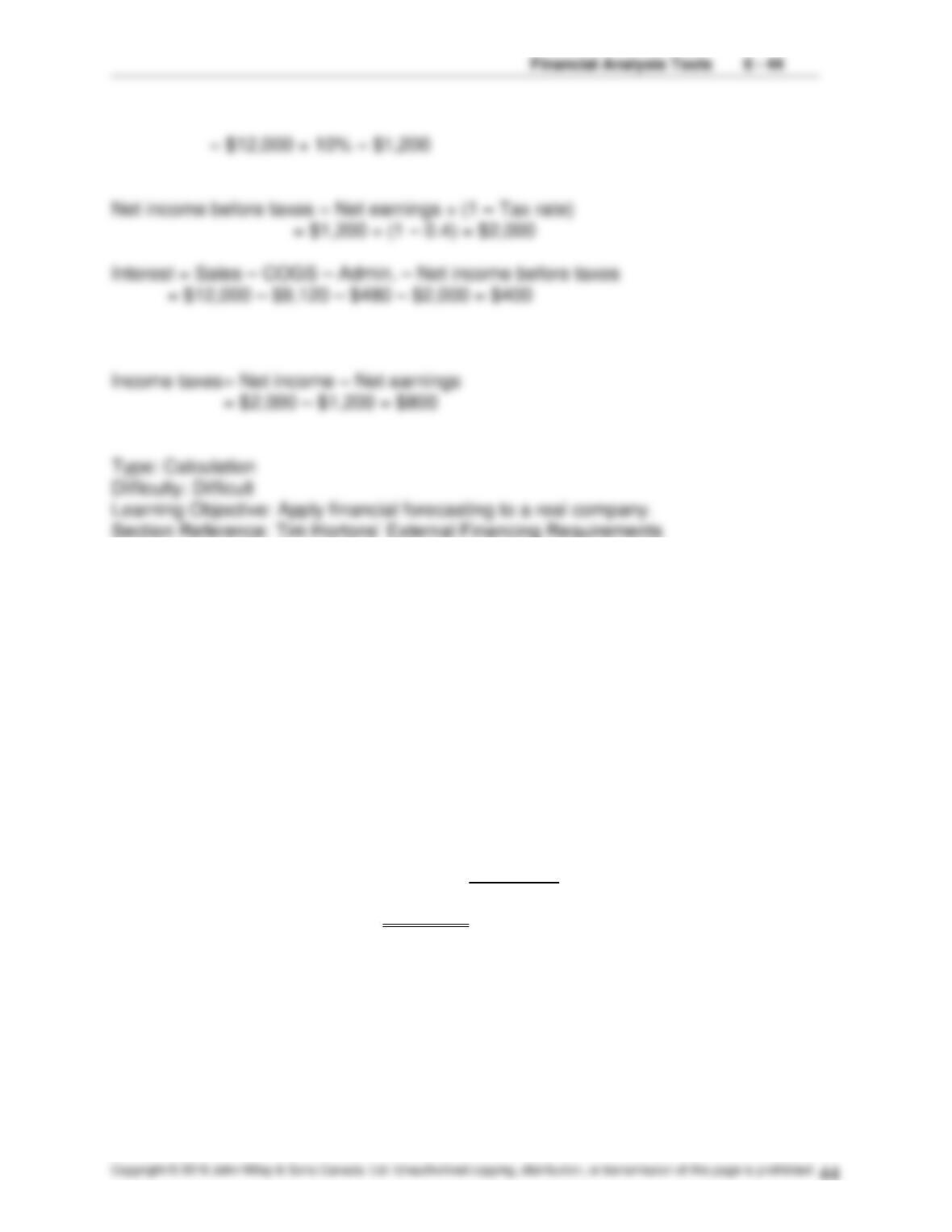
94. Complete the following income statement based on the information provided below:
Sales $
Less:
Cost of goods sold
Administration costs
Interest
Net income before taxes
Income taxes
Net earnings $
Selected values are given as follows:
Gross operating margin 24%
Net operating margin 20%
Asset turnover 0.8
Return on common equity 10%
Tax rate 40%
Tangible assets $15,000
Net worth $12,000
Preferred shares 0
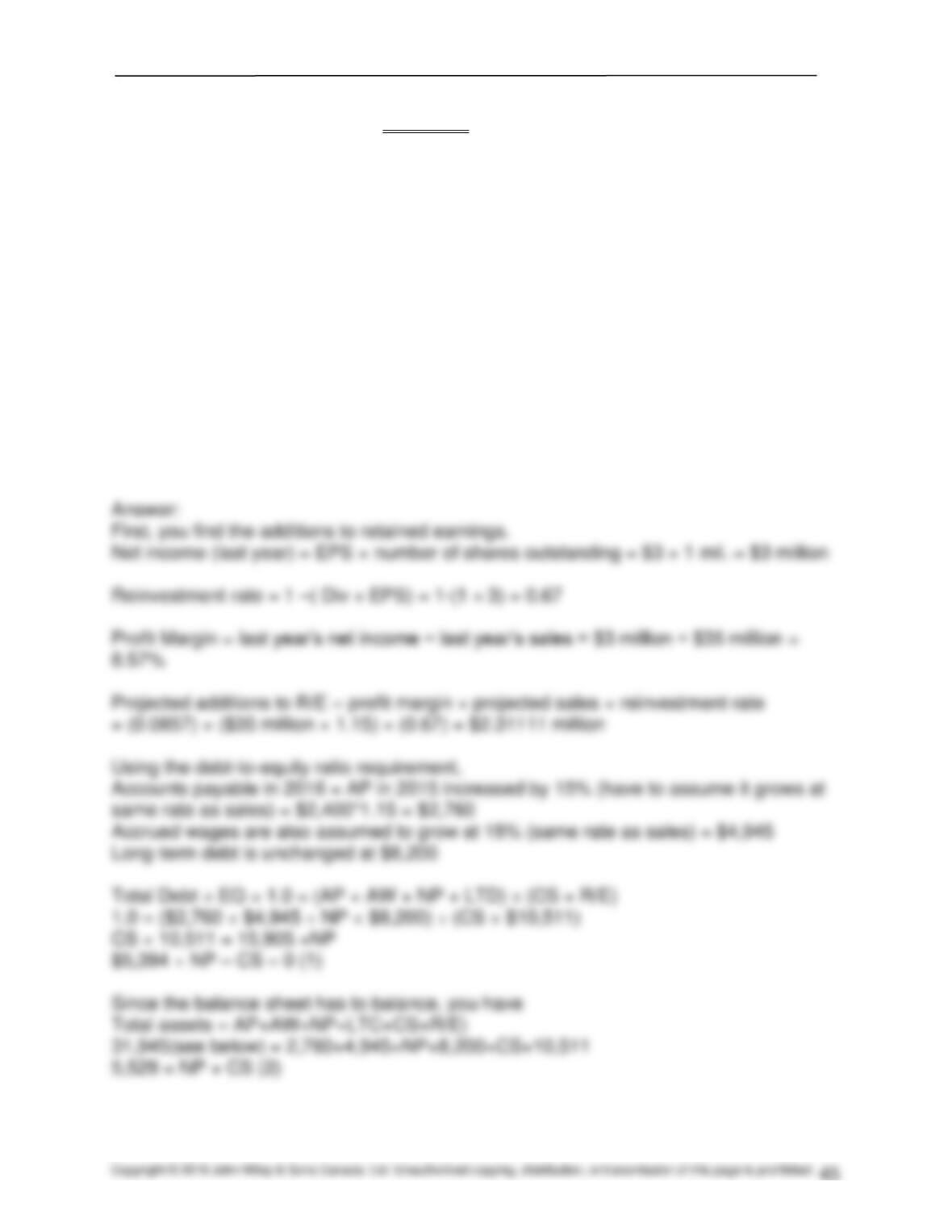
95. In 2015, Inglis Arctic Sports (IAS) had total sales of $35 million. The firm earned
$3.00 per share and paid dividends of $1.00 per share. There are 1 million shares
currently outstanding. The 2015 year-end balance sheet is shown below:
Inglis Arctic Sports
Consolidated Balance Sheet
(at year end in thousands of dollars)
2015 2016
Assets
Cash 4,800
Accounts Receivable 2,800
Inventory 3,400
Gross Fixed Assets 25,000
Less: Accumulated Depreciation (8,000)
Net Fixed Assets 17,000
Total Assets $28,000
Liabilities and Equity
Accounts Payable 2,400
Accrued Wages 4,300
Notes Payable 1,500
Long-Term Debt 8,200
Common Shares 3,400
Retained Earnings 8,200
4 – 45 Test Bank for Introduction to Corporate Finance, Fourth Canadian Edition
Total Liabilities and Equity $28,000
You are a financial analyst with IAS and have been asked to prepare a financial plan for
next year. You have been given the following information and projections for 2016 from
the marketing and production departments:
• Sales are projected to grow by 15 percent in 2016.
• New capital expenditures will be $3.75 million for the replacement of a production
line.
• Depreciation expense of $1,200,000 will be recorded in 2016.
• The new more efficient production line is expected to result in an inventory increase
of only 7.5 percent from 2015 levels.
• Management would like to achieve a total debt-to-equity ratio of 1.0 in 2016, while
keeping long-term debt unchanged from 2015.
• Management expects the net profit margin and dividend payout ratios to remain the
same as in 2015.
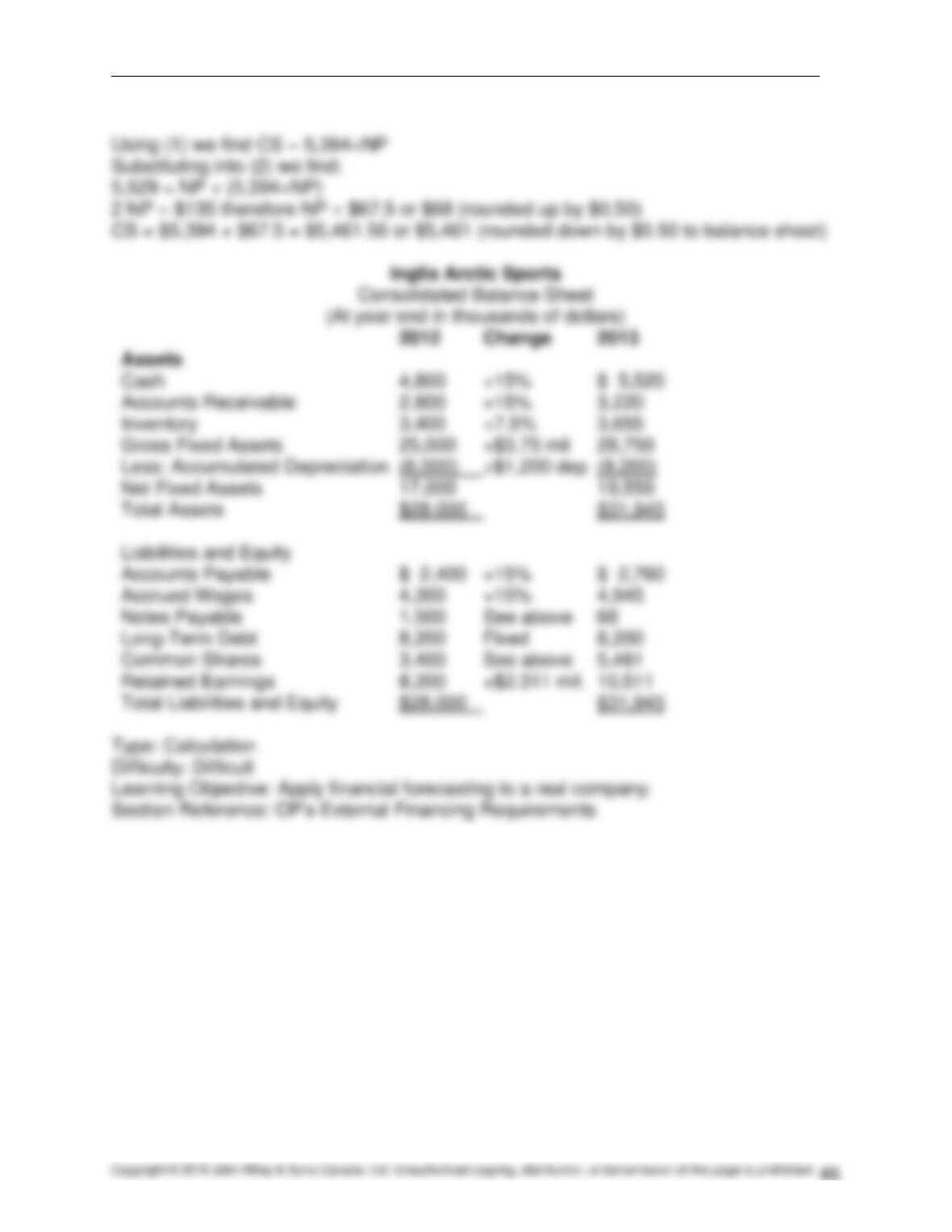
Forecast the 2016 balance sheet for IAS.
Financial Analysis Tools 6 – 46
4 – 47 Test Bank for Introduction to Corporate Finance, Fourth Canadian Edition
LEGAL NOTICE