
The explanatory notes (footnotes) accompanying the financial statements are generally
of little value in aiding a financial analyst when interpreting the financial statements.
Cash flow from financing is normally negative during the start-up phase for a company.
The matching principle in accounting prescribes that costs must be recognized in the
same period when the related revenues are recognized.
When calculating earnings coverage ratios, it is common to remove the effects of
extraordinary gains and losses and other one-time gains and losses from the numerator.

When analyzing postretirement benefits, one should evaluate the actuarial assumptions
and their effects on the financial statements.
One of the problems with purchase accounting is that there is often very little basis for
comparability of financial statements before acquisition and after acquisition.
The assumptions made about future changes in a company have a great effect on the
quality of the projected financial statements.

Over an extended period of time average cash flow from operations would be expected
to be higher than average net income.
As cash is the most liquid of all assets and liquidity is crucial to a company, all
companies should hold as much cash as possible.
The total debt to total capital ratio is more useful than the total debt to equity capital
ratio.
When forecasting future cash flows, it is useful to perform “what if” analyses to
determine the effect of various unexpected events in order to assess the company’s
financial flexibility.

It is possible to have increasing earnings growth while having decreasing return on net
operating assets.
If two firms are identical except that one firm uses percentage-of-completion
accounting and the other uses completed contract accounting for revenue recognition,
the cash flows of the firms will be identical.
Prospective analysis can only be used to project an income statement, a balance sheet,
and a statement of cash flows.

Companies that have low net operating profit margins generally only earn a reasonable
return on net operating assets if they can utilize their net operating assets very
efficiently.
Operating income is often referred to as net operating profit before tax.
Debt may contain sinking fund provisions. This means that bond is insured by
government and that in the event of default on the debt, the government will sink into
its funds in order to honor the debt.
If management underestimates the allowance for non-collectible accounts, this will
cause net income for the period to be overstated.

Employee stock options (ESOs) usually constitute a wealth transfer from current
shareholders to prospective shareholders (employees) and have no effect on total
liabilities and shareholders’ equity.
It is possible to have an increasing return on net operating assets while net operating
profit margin is decreasing.
Accounting or reported income is same as economic income.

Return on net operating assets is a better measure of operating performance than return
on equity, as it is independent of the form of financing.
The capitalization of interest costs during construction increases future net income.
The current ratio will always be greater than or equal to the acid test ratio.
When a company disposes of a segment of its business, it must restate all prior year
financial statements as if it had never owned that segment of the business.

Under the fair value model, income is determined by matching costs to recognized
revenues, which have to be realized and earned.
The development of the financial statements is management’s responsibility, and the
auditor is not concerned with the process of development.
If a company increases its discount rate for the purposes of calculating its pension
obligations, the accumulated benefit obligation and the projected benefit obligation will
both decrease.

Revenue from sales where the buyer has the right of return can only be recognized after
the return period has expired.
Liquidity is generally measured by a company’s ability to pay its short-term obligations
using its short-term assets.
Payment of a 5% stock dividend will not appear in the statement of cash flows.
Impairment of Long-lived Assets
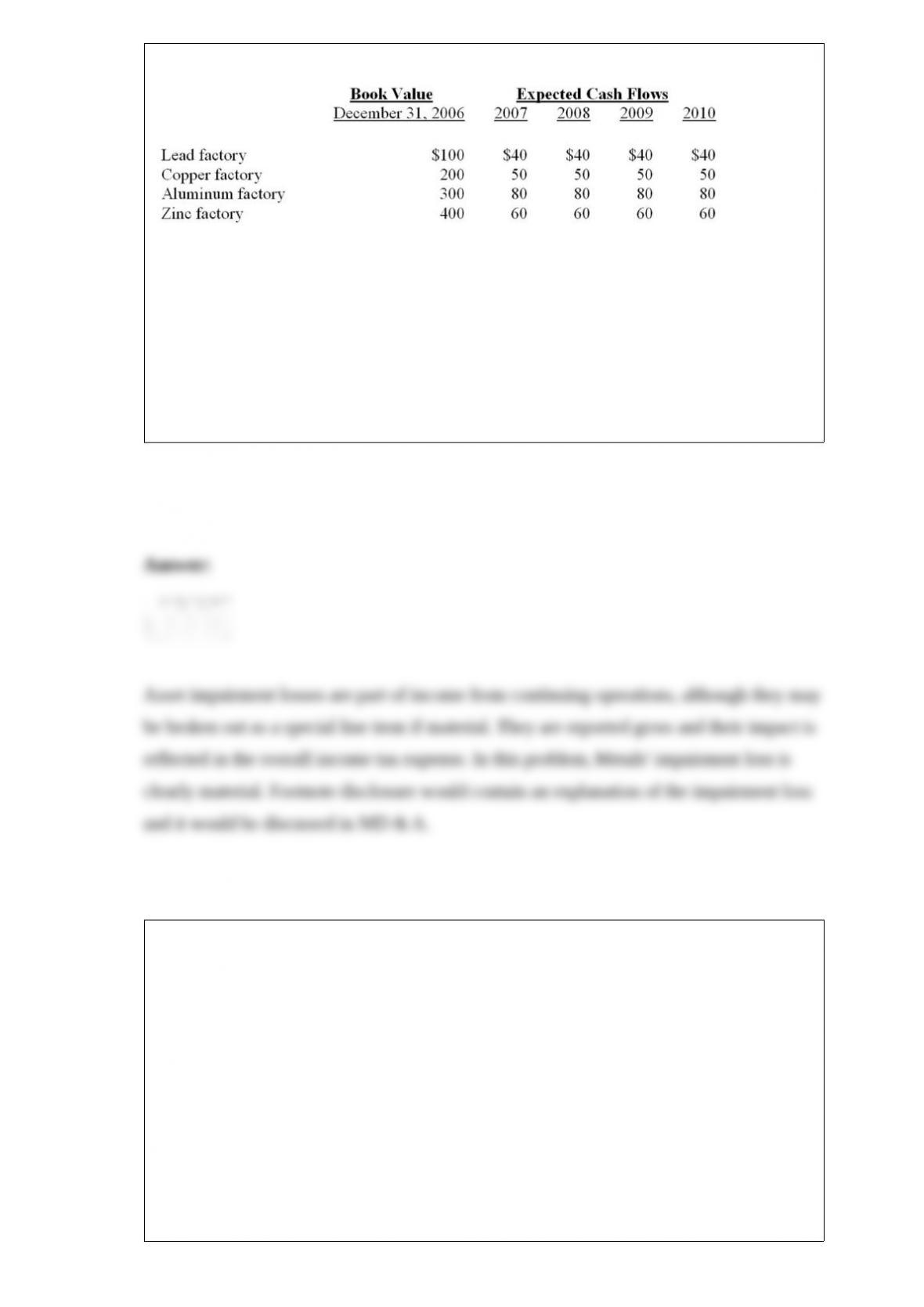
Metals Corp. has four factories with the following data:
All cash flows are at year-end and terminate after December 31, 2010. The company’s
cost of capital is 10% and its tax rate is 35%.
a. What is the value of each factory for balance sheet purposes at December 31, 2006?
b. What impairment loss, if any, would be reported on Metals’ 2006 income statement?
How would it be reported and where would it be reported (i.e. what component of the
income statement and other disclosures)?
The management of a company wishes to window-dress its cash flow from operations.
Which of the following will improve cash flow from operations?
I. Factoring accounts receivable
II. Paying suppliers more quickly
III. Selling of some excess marketable securities
IV. Deferring payment of taxes
A. IV only

B. III and IV
C. II, III, and IV
D. I and IV
Which of the following statements is correct?
A. Company A has a lower ROA than Company B.
B. Company A has a lower ROE than Company B.
C. Company A has same ROE as Company B.
D. Company A has used financial leverage to increase its return to its shareholders.
Which of the following statements about the equity growth rate is correct?
I. The higher the ROCE the higher equity growth rate, all other things equal.
II. The higher the dividend payout the higher the equity growth rate.
III. The equity growth rate is unaffected by the cost of debt.
IV. The equity growth rate indicates the expected growth in stock price each period.
A. I, II, III, and IV
B. I, II, and III

C. I and III
D. I only
Which of the following statements about the return on shareholders’ investment (ROSI)
is correct?
A. If book value of equity is less than market value, ROSI is greater than ROCE.
B. ROSI will be higher the greater the dividend payout ratio.
C. ROSI is likely to be more volatile than ROCE.
D. ROSI normally equals ROCE.
Fristy Corporation has a book value of equity of $5,000 at the beginning of 2005, and
net income of $1,000 for year ended 2005. It pays no dividends, and its cost of equity
capital is 10%. It expects return on beginning of year equity to remain constant for 2006
and 2007 and decrease to 10% thereafter. What should its price-to-book ratio be at the
end of 2005 (pick closest number)?
A. 1.01
B. 1.05
C. 1.09
D. 1.19

Accounting standards are:
A. the result of a political process among groups with diverse interests.
B. presentation standards mandated by the Securities and Exchange Commission.
C. the state-of-the-art presentation of the science of accounting.
D. standards measuring the quality of safeguarding assets.
Return on net operating assets for 2006 is:
A. 11.30%.
B. 12.03%.
C. 9.93%.
D. 11.19%.
Return on common equity for 2006 is:

A. 15.46%.
B. 24.14%.
C. 16.79%.
D. 22.04%.
As of December 31, 2005, two otherwise identical companies in the same industry, East
Company and West Company, have dividend payouts of 20% and 40%, respectively.
Looking forward one year, which outcomes are least likely?
I. East Company requires debt financing.
II. West Company increases its dividend payout.
III. West Company’s share price is twice that of East Company.
IV. East Company repurchases outstanding shares.
A. I and II
B. II and IV
C. I, II, and III
D. II, III, and IV
The use of LIFO rather than FIFO for inventory costing under normal economic
conditions results in:

I. lower net income.
II. higher total assets.
III. higher retained earnings.
IV. unchanged retained earnings.
A. II and III
B. I, II, and IV
C. I only
D. I and IV
According to FASB, initial franchise fees should be recognized as income when:
A. the franchiser has substantially performed or satisfied all material services and
conditions.
B. the franchiser has collected the majority of fee in cash.
C. the franchisee shows the ability to pay the fee.
D. the franchiser bills the franchisee.
The inventory costing method used by a company (LIFO, FIFO, etc.) will affect:
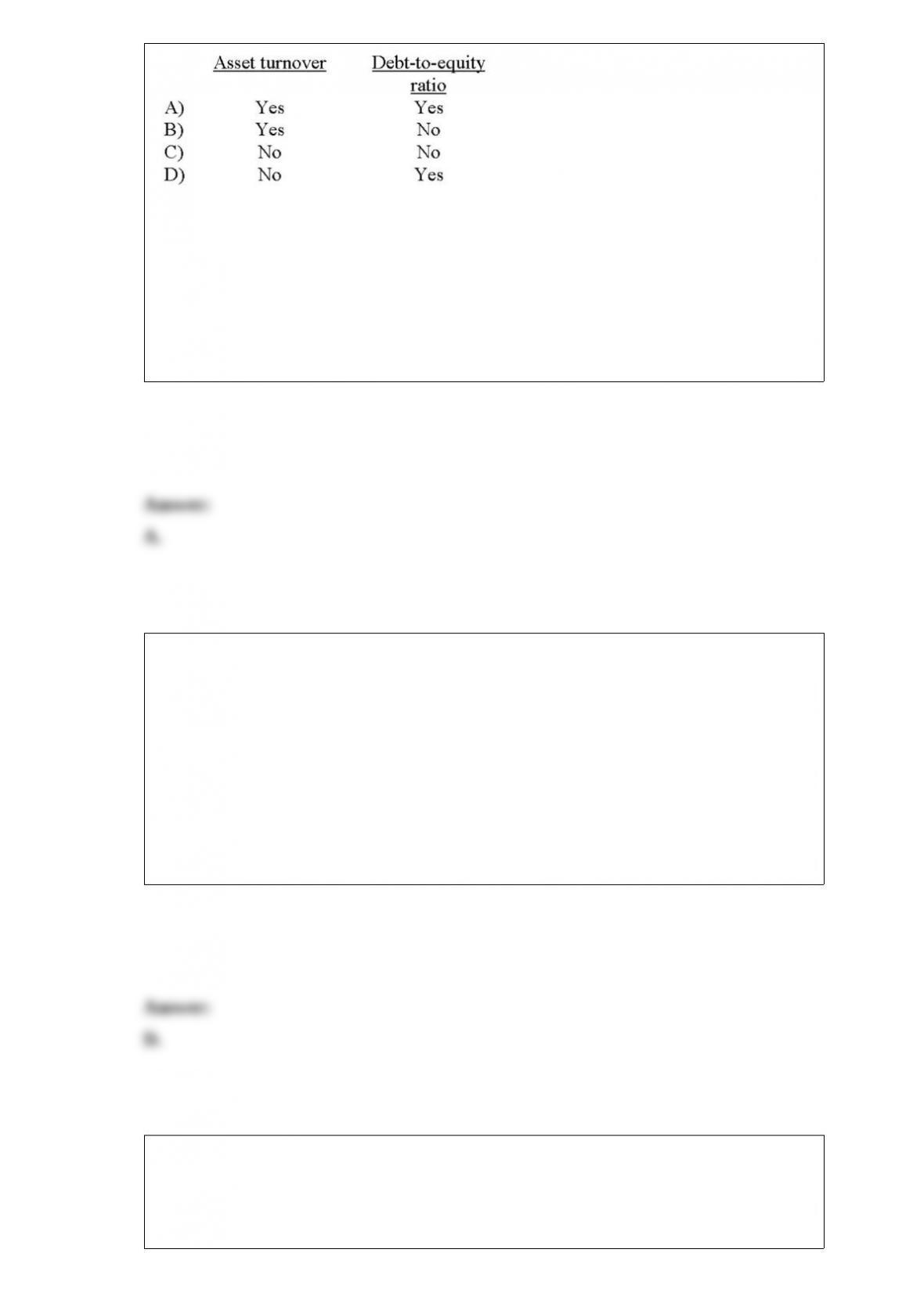
A. Option A
B. Option B
C. Option C
D. Option D
If a company estimates that its expected return on pension plan assets will increase to
9.5% from 9.0%, this would be considered:
A. an extraordinary gain.
B. a change in accounting principle.
C. a prior period adjustment.
D. a change in accounting estimate.
Which of the following is incorrect when calculating the earnings to fixed charges ratio
for a company?
A. Interest expense is considered a fixed charge

B. Long-term rental payments are often considered fixed charges
C. Senior managements’ salaries are normally considered fixed charges
D. Preferred stock dividends are normally considered fixed charges
Which of the following statements is correct concerning changes from year 1 to year 2
at Tricrop?
A. Despite favorable changes in the tax rate, return on net operating assets has
decreased
B. Despite favorable changes in net operating asset utilization, return on net operating
assets has decreased
C. Largely because of favorable changes in tax rates, return on net operating assets has
increased
D. Largely due to favorable changes in leverage, return on net operating assets has
increased
Financial Statements of ABC Corp. indicates that ending inventory levels in 2005 and
2006 were $200,000 and $350,000 respectively. Cost of goods sold for 2005 and 2006
were $1,900,000 and $2,200,000 respectively. Purchases in 2006 were:
A. $1,950,000
B. $2,150,000

C. $2,350,000
D. $1,850,000
Compared with firms with capital leases, firms with operating leases generally report:
A. higher cash flow from operations.
B. lower cash flow from operations.
C. identical cash flow from operations.
D. lower or higher cash flow from operations depending upon market interest rates.
With respect to pension liabilities, which of the following statements is true?
I. The projected benefit obligation (PBO) is always greater than or equal to the
accumulated benefit obligation (ABO).
II. The vested benefit obligation (VBO) is always as least as or as big as the
accumulated benefit obligation (ABO).
III. If the PBO is greater than the plan assets, the plan is said to be overfunded.
IV. If the weighted-average assumed discount rate is increased, the PBO will decrease.
A. I, III, and IV
B. I and III
C. II and IV
D. I and IV
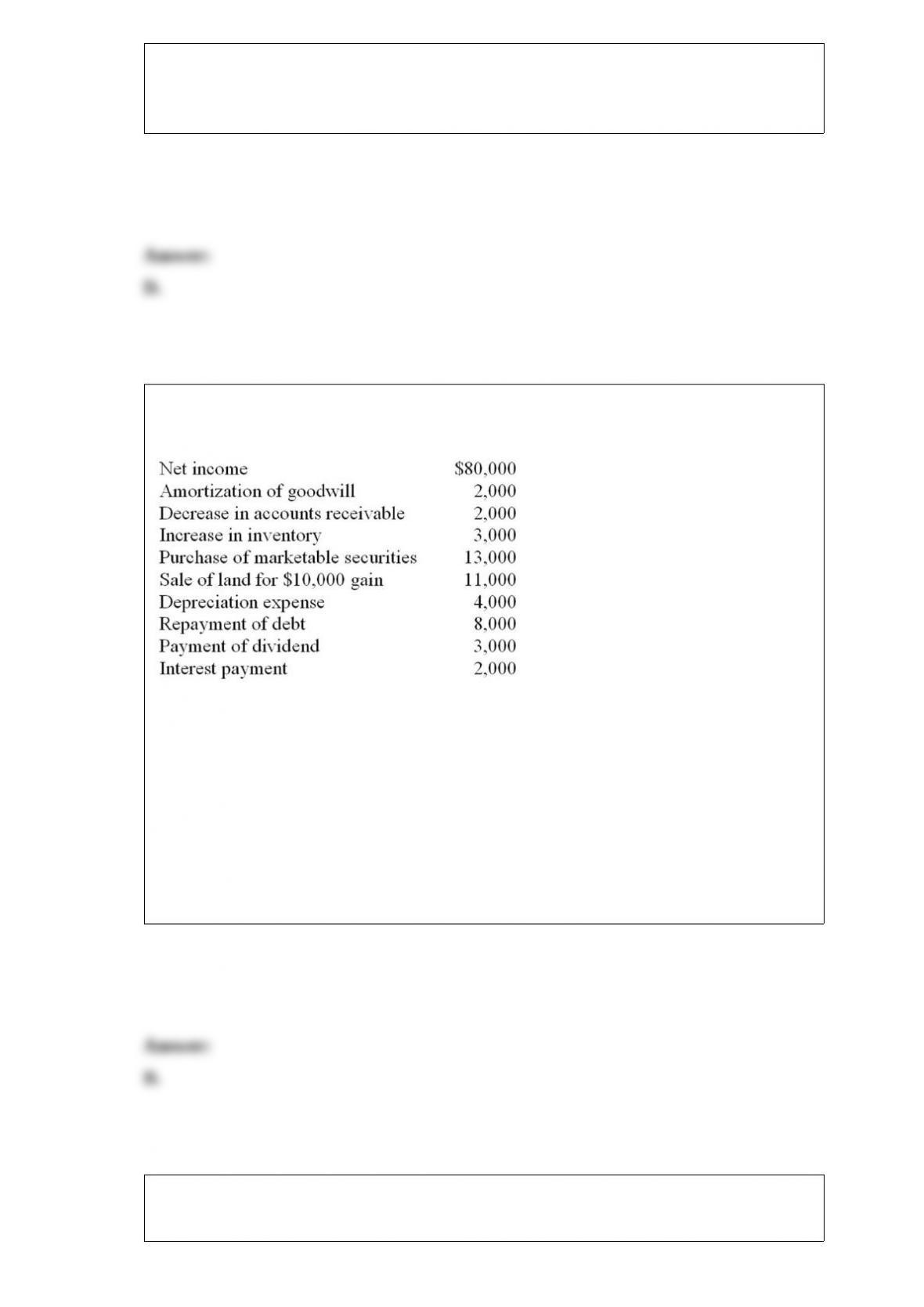
The following information should be used according to the provisions of GAAP
(Statement of Cash flows) and using the following data.
What is net cash flow from operations?
A. $74,000
B. $75,000
C. $83,000
D. $85,000
If software refinement had been capitalized each year and amortized over a three-year
period beginning in the year the cost was incurred, net income for fiscal 2007 would

have been:
A. $31.7 million.
B. $29.75 million.
C. $21.95 million.
D. $14.95 million.
Which of the following statements is correct?
A. Net operating profit margin divided by net operating asset turnover equals return on
net operating assets.
B. Return on net operating assets can be disaggregated into net operating profit margin
and leverage.
C. Return on equity equals return on net operating assets less interest, net of tax.
D. Return on equity can be disaggregated into net operating profit margin, net operating
asset turnover and leverage.
Under U.S. GAAP, the method used to convert financial statements of foreign
subsidiaries in countries experiencing hyperinflation is:
A. the current rate method.
B. the inflation method.

C. the temporal method.
D. the transition method.
Company A capitalized $100 in interest costs, the pension obligation, during the year.
Times interest earned ratio, after necessary adjustments, for Company A is:
A. 3.5.
B. 2.8.
C. 2.0.
D. 1.2.
A cash flow adequacy ratio, when measured over the last several years, of less than one:
A. indicates that a company’s net income is too low relative to its sales level.
B. indicates that a company should decrease its dividend payout ratio.
C. indicates that a company needs to pay down its debt to decrease interest costs.
D. indicates that a company’s internally generated cash flows have not been sufficient to
cover dividend payments and support current operating growth levels.

The correct change in cash for the year is:
A. $4,000
B. $15,000
C. $16,500
D. None of the above
If the acquisition is completed as of 12/31/06, what will the market value per share be
for the year ended 12/31/06 assuming purchase accounting is used?
A. $24.00
B. $20.00
C. $18.80
D. $15.67
Which of the following is incorrect? When using the 10-Q, the analyst should be aware
that the usefulness of the quarterly financial statements might be affected by:
A. seasonality.
B. adjustments made in the final quarter of the year.
C. the use of cash accounting.
D. the increased use of estimates.
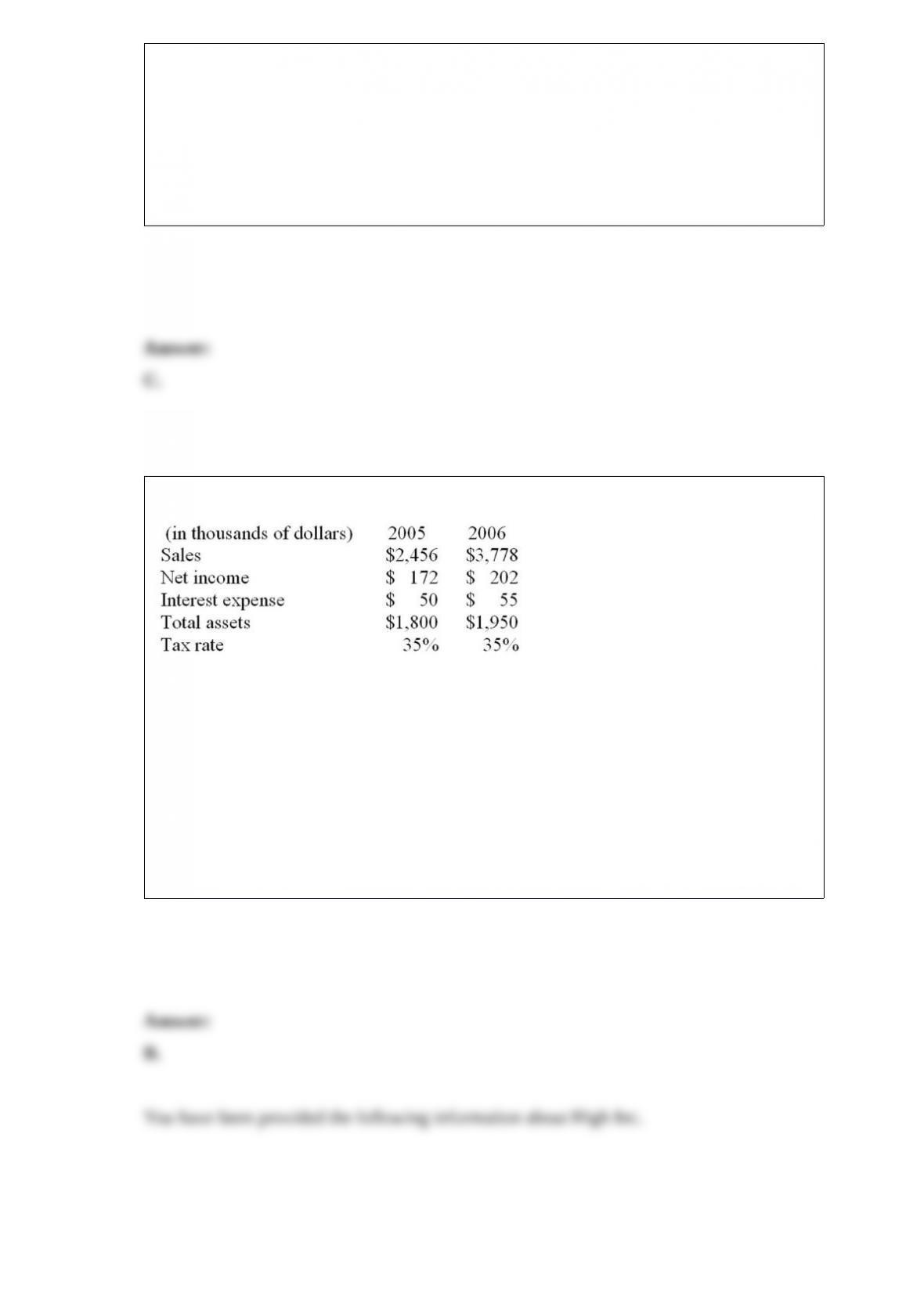
You have been provided the following information about Wert Inc.
Return on assets for 2006 is:
A. 13.71%.
B. 12.68%.
C. 10.77%.
D. 13.21%.
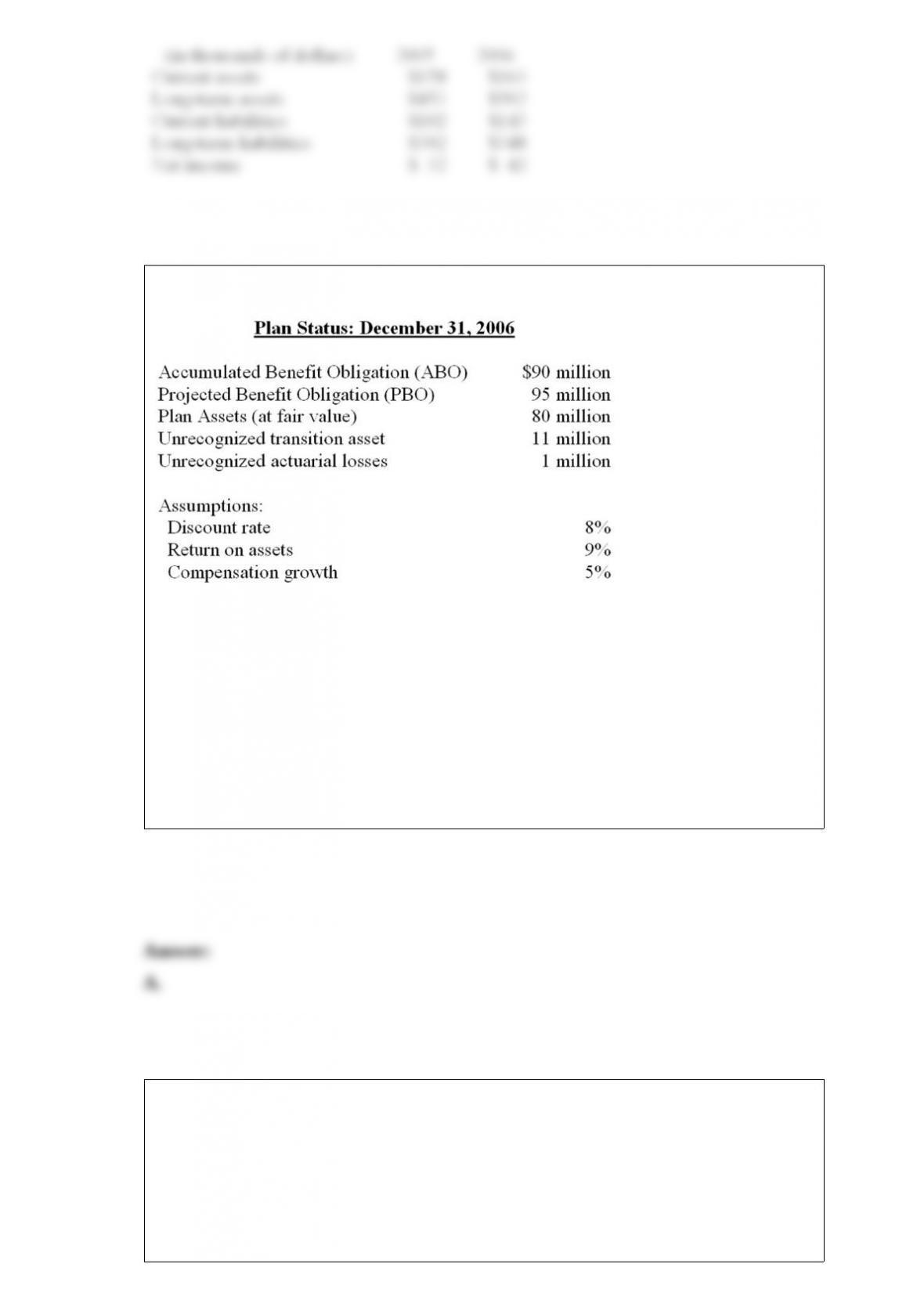
Harms Inc. reported in its 2006 annual report the following information:
Funded status at the end of 2006 was:
A. $15 million.
B. $12 million.
C. $10 million.
D. $0 million.
Target Company is trading at $20 a share at the end of the year 2006 and has 1 million
shares outstanding. Acquirer Corp. is trading at $50 a share and has 2 million shares
outstanding. Acquirer offers Target’s shareholders of one share of its stock for every two
shares of Target Company. For the year ending 12/31/06, Acquirer and Target had
earnings of $5 million and $2 million, respectively. The book value of Target’s net
assets is $12 million and fair value is $15 million as of 12/31/06. The book value of
Acquirer’s net assets is $35 million and fair value is $48 million as of 12/31/06.

How many outstanding shares will Acquirer have if they are successful in its
acquisition?
A. 2 million
B. 2.4 million
C. 2.5 million
D. 3 million
Which of the following is reported in the equity section of the balance sheet?
A. Redeemable preferred stock
B. Treasury stock
C. Investment in affiliates
D. Debentures
As per the definition of residual income model, what is the effect on stock price in a
given period if the firm’s cost of capital is greater than its return on equity?
A. Cannot be determined
B. No effect
C. Stock price increases.

D. Stock price decreases.
Which of the following will increase the sustainable equity growth of a company, all
other things equal?
A. Increase dividend payout
B. Pay suppliers more quickly
C. Pay suppliers more slowly
D. Decrease dividend payout
A retrenching company with poor prospects would generally have:
A. high price-to-book ratio and high price-to-earnings ratio.
B. high price-to-book ratio and low price-to-earnings ratio.
C. low price-to-book ratio and high price-to-earnings ratio.
D. low price-to-book ratio and low price-to-earnings ratio.