
Under the simple interest method, a customer saves on interest as an installment loan
approaches maturity.
Answer:
Banks should concentrate their lending on those types of loans in which they have the
greatest cost advantage.
Answer:
Only federal regulators can limit the terms (amount, frequency, and use) of borrower
funds by the U.S. depository institutions.
Answer:

The barriers between securities dealers and international banks are falling in many
countries, making it harder for the public to see real differences between financial
institutions.
Answer:
One investment maturity strategy, called the front-end loaded policy, requires that the
bank put all of its investment portfolio in long-term securities.
Answer:
Bank branch offices are often specially configured today to maximize sales
opportunities.
Answer:

Personal checking accounts tend to be more profitable for banks than commercial
checking accounts.
Answer:
Basis risk is the difference in the interest rates (or prices) of the same security between
the cash market and the futures market.
Answer:
Leveraged buyouts (LBOs) involve the purchase of businesses with at least 75 percent
of the cost of the purchase funded by current earnings and sales of stock.
Answer:

An interest-rate cap on a loan would protect the lender.
Answer:
The advantage of a credit swap is that it allows each bank in the swap to broaden its
market area and spread out its credit risk on its loans.
Answer:
A mutual fund is a savings instrument where the customer makes cash payments to an
investment manager who invests them in earning assets. Later the purchaser receives a
stream of income from these assets.
Answer:

Loans of Federal funds under a continuing contract are automatically renewed each day
unless either the borrower or the lender decides to end the agreement.
Answer:
After the Tax Reform Act of 1986, large banks (>$500 million in assets) were required
to use the reserve method of accounting for future loan loss reserves.
Answer:
The liquidity problem for banks is made easier because depositors and borrowers are
not sensitive to changing interest rates.
Answer:

Demand deposits are among the most volatile and least predictable of a bank’s sources
of funds with the shortest potential maturity.
Answer:
Currently the debit card market is one of the fastest growing of all household financial
services, substantially exceeding the recent growth of credit cards.
Answer:
Borrowed liquidity (liability) management is less risky for a financial institution than is
asset conversion.
Answer:

Financial institutions face two major kinds of interest-rate risk. These risks include
price risk and reinvestment risk.
Answer:
Financial institutions that pursue the “quiet life” as a goal face less risk of losing
earnings or market share.
Answer:
A proprietary mutual fund is where the bank sells a mutual fund through one of their
affiliated companies and where the bank can act as an investment advisor.
Answer:

A bond with a greater duration will have a smaller price change in percentage terms
when interest rates change.
Answer:
A unit branch faces the risk of variability in earnings if the surrounding economy
weakens and people and businesses move away to other market areas.
Answer:
Payments made by electronic direct deposit now comprise over 50 percent of all
transactions in the U.S.
Answer:

The largest source of thrift capital in terms of dollar volume is common stock (par
value).
Answer:
A bank or financial service institution can meet reserve requirements by selling
Treasury securities in its portfolio.
Answer:
The Eurobond market provides a firm with access to funds outside its home country.
Answer:

The Federal Reserve Board can terminate the operations of a foreign bank in the United
States if it finds that the bank is not being operated in a manner consistent with the
public interest.
Answer:
If the ratio of tangible equity capital to total assets is 2 percent or less, it is subject to
being placed in conservatorship or receivership unless the institution’s principal
regulator and the FDIC determine that it would be in the public interest to allow the
institution to continue under present ownership and management.
Answer:
Banks have now expanded their service offerings into providing investment banking,
insurance protection, financial planning, and other services rather than restricting
themselves to traditional financial services.
Answer:

One of the principal reasons for government regulation of financial firms is to protect
the safety and soundness of the financial system.
Answer:
Most liquidity problems in banking arise from inside a bank, not from its customers.
Answer:
Interest rate floors protect the lender from falling interest rates.
Answer:

Nondeposit funds do have the advantage of quick availability compared to most types
of deposits, but are not as stable a funding source for banks as are time and savings
deposits.
Answer:
The basic strength of the cost-plus loan pricing method is that it considers the
competition from other lenders.
Answer:
Nearly three quarters of all U.S. banks exceed $100 million in asset size apiece.
Answer:

A bank will use a short hedge in the futures market to avoid higher borrowing costs or
to protect against declining asset values.
Answer:
The “direct cash flow” method and “cash flow by origin” are two very different ways of
assessing the cash flows of a potential borrower.
Answer:
Inflation risk is the possibility that the purchasing power of interest income and repaid
principal from a security or loan will be eroded by rising prices for goods and services.
Answer:

A ‘typical’ community bank is committed to:
A. attracting deposits from large companies.
B. attracting deposits from high net-worth individuals.
C. making loans to large corporates.
D. making loans to small households.
E. None of the options are correct.
Answer:
Which of the following would not be an example of operational risk?
A. A bank, on the coast of Louisiana, is hit by a hurricane and is flooded for 6 weeks.
B. A bank employee working as a derivatives trader, is also the one who writes the
reports on profits and losses in derivatives trading every day.
C. The banks older computer system breaks down causing a loss of service to
customers for 2 weeks.
D. A bank robber robs a teller at gun point and gets away before police can get to the
bank.
E. All of the examples are of operational risk.
Answer:

_____________ is a strategy of protecting securities purchased from loss of return, no
matter which way interest rates go.
A. Duration
B. Immunization
C. Front-end loading
D. Back-end loading
E. Factorization
Answer:
Which of the following is a type of service that a bank holding company is not allowed
to own?
A. Merchant banking company
B. Savings and loan association
C. Retail electronics equipment sales company
D. Security brokerage firm
E. Insurance agency
Answer:

Why do banks generally prefer lower capital requirements?
A. To minimize the impact shareholders have on management decisions
B. To increase the influence of bank regulators
C. To increase a bank’s return on equity
D. To increase depositor protection
E. To maximize operating leverage
Answer:
A merger may increase a bank’s expected future earnings or reduce its level of risk
exposure by:
A. improved operating efficiency.
B. increased earnings per share.
C. geographic or product diversification.
D. product diversification.
E. All of the options are correct.

Answer:
A bank which starts with ALL of $1.48 million at the beginning of the year, charges off
worthless loans of $0.94 million during the year, recovers $0.12 million on loans
previously charged off and charges current income for a $1.02 million provision for
loan losses, will have an ALL at the end of the year of:
A. $0.66 million.
B. $3.32 million.
C. $1.68 million.
D. $1.28 million.
E. The same amount as at the beginning of the year.
Answer:
Interbank deposits generally carry:
A. low credit risk.
B. high credit risk.
C. highest credit risk.
D. moderate credit risk.
E. zero credit risk.
Answer:
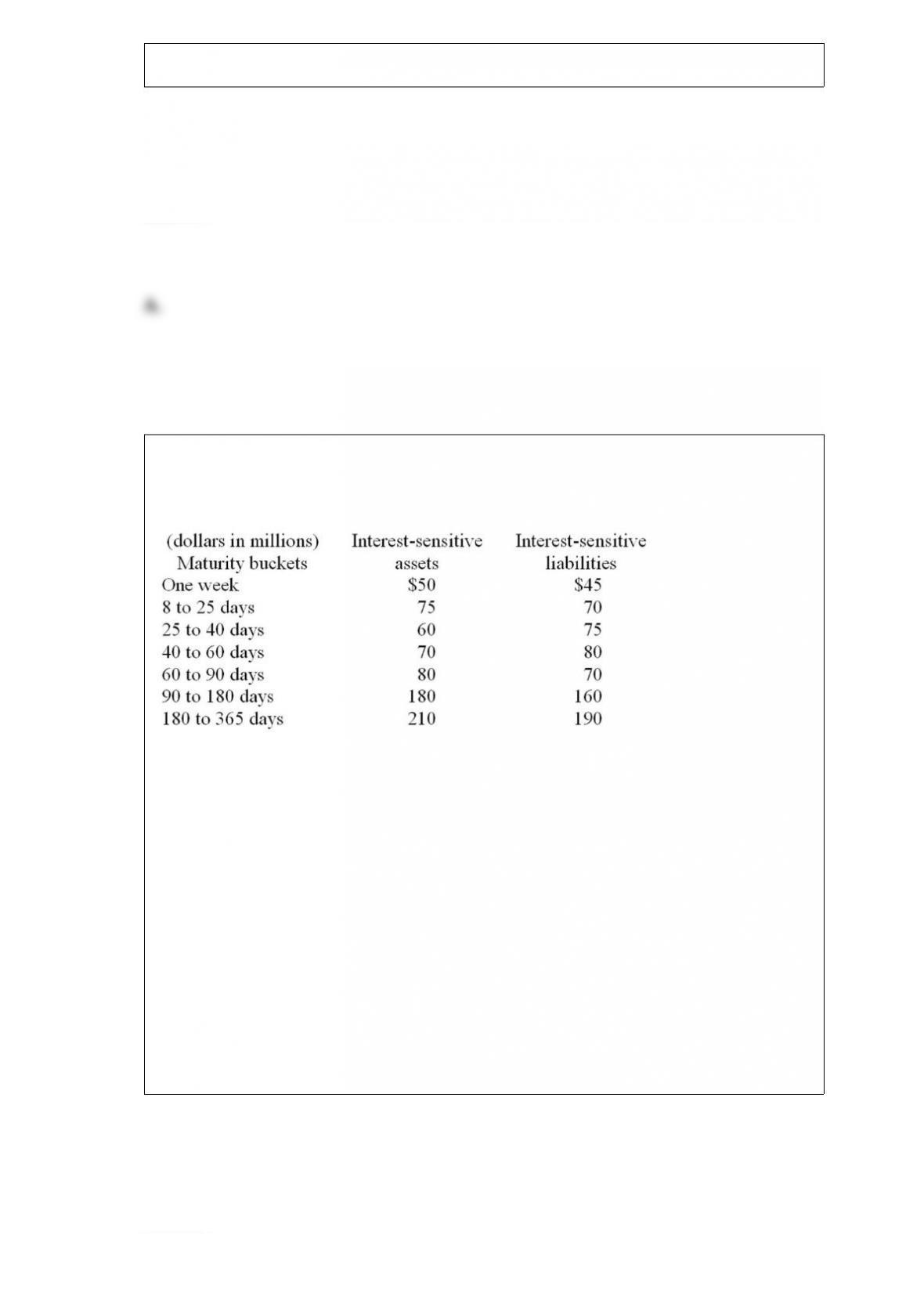
Loyola Bank classifies its assets and liabilities and the period (maturity buckets) within
which they are subject to repricing as on March 31, 2015 as follows:
Silvershine bank has $200 million in earning assets and $280 million in liabilities that
are subject to an interest rate change each month over the next six months. If market
interest rates suddenly rise by 2 full percentage points, what will be approximate
change in the net interest income for the bank?
A. $8.2 million
B. -$8.5 million
C. $8.5 million
D. $9.6 million
E. -$9.6 million
Answer:

FNMA does not purchase home mortgages in the secondary market if the borrower’s
monthly total debt repayments (including housing costs) exceed _________ percent of
the borrower’s monthly gross income.
A. 28
B. 30
C. 36
D. 40
E. None of the options is correct
Answer:
Nonperforming loans are credits on which any scheduled loan repayments and interest
payments are past due for more than:
A. 30 days.
B. 60 days.
C. 90 days.
D. 180 days.
E. None of the options are correct.

Answer:
A bank has $100 million of investment grade bonds with a duration of 9.0 years. This
bank also has $500 million of commercial loans with a duration of 5.0 years. This bank
has $300 million of consumer loans with a duration of 2.0 years. This bank has deposits
of $600 million with a duration of 1.0 year and non-deposit borrowings of $100 million
with an average duration of .25 years. What is this bank’s duration gap? These are all of
the assets and liabilities this bank has.
A. This bank has a duration gap of 14.75 years.
B. This bank has a duration gap of 15.03 years.
C. This bank has a duration gap of 3.55 years.
D. This bank has a duration gap of 3.75 years.
E. This bank has a duration gap of 5.15 years.
Answer:
Banks have been heavily involved in selling their services across national boundaries
since:
A. the industry’s very beginning.
B. the 1950s.
C. the 1980s.

D. the turn of the century.
E. None of the options is correct.
Answer:
The American Commerce Bank (ACB) lends $1.5 million to Unity International
Company for six months. The bank usually changes a rate of LIBOR plus 3 percent to
companies with similar credit ratings. However, since the bank’s economists are of the
view that short-term interest rates may fall in the near future, ACB decided to lend
money to Unity at a discounted rate of LIBOR plus 2 percent in return for an
interest-rate floor of 4.5 percent. What amount of interest rebate will the bank receive,
if LIBOR drops to 1.5 percent from 2.5 percent immediately after lending the amount?
A. $7,500
B. $20,000
C. $22,500
D. $17,500
E. Zero
Answer:

You know the following information about the Taylor National Bank:
Given this information, what is the value of this firm’s increase in undivided profits?
A. $150
B. $210
C. $400
D. ($250)
E. $750
Answer:
A standby letter of credit, backing the issue of state and local government general
obligation bonds, is given a credit risk-weight of 20 percent because of its:
A. modest credit risk.
B. zero credit risk.
C. moderate credit risk.
D. low credit risk.
E. highest credit risk.

Answer:
When two banks simply agree to exchange a portion of their customers’ loan
repayments, they are using:
A. a credit option.
B. a standby letter of credit.
C. a credit linked note.
D. a credit swap.
E. None of the options is correct.
Answer:
Prepaid cards which carry balances that can be spent electronically in stores until the
balance entered in such cards is fully used up are known as:
A. smart cards.
B. deposit cards.
C. match cards.

D. credit cards.
E. All of the options are correct.
Answer:
Alexis Downs uses her credit card to buy furniture but pays off the credit card at the
end of the month before she incurs any interest costs. How is Alexis using her credit
card?
A. As an installment loan
B. As a noninstallment loan
C. As a home equity loan
D. As a debit card
E. None of the options is correct
Answer:
Which of the following is considered a fringe bank?
A. Community Bank

B. Wholesale Bank
C. Merchant Bank
D. Payday Lender
E. None of the options are correct.
Answer:
The law that allows banks to affiliate with insurance companies and securities firms to
form financial services conglomerates is:
A. the National Bank Act.
B. the Glass-Steagall Act.
C. the Garn-St Germain Depository Institutions Act.
D. the Riegle-Neal Interstate Banking Act.
E. the Gramm-Leach-Bliley Act (Financial Services Modernization Act).
Answer:

A bank is considering adding security brokerage services to the services it offers. It has
estimated that the expected return and standard deviation of its traditional service are
6% and 14% respectively. It has estimated that the expected return and standard
deviation of its new securities brokerage services are 14% and 24% respectively. The
correlation between these services has been estimated to be -0.4 and the bank estimates
that 60% of its business will be from traditional services and 40% from the new
services. What is the standard deviation of the new combined firm?
A. 24.00 percent
B. 18.00 percent
C. 15.07 percent
D. 14.00 percent
E. 9.91 percent
Answer:
The most important source of liquidity for a depository institution is:
A. Federal funds loan.
B. new customer deposits.
C. sale of liquid securities.
D. money market loans.
E. sale of equity.
Answer:

Which of the following has(have) proven to be important factor(s) in credit scoring
models?
A. Credit Bureau ratings
B. Income bracket
C. Home ownership
D. Number and type of deposit accounts owned
E. All of the options are correct.
Answer:
The Tidewater State Bank has $1,000 in total assets (all of which are earning assets),
$700 of which will be repriced within the next 90 days. This bank also has $800 in total
liabilities, $400 of which will be repriced within the next 90 days. Currently, the bank is
earning 8 percent on its assets and is paying 5 percent on its liabilities.If interest rates
on both assets and liabilities rise by 2 percent in the next 90 days, what should happen
to this bank’s net interest margin? A. It should rise by 0.60 percent.
B. It should rise by 2 percent.
C. It should rise by 4 percent.
D. It should rise by 1 percent.
E. It should not show any rise.

Answer:
Suppose Citibank holds assets denominated in euros of 120 million and liabilities
denominated in euros of 180 million. They also have euro purchases of 40 million and
euro sales of 70 million. When would Citibank experience a loss in the currency
market?
A. When the euro declines in value relative to the dollar
B. When the dollar increases in value relative to the euro
C. When the yen increases in value
D. When the euro increases in value relative to the dollar
E. None of the options is correct.
Answer:
Capital gains on municipal bonds are:
A. fully taxable without any exceptions.
B. tax exempt.
C. tax deductible.
D. fully taxable except for appreciation to par for bonds originally issued at a discount.

E. tax exempt for bonds issued at a premium.
Answer:
A financial institution with a negative gap can reduce the risk of loss due to changing
interest rates by:
A. extending asset maturities.
B. increasing short-term interest-sensitive liabilities.
C. using financial futures or options contracts.
D. All of the options are correct
E. None of the options are correct
Answer:
The Foreign Bank Supervision Enhancement Act of 1991 places the responsibility for
supervising U.S. branches of foreign banks with the: A. Office of the Comptroller of
the Currency.
B. Federal Reserve Board.

C. Federal Deposit Insurance Corporation.
D. Secretary of Commerce.
E. None of options is correct.
Answer:
The Jennings Bank of Texas, wants to protect itself from credit risk by making large
loans to corporate customers, by making residential mortgages to families, by making
agriculture loans to farmers and ranchers in the area, by making small business loans to
business along main street and by making automobile loans for the car dealership across
the street from the bank. What defense against risk is this bank making?
A. Portfolio diversification
B. Geographic diversification
C. Quality management
D. Increasing owners’ capital
E. None of the options is correct.
Answer:

You know the following information about the Miller State Bank:
Given this information, what is the value of this firm’s net loans?
A. $250
B. $350
C. $500
D. $50
E. $150
Answer:
Under court interpretation of the Comprehensive Environmental Response,
Compensation, and Liability Act, lenders may be liable for clean-up costs of hazardous
substances if:
A. the lender is involved in managing property with hazardous wastes.
B. the lender has a strong association with the property owner.
C. the lender has treated the interest in the borrower’s property as a long-term

investment.
D. All of the options are correct.
E. the lender does not take action primarily to protect the credit they have extended.
Answer:
The degree of dilution in earnings of a combined firm is a function of a differential in
the _________ and relative size of the two merging companies.
Answer:
One of the principal components of evaluating ROE is _____________________ ratio,
which reflects a bank’s portfolio management policies and the mix and yield on its
assets.
Answer:

The ______________________ is the interest rate charged to the bank’s most
creditworthy customers on short-term working capital loans.
Answer:
____________________________ are domestic U.S. companies owned by U.S. or
foreign banks, located outside the home state of the bank that owns them. These
organizations are limited primarily to international business transactions.
Answer:
A lending institution that sells lower-yielding securities at a loss in order to reduce
current taxable income, while simultaneously purchasing higher-yielding new securities
in order to boost future returns is doing a(n) _______________.
Answer:

A(n) _________________________ is a retirement plan that is designed for
self-employed individuals.
Answer:
Banks which offer services within the grocery stores and other retail outlets are offering
services from a(n) ______________________ branch.
Answer:
The __________________ shows the relationship between the time to maturity and the
yield to maturity of bonds.
Answer:

A(n) __________________________ gap means that for a parallel increase in all
interest rates, the market value of net worth will tend to decline.
Answer:
__________________________ measures the return to stockholders on their
investment in a bank. It is the product of net profit margin, asset utilization, and the
equity multiplier.
Answer:
_________________________ are short-term notes, with maturities ranging from 3
days to 9 months, issued by well-known companies.

Answer:
Not all _____________ banks around the world have reserve requirements.
Answer:
______________________ is demonstrated by organizers of new banks by showing
that local banks are not conveniently located or fail to offer some key services.
Answer:
________________ CDs allow the depositor to withdraw some funds without a
withdrawal penalty.
Answer:

__________________________ measures the amount of debt or leverage a bank has
and is one part of the evaluation of the bank’s ROE. It is generally a number larger than
one.
Answer:
On October 28, 2004, ________________ became law, permitting depository
institutions to electronically transfer check images instead of the checks themselves.
Answer:
______________________ is the idea that cost of producing multiple services, using
the same organization and resources, will grow at a lower rate as the product mix
expands.

Answer:
Depository institutions are required to get their deposits insured from the
____________.
Answer: