
Consider a project with the following cash flows:
Assume the appropriate discount rate for this project is 15%. The payback period for
this project is closest to:
A) 3
B) 2.5
C) 2
D) 4
Answer:
Use the following information to answer the question(s) below.
Galt Industries is trading for $20 per share and has 25 million shares outstanding. Galt
Industries has a debt-equity ratio of 0.4 and its debt is zero coupon debt with a ten year
maturity and a yield to maturity of 8%.
In describing Galt’s equity as a call option, the market value of the assets underlying the
call option are:
A) $200 million
B) $300 million
C) $500 million

D) $700 million
Answer:
You expect that Bean Enterprises will have earnings per share of $2 for the coming
year. Bean plans to retain all of its earnings for the next three years. For the subsequent
two years, the firm plans on retaining 50% of its earnings. It will then retain only 25%
of its earnings from that point forward. Retained earnings will be invested in projects
with an expected return of 20% per year. If Bean’s equity cost of capital is 12%, then
the price of a share of Bean’s stock is closest to:
A) $17.00
B) $10.75
C) $27.75
D) $43.50
Answer:
Consider the following balance sheet:
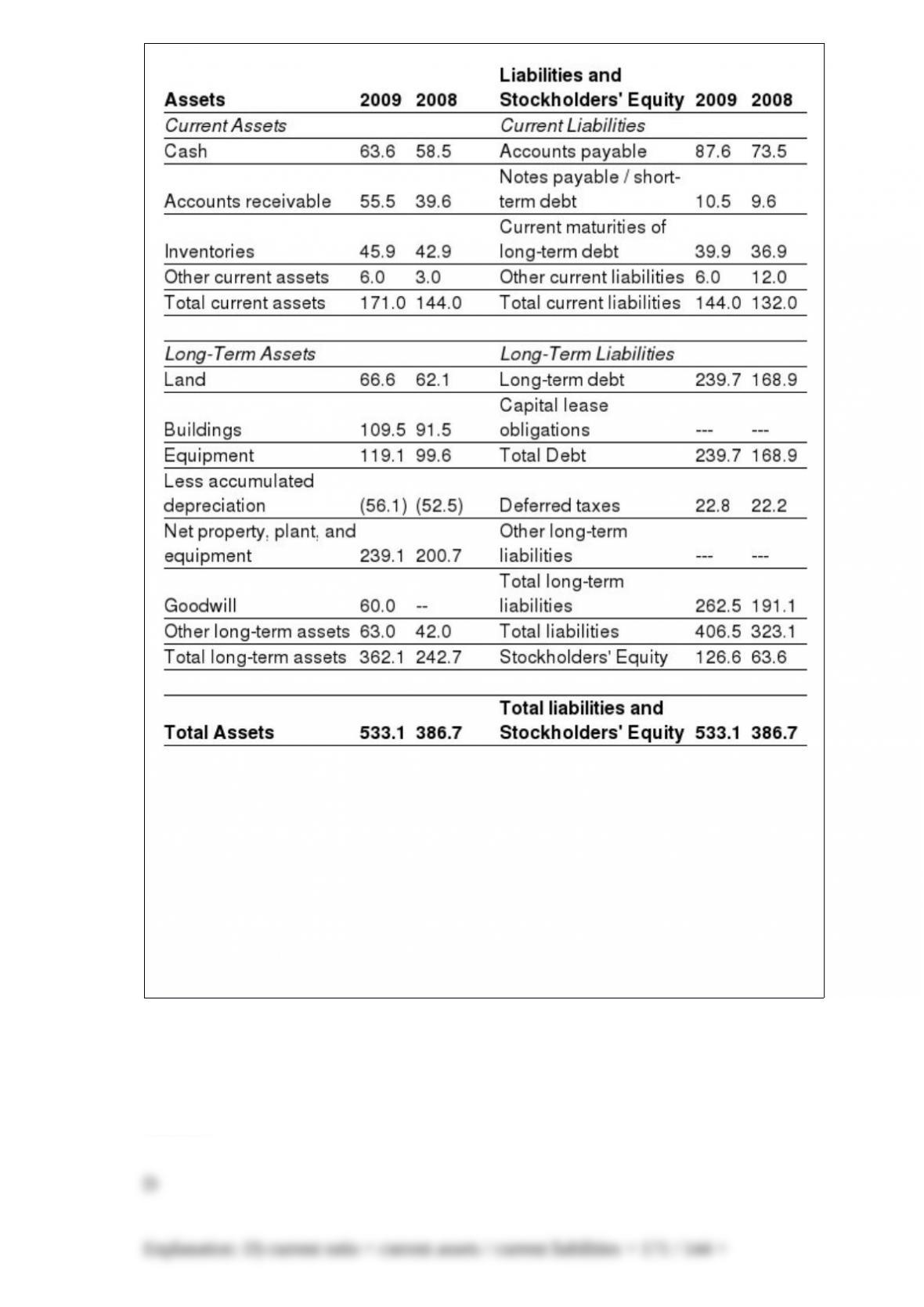
Luther’s current ratio for 2009 is closest to:
A) 0.84
B) 0.92
C) 1.09
D) 1.19
Answer:

Which of the following statements is false?
A) One way to see why you sometimes choose not to invest in a positive-NPV project is
to think about the decision of when to invest as a choice between two mutually
exclusive projects: (1) invest today or (2) wait.
B) You invest today only when the NPV of investing today exceeds the value of the
option of waiting, which from option pricing theory we know to be always positive.
C) When you do not have the option to wait, it is optimal to invest in any positive-NPV
project.
D) When you have the option of deciding when to invest, it is usually optimal to invest
only when the NPV is positive but close to zero.
Answer:
Use the information for the question(s) below.
Omicron Technologies has $50 million in excess cash and no debt. The firm expects to
generate additional free cash flows of $40 million per year in subsequent years and will
pay out these future free cash flows as regular dividends. Omicrons unlevered cost of
capital is 10% and there are 10 million shares outstanding. Omicron’s board is meeting
to decide whether to pay out its $50 million in excess cash as a special dividend or to
use it to repurchase shares of the firm’s stock.
Assume that Omicron uses the entire $50 million to repurchase shares. The number of
shares that Omicron will repurchase is closest to:
A) 1.0 million

B) 1.2 million
C) 1.1 million
D) 0.9 million
Answer:
An exchange traded fund (ETF) is a security that represents a portfolio of individual
stocks. Consider an ETF for which each share represents a portfolio of two shares of
Apple Inc. (APPL), one share of Google (GOOG), and ten shares of Microsoft (MSFT).
Suppose the current stock prices of each individual stock are as shown below:
The price per share of this ETF in a normal market is closest to:
A) $800
B) $1,001
C) $1,067
D) $1,267
E) $1,601
Answer:
Use the table for the question(s) below.
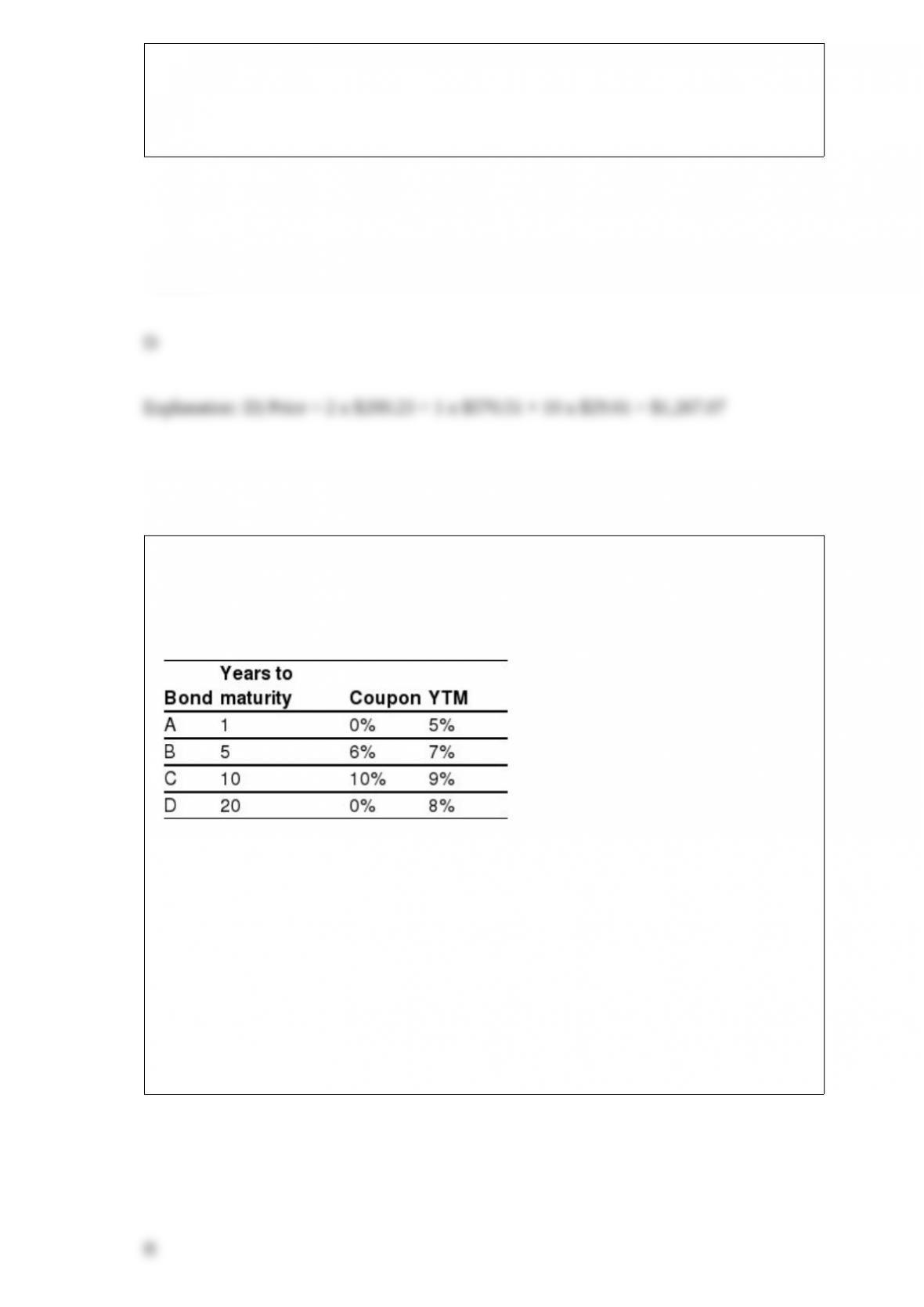
Consider the following four bonds that pay annual coupons:
The percentage change in the price of the bond “C” if its yield to maturity increases
from 9% to 10% is closest to:
A) -17%
B) -6%
C) -4%
D) 4%
Answer:

You work for a pharmaceutical company that has developed a new drug. The patent on
the drug will last for 17 years. You expect that the drug will produce cash flows of $10
million in its first year and that this amount will grow at a rate of 4% per year for the
next 17 years. Once the patent expires, other pharmaceutical companies will be able to
produce generic equivalents of your drug and competition will drive any future profits
to zero. If the interest rate is 12% per year, then the present value of producing this drug
is closest to:
A) $71 million
B) $90 million
C) $170 million
D) $105 million
Answer:

Which of the following statements is false?
A) In general, the gain to investors from the tax deductibility of interest payments is
referred to as the interest tax shield.
B) The interest tax shield is the additional amount that a firm would have paid in taxes
if it did not have leverage.
C) Because Corporations pay taxes on their profits after interest payments are deducted,
interest expenses reduce the amount of corporate tax firms must pay.
D) As Modigliani and Miller made clear in their original work, capital structure matters
in perfect capital markets. Thus, if capital structure does not matter, then it must stem
from a market imperfection.
Answer:
Use the information for the question(s) below.
Tom’s portfolio consists solely of an investment in Merck stock. Merck has an expected
return of 13% and a volatility of 25%. The market portfolio has an expected return of
12% and a volatility of 18%. The risk-free rate is 4%. Assume that the CAPM
assumptions hold in the market.
Assuming that Tom wants to maintain the current volatility of his portfolio, then the
maximum expected return that Tom could achieve by investing in the market portfolio
and risk-free investment is closest to:
A) 13%
B) 15%

C) 16%
D) 12%
Answer:
You overhear your manager saying that she plans to book an Ocean-view room on her
upcoming trip to Miami for a meeting. You know that the interior rooms are much less
expensive, but that your manager is traveling at the Company’s expense. This use of
additional funds comes about as a result of:
A) an agency problem.
B) an adverse selection problem.
C) a moral hazard.
D) a publicity problem.
Answer:
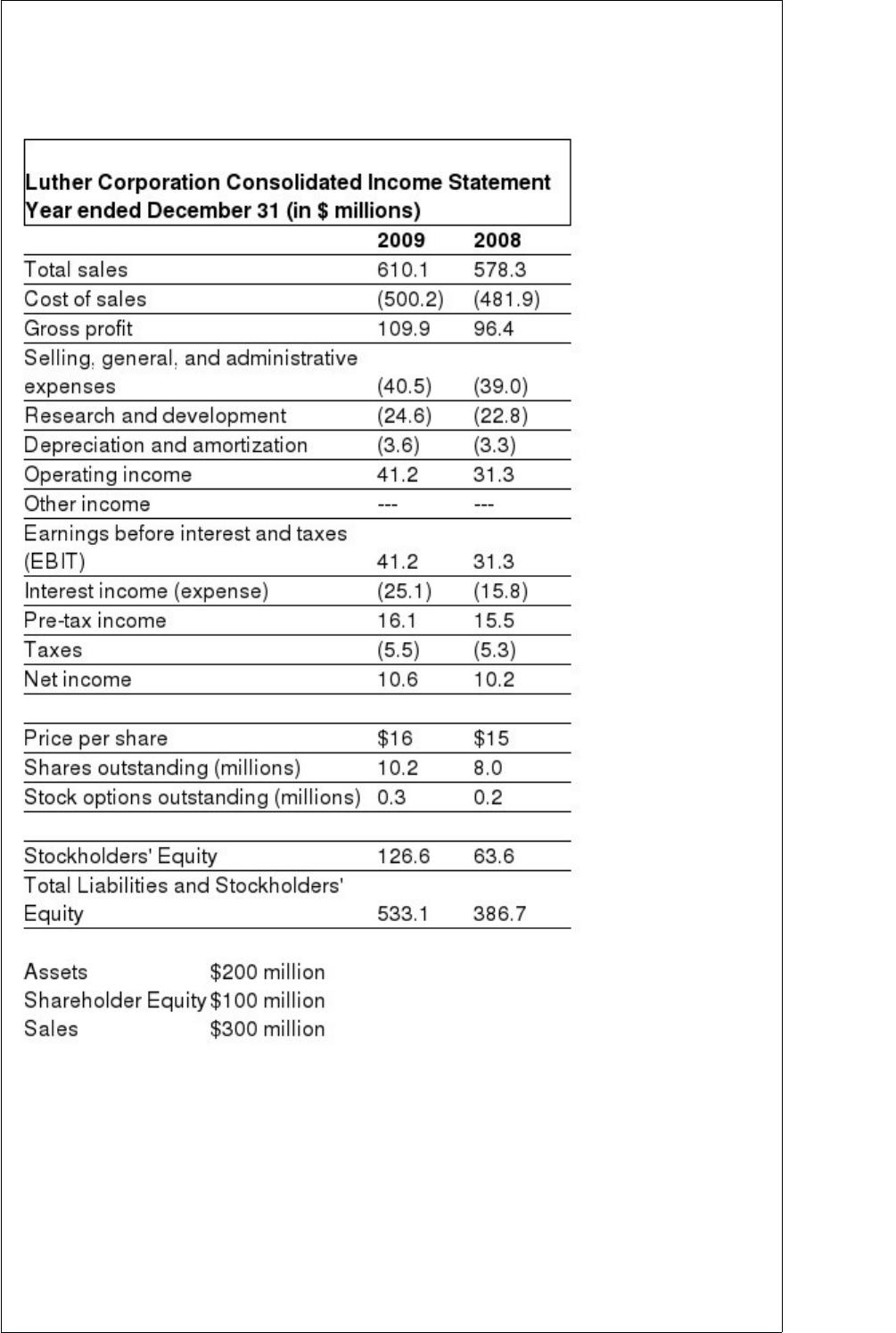
Consider the following income statement and other information:
If ECE’s return on assets (ROA) is 12% , then ECE’s net income is:
A) $6 million
B) $12 million
C) $24 million
D) $36 million

Answer:
Which of the following formulas is incorrect?
A) PV of a growing annuity = C x
B) PV of an annuity = C x
C) PV of a growing perpetuity =
D) PV of a perpetuity =
Answer:
Which of the following statements is false?
A) Real estate firms are likely to have low costs of financial distress, as much of their

value derives from assets that can be sold relatively easily.
B) For low levels of debt, the risk of default remains low and the main effect of an
increase in leverage is an increase in the interest tax shield, which has present value
τ*D, where τ* is the effective tax advantage of debt.
C) Firms whose value and cash flows are very volatile (for example, semiconductor
firms) must have much higher levels of debt to avoid a significant risk of default.
D) The probability of financial distress depends on the likelihood that a firm will be
unable to meet its debt commitments and therefore default.
Answer:
Which of the following statements is false?
A) For capital budgeting purposes, the project’s financing is the incrementalfinancing
that results if the firm takes on the project.
B) Projects with safer cash flows can support more debt before they increase the risk of
financial distress for the firm.
C) If the positive free cash flow from a project will increase the firm’s cash holdings,
then this growth in cash is equivalent to a reduction in the firm’s leverage.
D) The incremental financing of a project corresponds directly to the financing that is
directly tied to the project.
Answer:
Which of the following statements is false?

A) Interest rate swaps are an alternative means of modifying the firm’s interest rate risk
exposure without buying or selling assets.
B) A portfolio with a negative duration is called a duration-neutral portfolio or an
immunized portfolio, which means that for small interest rate fluctuations, the value of
equity should remain unchanged.
C) Maintaining a duration-neutral portfolio will require constant adjustment as interest
rates change.
D) A duration-neutral portfolio is only protected against interest rate changes that affect
all yields identically.
Answer:
Taggart Transcontinental needs a $100,000 loan for the next 30 days. Taggart has three
alternatives available:
Alternative #1: Forgo the discount on its trade credit agreement that offers terms of 2/5
net 35.
Alternative #2: Borrow the money from Bank A, which has offered to lead the firm
$100,000 for one month at
an APR of 9%. The bank will require a (no-interest) compensating balance of 10% of
the face-value of the loan and will charge a $200 loan origination fee, which means that
Taggart must morrow even more than the $100,000 they need.
Alternative #3: Borrow the money from Bank B, which has offered to lend the firm
$100,000 for one month at an APR of 12%. The loan has a 1% origination fee.
The effective annual rate for Taggart if they choose alternative #3 is closest to:
A) 13.9%

B) 18.8%
C) 27.0%
D) 27.9%
Answer:
Use the information for the question(s) below.
Omicron Technologies has $50 million in excess cash and no debt. The firm expects to
generate additional free cash flows of $40 million per year in subsequent years and will
pay out these future free cash flows as regular dividends. Omicrons unlevered cost of
capital is 10% and there are 10 million shares outstanding. Omicron’s board is meeting
to decide whether to pay out its $50 million in excess cash as a special dividend or to
use it to repurchase shares of the firm’s stock.
Assume that Omicron uses the entire $50 million in excess cash to pay a special
dividend. The amount of the special dividend is closest to:
A) $5.00

B) $9.00
C) $4.00
D) $4.50
Answer:
Use the information for the question(s) below.
Rockwood Industries has 100 million shares outstanding, a current share price of $25,
and no debt. Rockwood’s management believes that the shares are under-priced, and
that the true value is $30 per share. Rockwood plans to pay $250 million in cash to its
shareholders by repurchasing shares. Management expects that very soon new
information will come out that will cause investors to revise their opinion of the firm
and agree with Rockwood’s assessment of the firm’s true value.
If Rockwood is able to repurchase shares prior to the market becoming aware of the
new information regarding Rockwood’s true value, then the number of shares
outstanding following the repurchase is closest to:
A) 92 million
B) 10 million
C) 75 million
D) 90 million
Answer:

Which of the following statements is false?
A) A board is said to be classified when its monitoring duties have been compromised
by connections or perceived loyalties to management.
B) Even the most active independent directors spend only one or two days per month on
firm business, and many independent directors sit on multiple boards, further dividing
their attention.
C) On a board composed of insider, gray, and independent directors, the role of the
independent director is really that of a watchdog.
D) Because independent directors’ personal wealth is likely to be less sensitive to
performance than that of insider and gray directors, they have less incentive to closely
monitor the firm.
Answer:
Which of the following statements is false?
A) The lower the discount percentage offered, the greater the cost of forgoing the
discount and using trade credit.

B) A firm should choose to borrow using accounts payable only if trade credit is the
cheapest source of funding.
C) A firm should always pay on the latest day allowed.
D) A firm should strive to keep its money working for it as long as possible without
developing a bad relationship with its suppliers or engaging in unethical practices.
Answer:
If the current inflation rate is 5%, then the nominal rate necessary for you to earn an 8%
real interest rate on your investment is closest to:
A) 13.0%
B) 13.4%
C) 4.9%
D) 3.0%
Answer:

Use the information for the question(s) below.
The Sisyphean Company has a bond outstanding with a face value of $1000 that
reaches maturity in 15 years. The bond certificate indicates that the stated coupon rate
for this bond is 8% and that the coupon payments are to be made semiannually.
Assuming that this bond trades for $1,112, then the YTM for this bond is closest to:
A) 8.0%
B) 3.4%
C) 6.8%
D) 9.2%
Answer:
Which of the following statements is false?
A) The simplest method used to calculate depreciation is the straight-line method.
B) A sunk cost is any unrecoverable cost for which the firm is already liable.
C) Unlevered Net Income = EBIT x τc.
D) The decision to continue or abandon should be based only on the incremental costs
and benefits of the project going forward.

Answer:
Consider the following equation:
S x =
The term F in this equation is
A) the future spot exchange rate.
B) the current spot exchange rate.
C) the amount of foreign currency.
D) the forward exchange rate.
Answer:
Which of the following statements regarding efficiency gains is false?
A) Takeovers relying on the improvement of target management are difficult to
complete, and post-takeover resistance to change can be great. Thus not all inefficiently
run organizations are necessarily more efficient following a takeover.
B) Although identifying poorly performing corporations is relatively easy, fixing them
is another matter entirely.
C) A justification that acquirers cite for paying a premium for a target is efficiency
gains, which are often achieved through an elimination of duplication.
D) A chief executive of an inefficiently run corporation can be ousted by current
shareholders voting to replace the board of directors, and in fact a large number of
ineffective managers are replaced in this way.

Answer:
Which of the following statements is false?
A) For a call written on a stock with positive beta, the beta of the call always exceeds
the beta of the stock.
B) The beta of a put option written on a negative beta stock is always negative.
C) As the stock price changes, the beta of an option will change, with its magnitude
falling as the option goes in-the-money.
D) A put option is a hedge, so its price goes up when the stock price goes down.
Answer:
Use the information for the question(s) below.
Omicron Technologies has $50 million in excess cash and no debt. The firm expects to
generate additional free cash flows of $40 million per year in subsequent years and will
pay out these future free cash flows as regular dividends. Omicrons unlevered cost of

capital is 10% and there are 10 million shares outstanding. Omicron’s board is meeting
to decide whether to pay out its $50 million in excess cash as a special dividend or to
use it to repurchase shares of the firm’s stock.
Assume that Omicron uses the entire $50 million to repurchase shares. The number of
shares that Omicron will have outstanding following the repurchase is closest to:
A) 8.8 million
B) 1.2 million
C) 9.0 million
D) 8.9 million
Answer:
Which of the following statements is false?
A) If we can identify a comparison firm whose assets have the same risk as the project
being evaluated, and if the comparison firm is levered, then we can use its equity cost
of capital as the cost of capital for the project.

B) We can calculate the cost of capital of the firm’s assets by computing the weighted
average of the firm’s equity and debt cost of capital, which we refer to as the firm’s
weighted average cost of capital (WACC).
C) The portfolio of a firm’s equity and debt replicates the returns we would earn if the
firm were unlevered.
D) When evaluating any potential investment project, we must use a discount rate that
is appropriate given the risk of the project’s free cash flow.
Answer:
Use the following information to answer the question(s) below.
Assume that the economy has three types of people. 20% are fad followers, 75% are
passive investors, and 5% are informed traders. The portfolio consisting of all informed
traders has a beta of 1.4 and an expected return of 16%. The market has an expected
return of 10% and the risk-free rate is 4%.
The alpha for the informed investors is closest to:
A) -2.4%
B) -0.9%
C) 0.0%
D) 3.6%
Answer:

Which of the following statements is false?
A) Zero-coupon bonds are also called pure discount bonds.
B) The IRR of an investment opportunity is the discount rate at which the NPV of the
investment opportunity is equal to zero.
C) The yield to maturity for a zero-coupon bond is the return you will earn as an
investor from holding the bond to maturity and receiving the promised face value
payment.
D) When prices are quoted in the bond market, they are conventionally quoted in
increments of $1000.
Answer:
Which of the following statements regarding arbitrage is the most correct?
A) Any situation in which it is possible to make a profit without taking any risk is
known as an arbitrage opportunity.
B) Any situation in which it is possible to make a profit without making any investment
is known as an arbitrage opportunity.
C) We call a competitive market in which there are no arbitrage opportunities an
arbitrage market.
D) The practice of buying and selling equivalent goods in different markets to take
advantage of a price difference is known as arbitrage.

Answer:
Which of the following statements is false?
A) The holder of a callable bond faces reinvestment risk precisely when it hurts: when
market rates are lower than the coupon rate she is currently receiving.
B) When yields have risen, the issuer will not choose to exercise the call on the callable
bond.
C) The issuer will exercise the call option only when the prevailing market rate exceeds
the coupon rate of the bond.
D) A callable bond is relatively less attractive to the bondholder than the identical
non-callable bond.
Answer: