
One year ago, Alpha Supply issued 15-year bonds at par. The bonds have a coupon rate
of 6.5 percent, paid semiannually, and a face value of $1,000. Today, the market yield
on these bonds is 7.2 percent. What is the percentage change in the bond price over the
past year?
A. 5.94 percent
B. 5.38 percent
C. -6.11 percent
D. -5.87 percent
E. The bond price did not change.
Which answer creates a false sentence? Percentage returns:
A. relay information about a security more easily than dollar returns do.
B. are not affected by the amount of the investment.
C. can be easily separated into dividend yields and capital gain yields.
D. are easy to understand.
E. are difficult to compute.
Shelf registration:
A. only applies to initial public offerings.
B. only applies to debt securities.
C. only applies to securities issued through crowdfunding.
D. permits firms to sell the registered securities, if they so choose, over a two-year
period.
E. requires that all registered securities be sold over a two-year period.
Bressler’s would like to sell 600shares of stock using the Dutch auction method. The
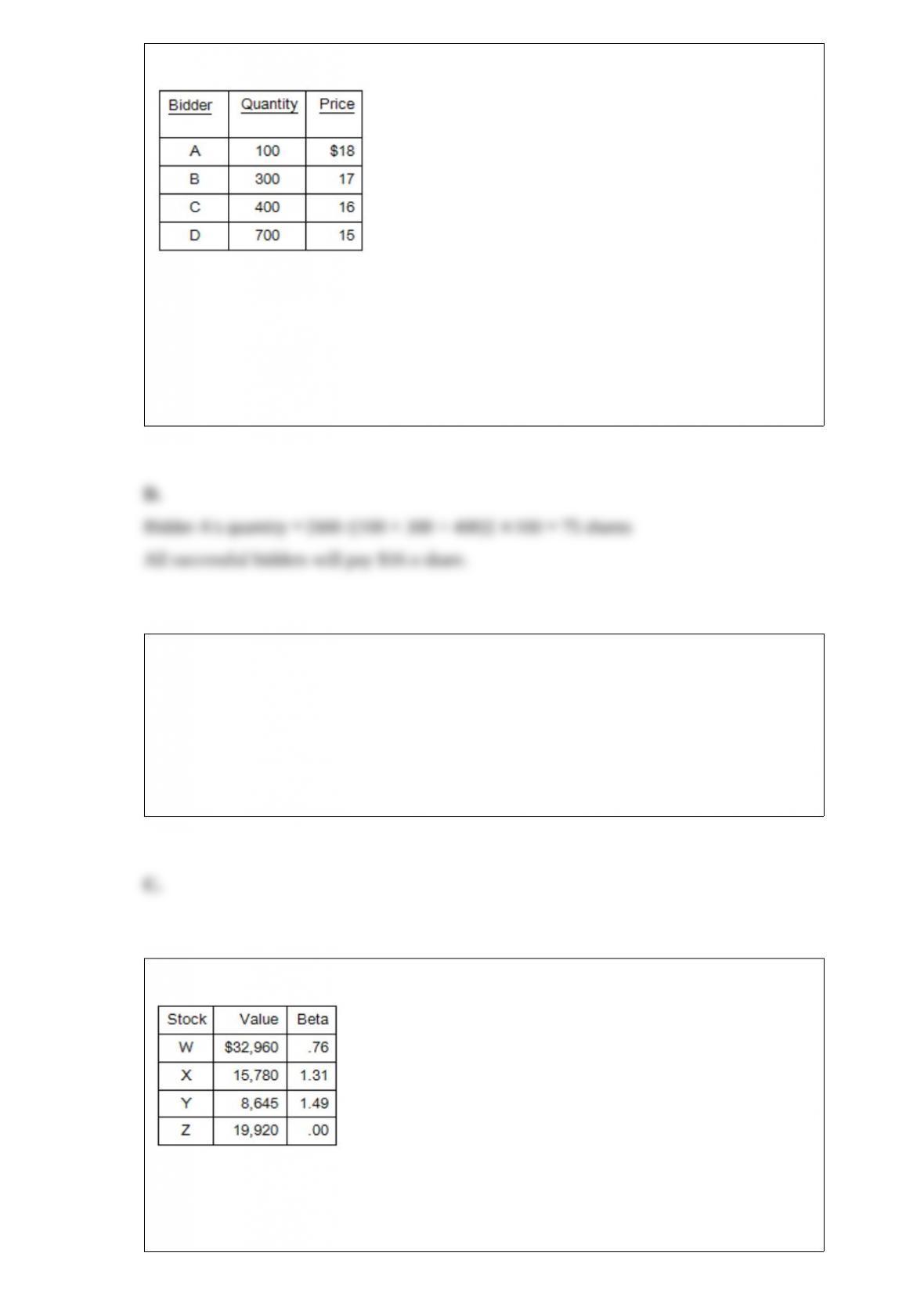
bids received are as follows:
Bidder A will receive _____ shares and pay a price per share of ____. Bidder C will
receive no allocation.
A. 0; $0
B. 75; $17
C. 100; $17
D. 75; $16
E. 100; $18
Which one of the following types of bonds permits its issuer to forego paying interest
payments if certain natural events cause significant losses?
A. PETS
B. PUT
C. CAT
D. PINES
E. LIBOR
What is the beta of the following portfolio?
A. .98
B. .76
C. 1.18
D. 1.21

E. 1.13
Which one of the following will reduce the disbursement float of a firm?
A. Mailing a check from a very remote location
B. Mailing an unsigned check so that it must be returned for a signature
C. Paying a loan payment at the bank rather than mailing a check to the bank
D. Requiring that all checks be held one day before mailing so they can be reviewed by
a manager
E. Writing checks on a zero-balance account rather than on the master account
The Corner Market has annual sales of $761,000 and cost of goods sold of $568,000.
The profit margin is 4.2 percent and the accounts payable period is 37 days. What is the
average accounts payable balance?
A. $77,142
B. $65,488
C. $57,578
D. $73,211
E. $59,449
Compass Bank is offering an APR of.8 percent, compounded daily, on its savings
accounts. If you deposit $2,500 today, how much will you have in the account in 15
years?
A. $2,567.15
B. $2,675.10
C. $2,761.32
D. $2,818.74
E. $2,890.62

The average risk premium on long-term government bonds for the period 1926-2014
was equal to:
A. zero.
B. 1 percent.
C. the rate of return on the bonds plus the corporate bond rate.
D. the rate of return on the bonds minus the T-bill rate.
E. the rate of return on the bonds minus the inflation rate.
Outdoor Sports is considering adding a miniature golf course to its facility. The course
would cost $138,000, would be depreciated on a straight-line basis over its five-year
life, and would have a zero salvage value. The estimated income from the golfing fees
would be $72,000 a year with $24,000 of that amount being variable cost. The fixed
cost would be $11,600. In addition, the firm anticipates an additional $14,000 in
revenue from its existing facilities if the golf course is added. The project will require
$3,000 of net working capital, which is recoverable at the end of the project. What is
the net present value of this project at a discount rate of 12 percent and a tax rate of 34
percent?
A. $11,309.11
B. $11,628.04
C. $12,737.26
D. $14,438.78
E. $14,900.41
The Chip Dip Co. has 685,500 shares of stock outstanding, grants one vote per share,
and uses straight voting. How many shares must you control to guarantee that you will
be elected to the firm’s board of directors if there are five open seats?
A. 335,167 shares
B. 345,134 shares
C. 345,876 shares
D. 342,751 shares
E. 337,134 shares
Farm Equipment announced this morning that its next annual dividend will be
decreased to $1.67 a share and that all future dividends will be decreased by an
additional 1.3 percent annually. What is the current value per share if the required return
is 15.7 percent?
A. $8.46
B. $9.82
C. $10.02
D. $9.54
E. $10.16
ALC needs to raise $12 million to finance its expansion into new markets and has
decided to sell new shares of equity via a general cash offering. The offer price will be
$28 per share, the accounting and legal fees are expected to be $645,000, and the
company’s underwriters will charge a spread of 8.2 percent. How many shares need to
be sold?
A. 489,889 shares
B. 521,208 shares
C. 523,467 shares
D. 491,947 shares
E. 515,323 shares
Smiley Industrial Goods has $1,000 face value bonds on the market with semiannual
interest payments, 13.5 years to maturity, and a market price of $1,023. At this price,
the bonds yield 6.4 percent. What must be the coupon rate on these bonds?
A. 3.33 percent
B. 3.75 percent
C. 7.33 percent
D. 6.66 percent
E. 7.50 percent
LOG, Inc. currently has 329,000 shares of stock outstanding that sell for $62 per share.
Assuming no market imperfections or tax effects exist, what will be the share price after
LOG implements a 7-for-3 stock split?
A. $26.57
B. $25.60
C. $28.84
D. $19.18
E. $21.67
Security dealers:
A. match buyers with sellers.
B. buy and sell from their own inventory.
C. operate on a physical trading floor.
D. operate exclusively in auction markets.
E. are limited to trading non-listed stocks.
The 7.5 percent preferred stock of Rock Bottom Floors is selling for $84 a share. What
is the firm’s cost of preferred stock if the tax rate is 35 percent and the par value per

share is $100?
A. 7.50 percent
B. 8.13 percent
C. 8.93 percent
D. 10.79 percent
E. 9.14 percent
An investment has an initial cost of $2.7 million and net income of $189,400, $178,600,
and $172,500 for Years 1 to 3. This investment will be depreciated by $900,000 a year
over the three-year life of the project. Should this project be accepted based on the
average accounting rate of return if the required rate is 12.5 percent? Why or why not?
A. Yes, because the AAR is 12.5 percent
B. Yes, because the AAR is less than 12.5 percent
C. Yes, because the AAR is greater than 12.5 percent
D. No, because the AAR is greater than 12.5 percent
E. No, because the AAR is less than 12.5 percent
Kelly’s uses the firm’s WACC as the required return for some of its projects. For other
projects, the firms uses a rate equal to WACC plus one percent, while another set of
projects is assigned rates equal to WACC minus some amount. Which one of the
following factors should be the key factor the firm uses to determine the amount of the
adjustment it will make when assigning a discount rate to a specific project?
A. The current market rate of interest
B. Actual source of funds used to finance the project
C. The perceived risk level of project
D. The division within the firm that will be assigned to manage the project
E. The firm’s current debt-equity ratio
Consider the following financial statement information:
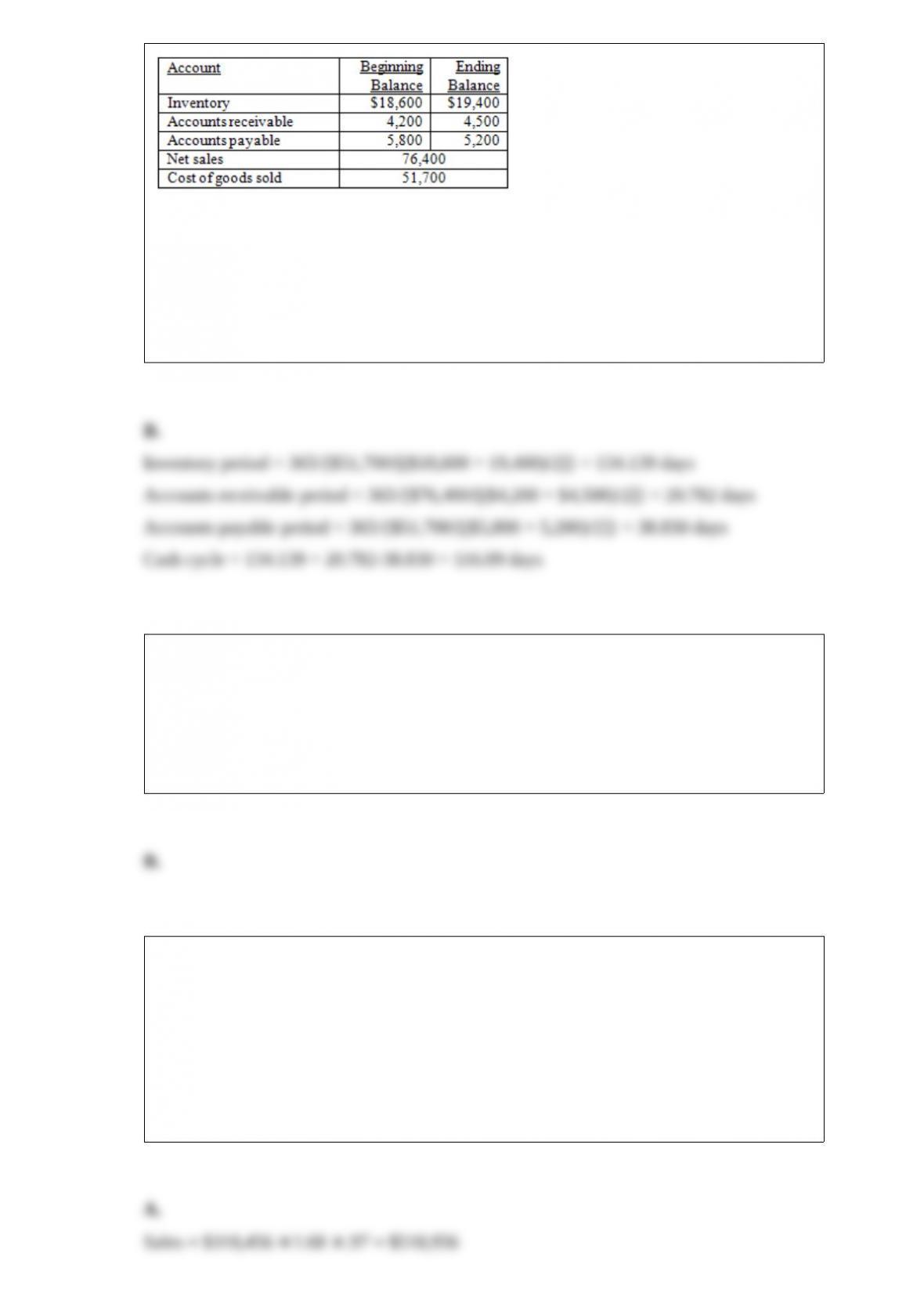
Assume all sales and purchases are on credit. How long is the cash cycle? (Use average
balance sheet account balances.)
A. 80.21 days
B. 116.09 days
C. 101.03 days
D. 113.58 days
E. 73.57 days
If the financial markets are semistrong form efficient, then:
A. only the most talented analysts can determine the true value of a security.
B. only individuals with private information have a marketplace advantage.
C. technical analysis provides the best tool to use to gain a marketplace advantage.
D. no one individual has an advantage in the marketplace.
E. every security offers the same rate of return.
Western Hardwoods has total equity of $318,456, a profit margin of 3.79 percent, an
equity multiplier of 1.68, and a total asset turnover of .97. What is the amount of the
firm’s sales?
A. $518,956
B. $473,550
C. $195,420
D. $190,839
E. $639,440
A firm has net working capital of $6,800 and current assets of $21,800. What is the
current ratio?
A. .69
B. .60
C. 1.45
D. 1.67
E. .92
Allison’s Trees has total assets of $846,200 and total debt of $367,500. What is the
equity multiplier?
A. .46
B. .57
C. 2.17
D. 1.85
E. 1.77
Hometown Builders is borrowing $195,000 today for four years. The loan is an
interest-only loan with an APR of 7.65 percent. Payments are to be made annually.
What is the amount of the first annual payment?
A. $14,917.50
B. $20,610.90
C. $18,029.18
D. $58,416.55
E. $63,667.50
Able Co. has $267,000 in taxable income and Bravo Co. has $1,600,000 in taxable
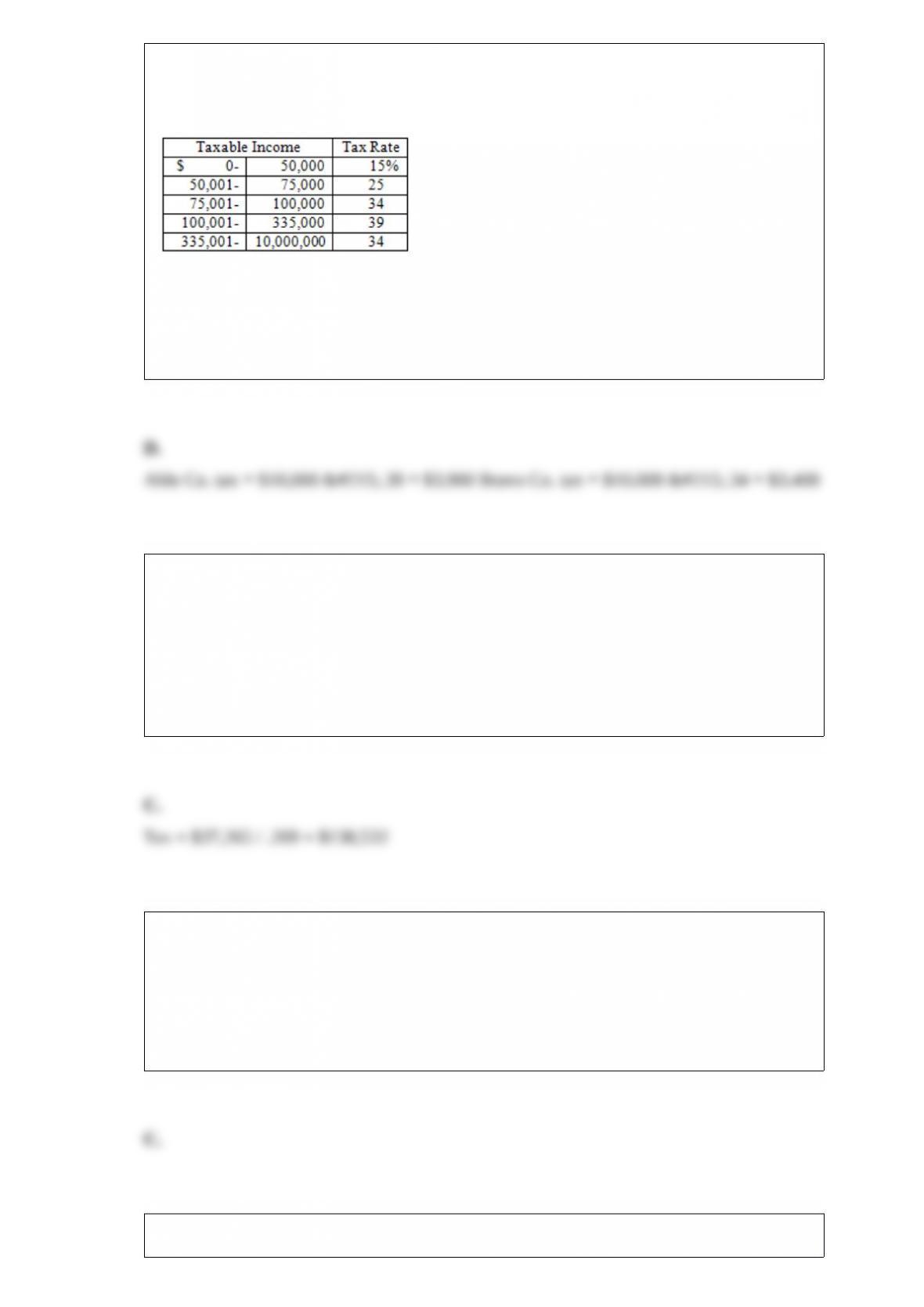
income. Suppose both firms have identified a new project that will increase taxable
income by $10,000. The additional project will increase Able Co.’s taxes by _____ and
Bravo Co.’s taxes by ____.
A. $1,500; $1,500
B. $1,500; $3,400
C. $3,400; $3,900
D. $3,900; $3,400
E. $3,400; $3,400
Rusty Antiques has a marginal tax rate of 39percent and an average tax rate of 26.9
percent. If the firm owes $37,265 in taxes, how much taxable income did it earn?
A. $137,098
B. $136,800
C. $138,532
D. $139,957
E. $137,750
Which one of the following is a unique characteristic of an income bond?
A. Interest income is tax-free.
B. Interest income is paid at the time of issuance.
C. Coupon payments are dependent on the issuer’s income.
D. Coupon payments are paid on a regular monthly basis.
E. Coupon payments can be converted into equity shares.
Home Supply, Inc. has compiled the following information:
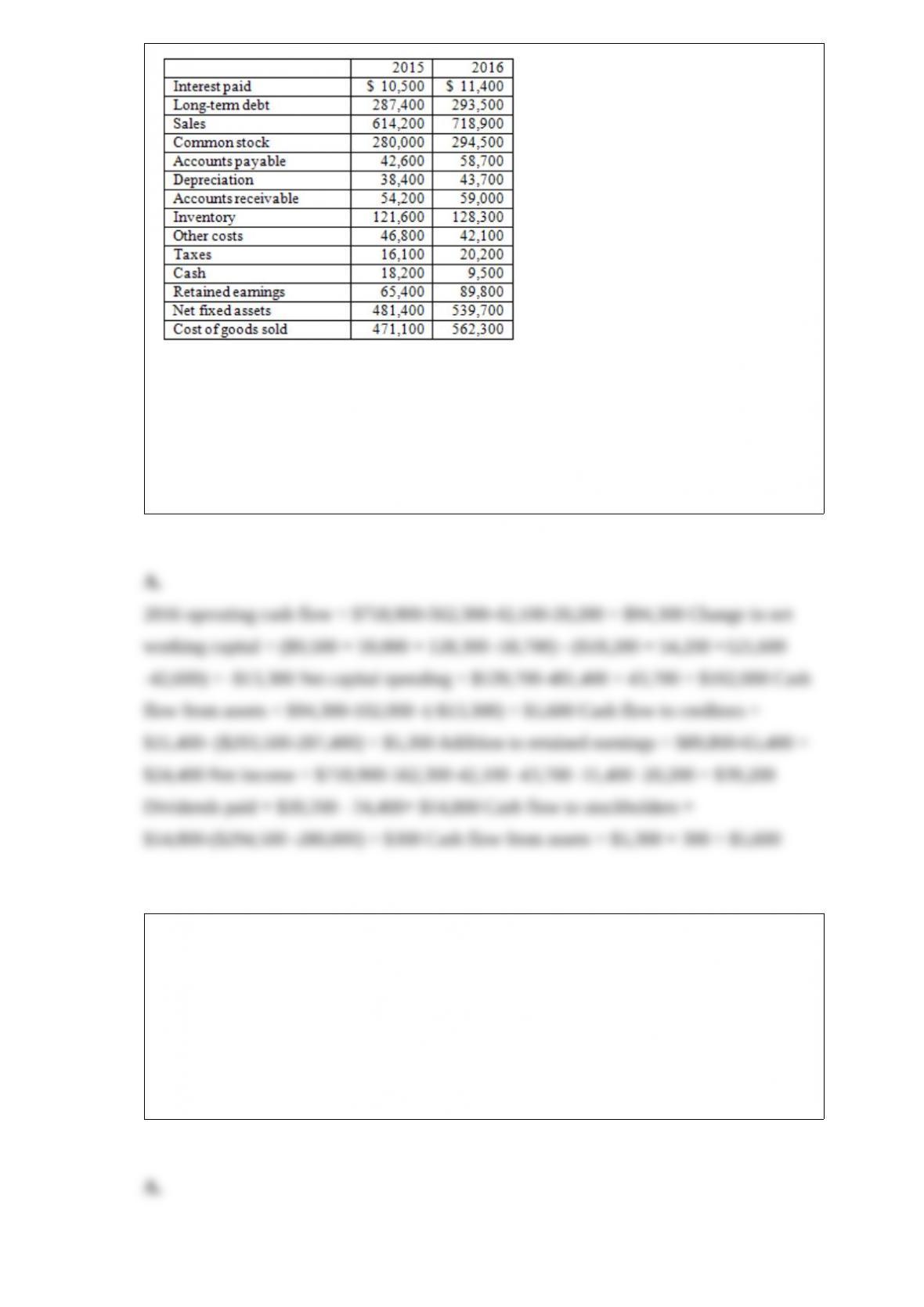
For 2016, the cash flow from assets is _____ and the cash flow to stockholders is
______.
A. $5,600; $300
B. $5,600; $15,100
C. $5,600; $14,500
D. $6,300; $300
E. $6,300; $14,500
Kate’s Korner Market monitors 3 percent of its inventory on a daily basis, another 20
percent on a weekly basis, and the remaining inventory on a quarterly basis. What
inventory management approach is being used?
A. ABC
B. EOQ
C. MRP
D. Q*
E. JIT

Rockingham Motors issued a 30-year, 8 percent semiannual bond 3 years ago. The bond
currently sells for 103.1 percent of its face value. The company’s tax rate is 34 percent.
What is the aftertax cost of debt?
A. 2.72 percent
B. 5.10 percent
C. 5.69 percent
D. 5.72 percent
E. 5.99 percent
Which one of the following is the agreed-upon exchange rate that is to be used when
currencies are exchanged at some point in the future based on an agreement made
today?
A. Spot rate
B. ADR rate
C. London Interbank Offer Rate
D. Forward exchange rate
E. Cross-rate