
If the Fed wants to reduce the value of the dollar it will
(a) sell foreign assets and buy dollars.
(b) sell dollars and buy foreign assets.
(c) buy foreign assets and also buy dollars.
(d) sell foreign assets and also sell dollars.
Answer:
Which of the following statements is correct?
(a) The bank lending channel does not reject the idea that monetary policy can affect
output by changing interest rates.
(b) The bank lending channel argues that monetary policy affects output only through
its effect on banks’ portfolio decisions regarding loans and securities.
(c) The bank lending channel argues that monetary policy affects output only through
its effect on the public’s portfolio decisions regarding money and nonmoney assets.
(d) The bank lending channel has been unable to explain the movements in bank
lending observed in the 1980s and 1990s.
Answer:

A supply shock that is not responded to with an expansionary policy will result in
(a) a one-time increase in the price level, but not inflation.
(b) neither a one-time increase in the price level nor inflation.
(c) both a one-time increase in the price level and inflation.
(d) inflation, but not a one-time increase in the price level.
Answer:
An increase in the money supply can reduce the probability of financial distress by
(a) directly increasing the funds available to households and businesses.
(b) lowering the prices of U.S. Treasury securities.
(c) allowing the federal government to reduce its budget deficit.
(d) raising stock prices and the value of liquid financial assets.
Answer:
Suppose that Microsoft announces that its profits for the third quarter of 2001 were
$400 million.
As result of the this announcement the price of Microsoft’s stock declines. The best

explanation of this is
(a) market participants were expecting Microsoft’s profits to be greater than $400
million for the third quarter.
(b) market participants were expected Microsoft’s profits to be less than $400 million
for the third quarter.
(c) the stock market is not an efficient market.
(d) market participants have adaptive expectations.
Answer:
At a point below the IS curve,
(a) there is an excess supply of goods.
(b) the real interest rate is below its equilibrium value.
(c) saving exceeds investment.
(d) there is a federal budget surplus.
Answer:
If the current price of a bond is equal to its face value,
(a) there is no capital gain or loss from holding the bond until maturity.
(b) the yield to maturity must be greater than the current yield.
(c) the current yield must be greater than the coupon rate.
(d) the coupon rate must be greater than the yield to maturity.
Answer:
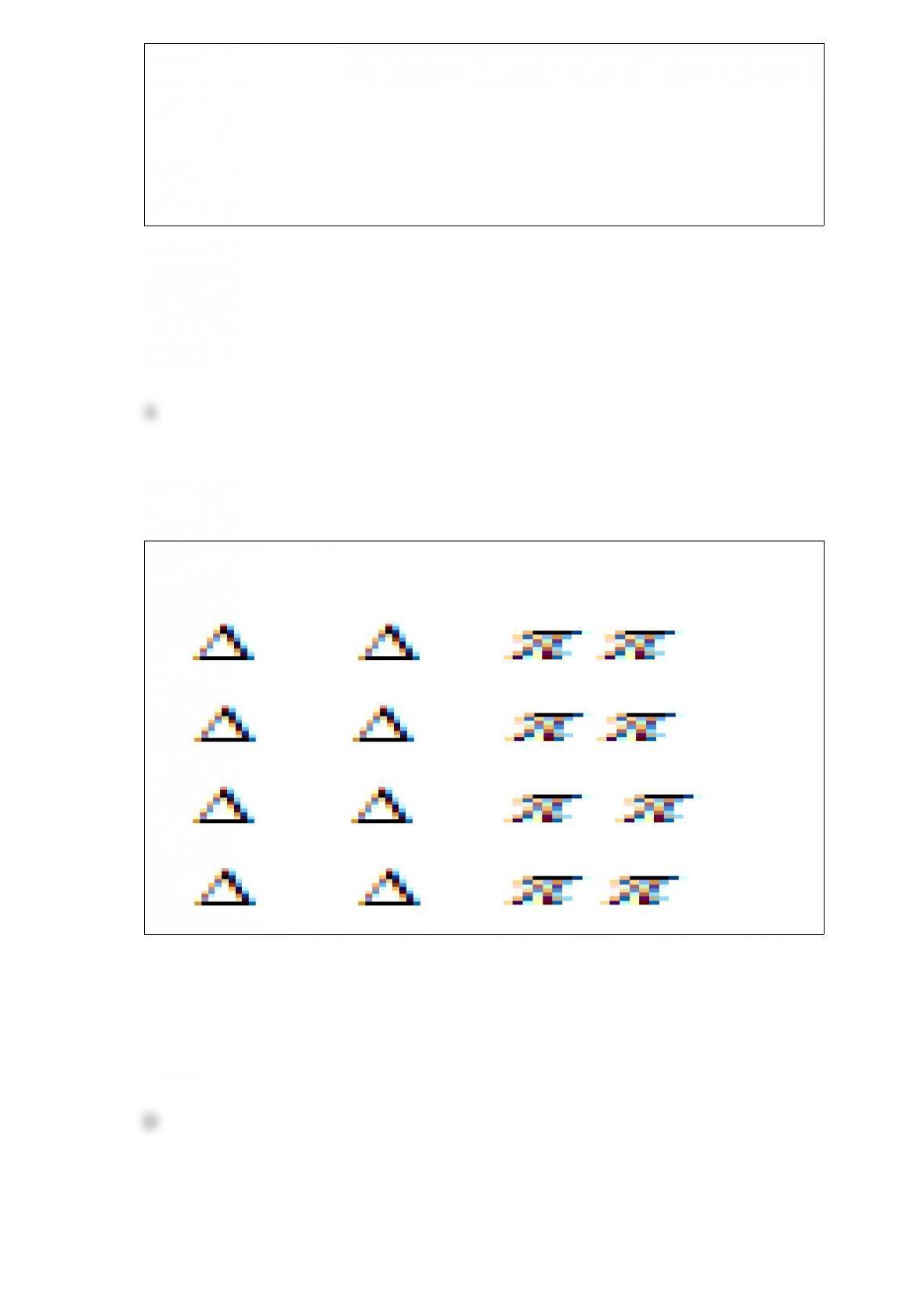
The relation between changes in the nominal and real exchange rates is given by which
of the following equations?
(a) EXr/EXr= EX/EX + f.
(b) EX/EX = EXr/EXr+ f.
(c) EX/EX = EXr/EXr+ f + .
(d) EXr/EXr =EX/EX + f .
Answer:

The seller of a futures contract
(a) assumes the short position.
(b) has the obligation to deliver the underlying financial instrument at the specified
date.
(c) has the obligation to receive the underlying financial instrument at the specified
future date.
(d) may, at his or her option, deliver or receive the underlying financial instrument at
the specified date.
Answer:
The greatest problem with bank capital requirements as they currently exist is that they
(a) do nothing to reduce the moral hazard problem of deposit insurance.
(b) do nothing to lessen the willingness of bank managers to take risks.
(c) are based on historical cost rather than market value.
(d) are too low.
Answer:
According to the preferred habitat theory

(a) investors prefer longer to shorter maturities.
(b) investors prefer shorter to longer maturities.
(c) investors are indifferent between short and long maturities.
(d) investors are more interested in the tax treatment of bonds than they are in the
liquidity of bonds.
Answer:
If during a particular year, the money supply grows 6%, output grows 4%, and velocity
grows 2%, the inflation rate will be
(a) 0%.
(b) 4%.
(c) 8%.
(d) 12%.
Answer:
A one-year discount bond with a face value of $10,000 has an interest rate of 10%.
What is its price?

(a) $9000
(b) $9090.91
(c) $9100
(d) $9150.25
Answer:
Economic analysis is useful in
(a) explaining current developments.
(b) predicting future developments.
(c) both explaining current developments and predicting future developments.
(d) explaining current developments but not in predicting future developments.
Answer:
The largest firms in securities markets
(a) act as both brokers and dealers.
(b) act as brokers, but not as dealers.

(c) act as dealers, but not as brokers.
(d) act as neither brokers nor dealers.
Answer:
Disinflation is
(a) a decline in the price level.
(b) an inflation rate lower than the natural rate of inflation.
(c) a decline in the long-run rate of inflation.
(d) an inflation rate higher than the natural rate of inflation.
Answer:
If General Auto and Crystal Auto have returns that are perfectly positively correlated,
then adding Crystal Auto to a portfolio that already contains General Auto will
(a) reduce the risk in the portfolio.
(b) increase the risk in the portfolio.
(c) neither increase nor decrease the risk in the portfolio.
(d) reduce the risk in the portfolio only for risk-averse savers.

Answer:
When economists refer to default risk on a debt instrument, they are referring to
(a) the interest rate on the instrument minus the tax liability on that interest.
(b) the risk that borrowers will not repay all or part of their obligations.
(c) the risk that lenders will insist that borrowers repay the obligation before the
maturity date.
(d) the risk that lenders will insist that borrowers pay more than the agreed upon interest
rate.
Answer:
Electronic communications networks (ECNs) are
(a) stock-trading systems that rely on computer software to match buy and sell orders.
(b) systems for communicating financial information to private investors over the
Internet.
(c) systems for private investors to communicate buy and sell orders to their brokers.
(d) systems by which the government is able to monitor securities trades for possibly
fraudulent activities.

Answer:
The liquidity preference theory was developed by
(a) James Tobin.
(b) Milton Friedman.
(c) John Maynard Keynes.
(d) William Baumol.
Answer:
Which of the following is most likely to have an impact on the growth of productivity?
(a) A decrease in the price level
(b) An increase in government regulation of workplace safety
(c) An increase in the labor supply
(d) A decrease in real money balances
Answer:

The main way in which the Fed’s policy tools affect the monetary base is through
(a) changes in the demand for or supply of reserves.
(b) changes in interest rates.
(c) the announcement effect.
(d) their impact on the portfolio decisions of the nonbank public.
Answer:
The current yield is equal to
(a) the coupon divided by the market price of the bond.
(b) the yield to maturity, if the bond is a coupon bond.
(c) the coupon divided by the par value of the bond.
(d) the market price of the bond divided by its par value.
Answer:

Milton Friedman’s approach to money demand focuses on
(a) currency.
(b) checkable deposits.
(c) M1.
(d) M2.
Answer:
A simple loan involves
(a) interest payments from the borrower to the lender periodically during the life of the
loan.
(b) no payment of interest by the borrower to the lender.
(c) payment of interest by the borrower to the lender only at the time the loan matures.
(d) no repayment of principal by the borrower to the lender.
Answer:
Which criterion for suitability as a medium of exchange do Federal Reserve Notes
meet?

(a) They are of standardized quality.
(b) They are durable.
(c) They are acceptable to most traders.
(d) Federal Reserve Notes meet all of the criteria for suitability as a medium of
exchange.
Answer:
SEC Rule 415
(a) decreased competition among security underwriters.
(b) requires firms to sell an issue within two months of registering it with the SEC.
(c) requires firms to choose an underwriter before registering a security.
(d) led to underwriters taking positions in bonds on their own account.
Answer:
Which president failed to renew the charter of the Second Bank of the United States?
(a) George Washington
(b) Andrew Jackson
(c) Franklin Roosevelt
(d) Lyndon Johnson
Answer:
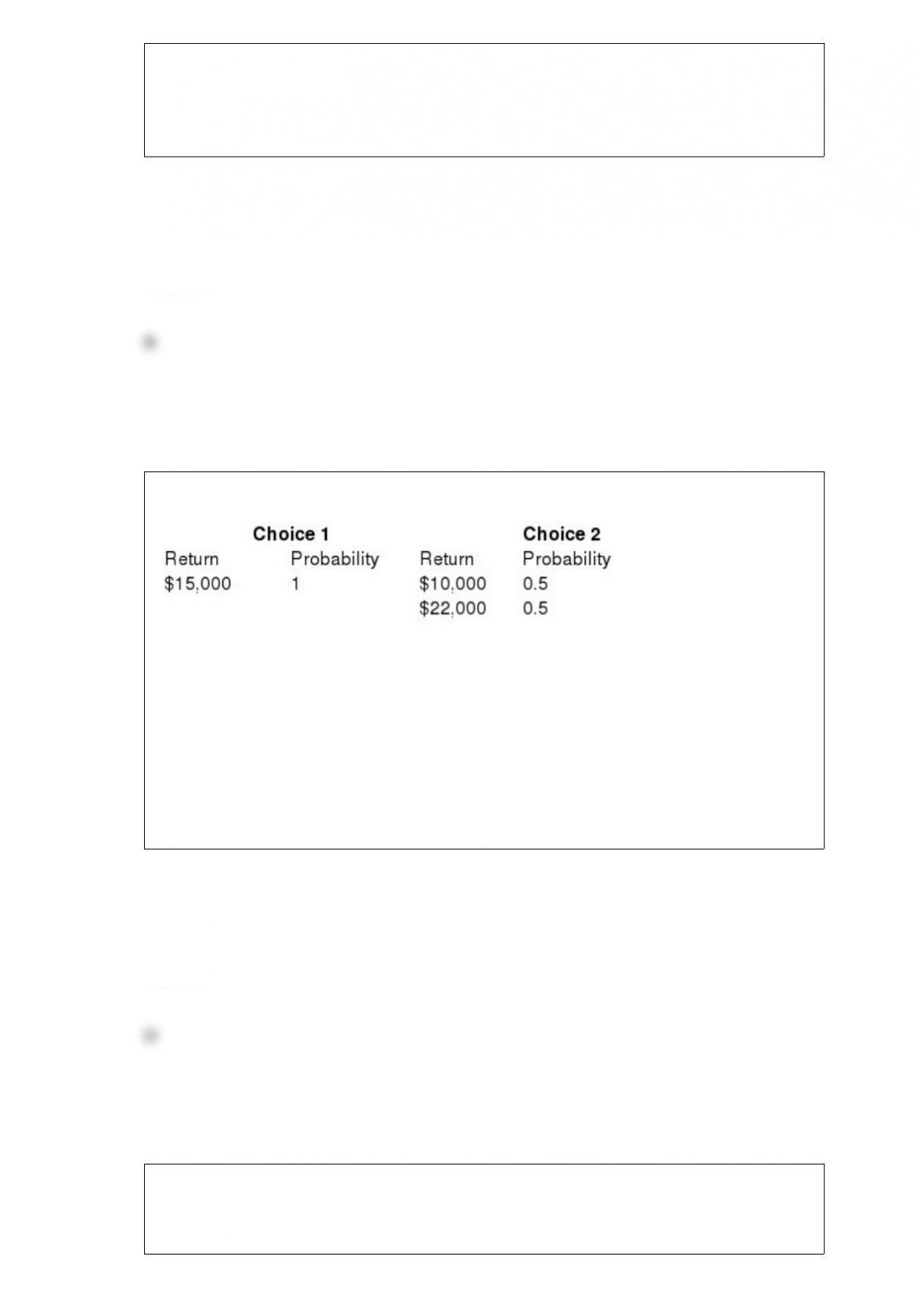
A risk-averse saver will
(a) prefer Choice 1 to Choice 2.
(b) prefer Choice 2 to Choice 1.
(c) be indifferent between Choice 1 and Choice 2.
(d) Not enough information has been provided to be certain of the saver’s decision.
Answer:
In earlier times how was the problem of ascertaining the weight and purity of metals
used as money solved?

(a) By not allowing metals other than gold, which is of a constant purity, to be used as
money.
(b) By having respected merchants assay metals and stamp them with a mark certifying
weight and purity.
(c) By replacing the metals with paper currency.
(d) By using metals only for small transactions where the exact value of the money
involved was relatively unimportant.
Answer: