
The concentration of U.S. bank deposits in the hands of the largest banks has
_________ recently.
A. declined
B. increased
C. remained essentially unchanged
D. exhibited large fluctuations in both directions
E. None of the options are correct
Answer:
Which of the following is true regarding regulatory rules for standby credit letters
issued by banks?
A. They must list the standby credit letter as a liability on their balance sheet
B. They must count standby credit letters as loans when assessing how risk-exposed
the institution is to a single customer
C. They do not have to apply the same credit standards for approving standby credit
letters as direct loans
D. They can apply lower capital standards to standbys than loans
E. They must provide capital reserve against issued standby letters of credit
Answer:

The Jung Company and the Nguyen Company have combined to build a new container
ship docking facility in Charleston Harbor. The facility is expected to take two years to
complete and cost $3 billion to construct. These companies want to borrow money in
order to build this facility. What type of loan is this most likely to be?
A. Term business loan
B. Revolving credit financing
C. Long-term project loan
D. Leveraged buyout
E. Syndicated loan
Answer:
The Jones State Bank is planning to add a branch office on the west side of Edmond,
Oklahoma. The bank has done a study and found that the site where it wants to build the
branch office sees 35,000 cars pass in an average day. Which factor would this address
when considering whether to add a new branch?
A. Traffic count
B. Number of retail shops
C. Average age of the local population
D. Population Density
E. Population Growth

Answer:
Among potential advantages of combining various financial services activities in one
FHC, all of the following can be included except: A. supplementing traditional sources
of funds with new funds.
B. supplementing traditional revenue with new revenue sources.
C. lowering the cost of service production through economies of scale and scope.
D. reducing the risk of failure.
E. increasing earnings fluctuations.
Answer:
The difference between such sources of bank income as service charges on deposits and
trust-service fees, and such sources of bank expenses as salaries and wages and
overhead expenses divided by total assets or total earning assets is called the:
A. net profit margin.
B. net operating margin.
C. net noninterest margin.
D. net return on assets.
E. None of the options is correct.

Answer:
CDs that are sold by some of the largest foreign banks through their U.S. branches are
called:
A. thrift CDs.
B. domestic CDs.
C. EuroCDs.
D. Yankee CDs.
E. None of the options is correct.
Answer:
A group of six investors wants to open a new bank. In their application to the
Comptroller of the Currency, they discuss that the community they want to do business
in has a median income of $55,000, that there are approximately 75,000 homes in the
community, and that there is approximately $5.6 million in sales generated in the
community on any given day. Which decision factor are the investors discussing for
seeking a new charter?
A. The level of economic activity in the community

B. The growth of economic activity in the community
C. The need for a new financial firm
D. The strength and character of the local competition
E. None of the options are correct
Answer:
Increases in ______________ ratios tend to reduce new chartering activities in a
particular region.
A. gross NPA
B. net NPA
C. liquidity
D. concentration
E. net interest margin
Answer:

A bank has $200 million in assets in the 0 percent risk-weight category. It has $400
million in assets in the 20 percent risk-weight category. It has $1,000 million in assets
in the 50 percent risk-weight category and has $1,000 million in assets in the 100
percent risk-weight category. This bank has $96 million in Tier 1 capital and $48
million in Tier 2 capital. What is this bank’s ratio of Tier 1 capital to risk assets?
A. 6.08 percent
B. 3.04 percent
C. 9.11 percent
D. 5.54 percent
E. None of the options is correct.
Answer:
Bonds backed by pools of home equity loans often carry higher yields than other
loan-backed securities because of their substantial:
A. market risk.
B. credit risk.
C. liquidity risk.
D. basis risk.
E. prepayment risk.
Answer:

Gerald Wilkens is planning to invest in the stock of Tallahassee State Bank. He is
examining the ratios of cash assets and government securities to total assets and
purchased funds to total assets. What type of risk is Gerald attempting to measure with
these ratios?
A. Credit risk
B. Liquidity risk
C. Market risk
D. Interest rate risk
E. Operational risk
Answer:
A personal identification number (PIN) gives a bank customer access to his or her
account through a(n):
A. ACH.
B. bank-by-mail service.
C. ATM.
D. electronic calculator.
E. None of the options are correct.

Answer:
In a collateralized mortgage obligation (CMO), a tranche:
A. promises a different return (coupon) to investors.
B. acts as a liquidity enhancement.
C. carries a different risk exposure.
D. options A and C are correct.
E. All of the options are correct.
Answer:
A bank wants to examine how well a customer uses assets to generate sales. They are
most likely to look at which of the following ratios?
A. Wages and salaries/Net sales
B. Accounts receivable/(Annual credit sales/360)
C. Net income after taxes/Net sales
D. Income before interest and taxes/Interest payments
E. (Current assets – Inventory)/Current liabilities

Answer:
A Treasury Bond futures contract is selling in the market for $98,225 and has a duration
of 8 years. The same Treasury Bond is selling in the cash market for $98,625 and has a
duration of 8.25 years. What is the basis for this futures contract?
A. $400
B. 0.25 years
C. $28,156.25
D. $1,600
E. None of the options are correct
Answer:
Mary Williams needs to purchase a new bulldozer and excavator for her construction
business and wants to repay the loan over the next three years in regularly scheduled
payments. What type of loan does Mary need?
A. Term business loan
B. Revolving credit financing

C. Long-term project loan
D. Leveraged buyout
E. Syndicated loan
Answer:
If a bank has a positive gap, that is, if it is asset sensitive, the bank can hedge its
interest-rate risk by which of the following activities?
A. Reducing maturities of its assets
B. Reducing maturities of its liabilities
C. Using a long hedge
D. All of the options are correct
E. Reducing maturities of its assets and liabilities
Answer:
Moody’s Investor Service has added the numbers 1, 2, and 3 to some of their ratings.
What type of risk are these ratings attempting to measure?
A. Credit risk
B. Interest rate risk
C. Business risk
D. Call risk
E. Prepayment risk
Answer:
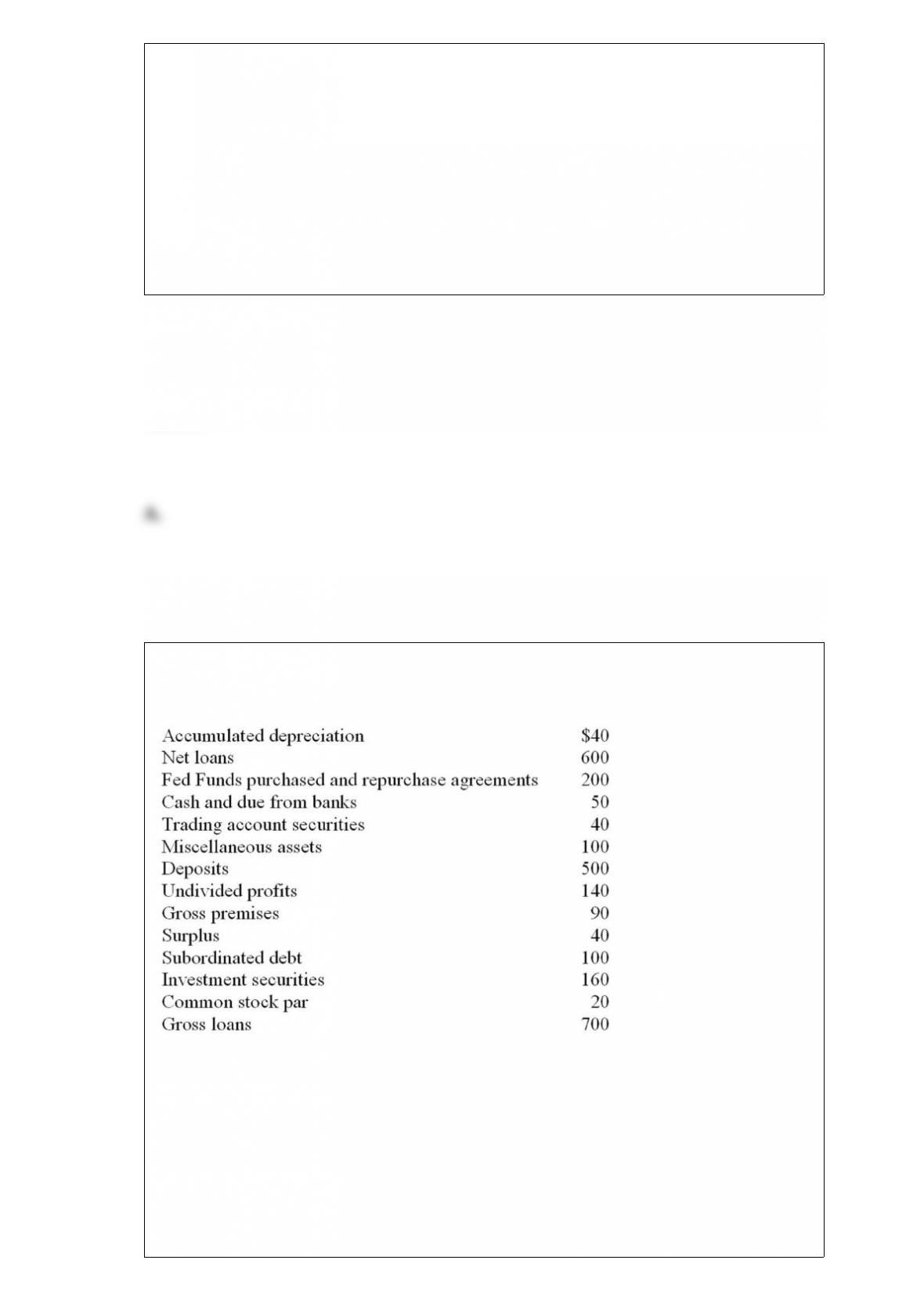
You know the following information about the Webb State Bank:
Given this information, what is the value of this firm’s total equity?
A. $1,000
B. $300
C. $800

D. $200
E. $500
Answer:
The risk that a financial institution may be forced to borrow emergency funds excessive
cost to cover its immediate cash needs is known as:
A. credit risk
B. liquidity risk
C. market risk
D. interest-rate risk
E. None of the options is correct
Answer:
__________ are often the most profitable deposit services for a bank.
A. Time deposits

B. Transaction deposits
C. Thrift deposits
D. Passbook savings deposits
E. Certificates of deposits
Answer:
The number of contracts that have been established and not yet offset or exercised is
called __________________.
A. trade contracts
B. unexpired contracts
C. accumulated contracts
D. open interest
E. uncleared contracts
Answer:
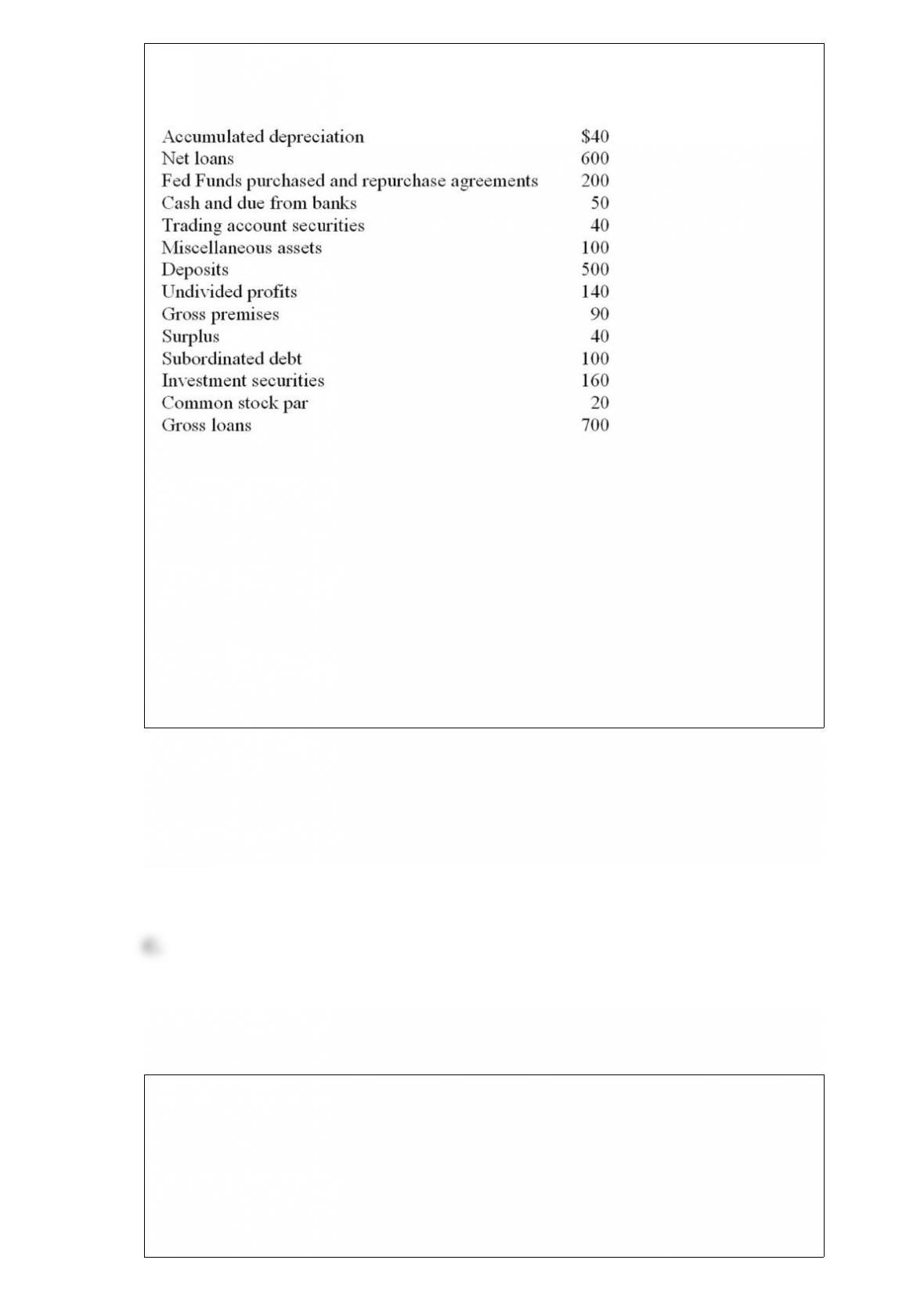
You know the following information about the Webb State Bank:
Given this information, what is the value of this firm’s total liabilities?
A. $1,000
B. $300
C. $800
D. $200
E. $500
Answer:
The gain or loss to a bank from the use of a financial futures contract depends upon:
A. the duration of the underlying security named in the futures contract.
B. the initial futures price.
C. the change expected in interest rates.

D. All of the options are correct.
E. None of the options are correct.
Answer:
What prompted a surge in loan sales in the 1980s?
A. A wave of corporate buyouts
B. An increase in lesser-developed country loans
C. A loosening of government regulations
D. An increase in international lending
E. None of the options is correct
Answer:
Nonbank financial firms that supply insurance coverage to customers borrowing money
to guarantee repayment of a loan are referred to as:
A. merchant bankers.

B. factoring companies.
C. savings associations.
D. investment bankers.
E. credit insurance underwriters.
Answer:
The Price Perpetual Bank has purchased a bond that has a coupon rate of 5.5% and a
face value of $1,000. It has 11 years to maturity and is currently selling in the market
for $887.52. The bond makes annual coupon payments. The Price Perpetual Bank is
planning on selling this bond at the end of 5 years for $1,036.50 (ex-interest). What is
the holding period return on this bond?
A. 5.5%
B. 7%
C. 11%
D. 9.82%
E. None of the options is correct
Answer:

An account at a bank that carries a fixed maturity date, with a fixed interest rate, and
which often carries a penalty for early withdrawal of money is called a:
A. demand deposit.
B. transaction deposit.
C. time deposit.
D. money market mutual deposit.
E. None of the options is correct.
Answer:
Credit reports provided by credit bureaus provide lenders with:
A. personal identifying data.
B. personal credit histories derived from data submitted by lenders.
C. public information that may bear on a borrower’s honesty and stability.
D. the volume of inquiries from lenders about the borrower.
E. All of the options are correct.
Answer:

A bankruptcy filing usually remains in the credit report of the filer for up to:
A. 2 years.
B. 5 years.
C. 10 years.
D. 20 years.
E. the individual’s life.
Answer:
_____ allows European and foreign banks greater freedom to cross national borders.
A. The European Monetary Union
B. The European Council
C. The Sarbanes-Oxley Act
D. The Garn-St Germain Depository Institutions Act
E. The Gramm-Leach-Bliley Act
Answer:

The Price Perpetual Bank has purchased a bond that has a coupon rate of 5.5% and a
face value of $1000. It has 11 years to maturity and is currently selling in the market for
$887.52. The bond makes annual coupon payments. What is the yield-to-maturity on
this bond?
A. 7%
B. 5.5%
C. 11%
D. 4.70%
E. None of the options is correct
Answer:
First State Bank’s loan policy manual states ‘that the goal of the bank is to make high
quality loans for home mortgages, the purchase of automobiles and small business
accounts receivables’. What factor determining the growth and mix of loans does this
fact reflect?
A. Characteristics of the market area
B. Lender Size
C. The experience and expertise of management
D. The written loan policy of the bank
E. Bank regulations

Answer:
The ______________________________________________ requires regulators to
determine if foreign banks selling their services in the U.S. are adequately regulated by
their home governments and to close those not adequately supervised or in violation of
U.S. law.
Answer:
__________________ are one of the earliest services provided by banks and involves
the management of customer’s property and other assets.
Answer:

A(n) ______________________ is a credit-rating agency that keeps records of
borrowers’ loan payment histories.
Answer:
Traditional home equity loans are usually priced using _______-term interest rates
while home equity lines of credit are priced using _________-term interest rates.
Answer:
The most rapidly growing source of income for banks is ________ income.
Answer:

A(n) __________________ guards against the losses in the value of a credit asset. It
would pay off if the asset declines significantly in value or if it completely turns bad.
Answer:
A(n) _________________________ is a type of loan sale which is a short-dated piece
of a longer maturity loan, entitling the purchaser to a fraction of the expected loan
income.
Answer:
_______________________ emerge when financial organization grows in size and is
able to reduce its cost of production per unit of output.
Answer:

Fees for ATMs are larger and more common if a customer uses another financial
institution’s ATM because most institutions charge each other _____________ fees.
Answer:
In real estate lending, competent property __________________ is vitally important to
a loan decision. The value and condition of the property are determined by an
independent party. These must conform to industry and government standards.
Answer:
The most actively traded futures contract in the world is the ________. It is traded on
exchanges in Chicago, London, Tokyo, Singapore and elsewhere and allows investors
the opportunity to hedge against market interest rate changes.
Answer:

A(n) _________________________ is one where the interest portion of a security is
sold separately from the principal portion.
Answer:
One defense against risk for a bank is to seek out customers located in different
communities or in different countries. This defense is known as
________________________.
Answer:
The _________________________ proposes various regulations applying to the
financial markets to combat the recent credit crisis. This “bail-out” bill granted the US
Treasury the means to purchase troubled loans, allowed the FDIC to temporarily
increase deposit insurance, and permitted the government to inject additional capital
into the banking system.

Answer:
A(n) _________________________ protects the lender from falling interest rates. It is
the minimum rate that the borrower must pay on a floating-rate loan.
Answer:
Due to the fact that they may be perceived as more risky, ________________ banks
generally offer higher deposit rates than traditional brick and mortar banks.
Answer:
An investment maturity strategy which calls for a bank to have all of its investment
assets in very short term maturities is called the ________________________.

Answer: