
Barber and Odean (2001) report that men __________ women.
A. earn higher returns than
B. earn lower returns than
C. earn about the same returns as
D. generate lower trading costs than
If a firm has a positive tax rate, a positive ROA, and the interest rate on debt is the same
as ROA, then ROA will be
A. greater than the ROE.
B. equal to the ROE.
C. less than the ROE.
D. greater than zero, but it is impossible to determine how ROA will compare to ROE.
E. negative in all cases.
Portfolio A consists of 500 shares of stock and 500 calls on that stock. Portfolio B
consists of 800 shares of stock. The call delta is 0.6. Which portfolio has a higher dollar
exposure to a change in stock price?
A. Portfolio B
B. Portfolio A
C. The two portfolios have the same exposure.
D. Portfolio A if the stock price increases and portfolio B if it decreases
E. Portfolio B if the stock price increases and portfolio A if it decreases

________ is a risk measure that indicates vulnerability to extreme negative returns.
A. Value at risk
B. Lower partial standard deviation
C. Standard deviation
D. Value at risk and lower partial standard deviation
E. None of the options are correct.
A study by Mehra and Prescott (1985) found that historical average excess returns
A. have been too small to be consistent with rational security pricing.
B. have been too large to be consistent with rational security pricing.
C. have been too small to be consistent with fractional security pricing.
D. prove CAPM is incorrect.
E. prove the market is efficient.
Alex Goh is 39 years old and has accumulated $128,000 in his selfdirected defined
contribution pension plan. Each year he contributes $2,500 to the plan, and his
employer contributes an equal amount. Alex thinks he will retire at age 62 and figures
he will live to age 86. The plan allows for two types of investments. One offers a 4%
riskfree real rate of return. The other offers an expected return of 11% and has a
standard deviation of 37%. Alex now has 25% of his money in the riskfree investment
and 75% in the risky investment. He plans to continue saving at the same rate and keep
the same proportions invested in each of the investments. His salary will grow at the
same rate as inflation. How much can Alex expect to have in his risky account at
retirement?
A. $1,400,326
B. $1,309,529
C. $1,543,781
D. $1,224,651
E. $1,345,886

The index model for stock B has been estimated with the following result:
RB = 0.01 + 1.1RM + eB.
If σM = 0.20 and R2
B = 0.50, the standard deviation of the return on stock B is
A. 0.1111.
B. 0.2111.
C. 0.3111.
D. 0.4111.
What does the term negotiable mean, with regard to negotiable certificates of deposit?
A. The CD can be sold to another investor if the owner needs to cash it in before its
maturity date.
B. The rate of interest on the CD is subject to negotiation.
C. The CD is automatically reinvested at its maturity date.
D. The CD has staggered maturity dates built in.
E. The interest rate paid on the CD will vary with a designated market rate.
Unlike mutual funds, hedge funds
A. allow private investors to pool assets to be managed by a fund manager.
B. are commonly organized as private partnerships.
C. are subject to extensive SEC regulations.

D. are typically only open to wealthy or institutional investors.
E. are commonly organized as private partnerships and are typically only open to
wealthy or institutional investors.
An American-style call option with six months to maturity has a strike price of $35. The
underlying stock now sells for $43. The call premium is $12. If the option has delta of .
5, what is its elasticity?
A. 4.17
B. 2.32
C. 1.79
D. 0.5
E. 1.5
The ____ index represents the performance of the Hong Kong stock market.
A. DAX
B. FTSE
C. Nikkei
D. Hang Seng
In a two-security minimum variance portfolio where the correlation between securities
is greater than 1.0,
A. the security with the higher standard deviation will be weighted more heavily.
B. the security with the higher standard deviation will be weighted less heavily.

C. the two securities will be equally weighted.
D. the risk will be zero.
E. the return will be zero.
The expected return-beta relationship of the CAPM is graphically represented by
A. the security-market line.
B. the capital-market line.
C. the capital-allocation line.
D. the efficient frontier with a risk-free asset.
E. the efficient frontier without a risk-free asset.
Pairs trading is associated with
A. triangular arbitrage.
B. statistical arbitrage.
C. data mining.
D. triangular arbitrage and data mining.
E. statistical arbitrage and data mining.
________ is a proposition that a strong proponent of supply-side economics would
most likely stress.
A. Higher marginal tax rates will lead to a reduction in the size of the budget deficit and

lower interest rates as they depend on government revenues
B.-Higher marginal tax rates promote economic inefficiency and thereby retard
aggregate output as they encourage investors to undertake low productivity projects
with substantial tax shelter benefits
C. Income redistribution payments will exert little impact on real aggregate supply as
they do not consume resources directly
D. A tax reduction will increase the disposable income of households, and thus, the
primary impact of a tax reduction on aggregate supply will stem from the influence of
the tax change on the size of the budget deficit or surplus
E. None of the options is a likely statement for a supply-side proponent.
Which of the following are commonly thought to be bad general investment guidelines?
I) Don’t try to outguess the market, buying and holding generally pays off.
II) Diversify investments to spread risk.
III) Investments should be highly concentrated in your company’s stock.
IV) 401K money is best placed in money market accounts because risk is very low.
V) Investments should be allocated to stocks, bonds, and moneymarket funds.
A. I, III, and IV
B. I, II, and IV
C. II, IV, and V
D. III and IV
E. I, II, IV, and V
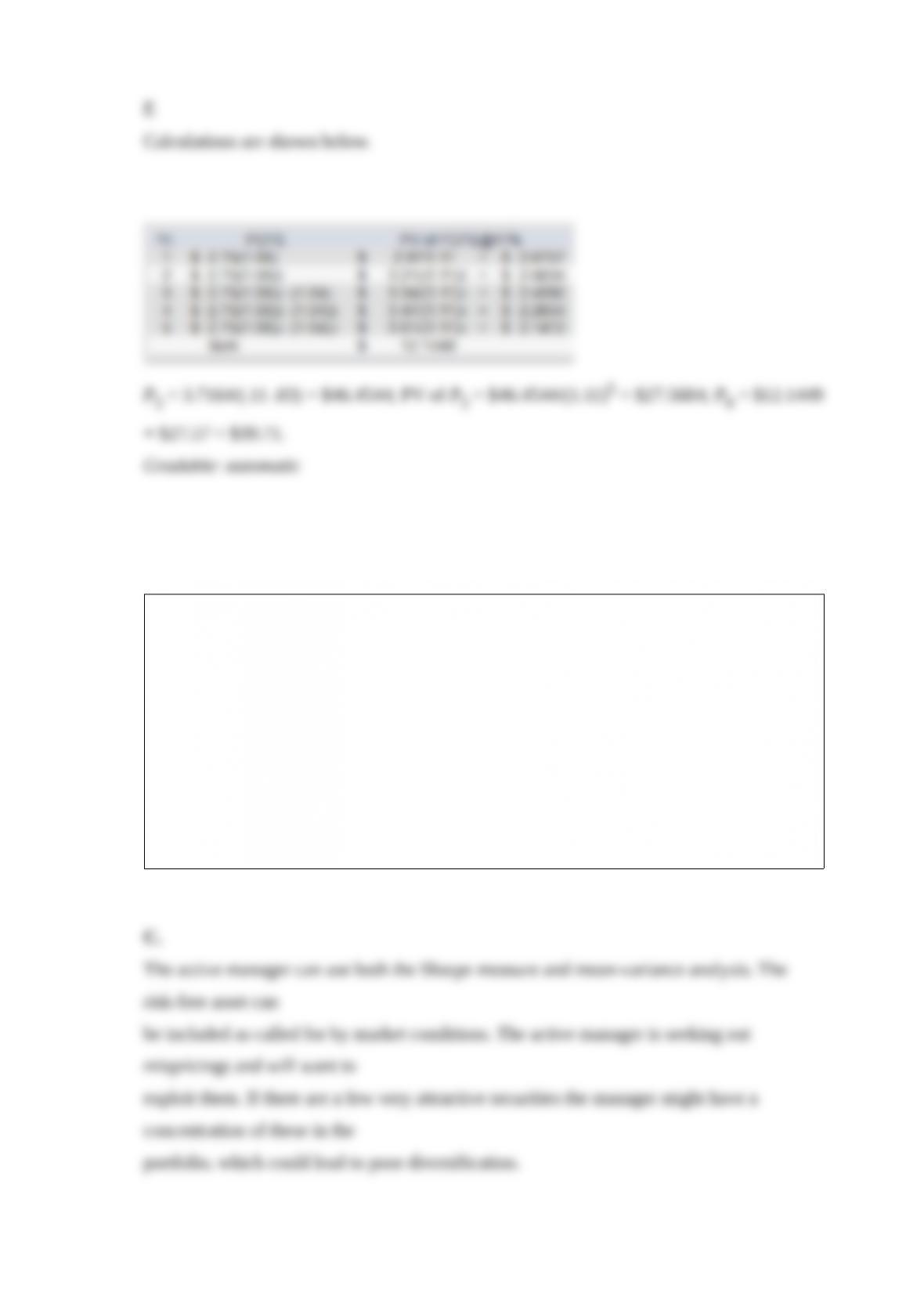
The growth in per share FCFE of SYNK, Inc. is expected to be 8% per year for the next
two years, followed by a growth rate of 4% per year for three years. After this five-year
period, the growth in per share FCFE is expected to be 3% per year, indefinitely. The
required rate of return on SYNC, Inc. is 11%. Last year’s per share FCFE was $2.75.
What should the stock sell for today?
A. $28.99
B. $35.21
C. $54.67
D. $56.37
E. $39.71
An active portfolio manager faces a trade-off between
I) using the Sharpe measure.
II) using mean-variance analysis.
III) exploiting perceived security mispricings.
IV) holding too much of the risk-free asset.
V) letting a few stocks dominate the portfolio.
A. I and II
B. II and V
C.III and V
D. III and IV
E. II and III
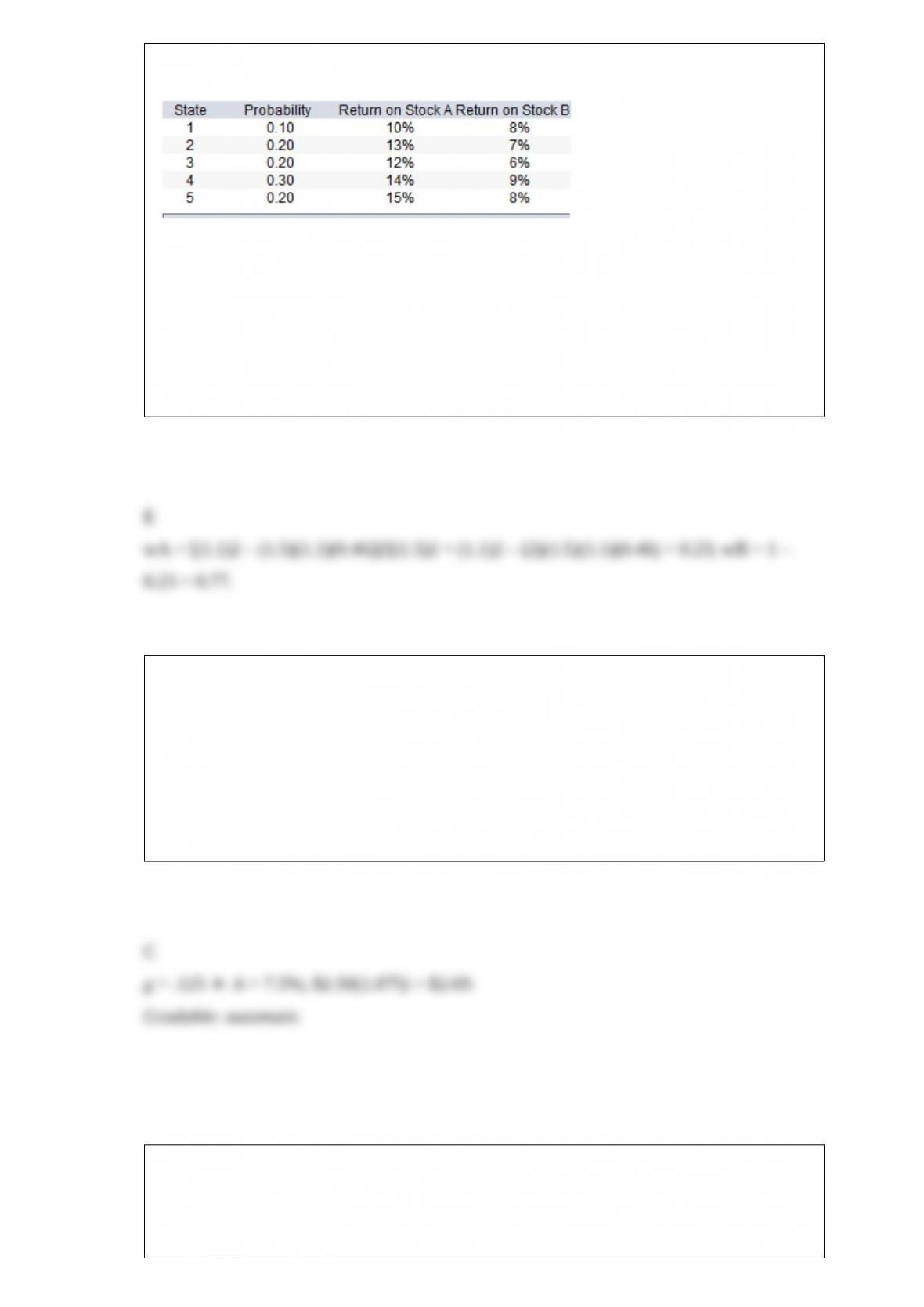
Consider the following probability distribution for stocks A and B:
Let G be the global minimum variance portfolio. The weights of A and B in G are
__________ and __________,
respectively.
A. 0.40; 0.60
B. 0.66; 0.34
C. 0.34; 0.66
D. 0.77; 0.23
E. 0.23; 0.77
High Tech Chip Company paid a dividend last year of $2.50. The expected ROE for
next year is 12.5%. An appropriate required return on the stock is 11%. If the firm has a
plowback ratio of 60%, the dividend in the coming year should be
A. $1.00.
B. $2.50.
C. $2.69.
D. $2.81.
E. None of the options are correct.
The beta of an active portfolio is 1.45. The standard deviation of the returns on the
market index is 22%. The
nonsystematic variance of the active portfolio is 3%. The standard deviation of the
returns on the active portfolio
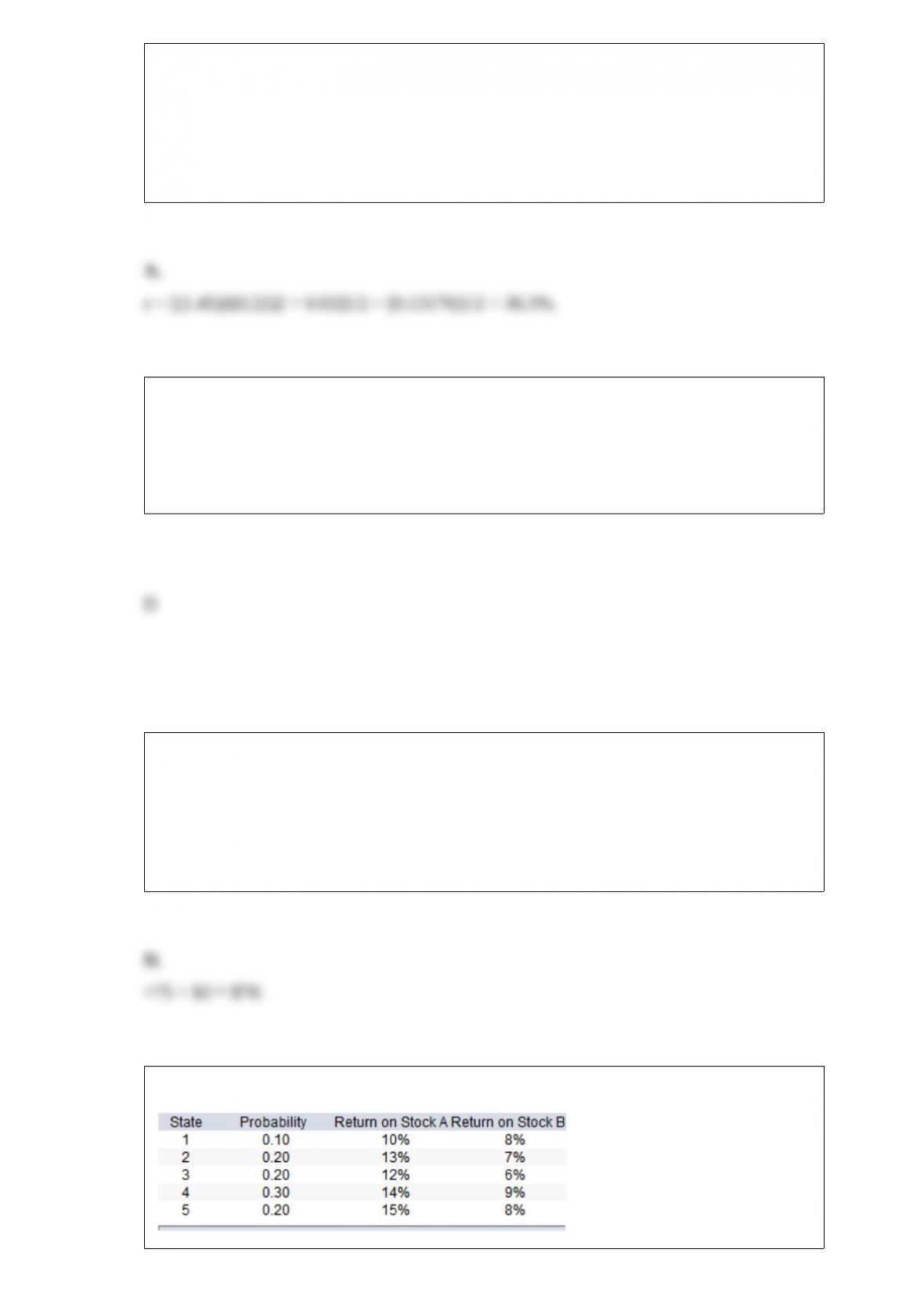
is
A.36.30%.
B. 5.84%.
C. 19.60%.
D. 24.17%.
E. 26.0%.
As exchange rates change, they
A. change the relative purchasing power between countries.
B. can affect imports and exports between countries.
C. will affect the flow of funds between countries.
D. All of the options are true.
You purchase one JNJ 75 call option for a premium of $3. Ignoring transaction costs,
the break-even price of the position is
A. $75.
B. $72.
C. $3.
D.$78.
Consider the following probability distribution for stocks A and B:

The variances of stocks A and B are _____ and _____, respectively.
A. 1.5%; 1.9%
B. 2.2%; 1.2%
C. 3.2%; 2.0%
D. 1.5%; 1.1%
Assume the U.S. government was to decide to increase the budget field. Holding all
else constant, this will cause ______ to decrease.
A. interest rates
B. government borrowing
C. unemployment
D.-interest rates and government borrowing
E. None of the options are correct.
Which of the following factors did Chen, Roll, and Ross include in their multifactor
model?
A. Change in industrial waste
B. Change in expected inflation
C. Change in unanticipated inflation
D. Change in expected inflation and unanticipated inflation
E. All of the factors were included in their model.

A coupon bond pays interest semi-annually, matures in five years, has a par value of
$1,000, a coupon rate of 12%, and an effective annual yield to maturity of 10.25%. The
price the bond should sell for today is
A. $922.77.
B. $924.16.
C. $1,075.80.
D. $1,077.20.
E. None of the options are correct.
Interest rate futures contracts are actively traded on the
A. eurodollars.
B. euroyen.
C. sterling.
D. eurodollars and euroyen.
E. All of the options are correct.
Which of the following statements is false?
I) The maintenance-margin is the amount of money you post with your broker when
you buy or sell a futures contract.
II) If the value of the margin account falls below the maintenance-margin requirement,
the holder of the contract will receive a margin call.
III) A margin deposit can only be met with cash.
IV) All futures contracts require the same margin deposit.
A. I only
B. II only
C. III only
D. IV only
E. I, III, and IV

The current yield on a bond is equal to
A. annual interest payment divided by the current market price.
B. the yield to maturity.
C. annual interest divided by the par value.
D. the internal rate of return.
E. None of the options are correct.
An extension of the Fama French three factor model includes a fourth factor to measure
A. default spread.
B. term spread.
C. momentum.
D. industrial production.
E. inflation.