
What is the net present value of a project that has an initial cost of $42,700 and
produces cash inflows of $9,250 a year for 9 years if the discount rate is 14.65 percent?
A. $798.48
B. $1,240.23
C. $1,992.43
D. $2,111.41
E. $2,470.01
You want to invest an amount of money today and receive back twice that amount in
the future. You expect to earn 6 percent interest. Approximately how long must you
wait for your investment to double in value?
A. 6 years
B. 7 years
C. 8 years
D. 12 years
E. 14 years
Which one of the following is the hypothesis that securities markets are efficient?
A. Geometric market hypothesis
B. Standard deviation hypothesis
C. Efficient markets hypothesis
D. Capital market hypothesis
E. Financial markets hypothesis
Which one of the following categories has the widest frequency distribution of returns
for the period 1926-2014?
A. Small-company stocks
B. U.S. Treasury bills
C. Long-term government bonds
D. Inflation
E. Large-company stock
You want to have $40,000 for a down payment on a house 4 years from now. If you can
earn 5.6 percent, compounded annually on your savings, how much do you need to
deposit today to reach your goal?
A. $32,166.54
B. $34,420.73
C. $27,880.69
D. $28,211.17
E. $30,886.40
Ernst Electrical has 7,500 shares of stock outstanding and no debt. The new CFO is
considering issuing $50,000 of debt and using the proceeds to retire 600 shares of stock.
The coupon rate on the debt is 8.5 percent. What is the break-even level of earnings
before interest and taxes between these two capital structure options?
A. $48,360
B. $50,020
C. $49,740
D. $52,500
E. $53,125
Which one of the following statements is correct concerning the taxation of dividends
and capital gains?
A. Seventy percent of capital gains derived from stock investments are tax exempt for
corporate investors.
B. Dividends are a form of tax-exempt income for individual investors.
C. All investors are subject to the same tax rate on dividend income.

D. Individual investors can defer taxation on both dividends and capital gains.
E. As of 2015, individual investors pay a tax rate that varies from 0 to 15 percent on
dividend income.
Which statement is true?
A. An increase in the market value of preferred stock will increase a firm’s weighted
average cost of capital.
B. The cost of preferred stock is unaffected by the issuer’s tax rate.
C. Preferred stock is generally the cheapest source of capital for a firm.
D. The cost of preferred stock remains constant from year to year.
E. Preferred stock is valued using the capital asset pricing model.
Delfino’s expects to pay an annual dividend of $1.50 per share next year. What is the
anticipated dividend for Year 5 if the firm increases its dividend by 2 percent annually?
A. $1.50 x(1.02)1
B. $1.50 x(1.02)2
C. $1.50 x(1.02)3
D. $1.50 x(1.02)4
E. $1.50 x(1.02)5
NU-Tech wants to raise $11.6 million to purchase equipment by issuing new securities.
Management estimates the issue will cost the firm $785,000 for accounting, legal, and
other costs. The underwriting spread is 7.5 percent and the issue price is $23 per share.
How many shares of stock must be sold if the firm is to have sufficient funds remaining
after costs to purchase all of the desired equipment?
A. 608,010 shares
B. 521,121 shares
C. 582,139 shares
D. 647,666 shares
E. 710,333 shares

Stevenson’s Bakery is an all-equity company that has projected perpetual earnings
before interest and taxes of $43,700 a year. The cost of equity is 15.2 percent and the
tax rate is 34 percent. The company can borrow money at 7.15 percent. If the company
borrows $50,000, what will be its levered value?
A. $187,613
B. $189,919
C. $206,750
D. $229,507
E. $203,682
Which of these is defined as an agreement to exchange two securities or two
currencies?
A. Hedge
B. Swap
C. SWIFT
D. Gilt
E. Arbitrage
Postal Express is considering the purchase of a new sorting machine. The sales quote
consists of quarterly payments of $37,200 for five years at 7.6 percent interest. What is
the purchase price?
A. $621,380.92
B. $614,184.40
C. $687,418.22
D. $774,311.28
E. $836,267.35

You just won $30,000 and deposited your winnings into an account that pays 3.9
percent interest, compounded annually. How long will you have to wait until your
winnings are worth $75,000?
A. 21.24 years
B. 25.00 years
C. 22.29 years
D. 22.67 years
E. 23.95 years
Which one of the following methods of analysis ignores the time value of money?
A. Net present value
B. Internal rate of return
C. Discounted cash flow analysis
D. Payback
E. Profitability index
Which one of the following statements concerning financial leverage is correct?
A. Financial leverage increases profits and decreases losses.
B. Financial leverage has no effect on a firm’s return on equity.
C. Financial leverage refers to the use of common stock.
D. Financial leverage magnifies both profits and losses.
E. Increasing financial leverage will always decrease the earnings per share.
The Bermuda Triangle Store pays a constant dividend. Last year, the dividend yield was
4.0 percent when the stock was selling for $16 a share. What must the stock price be
today if the market currently requires a 4.3 percent dividend yield on this stock?
A. $14.88
B. $12.30
C. $15.59

D. $19.22
E. $12.48
Which one of the following would tend to favor a low-dividend payout?
A. Higher tax rates on capital gains than on dividend income
B. High flotation cost for equity issues
C. Endowment fund investors who cannot spend principal
D. Investors’ desire for a high-dividend yield
E. Elimination of the tax deferral on capital gains
Builder’s Outlet just hired a new chief financial officer. To get a feel for the company,
she wants to compare the firm’s sales and costs over the past three years to determine if
any trends are present and also determine where the firm might need to make changes.
Which one of the following statements will best suit her purposes?
A. Income statement
B. Balance sheet
C. Common-size income statement
D. Common-size balance sheet
E. Statement of cash flows
Dry Dock Marina is expected to pay an annual dividend of $1.58 next year. The stock is
selling for $18.53 a share and has a total return of 9.48 percent. What is the dividend
growth rate?
A. .82 percent
B. 1.03 percent
C. 1.28 percent
D. .95 percent
E. .66 percent

When evaluating a project, the dividend growth model:
A. can only be used by firms that pay increasing dividends.
B. must be used by all dividend-paying firms.
C. is only applicable when the growth rate of the project exceeds the dividend growth
rate.
D. is relatively simple to use.
E. must use the growth rate of the project as the rate of growth in the formula.
The reinvestment approach to the modified internal rate of return:
A. individually discounts each separate cash flow back to the present.
B. reinvests all the cash flows, including the initial cash flow, to the end of the project.
C. discounts all negative cash flows to the present and compounds all positive cash
flows to the end of the project.
D. discounts all negative cash flows back to the present and combines them with the
initial cost.
E. compounds all of the cash flows, except for the initial cash flow, to the end of the
project.
Which one of the following might be included in a bond’s list of negative covenants?
A. Maintain a current ratio of 1.2 or more
B. Maintain a minimum cash balance of $1.2 million
C. Limit cash dividends to $1 per share or less
D. Maintain a times interest earned ratio of 2 or more
E. Provide audited financial statements in a timely manner
JK’s is borrowing $132,000 for three years at an APR of 7.6 percent. The loan calls for
the principal balance to be reduced by equal amounts over the life of the loan. Interest is
to be paid in full each year. The payments are to be made annually at the end of each
year. How much will be paid in interest over the life of this loan?
A. $10,032
B. $30,096
C. $12,840
D. $20,064
E. $18,667
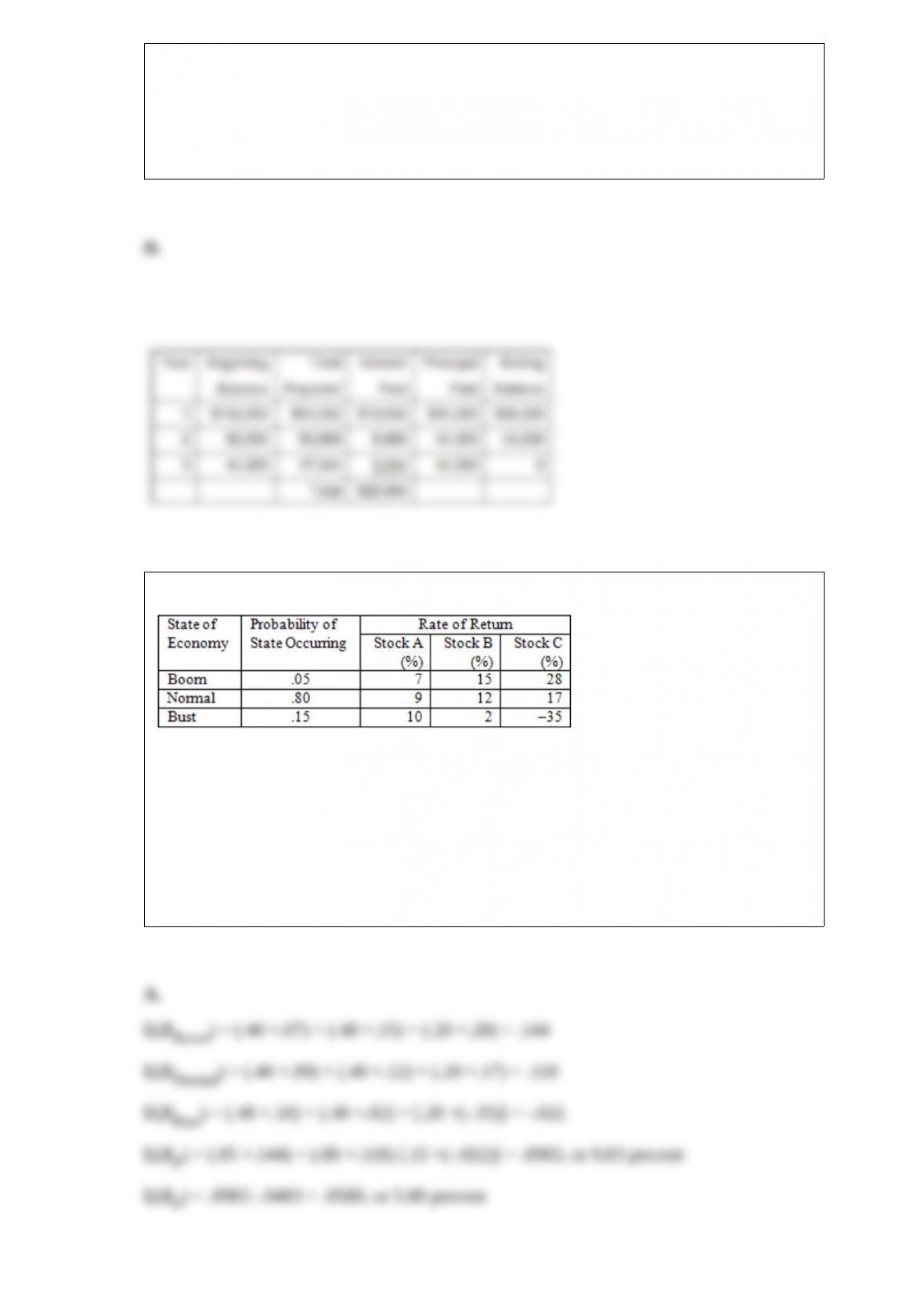
Consider the following information on a portfolio of three stocks:
The portfolio is invested 40 percent in each Stock A and Stock B and20 percent in
Stock C. If the expected T-bill rate is 4.03 percent, what is the expected risk premium
on the portfolio?
A. 5.80 percent
B. 6.90 percent
C. 5.38 percent
D. 6.72 percent
E. 7.68 percent

Jessica currently owns 500 shares of Alpha stock valued at $19 share. What will her
investment in Alpha be worth if the company declares a 4-for-3 stock split?
A. $6,075
B. $9,500
C. $11,000
D. $7,125
E. $8,800
Which statement is correct?
A. The underwriters pay the spread.
B. Taxes are an indirect underwriting cost.
C. Seasoned equity offerings (SEOs) tend to be less costly than IPOs.
D. Straight bonds are more costly to issue than convertible bonds.
E. The total direct cost as a percentage of gross proceeds for an IPO tends to decrease as
the size of the offer decreases.
JK Industries just signed a sales contract with a new customer. JK will receive annual
payments in the amount of $62,000, $108,000, $135,000, and $150,000 at the end of
Years 1 to 4, respectively. What is this contract worth at the end of Year 4 if the firm
earns 4.3 percent on its savings?
A. $497,425.35
B. $402,311.19
C. $466,118.00
D. $485,271.13
E. $478,639.54
The manager of Gloria’s Boutique has approved Carla’s application for 24 months of
credit with maximum monthly payments of $70.If the APR is 14.2 percent, what is the
maximum initial purchase that Carla can buy on credit?

A. $1,006.90
B. $1,300.00
C. $1,455.08
D. $1,184.75
E. $1,228.46
Common-size financial statements present all balance sheet account values as a
percentage of:
A. the forecasted budget.
B. sales.
C. total equity.
D. total assets.
E. last year’s account value.
A bond’s annual interest divided by its face value is referred to as the:
A. market rate.
B. call rate.
C. coupon rate.
D. current yield.
E. yield-to-maturity.
A bond has a make-whole call provision. Given this, you know that the:
A. bond will always sell at par.
B. call premium must equal the annual coupon payment.
C. call price is directly related to the market rate of interest.
D. call price is inversely related to the market rate of interest.
E. bond must be a zero coupon bond.

Pluto United has 14,200 shares of stock outstanding at a price per share of $23. How
many shares will be outstanding if the firm does a 4-for-3 stock split?
A. 18,300 shares
B. 19,033 shares
C. 18,667 shares
D. 19,100 shares
E. 18,933 shares
Stock J has a beta of 1.06 and an expected return of 12.3 percent, while Stock K has a
beta of .74 and an expected return of 6.7 percent. If you create portfolio with the same
risk as the market, what rate of return should you expect to earn?
A. 10.67 percent
B. 11.18 percent
C. 11.62 percent
D. 11.25 percent
E. 11.13 percent
Two weeks ago, Jensen’s declared a dividend of $1.34 a share. The ex-dividend date is
tomorrow. All else constant, which one of the following is the best estimate of Jensen’s
opening stock price tomorrow?
A. $1.34 lower than today’s closing price
B. Today’s closing price minus an amount approximately equal to the aftertax value of
the dividend
C. The same as today’s closing price since the dividend is expected
D. $1.34 higher than today’s closing price
E. Today’s closing price plus an amount approximately equal to the aftertax value of the
dividend