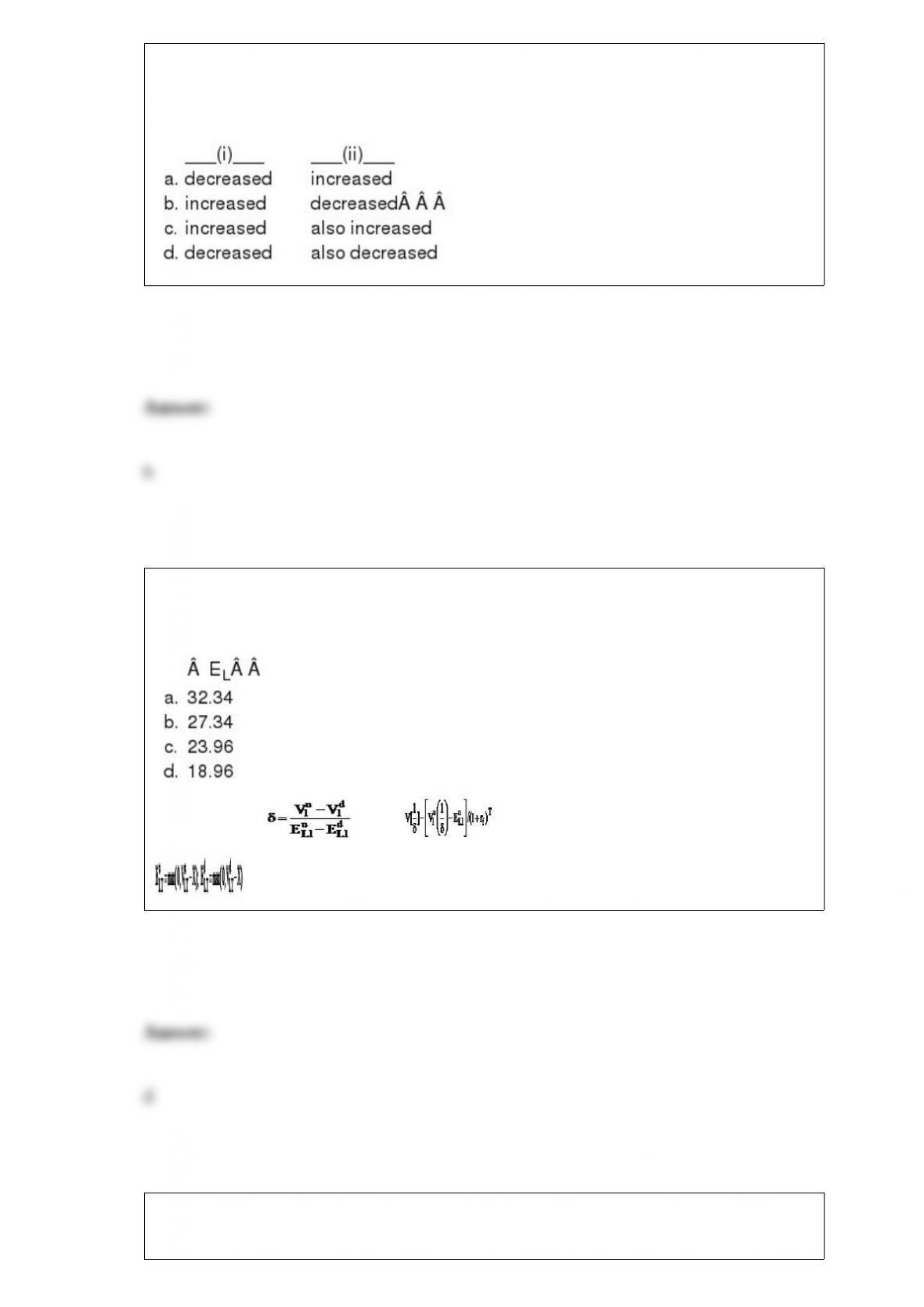
Throughout the period 1980-2000, the composite proportion of the TA of U.S.
nonfinancial firms accounted for by net PP&E generally ___(i)____, and the proportion
of TA financed by equity ___(ii)___ fairly steadily.
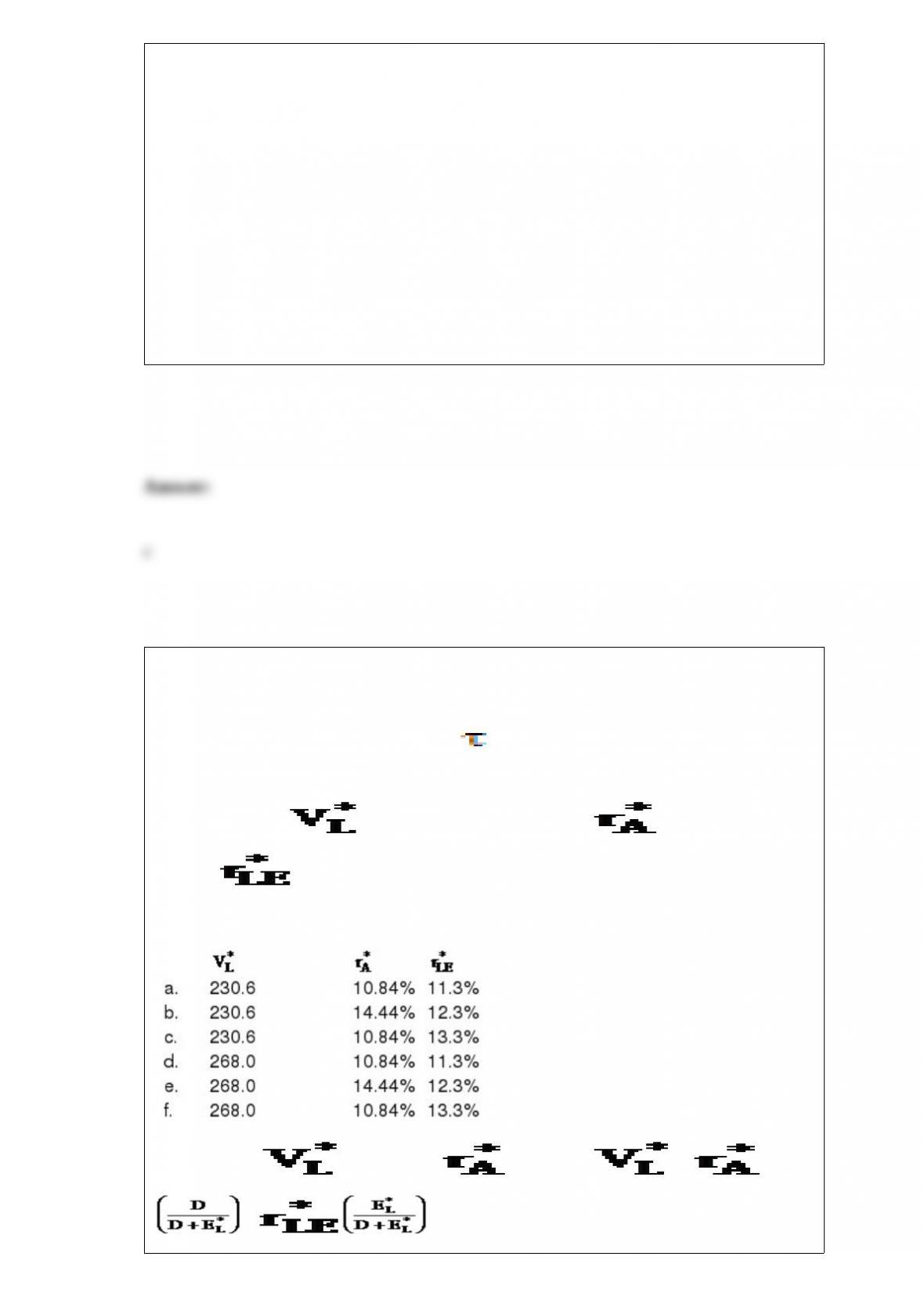
Using the Binomial Model, find the value of a firm’s levered equity (EL) given the
following values: V=100, u=1.3, d=1/u, p=0.7, rf=5%, X=100, and T=3.
FORMULAS: ; EL = ;
One principal-agent conflict is that between a firm’s creditors (as a principal) and its
shareholders (as agent). For example, after issuing risky debt, stockholders have an
incentive to increase the riskiness of the firm’s assets (e.g., by changing operating
strategy), which would tend to expropriate wealth from creditors to stockholders.
Which of the assumptions of an ideal capital market is violated in this example?
a. Capital Markets are frictionless
b. Homogeneous expectations
c. Atomistic competition
d. The firm has a fixed investment program
e. Once chosen, the firm’s financing is fixed
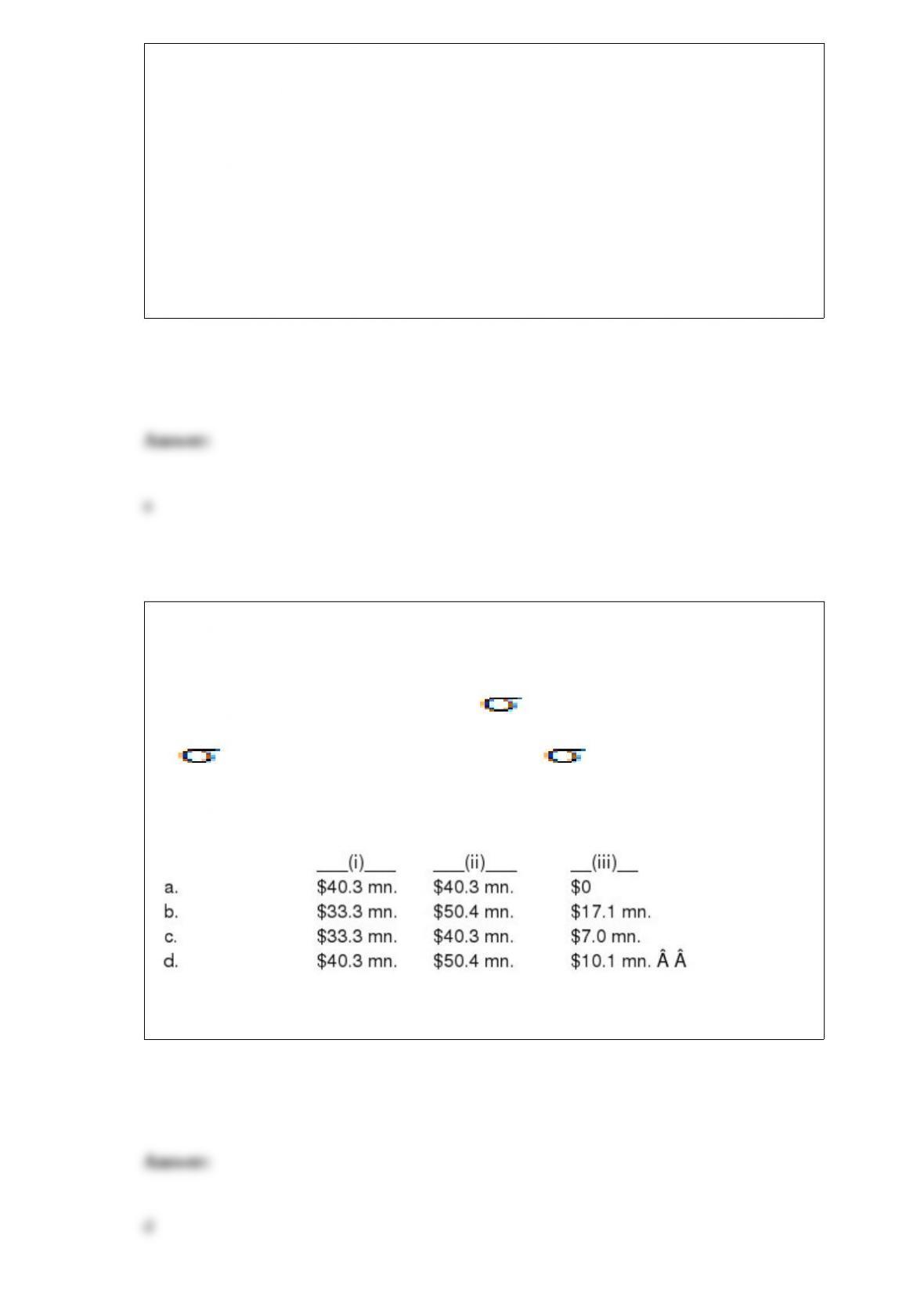
The value of Jones Company as an unlevered firm is VU=200. However, Jones
Company has perpetual debt outstanding with a value of D=90. The rate on the firm’s
debt is rD=7%. The firm’s tax rate is C=34%. The firm’s expected annual
after-tax cash flow to shareholders and bondholders combined is ATCF=$25. Calculate
the firm’s value, , tax-adjusted cost of capital, , and cost of
equity, .
FORMULA: = VU+ cD; = ATCF/ ; = rD
+

Firm XYZ is currently financed entirely with equity that has a total market value of
$900 mn. The firm’s management is considering engaging in a debt-for-equity swap to
add leverage to the firm’s capital structure. Management recognizes two factors that
would affect the value of the firm as leverage is added. First, the addition of permanent
debt in the amount of D would provide a tax shield that has a value of cD,
where for firm XYZ c=0.34, or 34%. The second, and offsetting, factor is
the present value of expected costs of future financial distress, PV[E(CFFD)], which
increases at an accelerating rate with leverage. Management decides that the
relationship of PV[E(CFFD)] to leverage can be approximated with the following
equation: PV[E(CFFD)]= D2, where =0.001. Given these
specifications, find the value of debt, D, that would maximize the value of firm XYZ.
What is the market value of the firm, , if it has this amount of debt?
Shareholders have sued board directors for losses arising from alleged mismanagement.
Over the years 1984-87, a director liability crisis emerged in the U.S. because of

accelerating litigation against corporate directors. The threat of litigation severely
decreased the supply of qualified outside directors nationwide. In response to this crisis,
many states have passed ___(i)___ statutes, which allow firms to adopt new ___(ii)___
that protect directors from shareholder suits.
At the end of year 1 firm XYZ has TA=$325 bn., and it is financed with debt with a
book value of $125 mn. and equity with a book value of $200 mn. The firm must pay
10% interest annually on its debt. In year 2, the firm had a net income of $55 mn. The
firm’s year 2 ROA was ___(i)___, and the firm’s year 2 ROE was ___(ii)___.
FORMULAS: ROA=NI/TA; ROE=NI/BEQ

Over the weekend prior to April 3, 2000, a U.S. District Court ruled that Microsoft
Corp. is a monopoly. On Monday, April 3, Microsoft’s stock return was -14.47%, while
the return on the S&P500 (the “market”) was 0.49%. For the two years leading up to
this date, the “market model” relationship between Microsoft’s daily returns and the
market’s daily returns was as given below. Using this market model relationship,
compute the “abnormal return” on Microsoft’s stock on April 3, 2000.
RMSFT=0.19% + 0.60(RMKT) + .
a. -2.56%
b. -5.56%
c. -8.56%
d. -14.95%
FORMULAS: Rit= i+ ßiRmt+ it; ARi0= Ri0– ( i+
iRm0)
In _______, an issuing firm solicits bids from among several investment banks for the
job of underwriting a bond issue.
a. competitive bidding
b. negotiated underwriting
c. aggressive bidding
d. bargain bidding

Standard & Poors ratings are grouped into two major categories, investment-gradeand
speculative- grade. Bonds that are rated (i) are included in the investment-grade group,
while speculative-grade bonds are those rated (ii) .
An important aspect of insiders’ commitment to continuing ownership is the ______,
whereby insiders agree to hold their shares for a period (typically 180 days) after the
IPO date.
a. ownership commitment
b. signaling agreement
c. statue quo agreement
d. lockup provision

A ______ is an agreement among the few dominant firms in an industry to coordinate
production and, as alleged, to cut prices temporarily in order to drive out or acquire
smaller competitors, after which they could raise prices substantially.
a. syndicate
b. trust
c. non-compete clause
d. cut-throat accord
If the bidder in a hostile takeover faces target management resistance, as an alternative
to either bidding higher or terminating the tender offer process, bidders sometimes offer
target management compensation to end its resistance. This compensation is called:
a. a golden parachute.
b. a silver bullet.
c. a gold watch.
d. removal remuneration.
Empirical evidence indicates that for distressed firms, higher pre-distress leverage

increases the probability of operational actions (e.g., asset restructuring and employee
layoffs) and financial actions (e.g., dividend cuts). This evidence is consistent with the:
a. disciplinary role of debt.
b. wasteful cuts hypothesis.
c. managerial discretion hypothesis.
d. leverage aggressiveness hypothesis.
To address distress, any of the following changes in the focal firm’s board structure are
consistent with theory EXCEPT:
a. replacing insiders with outsiders.
b. limiting the ability of the board to veto the CEO’s proposals.
c. requiring directors to hold equity shares.
d. limiting the tenure of directors
e. ending the staggering of board elections
f. reducing the size of the board.
Miller and Rock (1985) developed an ingenious signaling model in which ________ by
a firm serve as powerful signals of the firm’s earnings capacity, and thus its value. Any
such _______ reveal that the firm has been generating, and is expected to continue to
generate, high net cash inflows.
a. cash payouts
b. debt issuance
c. equity issuance
d. earnings announcements
The current value of levered firm ABC, Inc. is $100 million. Its capital structure
consists of equity and pure discount debt on which a payment of $80 mn. is due in 5
years. The risk-free rate is 5%. Using the Black-Scholes Option Pricing Model, the
value of the firm’s equity is ___(i)___ if =20%, and is ___(i)___ if
=40%. Assuming that the increase in was a deliberate action of
the firm’s management designed to expropriate wealth from bondholders to
stockholders, what was the value of this expropriation?
(The BSOPM formula and values of the cumulative normal distribution function, must
be supplied.)

Investors who specialize in the debt or equity of distressed firms are called:
a. speculators.
b. arbitrageurs.
c. bottom dwellers.
d. vulture investors.
A spin-off is a
a. pro-rata distribution of new equity claims on a subsidiary to the parent’s shareholders.
b. sale of a division for cash to another firm.
c. tax-driven sale of depreciation rights to another firm.
d. sale of patent rights (e.g., for a pharmaceutical drug) to another firm.
Which groups of U.S. nonfinancial firms have the highest composite proportions of
PP&E to TA?
a. S&P Industrials

b. S&P MidCaps
c. S&P SmallCaps
d. S&P Transports and Utilities
According to signaling theory, Chapter 11 is a useful mechanism for screening
inefficient firms out of debt renegotiation. Inefficient firms voluntarily choose Chapter
11 because:
a. the firm can be liquidated more quickly.
b. negotiations therein generally result in some value retained by shareholders.
c. creditors are protected from violations of the absolute priority rule (APR).
d. management can better signal a higher firm value within Chapter 11.
Firm XYZ is currently financed entirely with equity that has a total market value of
$900 mn. The firm’s management is considering engaging in a debt-for-equity swap to
add leverage to the firm’s capital structure. Management recognizes two factors that
would affect the value of the firm as leverage is added. First, the addition of permanent
debt in the amount of D would provide a tax shield that has a value of cD,
where for firm XYZ c=0.34, or 34%. The second, and offsetting, factor is

the present value of expected costs of future financial distress, PV[E(CFFD)], which
increases at an accelerating rate with leverage. Management decides that the
relationship of PV[E(CFFD)] to leverage can be approximated with the following
equation: PV[E(CFFD)]= D2, where =0.0005. Given these
specifications, find the value of debt, D, that would maximize the value of firm XYZ.
What is the market value of the firm, , if it has this amount of debt?
Essentially, a convertible bond is a portfolio of:
a. a bond and an automobile whose top can be removed.
b. an otherwise equivalent nonconvertible bond and shares of the issuing firm’s stock.
c. an otherwise equivalent nonconvertible bond and a call option on the firm’s stock.
d. an otherwise equivalent nonconvertible bond and a put option on the firm’s stock.

What average annual proportion of the total number of public U.S. nonfinancial firms at
year-end 1980 exited over the years 1981-2000 (i.e., the average attrition rate)?
a. 5.9%
b. 15.9%
c. 25.9%
d. 35.9%
Suppose a firm wants to borrow $200 million for 5 years to fund capital expenditures,
and is
considering the choice of a bank loan or a public issue through an investment banking
firm as underwriter. For simplicity, we will assume that in either case the firm will issue
pure-discount debt. The bank demands a 10.25% interest rate (with no fee), while the
underwriter states that the interest cost will be 9.25 percent with 3% flotation costs.
Which funding source provides the lower effective interest cost?
a. the bank loan
b. the public issue
c. both provide exactly the same effective interest cost

If the securities markets are efficient, the market’s reaction to new information about a
firm’s value (such as an earnings announcement) should be:
a. gradual, as investors rationally deliberate the effect of the information on the stock’s
value.
b. immediate and unbiased.
c. slow or fast, depending on the amount of ‘surprise” contained in the new information.
d. negligible (the information would have already been impounded into the firm’s stock
price).
TRUE or FALSE: VCs are rarely involved in the governance and management of a
venture that they finance.
a. TRUE
b. FALSE
The macroeconomic component of a firm’s business architecture includes all of the
following elements EXCEPT:
a. economic growth projections, inflation, and taxes.
b. industry characteristics.
c. legal environment.
d. macroeconomic risk factors.

For the equity of Delaware East, ß=1.25. If the expected return on the market is 15%
and the risk-free rate is 5%, what is the expected return on the firm’s equity?
a. 12.50%
b. 15.00%
c. 17.50%
d. 18.75%
FORMULA: ri= rf+ ßi[rm-rf]
In an event study, what two steps does a researcher take to adjust for the valuation
effects of other new (and simultaneously-revealed) value-relevant information, in order
to isolate the valuation effect of a specific event?
a. (i) using the market model to remove the effects of other firm-specific factors; and
(ii) averaging abnormal returns across many firms with a similar event to wash out the
effect of the market.
b. (i) using the market model to remove the effect of the market; and (ii) averaging
abnormal returns across many firms with a similar event to wash out the effects of other
firm-specific factors.
c. (i) averaging returns on “event” stocks over several days to ‘smooth” the information
impact; and (ii) washing out the effect of the market by including only days when the
market return was small.
d. (i) averaging returns on “event” stocks over several days by including only days
when the market return was small; and (ii) washing out the effect of the market to

‘smooth” the information impact.
According to the _________ principal, short-term assets should be financed with
short-term capital and long-term assets with long-term capital.
a. maturity matching
b. hedging
c. risk-return
c. capital asset
The _______ of a firm’s management hierarchy is defined in terms of the allocation of
decision- making power among senior managers versus lower-level managers.
a. steepness
b. composition
c. sharpness
d. structure

Which of the following correctly describes the Dutch auction method of share
repurchase?
a. The firm conducts open-market purchases.
b. The firm specifies a price and a quantity of shares that it will repurchase.
c. The firm auctions shares to the highest bidder, as long as that bidder meets the firm’s
reservation price.
d. The firm establishes an acceptable range of prices, solicits and collects sell offers,
calculates the average price of these offers, and this average price is applied to all
tendered shares.
According to the Absolute Priority Rule (APR), the correct descending order of claim
priority is:
a. administrative claims; statutory priority claims; secured creditors’ claims; unsecured
creditors’ claims; equity claims.
b. equity claims; administrative claims; statutory priority claims; secured creditors’
claims; unsecured creditors’ claims.
c. statutory priority claims; administrative claims; secured creditors’ claims; unsecured
creditors’ claims; equity claims.
d. administrative claims; statutory priority claims; unsecured creditors’ claims; secured
creditors’ claims; equity claims.

______ bonds pay coupon interest in the form of additional bonds instead of cash.
a. Deferred coupon
b. Payment-in-kind
c. Zero-coupon
d. In lieu
Transaction costs and personal taxes may affect investors’ ability to undertake arbitrage.
Also, a firm’s earnings are taxed, and interest payments are deductible while dividends
are not. These are examples of the violation of which of the assumptions of an ideal
capital market?
a. Capital Markets are frictionless
b. Homogeneous expectations
c. Atomistic competition
d. The firm has a fixed investment program
e. Once chosen, the firm’s financing is fixed
Compute the promised yield to maturity and expected return to maturity on a
default-risky 5-year pure-discount corporate bond that has a current price of $541. With
a probability of 0.7, the issuer will repay the principal of $1,000 at maturity. However,
the probability is 0.3 that the issuer will default, in which case bondholders will receive
only $500 per bond.

FORMULAS: y = [X/P]1/T“1; rD= [E(PAY)/P]1/T“1, where E(PAY)= p[X] + (1-p)[X”]
The most fundamental services that governments provide to firms are:
a. the establishment of product and financial markets.
b. the regulation of industries.
c. the establishment of property rightsand the enforcement of legal contracts.
d. building infrastructure and monitoring managers.
Empirical studies have found that, across firms, Tobin’s Q ratio initially increases with
managerial ownership fraction, but beyond a critical level, the ratio decreases with
further increases in managerial ownership. One argument for why this ratio decreases at
higher managerial ownership levels is that:
a. board directors no longer believe that they need to monitor management’s incentives.
b. fewer passive shareholders own the firm’s stock.
c. outside blockholders tend to be attracted to firms with high managerial ownership,
and outside blockholder ownership generally destroys firm value.

d. management can use their shares to leverage their entrenched position.
Over the 20-year period of 1980-2000, the composite dividend yield of public U.S.
nonfinancial firms has generally:
a. increased.
b. decreased.
c. remained.
The original creditors of both firms in a merger would benefit from the overall decrease
in the probability of bankruptcy that attends the merger, which in turn results from the
_________ associated with creditors now having a claim against a larger combined
firm.
a. tax reduction
b. increased interest payments
c. decreased principle
d. co-insurance

Over the years 1980-2000, most U.S. firms that have gone public have chosen the
_____ as their listing market.
a. NYSE
b. AMEX
c. NASDAQ/OTC
d. Bulletin Board
Researchers point to the decades of the 1960s and 1970s as a period when internal
capital markets may have been superior to external capital markets in the U.S. To test
this argument, Hubbard and Palia (1999) examined 392 bidding firms involved in
mergers in the 1960s. Those bidders that realized the highest returns from merger were
cases in which the bidding firm was financially ___(i)___ while the target firm was
financially ___(ii)___.
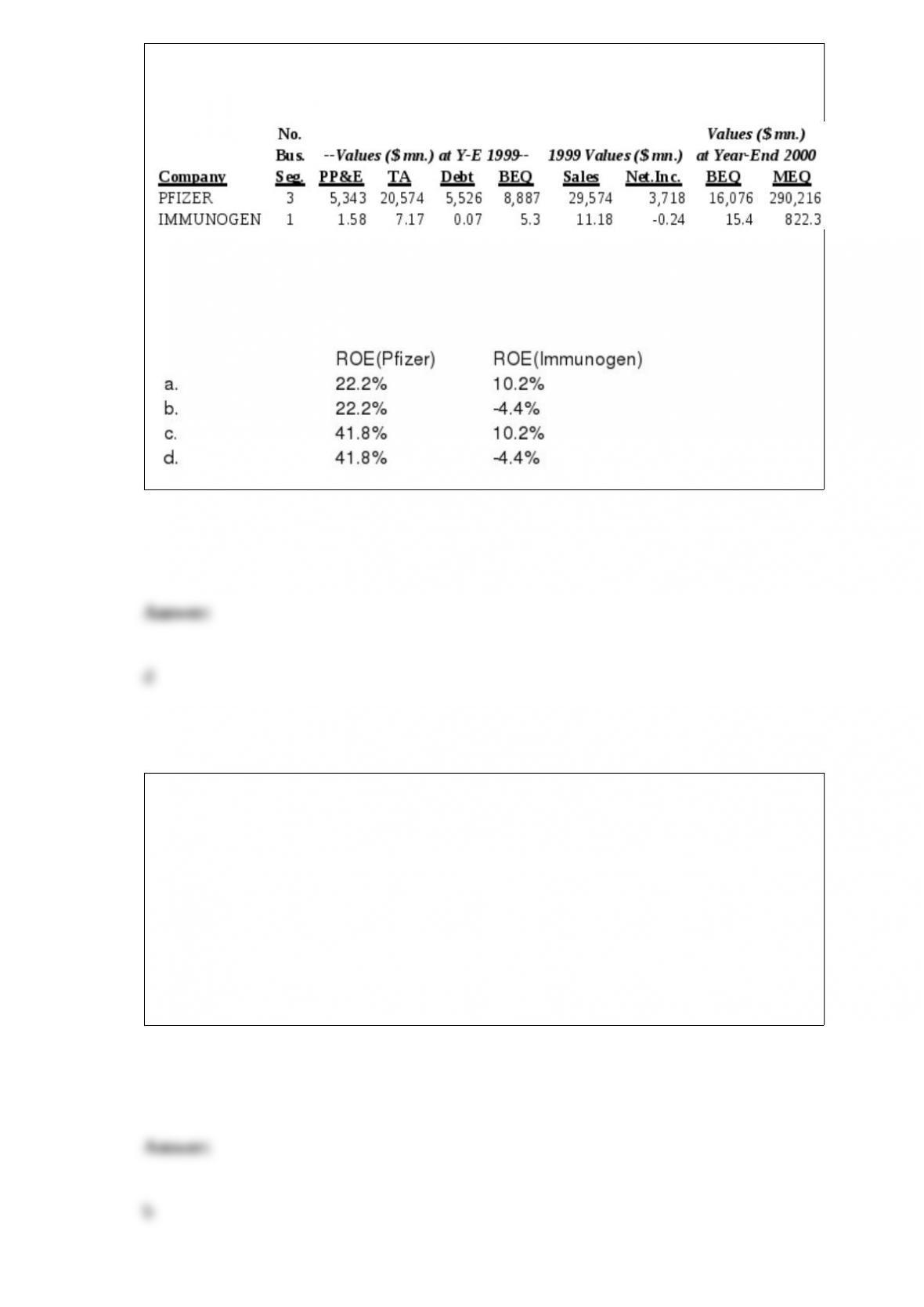
The next three problems require the data shown below for a large firm (Pfizer)
and a smaller firm (Immunogen) in the Chemicals & Allied Products industry:
FORMULAS: ROEt=(NIt/BEQt-1)=(NIt/Salest)(Salest/TAt-1)(TAt-1/BEQt-1)
Calculate each firm’s 2000 ROE.
Which of the following is the fundamental difference between private (bank) debt and
publicly issued debt?
a. Public debt is often referred to asinside debt because of the close relationship
between the lenders and the borrower, while a bank loan is called outside debt because
the lender essentially has no active relationship with the borrower.
b. A bank loan is often referred to asinside debt because of the close relationship
between lender and borrower, while public debt is called outside debt because the
lenders essentially have no active relationship with the borrower.

The beta (ß) of Ames’ stock is 2.5. The riskfree rate is 2%, and the expected return on
the market portfolio is 16%. What is the expected return on Ames’ stock?
a. 22%
b. 27%
c. 32%
d. 37%
FORMULA: ri=rf+ßi[rm-rf]
Gompers’ (1995) theoretical model of venture financing focused on mitigating
principal-agent conflicts between the entrepreneur and an outside financier. His model
explains why ventures are developed in stages: the end of each stage is
a. a cash-out opportunity.
b. an opportunity to harvest parts of the venture.
c. a time for management to rest and recuperate.
d. a monitoring opportunity.