
In January 2010, the U.S. Treasury issued a $1000 par. ten-year, inflation-indexed note
with a coupon of 4%. On the date of issue, the consumer price index (CPI) was 200. By
January 2020, the CPI had increased to 300. The coupon payment that was made in
January 2020 is closest to:
A) $20
B) $30
C) $40
D) $50
Answer:
Which of the following equations is incorrect?
A) E[Rxp] = rf + x(E[Rp] – rf)
B) E[Rxp] = (1 – x)rf + xE[Rp]
C) Sharpe ratio =
D) SD( Rxp) =xSD(Rp)
Answer:

Which of the following statements is false?
A) Depreciation expenses have a positive impact on free cash flow.
B) Free Cash Flow = (Revenues – Costs – Depreciation) x (1 – τc) – Capital Expenditures
– ΔNWC + τc x Depreciation.
C) The firm cannot use its earnings to buy goods, pay employees, fund new
investments, or pay dividends to shareholders.
D) The depreciation tax shield is the tax savings that results from the ability to deduct
depreciation.
Answer:
Use the information for the question(s) below.
You own a small manufacturing plant that currently generates revenues of $2 million
per year. Next year, based upon a decision on a long-term government contract, your
revenues will either increase by 20% or decrease by 25%, with equal probability, and
stay at that level as long as you operate the plant. Other costs run $1.6 million dollars
per year. You can sell the plant at any time to a large conglomerate for $5 million and
your cost of capital is 10%.

Given the embedded option to sell the plant, the value of your plant will be closest to:
A) $5.0 million
B) $4.0 million
C) $6.5 million
D) $8.0 million
Answer:
Which of the following statements is false?
A) Leases may include early cancellation options that allow the lessee to end the lease
early (perhaps for a fee).
B) The cost of the lease will depend on the asset’s residual value, which is its book
value at the end of the lease.
C) Leases may allow the lessee to trade in and upgrade the equipment to a newer model
at certain points in the lease.
D) Leases may contain buyout options that allow the lessee to purchase the asset before
the end of the lease term.

Answer:
Which of the following statements is false?
A) A public warehouse is a business that exists for the sole purpose of storing and
tracking the inflow and outflow of the inventory.
B) A warehouse arrangement is the riskiest collateral arrangement from the standpoint
of the lender.
C) Because the warehouser is a professional at inventory control, there is likely to be
little loss due to damaged goods or theft, which in turn lowers insurance costs.
D) A field warehouse is operated by a third party, but is set up on the borrower’s
premises in a separate area so that the inventory collateralizing the loan is kept apart
from the borrower’s main plant.
Answer:
Use the following information to answer the question(s) below:
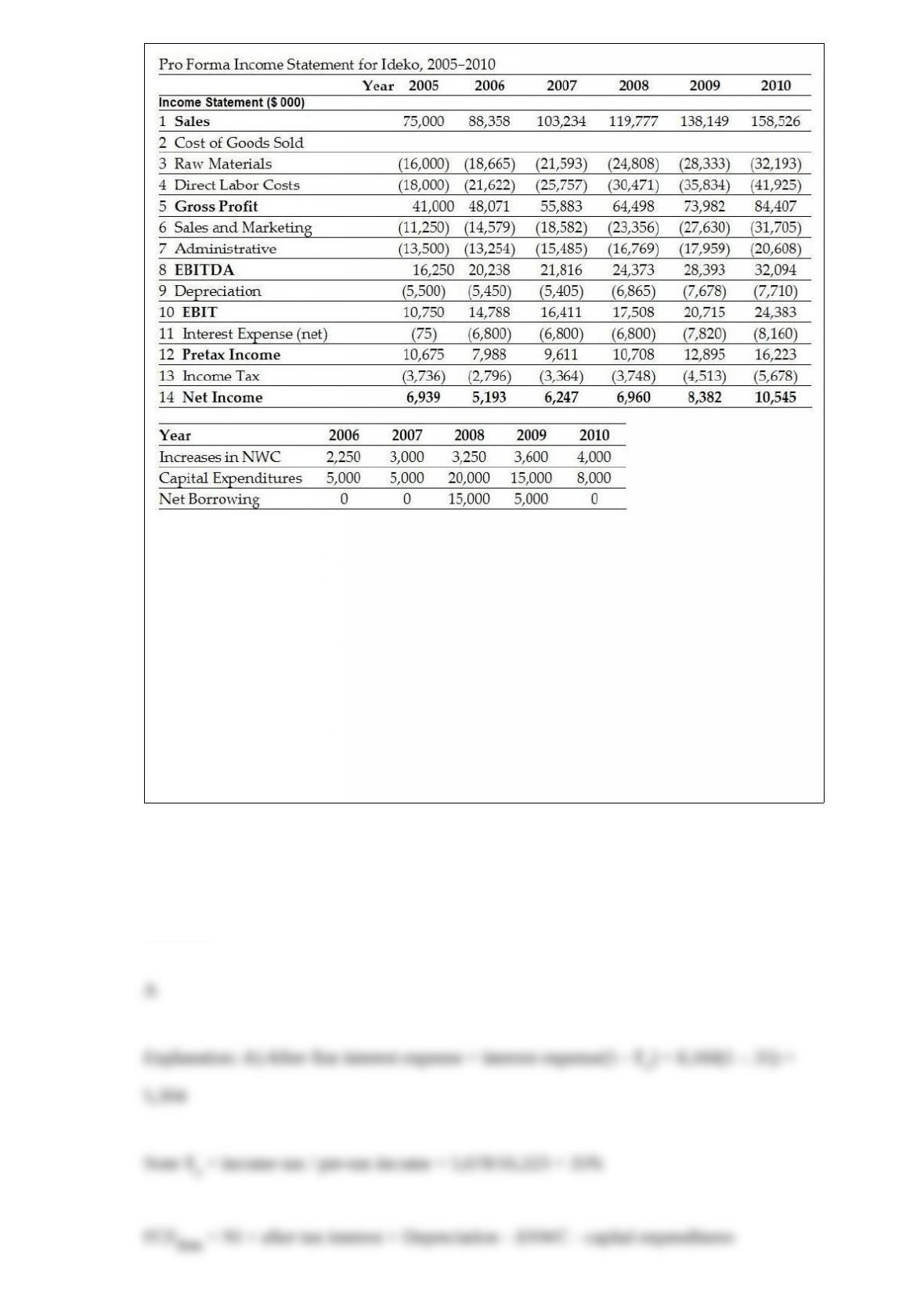
The free cash flow to equity in 2010 is closest to:
A) 6,255
B) 10,684
C) 11,559
D) 18,394
E) 19,269
Answer:

Use the information for the question(s) below.
Kinston Industries has come up with a new mountain bike prototype and is ready to go
ahead with pilot production and test marketing. The pilot production and test marketing
phase will last for one year and cost $500,000. Your management team believes that
there is a 50% chance that the test marketing will be successful and that there will be
sufficient demand for the new mountain bike. If the test-marketing phase is successful,
then Kinston Industries will invest $3 million in year one to build a plant that will
generate expected annual after tax cash flows of $400,000 in perpetuity beginning in
year two. If the test marketing is not successful, Kinston can still go ahead and build the
new plant, but the expected annual after tax cash flows would be only $200,000 in
perpetuity beginning in year two. Kinston has the option to stop the project at any time
and sell the prototype mountain bike to an overseas competitor for $300,000. Kinston’s
cost of capital is 10%.
Assuming that Kinston has the ability to sell the prototype in year one for $300,000, the
NPV of the Kinston Industries Mountain Bike Project is closest to:
A) $90,000
B) $590,000
C) $455,000
D) -$45,000
Answer:

Mutually dependent investments occur when
A) the value of one project depends upon the outcome of one or other projects.
B) the value of one project is independent of any other projects.
C) a firm depends on another firm to provide materials for a project.
D) consumers and producers depend on each other’s investments.
Answer:
Use the information for the question(s) below.
Shepard Industries is evaluating a proposal to expand its current distribution facilities.
Management has projected the project will produce the following cash flows for the
first two years (in millions).
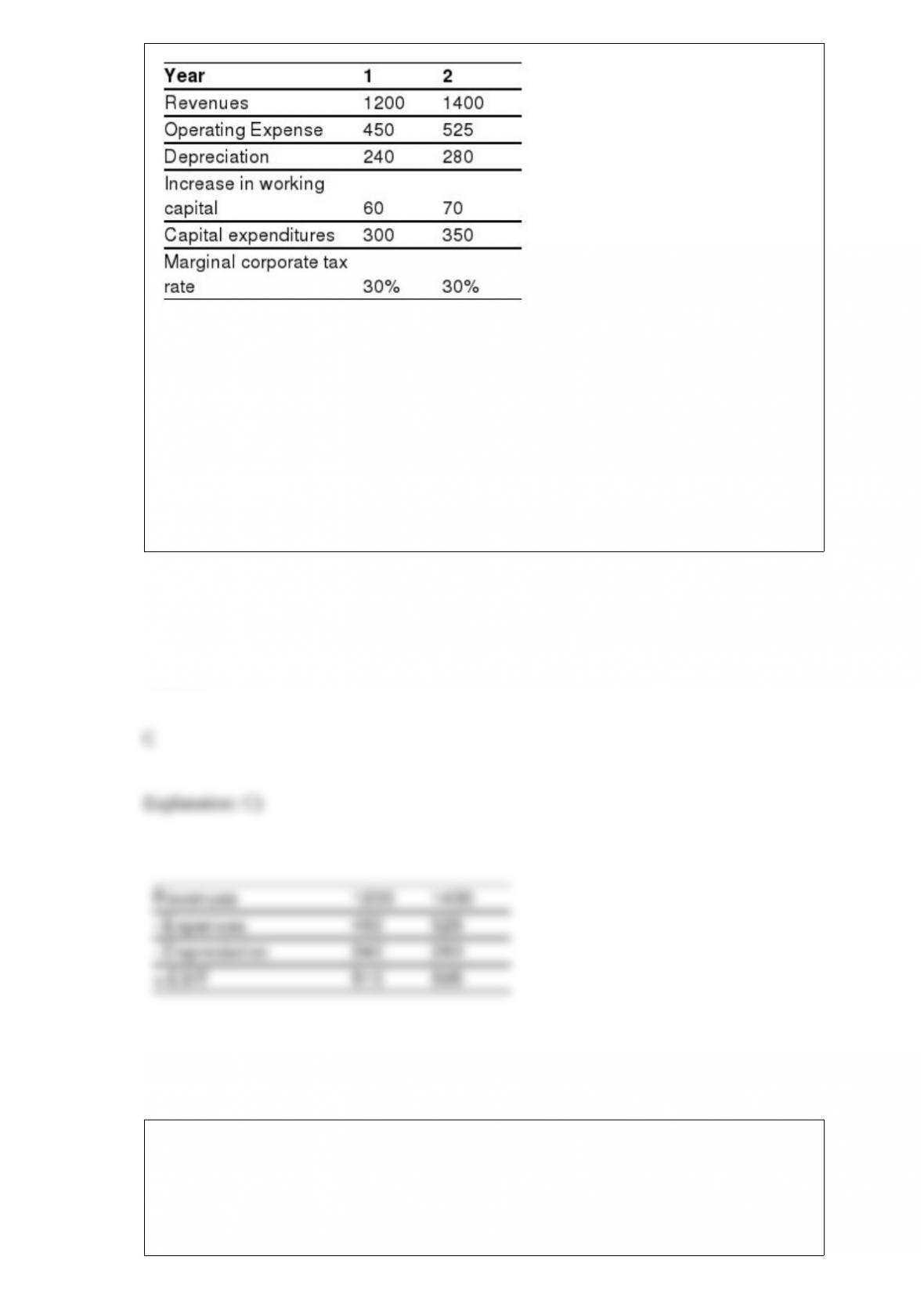
The incremental EBIT for Shepard Industries in year two is closest to:
A) $415
B) $875
C) $595
D) $510
Answer:
Which of the following statements is false?
A) Even after adjusting for personal taxes, the value of an unlevered firm exceeds the
value of a levered firm, and there is a tax advantage to using debt financing.

B) In Modigliani and Miller’s setting of perfect capital markets, firms could use any
combination of debt and equity to finance their investments without changing the value
of the firm.
C) When firms raise new capital from investors, they do so primarily by issuing debt.
D) In most years aggregate equity issues are negative, meaning that firms are reducing
the amount of equity outstanding by buying shares.
Answer:
In a corporation, the ultimate decisions regarding business matters are made by
A) the Board of Directors.
B) debt holders.
C) shareholders.
D) investors.
Answer:
Which of the following organization forms accounts for the greatest number of firms?
A) “S” Corporation
B) Limited Partnership
C) Sole Proprietorship
D) “C” Corporation
Answer:
Use the table for the question(s) below.
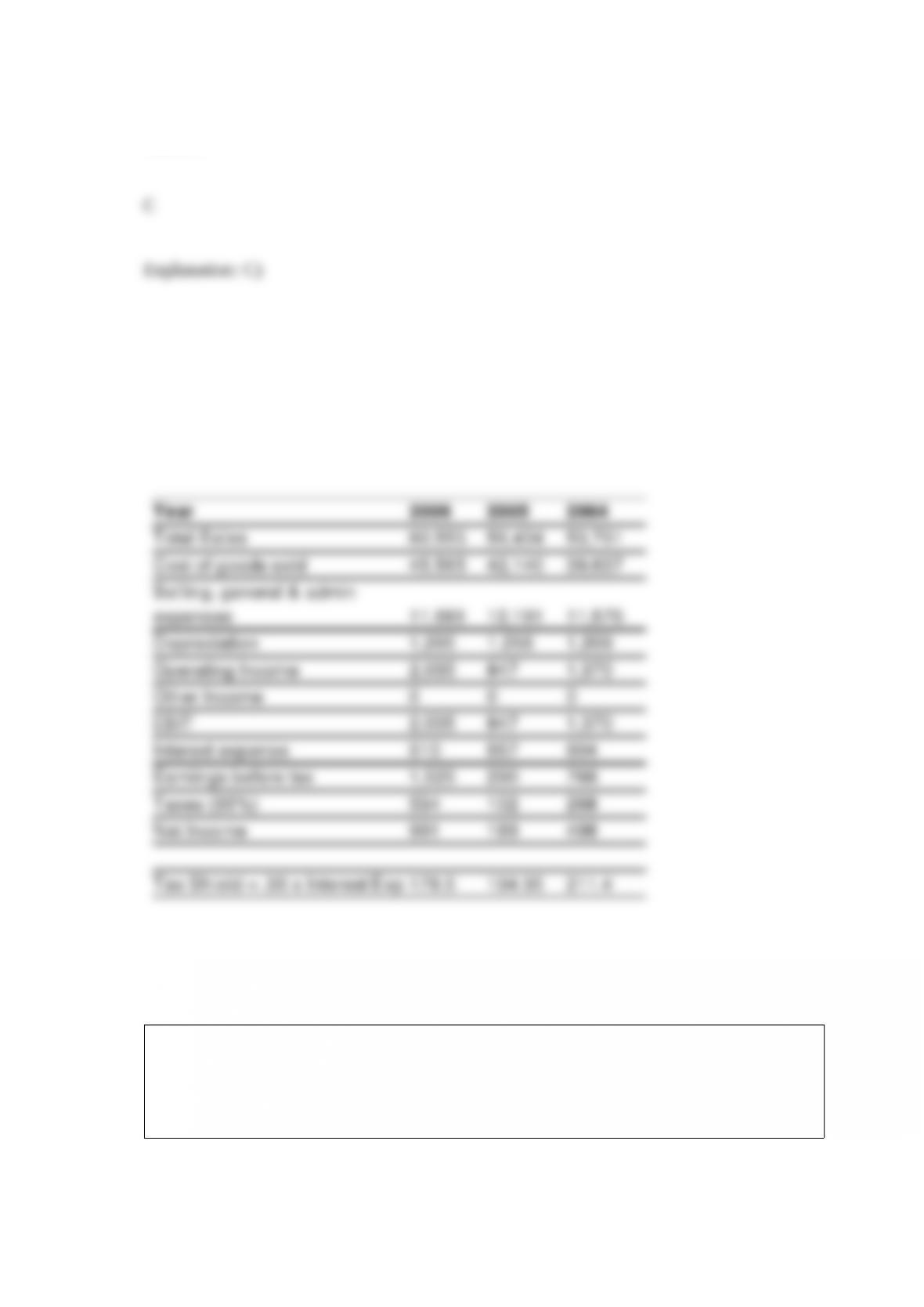
Consider the following income statement for Kroger Inc. (all figures in $ Millions):
The interest rate tax shield for Kroger in 2004 is closest to:
A) $268 million
B) $393 million
C) $211 million
D) $94 million
Answer:
Use the following information to answer the question(s) below.
Consider the following four corporate bonds that have semiannual compounding:

If the YTM of these bonds decreases to 7%, which bond’s price would be most sensitive
to this change in YTM?
A) #1
B) #2
C) #3
D) #4
E) #3 and #4
Answer:
You expect Whirlpool Corporation (WHR) to have earnings per share of $6.10 over the
coming year. If Whirlpool stock is currently trading at $87.00 per share, then
Whirlpool’s P/E ratio is closest to:
A) 17.00
B) 13.50
C) 14.25
D) 7.00
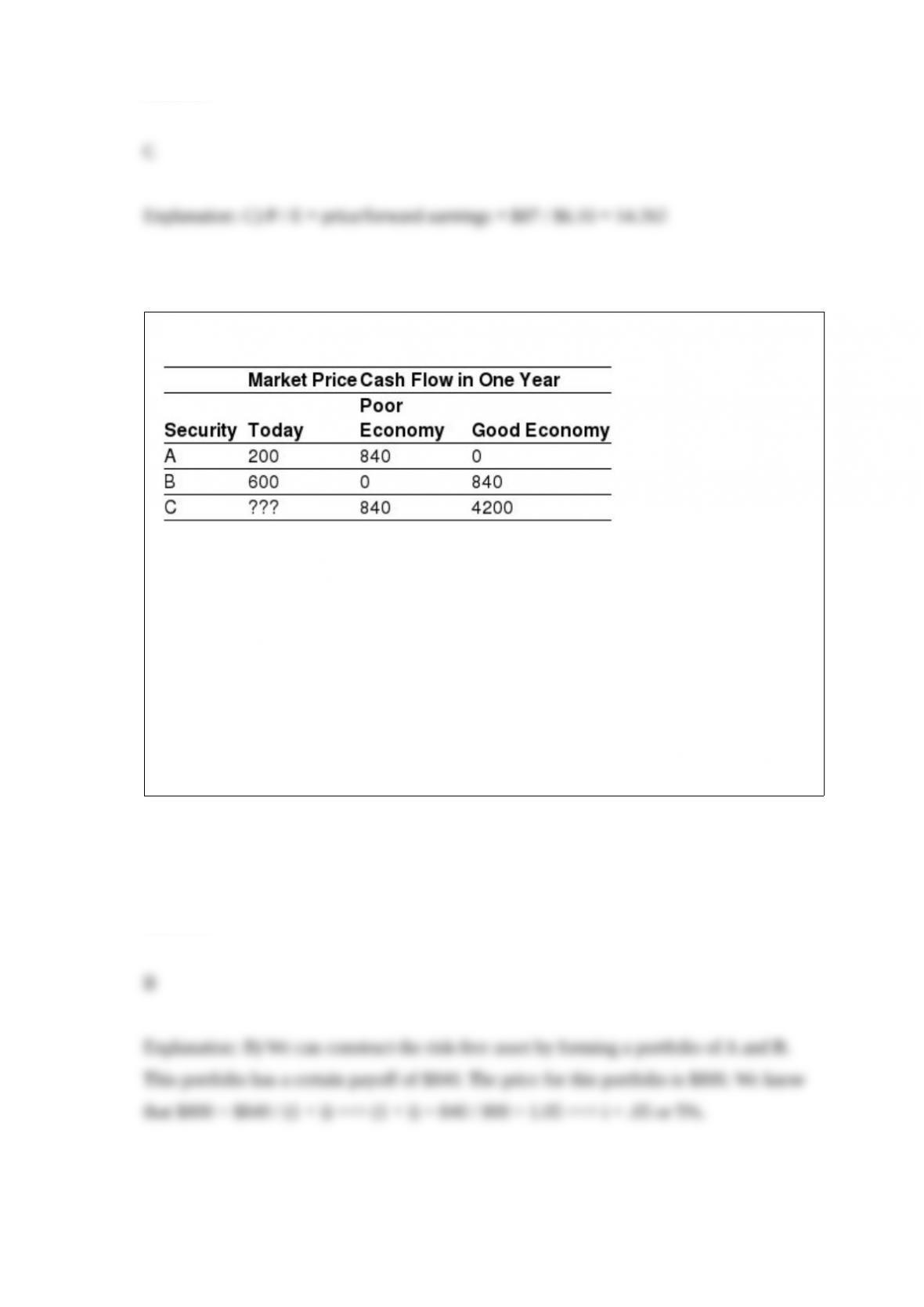
Answer:
Based upon the information provided about securities A, B, and C, the risk-free rate of
interest is closest to:
A) 4%
B) 5%
C) 8%
D) 10%
Answer:

Which of the following statements is false?
A) Almost all bonds that are issued today are registered bonds.
B) The trust company represents the bondholders and makes sure that the terms of the
indenture are enforced.
C) For private placements, the prospectus must include an indenture, a formal contract
between the bond issuer and a trust company.
D) In the case of default, the trust company represents the bondholders’ interests.
Answer:
If Wal-Mart and Target were to merge, this would be an example of a ________ merger.
A) conglomerate
B) vertical
C) horizontal
D) diagonal
Answer:
Which of the following statements is false?

A) In general, the expected future spot interest rate will reflect investor’s preferences
toward the risk of future interest rate fluctuations.
B) If investors did not care about risk, then they would be indifferent between investing
in a two-year bond and investing in a one-year bond and rolling over the money in
one-year.
C) When we refer to the one-year forward rate for year 5, we mean the rate available
today on a one-year investment that begins four years from today and is repaid five
years from today.
D) In general, we can compute the forward rate for year n by comparing an investment
in an n-year, zero-coupon bond to an investment in an (n + 1) year, zero-coupon bond,
with the interest rate earned in the nth year being guaranteed through an interest rate
forward contract.
Answer:
Which of the following statements is false?
A) Because a short position in an option is the other side of a long position, the profits
from a short position in an option are just the negative of the profits of a long position.
B) The deeper out-of-the-money the put option is, the less negative its beta, and the
higher is its expected return.
C) Although payouts on a long position in an option contract are never negative, the
profit from purchasing an option and holding it to expiration could well be negative
because the payout at expiration might be less than the initial cost of the option.
D) The put position has a higher return in states with lowstock prices; that is, if the
stock has a positive beta, the put has a negative beta.
Answer:

Using risk neutral probabilities, the calculated price of a one-year put option on KD
stock with a strike price of $20 is closest to:
A) $2.00
B) $2.15
C) $1.45
D) $2.40
Answer:
You own a bond with a face value of $1,000 and a conversion price of $40. The
conversion ratio is closest to:
A) 15
B) 20
C) 25
D) 40

Answer:
Which of the following statements is false regarding a call provision?
A) The issuer can repurchase a fraction of the outstanding bonds in the market or it can
make a tender offer for the entire issue.
B) A callprovision allows the issuer to repurchase the bonds at a predetermined price.
C) The call price is generally set at or below, and expressed as a percentage of, the
bond’s face value.
D) A call feature allows the issuer of the bond the right (but not the obligation) to retire
all outstanding bonds on (or after) a specific date (the call date), for the call price.
Answer:
Consider the following list of projects:

Assuming that your capital is constrained, so that you only have $600,000 available to
invest in projects, which project should you invest in and in what order?
A) CBFH
B) CBGF
C) BCFG
D) CBFG
Answer:

Use the following information to answer the question(s) below.
Dagny Taggart has just purchased a home and taken out a $400,000 mortgage. The
mortgage has a 30-year term with monthly payments and has an APR of 5.4%.
The total amount of principal that Dagny will pay during the first three months of her
mortgage is closest to:
A) $1,340
B) $1,345
C) $5,395
D) $6,740
Answer:

Which of the following statements is false?
A) In particular, because real options allow a decision maker to choose the most
attractive alternative after new information has been learned, the presence of real
options adds value to an investment opportunity.
B) To make an investment decision correctly, the value of embedded real options must
be included in the decision-making process.
C) A key distinction between a real option and a financial option is that real options,
and the underlying assets on which they are based, are often traded in competitive
markets.
D) We can compute the value of the real option by comparing the expected profit
without the real option to the value with the option.

Answer:
Which of the following statements is false?
A) The market portfolio contains more of the smallest stocks and less of the larger
stocks.
B) For the market portfolio, the investment in each security is proportional to its market
capitalization.
C) Because the market portfolio is defined as the total supply of securities, the
proportions should correspond exactly to the proportion of the total market that each
security represents.
D) Market capitalization is the total market value of the outstanding shares of a firm.
Answer:
Which of the following is not a direct action that can be taken by shareholders?
A) Submitting shareholder resolutions directing the board to take specific actions
B) Withholding votes for the board of directors candidates
C) Initiating a proxy contest
D) Voting to remove the management team

Answer:
Use the following information to answer the question(s) below.
Wyatt Oil issued $100 million in perpetual debt (at par) with an annual coupon of 7%.
Wyatt will pay interest only on this debt. Wyatt’s marginal tax rate is expected to be
40% for the foreseeable future.
Wyatt’s annual interest tax shield is closest to:
A) $2.8 million
B) $4.2 million
C) $7.0 million
D) $40 million
Answer:
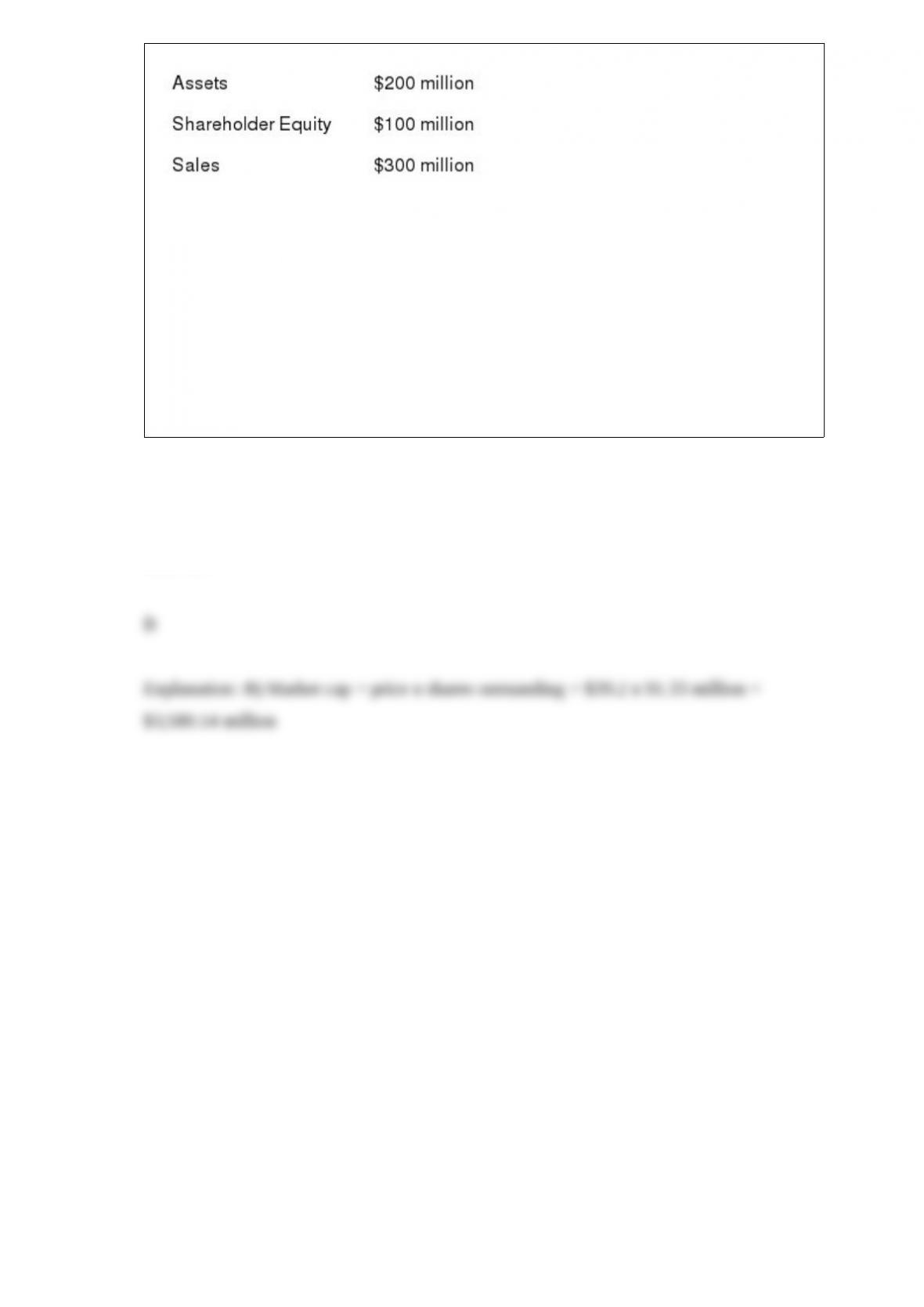
Use the following information for ECE incorporated:
Perrigo’s market capitalization is closest to:
A) $952.16 million
B) $3,580.14 million
C) $4,168.06 million
D) $4,425.15 million
Answer: