
Bank holding companies that want to achieve some reduction in earnings risk through
interstate banking, can achieve the same level of risk reduction by entering any of the
fifty states.
Answer:
One investment maturity strategy popular among smaller institutions is the ladder or
spaced-maturity policy. It is popular because it does not take much expertise to
implement.
Answer:
Legally imposed interest-rate ceilings on deposits were first set in place in the United
States after passage of the Bank Holding Company Act.
Answer:

Many banks are not only users of derivative products but also dealers.
Answer:
Nearly all U.S. banks with federal or state charters have their deposits insured by the
Federal Deposit Insurance Corporation.
Answer:
The board of directors and senior management of the banks that are awarded top CRA
ratings are often committed to promote community involvement.
Answer:

A proposed merger between two or more banks must be ratified by the board of
directors of each bank involved, followed by the management of each of the banks, and
then all the shareholders of all the banks. The merger can proceed thereafter once
regulators’ approval is received.
Answer:
Portfolio diversification refers to seeking out customers located in different
communities or countries, which presumably will experience different economic
conditions.
Answer:
According to the textbook, small business lending by banks is on the decline.
Answer:

Under U.S. regulations, Edge Act subsidiaries must devote at least 50 percent of their
business to assist customers with export-import trade and international credit.
Answer:
Smaller banks usually have fewer liquid assets than larger banks.
Answer:
A restriction against a borrower taking on new debt during a loan period is an
affirmative covenant in a loan contract.
Answer:

Yankee CDs are issued by savings and loan associations and other nonbank savings
institutions.
Answer:
The top trading firms in the global currency markets are all banks.
Answer:
According to recent studies cited in this chapter, the number one factor that households
consider in choosing a bank to hold their savings deposit is location.
Answer:

The “right of offset” allows a bank to auction a customer’s property to the highest
bidder to recover a loan in default.
Answer:
An interest-rate cap will become more valuable as interest rates rise.
Answer:
Real estate loans are smaller in size and shorter in maturity than most other types of
bank loans.
Answer:

Duration is the weighted average maturity of a promised stream of future cash flows.
Answer:
Under the terms of the 1994 Riegle-Neal Interstate Banking and Branching Efficiency
Act, adequately capitalized and managed bank holding companies can acquire a bank
anywhere inside the United States.
Answer:
One of the major reasons behind the rapid growth of mergers in recent years is that
stockholders expect the profit potential to increase once the merger is completed.
Answer:

For ease and convenience, most banks have the loan review conducted by the same
person who makes the loan. This is particularly true of large banks.
Answer:
When a financial institution offers to sell financial futures contract, it is agreeing to take
delivery of certain kinds of securities on a stipulated date at a predetermined price.
Answer:
The “A” in the CAMELS rating system stands for asset quality.
Answer:

Community banks are usually smaller banks that are devoted principally to the markets
for smaller, local deposits and loans.
Answer:
An international bank with a positive net exposure in a given foreign currency is said to
be in a net short position in that particular currency.
Answer:
According to recent research, bank stock prices usually drop within a week after a
dividend cut is announced.
Answer:

If a bank’s agent visits a dealer using floor planning and finds any inventory items sold
for which the bank providing finance has not received payment, the loan will be
immediately foreclosed upon.
Answer:
Mergers with anticompetitive effects can only be approved at the federal level if one of
the banks involved is failing.
Answer:
Interest income and capital gains from a bank’s portfolio of investment securities are
taxed in the United States as ordinary income.
Answer:

Basic principles of financial management suggest that attempting to maximize a bank’s
stock value is the key objective for banks which should have priority over all other
goals.
Answer:
Self-liquidating business loans are designed to take advantage of the normal cash cycle
in a business firm.
Answer:
Securitizations of commercial loans usually carry the same regulatory capital
requirements for a bank as the original loans themselves.
Answer:

A project loan is granted to several companies jointly sponsoring a large project, and
the lender can recover funds from such sponsoring companies, if the project does not
pay out as planned. This is known as a project loan granted on a recourse basis.
Answer:
One advantage of an interest rate swap agreement is that the brokerage fees are very
low.
Answer:
A standby letter of credit substantially reduces the issuing bank’s interest rate risk and
liquidity risk.

Answer:
Most banks report securities gains as a component of their total noninterest income.
Answer:
Term loans normally are secured by accounts receivable and inventory.
Answer:
The prohibition against combining investment banking and commercial banking
activity during the Depression-era, centered on possibly forcing customers seeking
loans to buy securities that the IB was trying to sell and increasing the risk exposure of
commercial banking firms.

Answer:
A foreign currency contract that gives the holder of the contract the right to purchase a
currency at a fixed price any time before the published expiration date is called a:
A. call currency option.
B. put currency option.
C. long-hedge currency futures contract.
D. short-hedge currency futures contract.
E. None of the options is correct.
Answer:
The approach in which the firm to be acquired is valued at its purchase price and that
price is added to the total assets of the acquirer is known as the:
A. purchase accounting method.
B. merger accounting method.
C. pooling of interest method.
D. pooling of equity method.
E. pooling of accounting method.

Answer:
A bank that goes short in the futures market: A. has the right to accept delivery of the
underlying security at the contract price if they wish.
B. has the right to make delivery of the underlying security at the contract price if they
wish.
C. is obligated to accept delivery of the underlying security at the contract price.
D. is obligated to make delivery of the underlying security at the contract price.
E. is exposed to limited losses and unlimited gains.
Answer:
The strategy that banks should buy the reserves they need to cover good-quality loan
requests is known as:
A. funds management.
B. asset management.
C. liability management.
D. asset-liability coordinated management.

E. None of the options is correct.
Answer:
Why do regulators prefer higher capital requirements?
A. It justifies the existence of regulatory agencies.
B. It protects the deposit insurance fund from serious losses.
C. It enhances bank asset quality.
D. It decreases bank profitability.
E. It increases bank leverage.
Answer:
Relative to manufacturing firms, banks tend to have ___________ number of board
members.
A. same
B. larger

C. smaller
D. insignificant
E. None of the options are correct
Answer:
A treasury bill currently selling for $9,845, has a face value of $10,000 and has 46 days
to maturity. What is the yield to maturity equivalent on this security?
A. 12.49 percent
B. 12.13 percent
C. 12.30 percent
D. 2 percent
E. None of the options is correct.
Answer:
Which of the following is one of the customer services supplied by banks in

international markets?
A. Underwriting notes and bond issues in the U.S. bond market
B. Helping customer market their products in the domestic market
C. Helping customers hedge against foreign currency risk
D. Making loans to domestic customers
E. All of the options are customer services offered by banks in the international market.
Answer:
Mark Brown receives a $2,000 loan with the intention of repaying the loan in 12
months. However, at the end of one month, Mr. Brown discovers that he can repay the
loan in full. According to the rule of 78s, what percentage of the interest charge is he
entitled to receive as a rebate?
A. 36.67 percent
B. 50.00 percent
C. 91.67 percent
D. 84.62 percent
E. None of the options is correct
Answer:

The federal agency that is the merging banks’ principal supervisor must review the
banks’ record to determine if they have made an affirmative effort to serve all segments
of the population in their trade area without any discrimination. This assessment is
required under the terms of:
A. Gramm-Leach-Bliley Act.
B. Riegle-Neal Interstate Banking Act.
C. Sherman Antitrust Act.
D. Community Reinvestment Act.
E. Sarbanes-Oxley Act.
Answer:
The earnings spread for a bank is equal to:
A. total interest income divided by total earning assets less total interest expense
divided by total interest-bearing bank liabilities.
B. total interest income less total interest expenses divided by earning assets.
C. total operating revenues less total operating expenses divided by total assets.
D. total cash and noncash expenses subtracted from interest and noninterest income
divided by total assets.
E. None of the options is correct.

Answer:
The Wabash Washing Machine Company has arranged to get a loan from their bank
over the next five years. They can borrow up to a pre-specified limit and repay it as
many times as they need until the loan matures. The Wabash Washing Machine
Company has not pledged any specific collateral for this loan. What type of loan is this
most likely to be?
A. Term business loan
B. Revolving credit financing
C. Long-term project loan
D. Leveraged buyout
E. Syndicated loan
Answer:
According to the textbook, the role(s) of capital is to:
A. provide a cushion against failure risk.
B. provide funds needed to charter, organize, and operate a bank.
C. promote public confidence.
D. support growth and the development of new services.
E. All of the options are correct.
Answer:
Following data pertains to Castle State Bank.
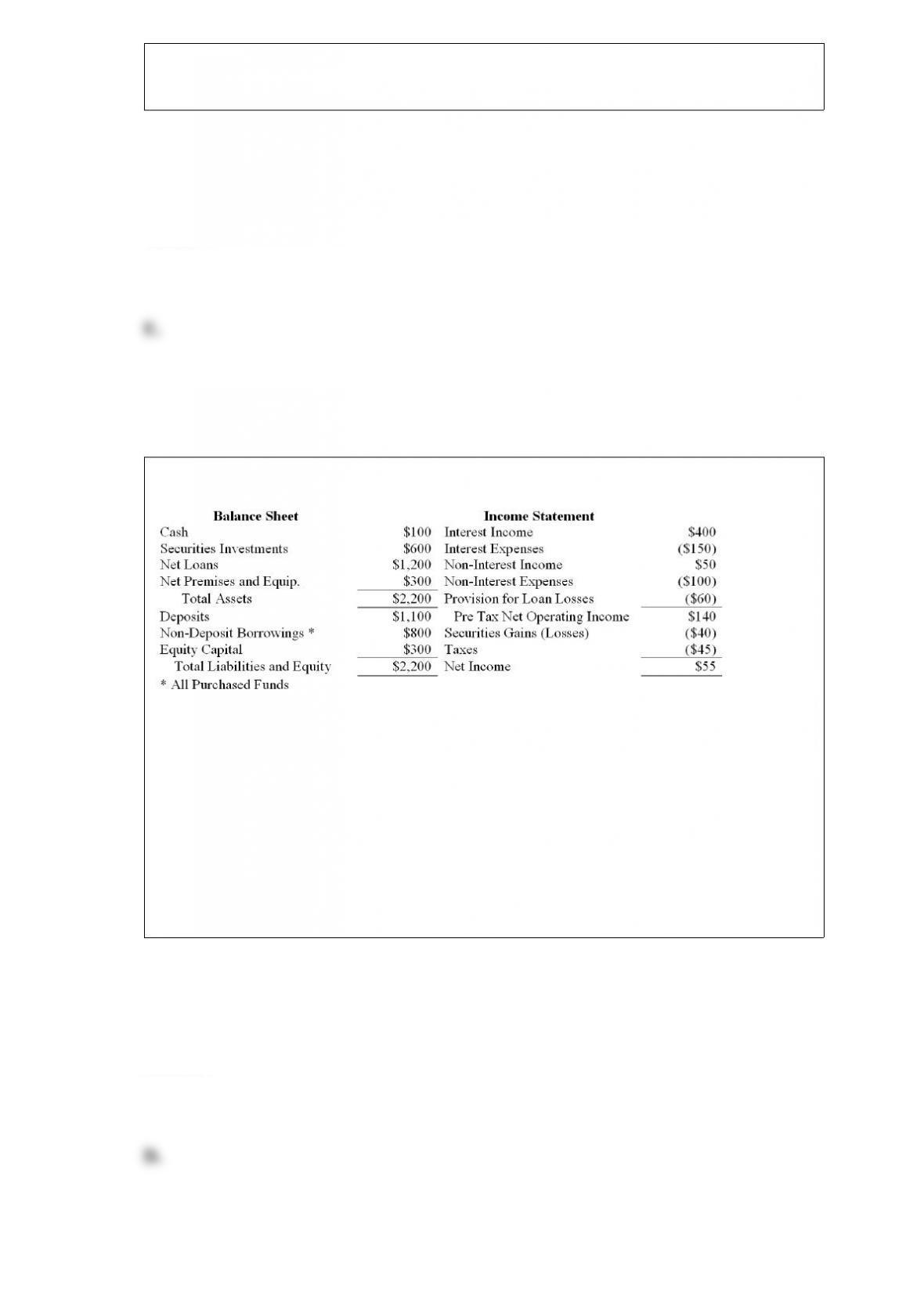
What is the bank’s equity multiplier? A. 20.45 times
B. 18.33 times
C. 12.22 times
D. 7.33 times
E. 2.5 times
Answer:

The most common type of loans foreign banks make in the U.S. are:
A. commercial loans.
B. retail loans.
C. real estate loans.
D. credit card loans.
E. None of the options is correct.
Answer:
A person responsible for overseeing an institution’s legal reserve account is called:
A. reserve manager.
B. money market manager.
C. money position manager.
D. legal counselor.
E. None of the options is correct.
Answer:

The September T-bond futures contract is currently selling at 111-05 and September call
option on T-bond futures for a strike price of 115-00 is currently quoting at 2-24. If an
investor purchases one contract of the call option at the current market price and if the
T-bond futures contract settles at 118-05 on the expiration day, what will be the net
gain/loss for the investor?
A. $781.25
B. $281.25
C. -$359.38
D. $791.25
E. $566.25
Answer:
Which of the following is a way in which a bank can deal with a troubled international
loan?
A. The loan can be restructured generally with a lower interest rate and longer time to
repay
B. The loan can be sold in the secondary market
C. The bank can write off all or part of the loan
D. The bank can accept exit bonds in lieu of loan repayment
E. All of the options are ways to deal with a troubled international loan
Answer:

The act which requires financial institutions to share information about customer
identities with government agencies is:
A. the Sarbanes-Oxley Act.
B. the National Banking Act.
C. the Garn-St Germain Depository Institutions Act.
D. the USA Patriot Act.
E. the Gramm-Leach-Bliley Act.
Answer:
A bank has capital to risk-weighted assets of 5.5%, Tier 1 capital to risk-weighted assets
of 2.8% and a leverage ratio of 2.6%. What type of bank is this?
A. Well capitalized
B. Adequately capitalized
C. Undercapitalized
D. Significantly undercapitalized
E. Critically undercapitalized

Answer:
Under current U.S. law, the Federal Reserve Board must be notified a minimum of
__________ days in advance if a foreign bank wishes to close any of its U.S. offices.
A. 30
B. 60
C. 90
D. 180
E. None of options is correct.
Answer:
ROE for a bank indicates:
A. how capable the management has been in converting assets into net earnings.
B. the growth of bank’s interest margin.
C. the growth of bank’s earnings spread.
D. the rate of return flowing to the shareholders of the bank.
E. All of the options are correct.

Answer:
In a revolving line of credit, where a customer is subject to high fees and interest costs
and is required to make only a small portion of total debt owed, usually called
“minimum payment”, often results in:
A. amortization of debt.
B. negative amortization of debt.
C. depreciation of debt.
D. cumulative depreciation of debt.
E. prepayment of debt.
Answer:
A financial institution that goes long in the futures market: A. has the right to accept
delivery of the underlying security at the contract price if they wish.
B. has the right to make delivery of the underlying security at the contract price if they
wish.
C. is obligated to accept delivery of the underlying security at the contract price.
D. is obligated to make delivery of the underlying security at the contract price.
E. is exposed to limited losses and unlimited gains.

Answer:
A buyer of a put option on fixed-income securities is most likely to:
A. exercise the option if interest rates rise.
B. let the option expire if the interest rates rise.
C. exercise the option if interest rates fall.
D. exercise the option if interest rates remain constant.
E. buy a call option also on the same securities.
Answer:
Which of the following is true regarding credit card loans?
A. There is evidence that considerable economies of scale exist in credit card loans.
B. Credit cards loans cannot act as installment loans.
C. Credit cards loans are very inconvenient for consumers.
D. Credit cards loans are very inflexible for consumers.

E. All of the options are true.
Answer:
Banks are regulated for which of the reasons listed below?
A. Banks are leading repositories of the public’s savings.
B. Banks have the power to create money.
C. Banks provide businesses and individuals with loans that support consumption and
investment spending.
D. Banks assist governments in conducting economic policy, collecting taxes, and
dispensing government payments.
E. All of the options are correct.
Answer:
The law that set up the federal banking system and provided for the chartering of
national banks was the:
A. National Bank Act.

B. McFadden Act.
C. Glass-Steagall Act.
D. Bank Merger Act.
E. Federal Reserve Act.
Answer:
A bank has a long-term relationship with a particular business customer. However,
recently the bank has become concerned because of a potential deterioration in the
customer’s income. In addition, regulators have expressed concerns about the bank’s
capital position. The business customer has asked for a renewal of its $25 million dollar
loan with the bank. Which of the following can be used to help this situation?
A. Standby letter of credit
B. Loan sale
C. Loan securitization
D. Credit risk option
E. Credit-linked notes
Answer:

Which of the following consumer loans has grown in popularity as a result of the
passage of the Tax Reform Act of 1986?
A. Credit card loans
B. Home equity loans
C. Long-term, noninstallment loans
D. Short-term, installment loans
E. All of the options are correct
Answer:
From an analysis on its deposits, a bank determines that account processing and other
operating expenses cost the bank $4.15 per month. It has also determined that
non-operating expenses on its deposits are $1.65 per month. The bank wants to have a
profit margin which is 10 percent of monthly costs. What monthly fee should the bank
charge on its deposit accounts?
A. $6.38 per month
B. $5.80 per month
C. $4.57 per month
D. $4.15 per month
E. None of the options is correct
Answer:

A(n) _________________________ is a savings instrument in which the customer
makes cash payments to an investment manager who invests them in an earning asset.
Later the purchaser receives a stream of income from those assets.
Answer:
One of the traditional measures of earnings efficiency is ________________________
or total interest income over total earnings assets less total interest expenses over total
interest bearing bank liabilities. It measures the effectiveness of a firm’s intermediation
function in the borrowing and lending of money.
Answer:
The borrower’s ______________________ position reflects his or her ability to raise
cash in a timely fashion at a reasonable cost.

Answer:
___________________________ is the idea that as the output grows, cost of
production per unit of goods and services will grow at a lower rate.
Answer:
The buyer of a(n) _________________________ option contract believes that the
market price of the underlying security will increase in the future.
Answer:
The law that requires full disclosure of credit terms and which promotes the informed
use of credit is the ______________________ Act. This law requires banks to report
the APR of the loan, the dollar amount of all finance charges and, where appropriate, all
fees.

Answer:
The degree of __________________ in a market is measured by the proportion of
assets controlled by the largest institutions serving that market. In the banking industry,
this is measured but the Herfindahl-Hirschman Index.
Answer:
The CDs that large foreign banks sell through their U.S. branches are called
________________________.
Answer:
____________________________________________ are the other potential claims
against the borrower which do not show up on the borrower’s balance sheet. One new
form of this is due to environmental damage by the borrower.

Answer:
The country with the most banks is ______________________.
Answer:
The daily average amount of deposits and other reservable liabilities are computed
using information gathered over a two-week period extending from a Tuesday to a
Monday two weeks later. This interval is known as ___________.
Answer:
On the exchange floor, _________ execute orders received from the public to buy and
sell the futures contract at the best possible price.

Answer:
The ______________________________ is a way to price loans which allows banks to
compete with the commercial paper rate.
Answer:
A popular prepaid card which carry balances that can be spent electronically in stores
until the balance entered on the card is fully used up, often used like a credit card,
especially popular in Europe, is known as a _________ card.
Answer:
_________________________ are instruments which have more than one year to reach

maturity.
Answer:
The __________________ premium on a bond allows the investor to be compensated
for their projected loss in purchasing power from the increase in the prices of goods and
services in the future.
Answer:
The ____________ is where a money position manager can cover a large reserve deficit
quickly. It is usually one of the cheapest places to borrow but is also frequently
volatile.
Answer:

Companies such as Merrill Lynch and Sears which offered some but not all banking
services in the 1980s were called ______________________.
Answer:
The interest rate method that adds the interest amount owed to the principal before
calculating required installment payments is called the __________ method.
Answer: