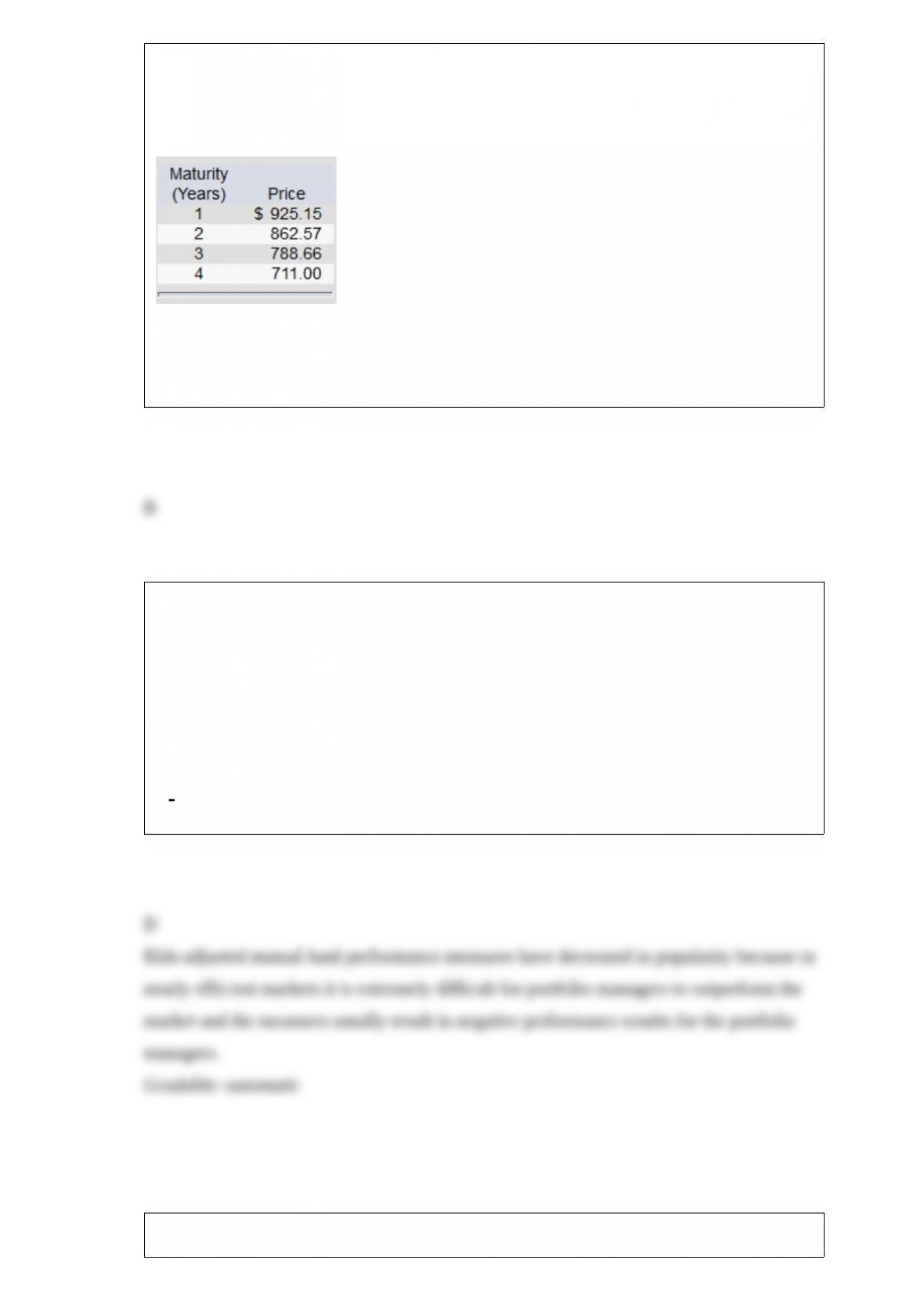
According to the expectations theory, what is the expected forward rate in the third
year?
The following is a list of prices for zero-coupon bonds with different maturities and par
values of $1,000.
A. 7.23%
B. 9.37%
C. 9.00%
D. 10.9%
Risk-adjusted mutual fund performance measures have decreased in popularity because
A. in nearly efficient markets, it is extremely difficult for portfolio managers to
outperform the market.
B. the measures usually result in negative performance results for the portfolio
managers.
C. the high rates of return earned by the mutual funds have made the measures useless.
D. in nearly efficient markets, it is extremely difficult for portfolio managers to
outperform the market, and the . measures usually result in negative performance
results for the portfolio managers.
E. None of the options are correct.
Swingin’Soiree, Inc. is a firm that has its main office on the Right Bank in Paris. The

firm just issued bonds with a final payment amount that depends on whether the Seine
River floods. This type of bond is known as
A. a contingency bond.
B. a catastrophe bond.
C. an emergency bond.
D. an incident bond.
E. an eventuality bond.
Which of the following is false about the security market line (SML) derived from the
APT?
A. The SML has a downward slope.
B. The SML for the APT shows expected return in relation to portfolio standard
deviation.
C. The SML for the APT has an intercept equal to the expected return on the market
portfolio.
D. The benchmark portfolio for the SML may be any well-diversified portfolio.
E. The SML has a downward slope, shows expected return in relation to portfolio
standard . deviation, and has an intercept equal to the expected return on the market
portfolio.
An 8% coupon U.S. Treasury note pays interest on May 30 and November 30 and is
traded for settlement on August 15. The accrued interest on the $100,000 face value of
this note is
A. $491.80.
B. $800.00.
C. $983.61.
D. $1,661.20.
E. None of the options are correct.

The EAFE is
A. the East Asia Foreign Equity index.
B. the Economic Advisor’s Foreign Estimator index.
C. the European and Asian Foreign Equity index.
D. the European, Asian, French Equity index.
E. the European, Australian, Far East index.
In a return-standard deviation space, which of the following statements is(are) true for
risk-averse investors?
(The vertical and horizontal lines are referred to as the expected return-axis and the
standard deviation-axis,
respectively.)
I) An investor’s own indifference curves might intersect.
II) Indifference curves have negative slopes.
III) In a set of indifference curves, the highest offers the greatest utility.
IV) Indifference curves of two investors might intersect.
A. I and II only
B. II and III only
C. I and IV only
D. III and IV only
E. None of the options are correct.

You want to purchase IBM stock at $80 from your broker using as little of your own
money as possible. If initial margin is 50% and you have $2,000 to invest, how many
shares can you buy?
A. 100 shares
B. 200 shares
C. 50 shares
D. 500 shares
E. 25 shares
If an investment provides a 3% return semi-annually, its effective annual rate is
A. 3%.
B. 6%.
C. 6.06%.
D. 6.09%.
The current market price of a share of Disney stock is $60. If a call option on this stock
has a strike price of $65, the call
A.is out of the money.
B.is in the money.
C. can be exercised profitably.
D. is out of the money and can be exercised profitably.
E. is in the money and can be exercised profitably.

Matthews Corporation has a beta of 1.2. The annualized market return yesterday was
13%, and the risk-free rate is currently 5%. You observe that Matthews had an
annualized return yesterday of 17%. Assuming that markets are efficient, this suggests
that
A. bad news about Matthews was announced yesterday.
B. good news about Matthews was announced yesterday.
C. no news about Matthews was announced yesterday.
D. interest rates rose yesterday.
E. interest rates fell yesterday.
All of the following are considered new trading strategies, except
A. high frequency trading.
B. algorithmic trading.
C. dark pools.
D. short selling.
The dollar-weighted return on a portfolio is equivalent to
A. the time-weighted return.
B. the geometric average return.
C. the arithmetic average return.
D. the portfolio’s internal rate of return.
E. None of the options are correct.
Highpoint had a FCFE of $246M last year and has 123M shares outstanding.
Highpoint’s required return on equity is 10%, and WACC is 9%. If FCFE is expected to
grow at 8.0% forever, the intrinsic value of Highpoint’s shares is
A. $21.60.
B. $108.
C. $244.42.
D. $216.00.
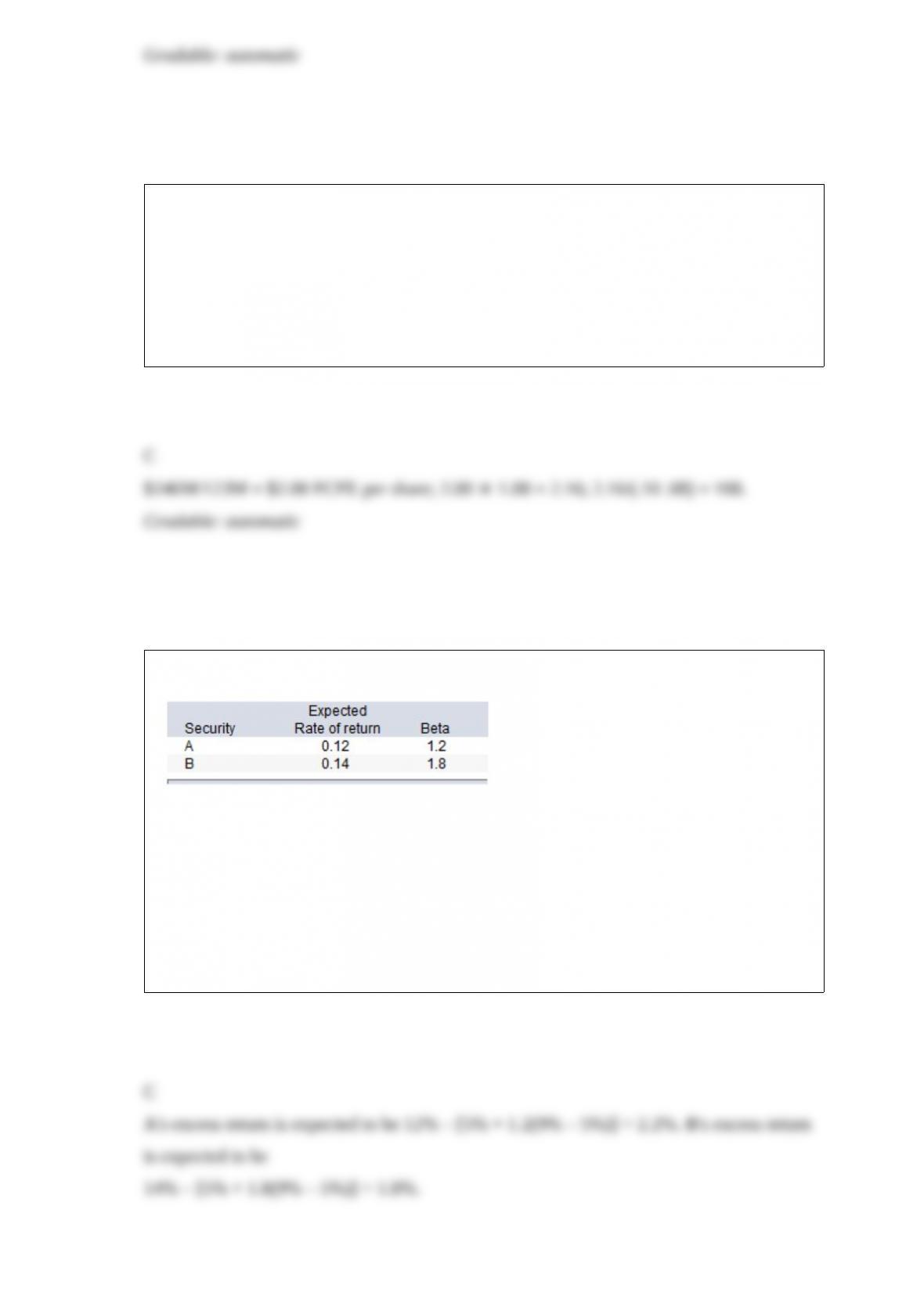
Given are the following two stocks A and B:
If the expected market rate of return is 0.09, and the risk-free rate is 0.05, which
security would be considered
the better buy, and why?
A. A because it offers an expected excess return of 1.2%.
B. B because it offers an expected excess return of 1.8%.
C. A because it offers an expected excess return of 2.2%.
D. B because it offers an expected return of 14%.
E. B because it has a higher beta.
Assume that at retirement you have accumulated $500,000 in a variable annuity
contract. The assumed investment return is 6%, and your life expectancy is 15 years.
What is the hypothetical constantbenefit payment?
A. $30,000.00
B. $33,333.33
C. $51,481.38
D. $52,452.73
E. The answer cannot be determined from the information provided.
Shares in hedge funds are priced
A. at NAV.
B. a significant premium to NAV.
C. a significant discount from NAV.
D. a significant premium to NAV or a significant discount from NAV.
E. None of the options are correct.
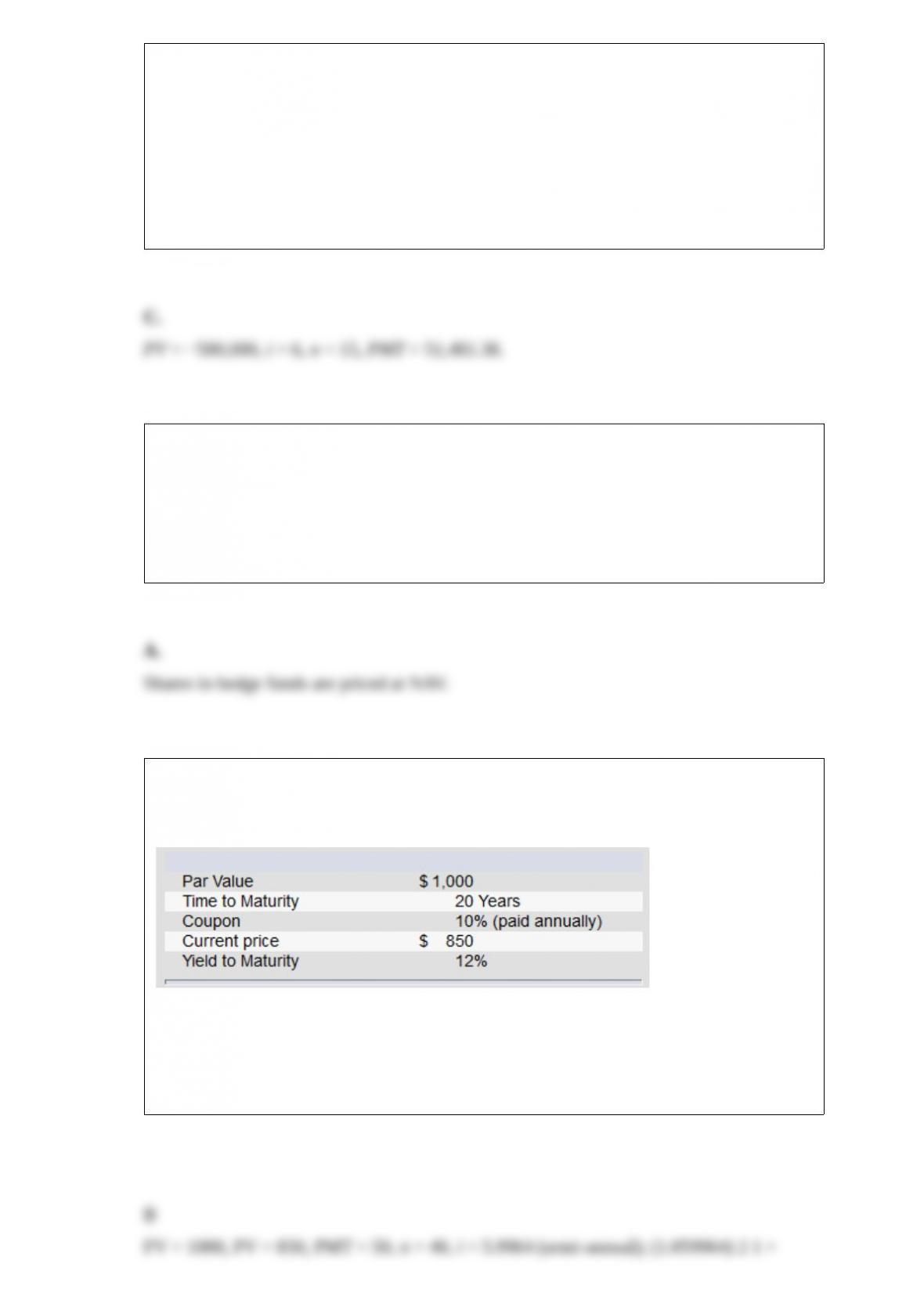
Given the bond described above, if interest were paid semi-annually (rather than
annually), and the bond continued to be priced at $850, the resulting effective annual
yield to maturity would be
A. less than 12%.
B. more than 12%.
C. 12%.
D. Cannot be determined.
E. None of the options are correct.

Credit risk in the swap market
A. is extensive.
B. is limited to the difference between the values of the fixed rate and floating rate
obligations.
C. is equal to the total value of the payments that the floating rate payer was obligated
to make.
D. is extensive and equal to the total value of the payments that the floating rate payer
was obligated to make.
E. None of the options are correct.
Consider the Treynor-Black model. The alpha of an active portfolio is 1%. The
expected return on the market
index is 16%. The variance of the return on the market portfolio is 4%. The
nonsystematic variance of the active
portfolio is 1%. The risk-free rate of return is 8%. The beta of the active portfolio is
1.05. The optimal proportion
to invest in the active portfolio is
A. 48.7%.
B. 50.0%.
C.51.3%.
D. 100.0%.
Based on their relative degrees of risk tolerance,
A. investors will hold varying amounts of the risky asset in their portfolios.
B. all investors will have the same portfolio asset allocations.
C. investors will hold varying amounts of the risk-free asset in their portfolios.
D. investors will hold varying amounts of the risky asset and varying amounts of the
risk-free asset in their
portfolios.
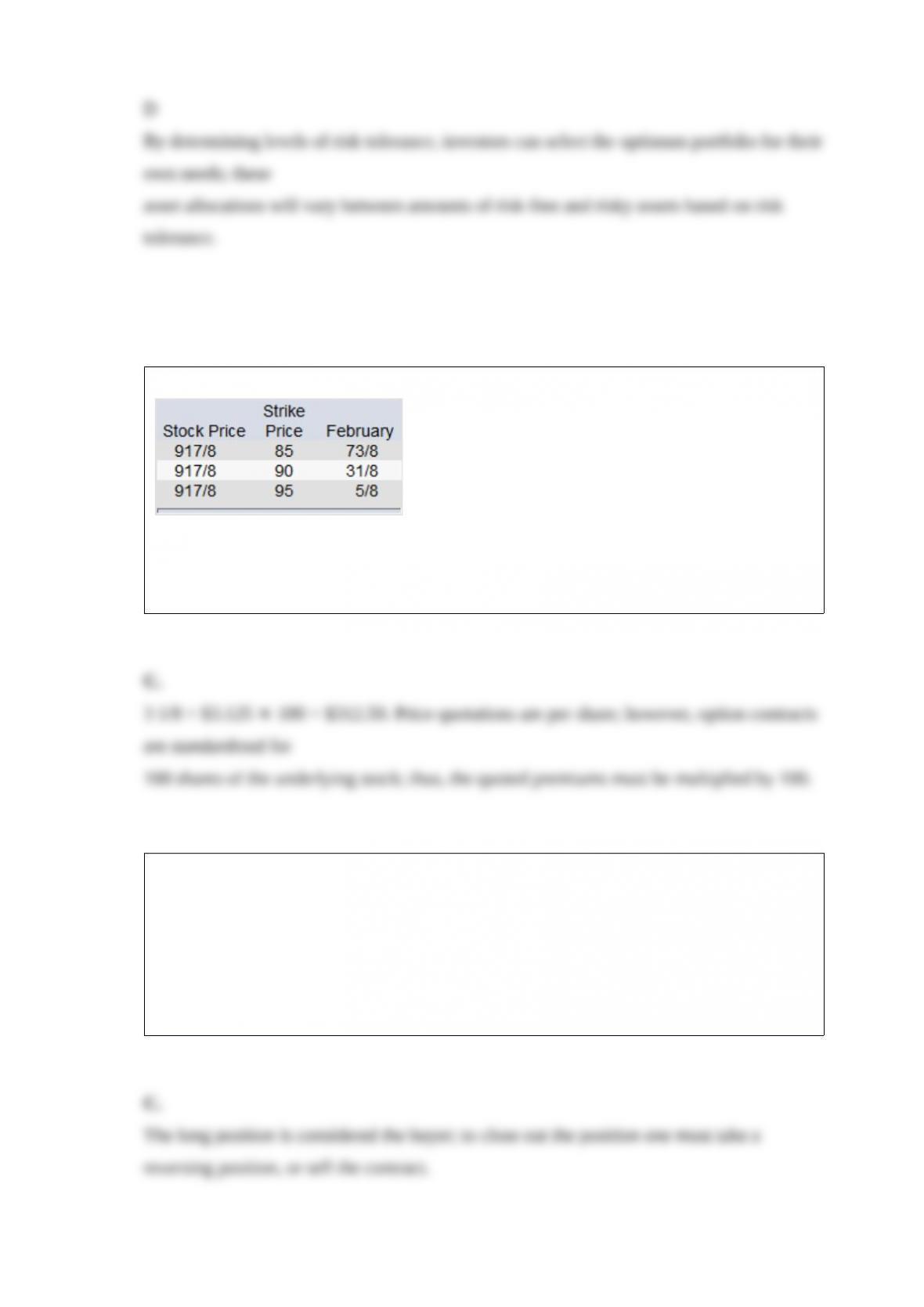
The following price quotations were taken from the Wall Street Journal.
The premium on one February 90 call
contract is
A. $3.1250.
B. $318.00.
C.$312.50.
D. $58.00.
You hold one long oil futures contract that expires in April. To close your position in oil
futures before the delivery date, you must
A. buy one May oil futures contract.
B. buy two April oil futures contracts.
C. sell one April oil futures contract.
D. sell one May oil futures contract.
E. None of the options are correct.

In 2016, ____________ was(were) the least significant financial asset(s) of U.S.
nonfinancial businesses in terms of total value.
A. cash and deposits
B. trade credit
C. trade debt
D. inventory
E. marketable securities
Hedging one commodity by using a futures contract on another commodity is called
A. surrogate hedging.
B. cross hedging.
C. alternative hedging.
D. correlative hedging.
E. proxy hedging.
Which of the following securities is a money market instrument?
A. Treasury note
B. Treasury bond
C. Municipal bond
D. Commercial paper
E. Mortgage security

U.S. investors
A. can trade derivative securities based on prices in foreign security markets.
B. cannot trade foreign derivative securities.
C can trade options and futures on the Nikkei stock index of 225 stocks traded on the
Tokyo stock exchange and on FTSE (Financial Times Share Exchange) indexes of U.K.
and European stocks.
D. can trade derivative securities based on prices in foreign security markets and can
trade options and futures on the Nikkei stock index of 225 stocks traded on the Tokyo
stock exchange and on FTSE (Financial Times Share Exchange) indexes of U.K. and
European stocks.
E. None of the options are correct.
You purchased a share of stock for $65. One year later, you received $2.37 as a
dividend and sold the share
for $63. What was your holding-period return?
A. 0.57%
B. –0.2550%
C. –0.89%
D. 1.63%
E. None of the options are correct.
Accrued interest
A. is quoted in the bond price in the financial press.
B. must be paid by the buyer of the bond and remitted to the seller of the bond.
C. must be paid to the broker for the inconvenience of selling bonds between maturity
dates.
D. is quoted in the bond price in the financial press and must be paid by the buyer of the
bond and remitted to the seller of the bond.

E. is quoted in the bond price in the financial press and must be paid to the broker for
the inconvenience of selling bonds between maturity dates.
If the nominal return is constant, the after-tax real rate of return
A. declines as the inflation rate increases.
B. increases as the inflation rate increases.
C. declines as the inflation rate declines.
D. increases as the inflation rate decreases.
E. declines as the inflation rate increases and increases as the inflation rate decreases.
Which of the following statements about real estate investment trusts is true?
A. REITs invest in real estate or loans secured by real estate.
B. REITs raise capital by borrowing from banks and issuing mortgages.
C. REITs are similar to open-end funds, with shares redeemable at NAV.
D. REITs invest in real estate or loans secured by real estate and raise capital by
borrowing from banks and issuing mortgages.
E. All of the options are true.
You invest $200 in security A with a beta of 1.4 and $800 in security B with a beta of
0.3. The beta of the

resulting portfolio is
A. 1.40.
B. 1.00.
C. 0.52.
D. 1.08.
E. 0.80.
The CFA Institute divides the process of portfolio management into three main
elements, which are ______, ______, and ______.
A. planning; execution; results
B. security selection; asset allocation; action
C. planning; asset allocation; feedback
D. planning; execution; feedback
E. risk tolerance; feedback; action