
A firm has a cost of debt of 7.8 percent and a cost of equity of 15.6 percent. The
debt-equity ratio is .52. There are no taxes. What is the firm’s weighted average cost of
capital?
A. 11.76 percent
B. 11.29 percent
C. 12.93 percent
D. 12.47 percent
E. 10.20 percent
A broker is an agent who:
A. trades on the floor of an exchange for himself or herself.
B. buys and sells from inventory.
C. offers new securities for sale to dealers only.
D. is ready to buy or sell at any time.
E. brings buyers and sellers together.
Which one of the following is contained in the corporate bylaws?
A. Procedures for electing corporate directors
B. State of incorporation
C. Number of authorized shares
D. Intended life of the corporation
E. Business purpose of the corporation
Assume earnings before interest and taxes of $38,218 and net income of $14,042. The
tax rate is 34 percent. What is the times interest earned ratio?
A. 2.08
B. 1.73
C. 3.09

D. 2.59
E. 2.26
A firm wants to create a WACC of 11.2 percent. The firm’s cost of equity is 16.8
percent and its pretax cost of debt is 8.7 percent. The tax rate is 35 percent. What does
the debt-equity ratio need to be for the firm to achieve its target WACC?
A. .86
B. .67
C. 1.04
D. .94
E. 1.01
Which one of the following statements is correct?
A. The risk premium on a risk-free security is generally considered to be one percent.
B. The expected rate of return on any security, given multiple states of the economy,
must be positive.
C. There is an inverse relationship between the level of risk and the risk premium given
a risky security.
D. If a risky security is correctly priced, its expected risk premium will be positive.
E. If a risky security is priced correctly, it will have an expected return equal to the
risk-free rate.
Stock Y has a beta of 1.28 and an expected return of 13.7 percent. Stock Z has a beta of
1.02 and an expected return of 11.4 percent. What would the risk-free rate have to be
for the two stocks to be correctly priced relative to each other?
A. 2.38 percent
B. 2.76 percent
C. 3.23 percent
D. 3.69 percent

E. 4.08 percent
On May 12, you purchased $6,200 of merchandise from a supplier. The terms of the
sale were 2/10, net 20. The discounted amount due is _____ which is payable no later
than ____. May has 31 days.
A. $2,960; June 1
B. $3,515; June 1
C. $5,580; May 22
D. $6,076; May 22
E. $5,960; May 22
The Tattle Teller has a printing press sitting idly in its back room. The press has no
market value to another printer because the machine utilizes old technology. The firm
could get $480 for the press as scrap metal. The press is six years old and originally cost
$174,000. The current book value is $3,570. The president of the firm is considering a
new project and feels he can use this press for that project. What value, if any, should be
assigned to the press as an initial cost of the new project?
A. $0
B. $480
C. $3,570
D. $3,090
E. $4,050
Perpetuities have:
A. irregular payments but constant payment periods.
B. equal payments and an infinite life.
C. equal payments and a set number of equal payment periods.
D. less value than comparable annuities.
E. no application in today’s world.
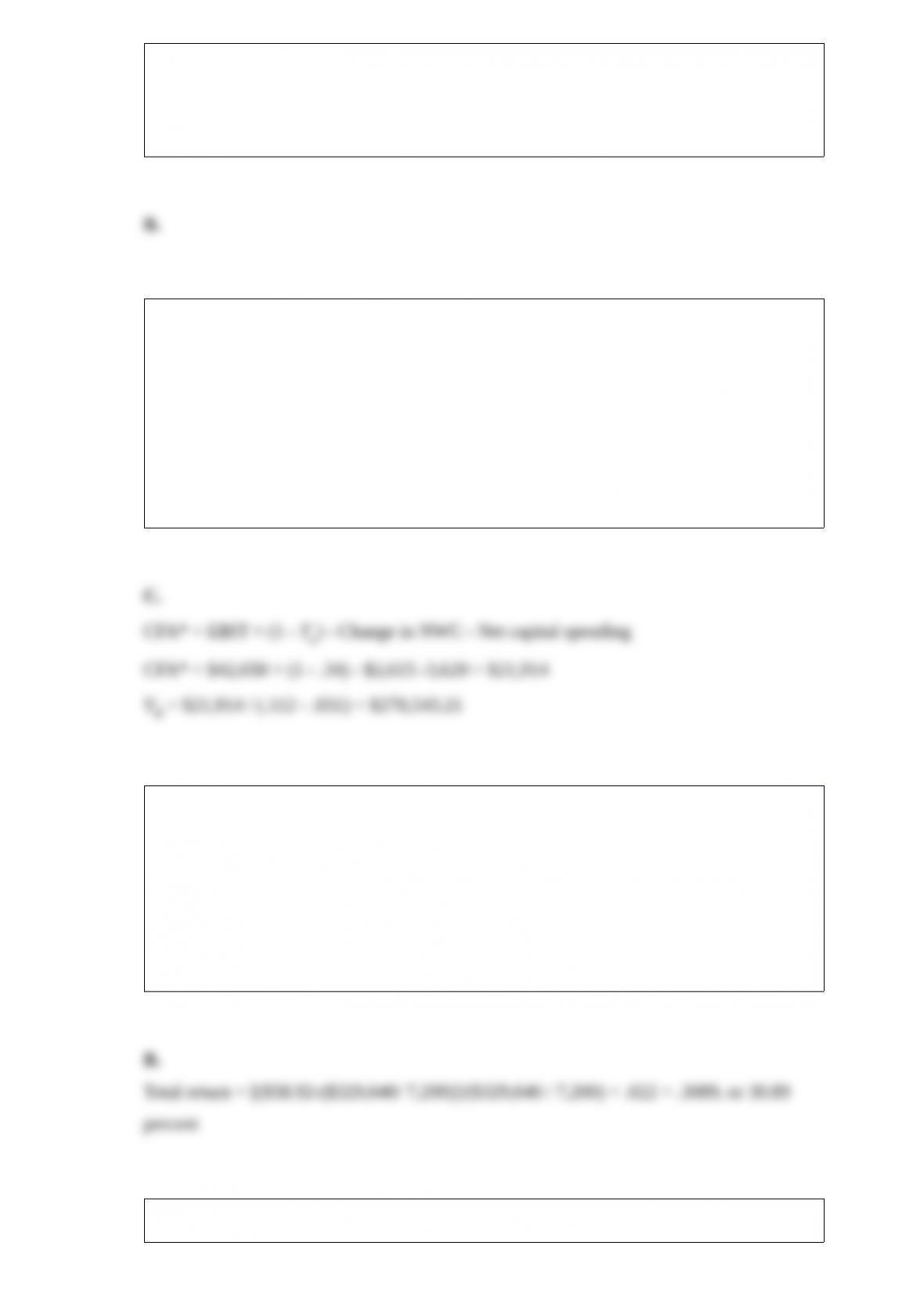
Country Markets has an EBIT of $42,650, an increase in net working capital of $2,615,
interest expense of $4,300, net capital spending of $3,620, and a tax rate of 34 percent.
The firm’s WACC is 11.2 percent and its growth rate is 3.1 percent. What is the
adjusted value of the firm?
A. $287,097.17
B. $311,208.16
C. $270,543.21
D. $238,009.72
E. $308,315.22
One year ago, Peyton purchased 7,200 shares of Broncos stock for $329,640. Today, he
sold those shares for $58.92 a share. What is the total return on this investment if the
dividend yield is 2.2 percent?
A. 33.98 percent
B. 30.89 percent
C. 24.50 percent
D. 20.10 percent
E. 28.40 percent
Shareholders’ equity is equal to:

A. total assets plus total liabilities.
B. net fixed assets minus total liabilities.
C. net fixed assets minus long-term debt plus net working capital.
D. net working capital plus total assets.
E. total assets minus net working capital.
Which one of the following is a drawback of cash dividends?
A. Firms may have to obtain additional external financing which would not be required
in the absence of the dividends.
B. Stock prices tend to increase as annual dividend amounts increase.
C. Cash dividends support stock prices.
D. Dividends tend to lower agency costs.
E. Dividend-paying firms tend to attract a wider field of investors than do
non-dividend-paying firms.
Boyertown Industrial Tools is considering a three-year project to improve its production
efficiency. Buying a new machine press for $578,000 is estimated to result in $184,000
in annual pretax cost savings. The press falls in the MACRS five-year class, which has
percentage rates starting with Year 1, of 20, 32, 19.20,11.52, 11.52, and 5.76. The
salvage value at the end of the project of $162,000. The press also requires an initial
investment in spare parts inventory of $19,000, along with an additional $1,500 in
inventory for each succeeding year of the project. The inventory will all be recovered
when the project ends. If the tax rate is 35 percent and the discount rate is 12 percent,
should the company buy and install the machine press? Why or why not?
A. Yes; the NPV is $51,613.33
B. Yes; the NPV is $45,602.57
C. No; the NPV is -$22,311.09
D. No; the NPV is -$52,918.78
E. Yes; the NPV is $64,728.29

Sand Mountain Resort has a tax rate of 32 percent. Its total interest payment for the year
just ended was $41,000. What is the interest tax shield for the year?
A. $27,590
B. $13,120
C. $13,410
D. 427,880
E. $41,000
Suppose MMP changes its policy and starts requiring all of its customers to pay within
20 days rather than the 30 days that it currently allows. Which one of the following will
result from this change?
A. Increase in receivables period
B. Increase in inventory period
C. Decrease in cash cycle
D. Increase in operating cycle
E. Increase in accounts payable period
All else constant, the weighted average cost of capital for a risky, levered firm will
decrease if:
A. the firm’s bonds start selling at a premium rather than at a discount.
B. the market risk premium increases.
C. the firm replaces some of its debt with preferred stock.
D. corporate taxes are eliminated.
E. the dividend yield on the common stock increases.

Solar Energy will pay an annual dividend of $1.93 per share next year. The company
just announced that future dividends will be increasing by 1.6 percent annually. How
much are you willing to pay for one share of this stock if you require a rate of return of
11.75 percent?
A. $15.14
B. $19.01
C. $19.78
D. $16.12
E. $19.32
Jessica invested $2,000 today in an investment that pays 6.5 percent annual interest.
Which one of the following statements is correct, assuming all interest is reinvested?
A. She will earn the same amount of interest each year.
B. She could have the same future value and invest less than $2,000 initially if she
could earn more than 6.5 percent interest.
C. She will earn an increasing amount of interest each and every year even if she should
decide to withdraw the interest annually rather than reinvesting the interest.
D. Her interest for Year 2 will be equal to $2,000 x.065 x2.
E. She will be earning simple interest.
Generally speaking, payback is best used to evaluate which type of projects?
A. Low-cost, short-term
B. High-cost, short-term
C. Low-cost, long-term
D. High-cost, long-term
E. Any size of long-term project
Last year, when the stock of Alpha Minerals was selling for $49.50 a share, the

dividend yield was 3.4 percent. Today, the stock is selling for $41 a share. What is the
total return on this stock if the company maintains a constant dividend growth rate of
2.2 percent?
A. 6.13 percent
B. 6.58 percent
C. 6.40 percent
D. 6.47 percent
E. 6.38 percent
A (n) _____ is a subsidiary of a firm that exists solely to handle the credit functions of
the parent company.
A. internal credit organization
B. bank
C. credit association
D. captive finance company
E. credit union
Motor Works has total assets of $919,200, long-term debt of $264,500, total equity of
$466,900, net fixed assets of $682,800, and sales of $1,021,500. The profit margin is
6.2 percent. What is the current ratio?
A. .79
B. .84
C. 1.01
D. 1.26
E. 1.19
You are comparing two possible capital structures for a firm. The first option is an
all-equity firm. The second option involves the use of $3.8 million of debt. The
break-even point between these two financing options occurs when the earnings before

interest and taxes (EBIT) are $428,000. Given this, you know that leverage is beneficial
to the firm:
A. whenever EBIT is less than $428,000.
B. only when EBIT is $428,000.
C. whenever EBIT exceeds $428,000.
D. only if the debt is decreased by $428,000.
E. only if the debt is increased by $428,000.
You’ve worked out a line of credit arrangement that allows you to borrow up to $2.5
million at any time. The interest rate is .65 percent per month. In addition, 2 percent of
the amount you borrow must be deposited in a non-interest-bearing account. Assume
your lender uses compound interest and that you need $1.2 million today which you
will repay in five months. How much interest will you pay?
A. $38,757
B. $40,317
C. $42,103
D. $44,142
E. $38,886
In a general partnership, each partner is personally liable for:
A. only the partnership debts that he or she personally created.
B. his or her proportionate share of all partnership debts regardless of which partner
incurred that debt.
C. the total debts of the partnership, even if he or she was unaware of those debts.
D. the debts of the partnership up to the amount he or she invested in the firm.
E. all personal and partnership debts incurred by any partner, even if he or she was
unaware of those debts.
Which one of the following portfolios will have a beta of zero?
A. A portfolio that is equally as risky as the overall market
B. A portfolio that consists of a single stock
C. A portfolio comprised solely of U. S. Treasury bills
D. A portfolio with a zero variance of returns
E. No portfolio can have a beta of zero.
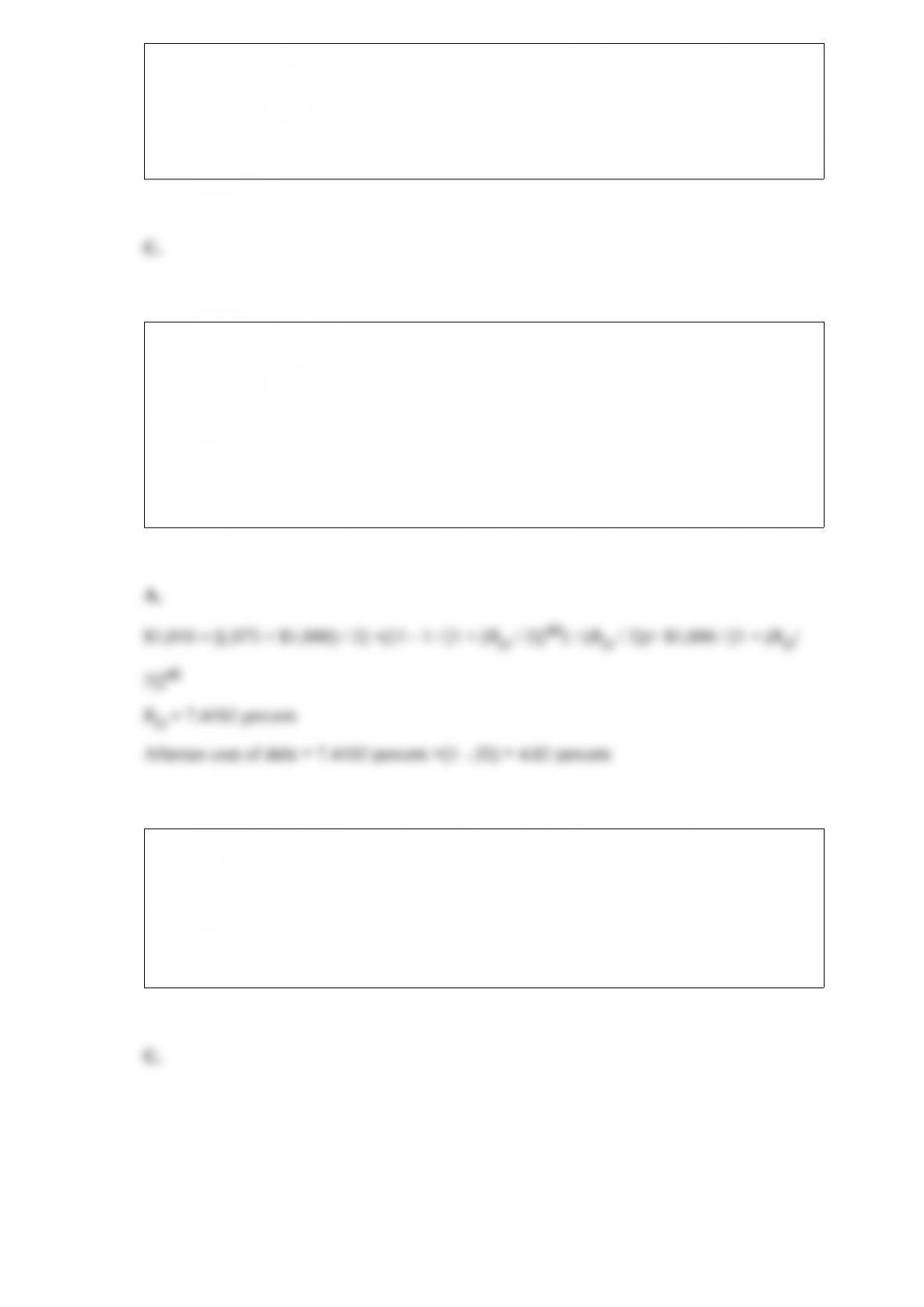
USA Manufacturing issued 30-year, 7.5 percent semiannual bonds 6 years ago. The
bonds currently sell at 101 percent of face value. What is the firm’s aftertax cost of debt
if the tax rate is 35 percent?
A. 4.82 percent
B. 5.62 percent
C. 3.76 percent
D. 3.59 percent
E. 4.40 percent
Most trades on the NYSE are executed:
A. by floor brokers on the exchange floor.
B. independent brokers on the exchange floor.
C. electronically.
D. by designated market makers of the floor of the exchange.
E. bydealers.