
Consider the following investment alternatives:
The highest effective rate of return you could earn on any of these investments is
closest to:
A) 6.250%
B) 6.267%
C) 6.295%
D) 6.310%
Answer:
Use the table for the question(s) below.
Consider the following returns:

The variance on a portfolio that is made up of equal investments in Stock x and Stock Z
stock is closest to:
A) 0.62
B) 0.05
C) 0.12
D) 0.06
Answer:

2Var(R1) + x2
2Var(R2) + 2X1X2Cov(R1,R2) = (.50)2(0.125447467) +
Use the following information to answer the question(s) below.
Suppose that the market portfolio is equally likely to increase by 24% or decrease by
8%. Security “X” goes up on average by 29% when the market goes up and goes down
by 11% when the market goes down. Security “Y” goes down on average by 16% when
the market goes up and goes up by 16% when the market goes down. Security “Z” goes
up on average by 4% when the market goes up and goes up by 4% when the market
goes down.
The risk-free rate is closest to:
A) 0%
B) 4%
C) 8%

D) 16%
Answer:
The risk neutral probability of an up state for KD Industries is closest to:
A) 37.5%
B) 60.0%
C) 40.0%
D) 62.5%
Answer:
You are a risk manager for Security First Trust Savings and Loan (SFTSL). SFTSL’s
balance sheet is as follows (in millions of dollars):

The duration of the auto loans is three years and the duration of the mortgages is eight
years. Both cash reserves and checking and savings have zero duration. The CDs have a
duration of two years and the long-term financing has a ten year duration.
Because of a new program called Kash for Klunkers, SFTSL experiences a rash of auto
loan prepayments, reducing the size of the auto loan portfolio from $200 million to
$100 million and increasing the cash reserves to $200 million. After these prepayments,
the duration of SFTSL’s equity is closest to:
A) 6 years
B) 8 years
C) 10 years
D) 14 years
Answer:

The risk that the firm will not have, or be able to raise, the cash required to meet the
margin calls on its hedges is called
A) liquidity risk.
B) basis risk.
C) commodity price risk.
D) speculation risk.
Answer:
Use the following information to answer the question(s) below.
Nielson Motors (NM) is a newly public firm with 25 million shares outstanding. You
are doing a valuation analysis of Nielson and you estimate its free cash flow in the
coming year to be $40 million. You expect the firm’s free cash flows to grow by 4% per
year in subsequent years. Because the firm has only been listed on the stock exchange
for a short time, you do not have an accurate assessment of Nielson’s equity beta.
However, you do have the following data for another firm in the same industry:
Nielson has a much lower debt-equity ratio of .5, which is expected to remain stable,
and Nielson’s debt is risk free. Nielson’s corporate tax rate is 40%, the risk-free rate is
5%, and the expected return on the market portfolio is 10%.
Nielson’s share price is closest to:
A) $20.80
B) $24.40
C) $27.50

D) $31.20
Answer:
Which of the following statements is false?
A) A short sale is a transaction in which you buy a stock that you do not own and then
agree to sell that stock back in the future.

B) The efficient portfolios are those portfolios offering the lowest possible level of
volatility for a given level of expected return.
C) A positive investment in a security can be referred to as a long position in the
security.
D) It is possible to invest a negative amount in a stock or security call a short position.
Answer:
You expect KT Industries (KTI) will have earnings per share of $3 this year and expect
that they will pay out $1.50 of these earnings to shareholders in the form of a dividend.
KTI’s return on new investments is 15% and their equity cost of capital is 12%. The
value of a share of KTI’s stock is closest to:
A) $39.25
B) $20.00
C) $33.35
D) $12.50
Answer:

The statement of financial position is also known as the
A) balance sheet.
B) income statement.
C) statement of cash flows.
D) statement of stockholder’s equity.
Answer:
Which of the following statements regarding leases and bankruptcy is false?
A) Operating and true tax leases are generally viewed as true leases by the courts,
whereas capital and non-tax leases are more likely to be viewed as a security interest.
B) By retaining ownership of the asset, the lessor has the right to repossess it if the
lease payments are not made, even if the firm seeks bankruptcy protection.
C) If a lease contract is characterized as a true lease in bankruptcy, the lessor is in a
somewhat superior position than a lender if the firm defaults.
D) If the lease is classified as a true leasein bankruptcy, then the lessee retains
ownership rights over the asset.
Answer:

Use the information for the question(s) below.
The Sisyphean Company has a bond outstanding with a face value of $1000 that
reaches maturity in 15 years. The bond certificate indicates that the stated coupon rate
for this bond is 8% and that the coupon payments are to be made semiannually.
Assuming that this bond trades for $903, then the YTM for this bond is closest to:
A) 8.0%
B) 6.8%
C) 9.9%
D) 9.2%
Answer:
KD Industries stock is currently trading at $32 per share. Consider a put option on KD
stock with a strike price of $30. The maximum value of this put option is:
A) $0

B) $32
C) $30
D) $2
Answer:
Suppose that Galt Ventures, a venture capital firm, raised $250 million of committed
capital. Each year over the 10-year life of the fund, 2% if this committed capital will be
used to pay Galt’s management fee. As is typical in the venture capital industry, Galt
will only invest $200 million (committed capital less lifetime management fees). At the
end of 10 years, the investments made by the fund are worth $800 million. Galt also
charges 20% carried interest on the profits of the fund (net of management fees).
Assume that Galt collects the $250 if committed capital and invests $200 million of it
immediately. Also assume that Galt collects all proceeds from its investments at the end
of the ten year life.
The IRR on the investments made by Galt Ventures is closest to:
A) 9.9%
B) 12.4%
C) 14.9%
D) 15.8%
Answer:
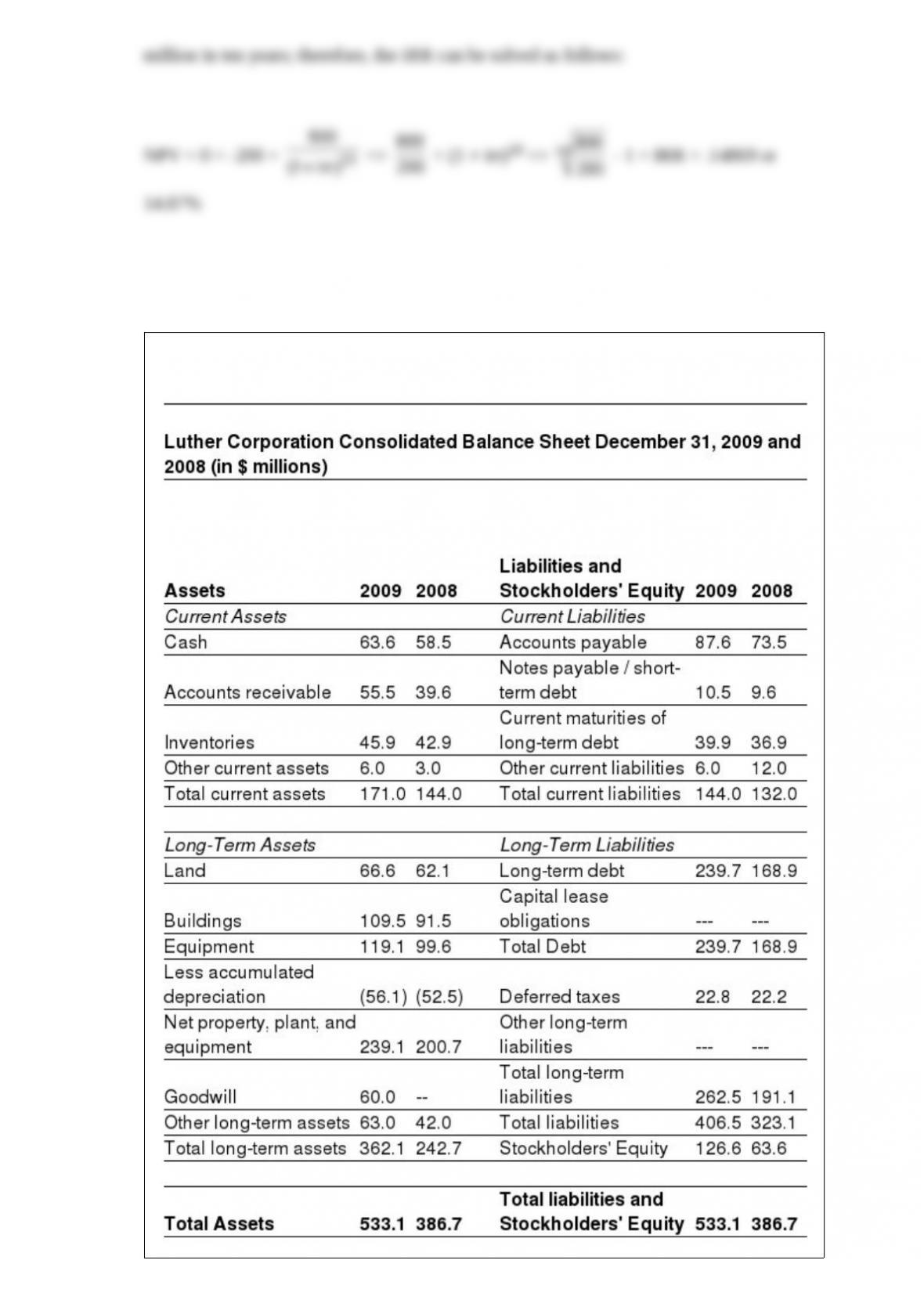
Consider the following balance sheet:

When using the book value of equity, the debt to equity ratio for Luther in 2009 is
closest to:
A) 0.43
B) 2.29
C) 2.98
D) 3.57
Answer:
Use the information for the question(s) below.
Assume that Rose Corporation’s (RC) EBIT is not expected to grow in the future and
that all earnings are paid out as dividends. RC is currently an all equity firm. It expects
to generate earnings before interest and taxes (EBIT) of $6 million over the next year.
Currently RC has 5 million shares outstanding and its stock is trading for a price of
$12.00 per share. RC is considering borrowing $12 million at a rate of 6% and using the
proceeds to repurchase shares at the current price of $12.00.
Prior to any borrowing and share repurchase, the equity cost of capital for RC is closest
to:
A) 10%
B) 10%

C) 12%
D) 9%
Answer:
Which of the following statements is false?
A) A serious concern for large corporations is that managers may make large,
unprofitable investments.
B) While overspending on personal perks may be a problem for large firms, these costs
are likely to be small relative to the overall value of the firm.
C) Some financial economists explain a manager’s willingness to engage in
negative-NPV investments as empire building.
D) While ownership is often diluted for small, young firms, ownership typically
becomes concentrated over time as a firm grows.
Answer:

Luther Industries is offered a $1 million dollar loan for four months at an APR of 9%. If
this loan has an origination fee of 1%, then the effective annual rate (EAR) for this loan
is closest to:
A) 12.0%
B) 12.6%
C) 4.1%
D) 13.8%
Answer:
Which of the following is one unintended consequence of the federal bailouts in
response to the 2008 financial crisis?
A) Bondholders will charge equity holders for the risk of this abuse.
B) Equity holders will credibly commit not to take excessive risk by agreeing to very
strong bond covenants.
C) Lenders to corporations considered “too big to fail” may presume they have an

implicit government guarantee, thus lowering their incentives to insist on strong
covenants.
D) Managers who earned large bonuses when their businesses did well did not need to
repay those bonuses later when things turned sour.
Answer:
Use the following information to answer the question(s) below.
Suppose you purchase a 20-year treasury bond with a 6% annual coupon ten years ago
at par. Today the bond’s yield to maturity has risen to 8% (EAR).
If you hold this bond to maturity, the internal rate of return you will earn on your
investment will be closest to:
A) 5.0%
B) 5.6%
C) 6.0%
D) 8.0%
Answer:
Use the information for the question(s) below.
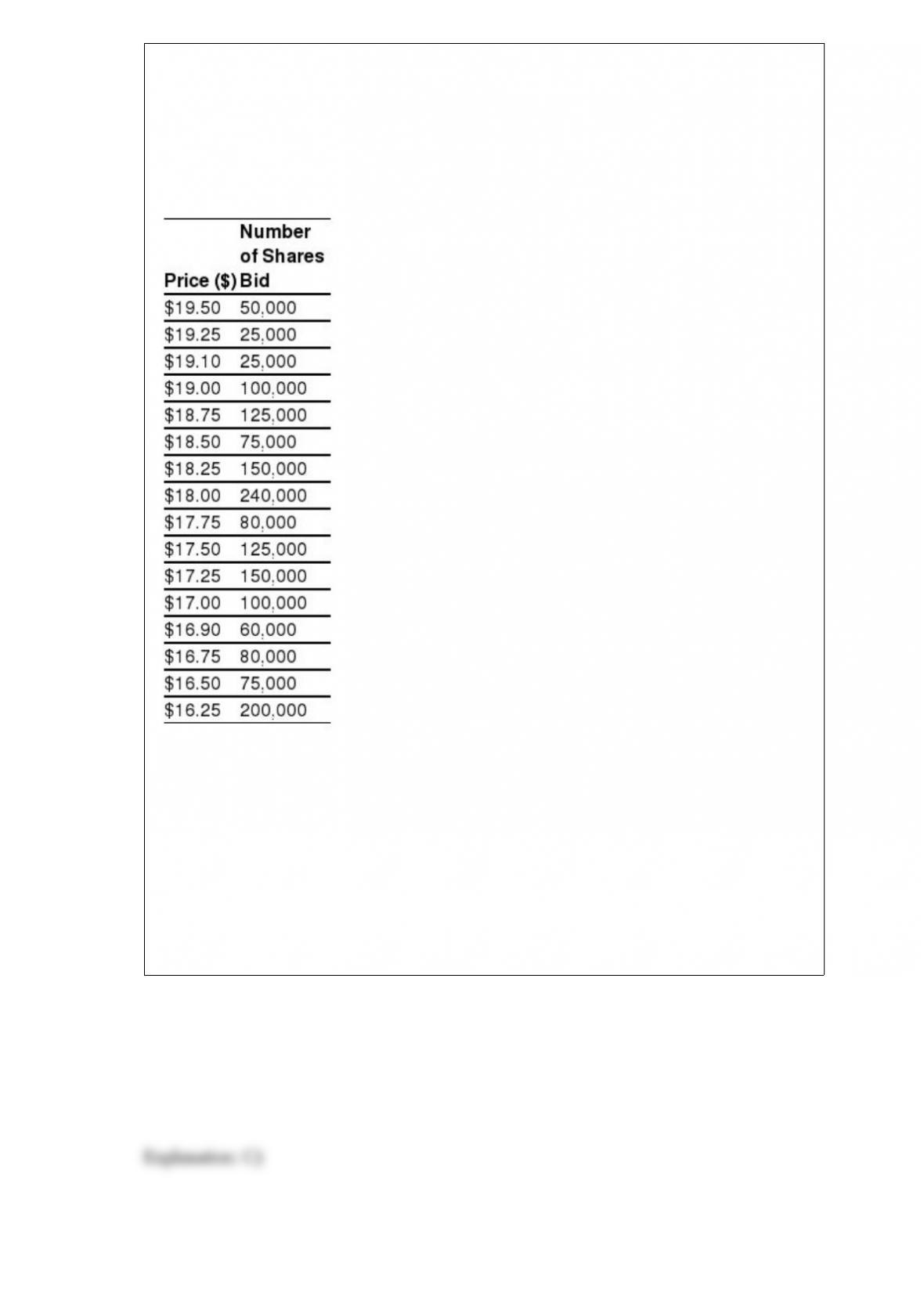
Luther Industries is in the process of selling shares of stock in an auction IPO. At the
end of the bidding period, Luther’s investment bank has received the following bids:
What will the offer price of these shares be if Luther is selling 1 million shares?
A) $17.00
B) $17.50
C) $17.25
D) $16.75
Answer:

Use the information for the question(s) below.
The Sisyphean Company has a bond outstanding with a face value of $1000 that
reaches maturity in 15 years. The bond certificate indicates that the stated coupon rate
for this bond is 8% and that the coupon payments are to be made semiannually.
How much will each semiannual coupon payment be?
A) $60
B) $40
C) $120
D) $80

Answer:
Which of the following is not a financial statement that every public company is
required to produce?
A) Income Statement
B) Statement of Sources and Uses of Cash
C) Balance Sheet
D) Statement of Stockholders’ Equity
Answer:
Use the following information to answer the question(s) below.
Taggart Transcontinental is considering a $250 million investment to launch a new rail
line. The project is expected to generate a free cash flow of $32 million per year, and its
unlevered cost of capital is 8%. Taggart’s marginal corporate tax rate is 35%.
Assume that to fund the investment Taggart will take on $150 million in permanent debt
with the remainder of the investment funded through issuance of new equity. Assuming
Taggart will incur a 2% underwriting fee on the new debt issue and a 5% underwriting
fee on the issuance of new equity, the NPV of Taggart’s new rail line is closest to:
A) $195 million
B) $200 million

C) $235 million
D) $240 million
Answer:
The Sisyphean Company is planning on investing in a new project. This will involve
the purchase of some new machinery costing $450,000. The Sisyphean Company
expects cash inflows from this project as detailed below:
The appropriate discount rate for this project is 16%.
The profitability index for this project is closest to:
A) .44
B) .26
C) 0.39
D) .34
Answer:

Which of the following statements is false?
A) If you take the option price quoted in the market as an input and solve for the
volatility you will have an estimate of a stock’s volatility known as the implied
volatility.
B) The Black-Scholes formula can be used to price American or European call options
on non-dividend-paying stocks.
C) We need to know the expected return on the stock to calculate the option price in the
Black-Scholes Option Pricing Model.
D) We can use the Black-Scholes formula to compute the price of a European put
option on a non-dividend-paying stock by using the put-call parity formula.
Answer:
A type of agency problem that results in shareholders gaining by choosing not to
finance new, positive-NPV projects is
A) asset substitution.
B) debt overhang.
C) excessive risk-taking.
D) distress costs.
Answer:
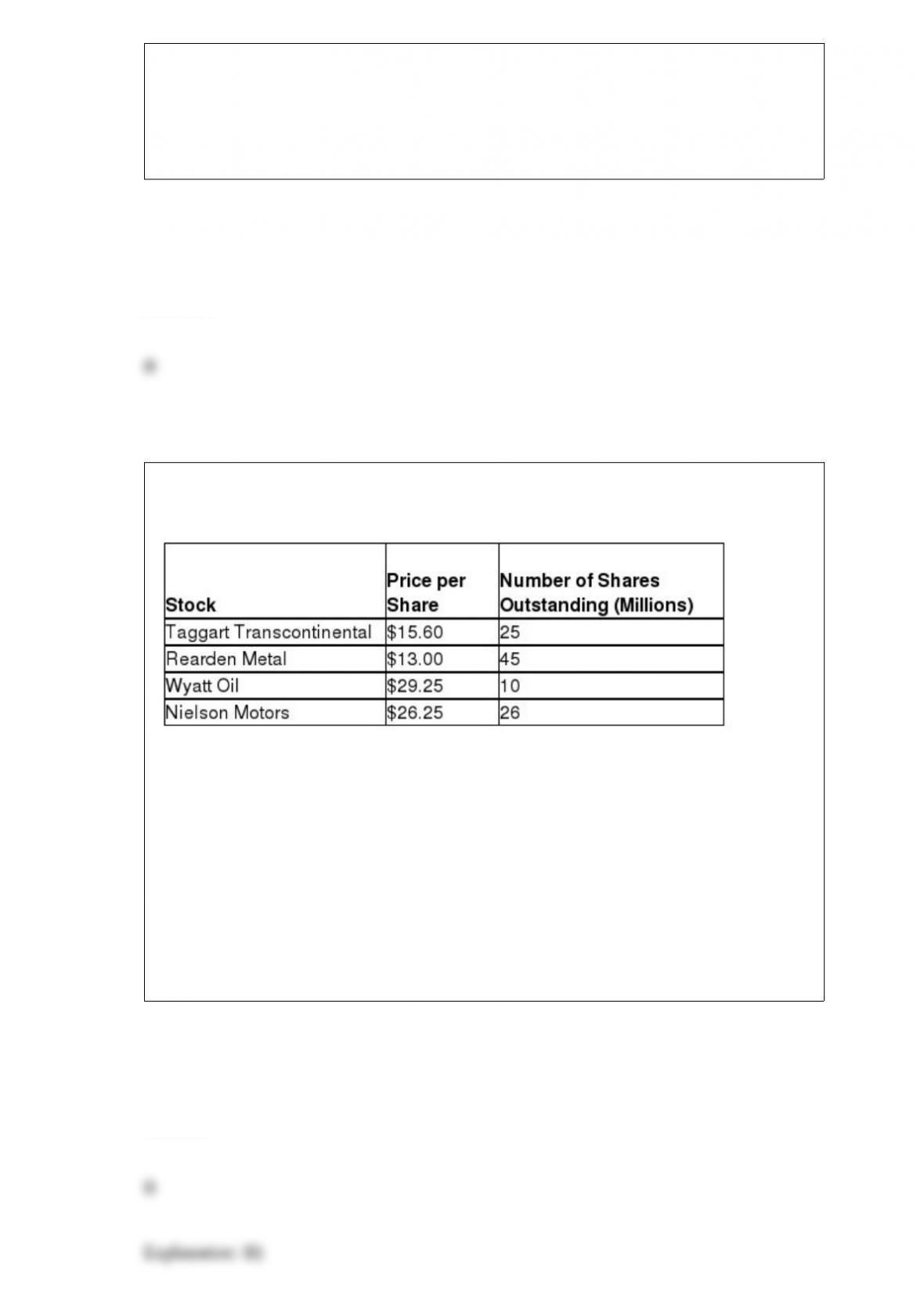
Suppose all possible investment opportunities in the world are limited to the four stocks
list in the table below:
Suppose that you have invested $30,000 invested in the market portfolio. Then the
number of shares of Rearden Metal that you hold is closest to:
A) 450 shares
B) 700 shares
C) 1,400 shares
D) 2,300 shares
Answer:

When investors imitate each other’s actions, this is known as ________ behavior.
A) pack
B) flock
C) herd
D) shepherd
Answer:
Suppose you have the following Loans / Investments

If your income tax rate is 30%, then the after-tax EAR for your home equity loan is
closest to:
A) 6.0%
B) 5.9%
C) 8.6%
D) 5.8%
Answer:
Which of the following is not considered a difficulty with regards to the CAPM?
A) Betas are not observed.
B) Expected returns are not observed.
C) The market proxy is not correct.
D) Investors risk preferences are not observed.

Answer:
Which of the following statements is false?
A) The optimal level of debt D*, balances the costs and benefits of leverage.
B) As the debt level increases, the firm benefits from the interest tax shield (which has
present value τ*D).
C) If the debt level is too large firm value is reduced due to the loss of tax benefits
(when interest exceeds EBIT), financial distress costs, and the agency costs of leverage.
D) As the debt level increases, the firm faces worse incentives for management, which
increase wasteful investment and perks.
Answer:
Which of the following statements regarding auditors is false?
A) Most auditors have a longstanding relationship with their audit clients; this extended
relationship and the auditors’ desire to keep the lucrative auditing fees makes auditors
less willing to challenge management.
B) Most accounting firms have developed large and extremely profitable consulting
divisions. Obviously, if an audit team refuses to accommodate a request by a client’s
management, that client will be less likely to choose the accounting firm’s consulting
division for its next consulting contract.
C) Auditing firms are supposed to ensure that a company’s financial statements
accurately reflect the financial state of the firm.
D) In the post Sarbanes-Oxley world, accounting firms are no longer allowed to offer

both audit and non-audit services to the same firm.
Answer: