
The marginal rate of return can be defined as the:
(A) Return that results from holding the property for one additional year
(B) IRR the year the internal rate of return starts to decrease from holding the property
(C) Incremental return over a holding period resulting from renovating a property
(D) Rate of return at which the net present value equals zero
Which of the following documents conveys title to a property at the time the purchaser
completes the performance of the obligation called for in the document?
(A) Junior mortgage
(B) Package mortgage
(C) Purchase-money mortgage
(D) Land contract
At the end of 8 years, your friend wants to have $50,000 saved for a down payment on
a house. He expects to earn 8%compounded monthlyon his investments over the next 8
years. How much would your friend have to put in his investment account each month
to reach his goal?
(a) $188

(b) $374
(c) $392
(d) $521
A loan was made 10 years ago for $140,000 at 10.5% for a 30 year term. Rates are
currently 9.25%. What is the market value of the loan?
(A) $128,271
(B) $147,600
(C) $139,828
(D) $151,395
All other factors being equal, a company would prefer to own rather than lease under
which of the following conditions?
(A) The expected life of an asset far exceeds the company’s projected period of use
(B) The real estate investment represents a large proportion of the company’s total
capital
(C) The corporate needs for the property are not highly sensitive to the level of

maintenance
(D) The corporation needs a specialized research and development building
If one of the terms of an ARM read, interest is capped at 2%/5%, what would that
mean?
(A) The borrower can choose the cap he wants by simply circling the appropriate choice
(B) The interest rate has a 2% annual cap rate and a 5% lifetime cap rate
(C) The interest rate has a 5% annual cap rate and a 2% lifetime cap rate
(D) The interest rate has a 2% annual cap rate and a 5% floor cap rate
If properly constructed and assuming everything but the structure of the interest
payment is equal, which of the following loans would typically have the highest
first-year debt service?
(A) Accrual loan
(B) Conventional loan
(C) Interest only loan
(D) Participation loan

Consider an investment held over three years with a return of +20percent in the first
year, 25percent in the second year, and +20percent in the third year. What is the
arithmetic mean return on the investment?
(a) -2.6%
(b) +2.6%
(c) +5.0%
(d) +8.0%
(e) Cannot be calculated from the information provided
Which of the following is FALSE regarding an expense stop?
(A) All operating expenses are covered by the stop
(B) The passthrough is based on the tenant’s percentage of total leasable area
(C) Expenses to be included must be agreed upon and included in the lease
(D) The stop is often based on the actual amount of operating expenses at the time the
lease is signed
A region has a location quotient of 0.5 for manufacturing. This means that:
(a) The region’s share of employment in manufacturing is twice as big as the share of
manufacturing employment in the U.S
(b) The region’s share of employment in manufacturing is half as big as the share of
manufacturing employment in the U.S
(c) Manufacturing is a “base” or “driver” industry for the region
(d) Both A and C
(e) Both B and C
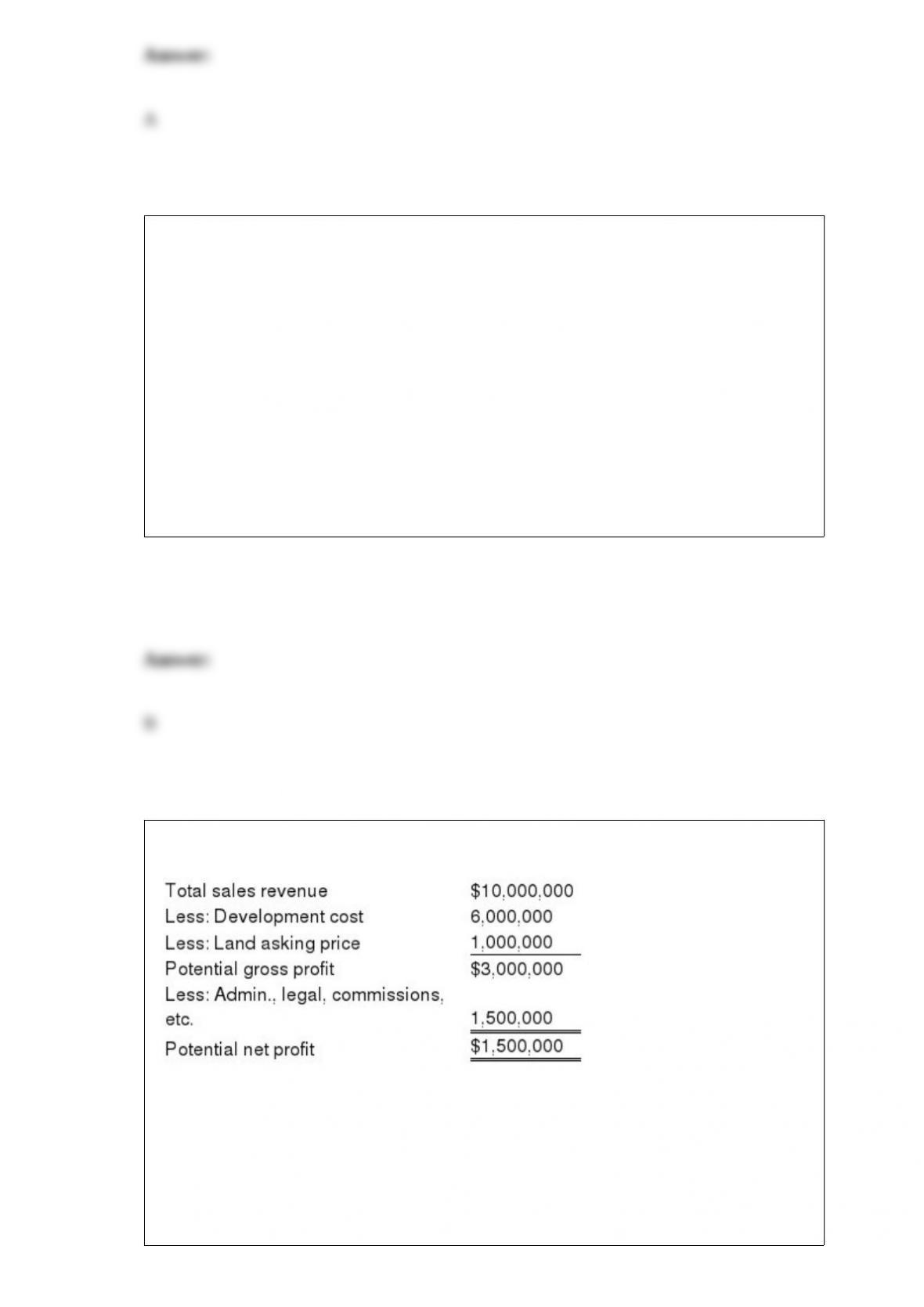
Refer to the information in the previous question. You have been advised that sales
revenues may be 10 percent lower and/or development costs may be 10 percent higher.
Performing a sensitivity analysis, you conclude:
(a) A 10 percent decrease in sales revenues would have a bigger impact on returns than
a 10 percent increase in development costs

(b) A 10 percent increase in development costs would have a bigger impact on returns
than a 10 percent decrease in sales revenues
(c) A 10 percent increase in development costs and a 10 percent decrease in sales
revenues would have opposite impacts on returns, canceling each other out and having
no impact on returns
(d) Both factors would have such a small impact, that there is no reason to be concerned
about either a 10 percent increase in development costs or a 10 percent decrease in sales
revenues
A loan in which the lender receives a percentage of the net operating income from the
property is known as a(n):
(A) Participation loan
(B) Accrual loan
(C) Convertible loan
(D) Percentage loan
What statistical concept do many portfolio managers use to represent risk when
considering investment performance?
(a) The standard deviation of returns

(b) The difference, or ‘spread,” between the highest value over the holding period and
the lowest value over the holding period
(c) The geometric mean return
(d) The coefficient of variation
Bud is offering a house for sale for $180,000 with an assumable loan which was made 5
years ago for $140,000 at 8.75% over 30 years. Kelsey is interested in buying the
property and can make a $20,000 down payment. A second mortgage can be obtained
for the balance at 12.5% for 25 years. What is the effective cost of the combined loans,
if Kelsey would like to compare this financing alternative to obtaining a first mortgage
for the full amount?
(A) 10.63%
(B) 9.39%
(C) 9.04%
(D) 11.27%
Which of the following is NOT a risk listed for mortgage-backed securities?
(A) Default risk

(B) Delayed payment risk
(C) Pass-through risk
(D) Interest rate risk
Which of the following is FALSE regarding the release price?
(A) It is usually calculated to pay off the loan when the last lot is sold
(B) It is usually calculated to pay off the loan before the last lot is sold
(C) Increasing the release price usually lowers the lender’s risk
(D) Increasing the release price is likely to lower the investor’s initial cash flow
A ‘short sale” of real estate is:
(a) A sale that closes in less than 30 days
(b) The sale of a house by someone who is not the owner; it is a way to profit from an
anticipated decline in real estate prices
(c) A sale in which the proceeds from the sale are less than the balance owed on the
loan secured by the property sold
(d) A sale in which the balance owed on the loan secured by the property sold is less

than the proceeds from the sale
Large, private funds are typically created by real estate investment managers who
develop an investment strategy involving which of the following: (1) the types of
properties to be acquired and markets where acquisitions will be made, (2) how the
fund will be operated, (3) when properties are to be sold, and (4) how the fund strategy
will align with the real estate investment requirements of investors.
A) 1, 2, 3
B) 1, 2, 4
C) 2, 3, 4
D) All of the above
An effective tax rate:
(a) Takes into account the effects of depreciation and time value of money
(b) Measures the actual difference between the BTIRR and the ATIRR
(c) Can be less than the actual marginal tax rate
(d) All of the above

Compared to mortgage pass-though securities (MPTs), MBBs should be priced to
provide:
(A) Lower yields, because of lower prepayment risk
(B) Higher yields, because of higher prepayment risks
(C) The same yields, because of equivalent amounts of prepayment risk
(D) None of the above
Which of the following tends to lower effective rents?
(A) Percentage rent
(B) Step up provisions
(C) Concessions
(D) CPI adjustment
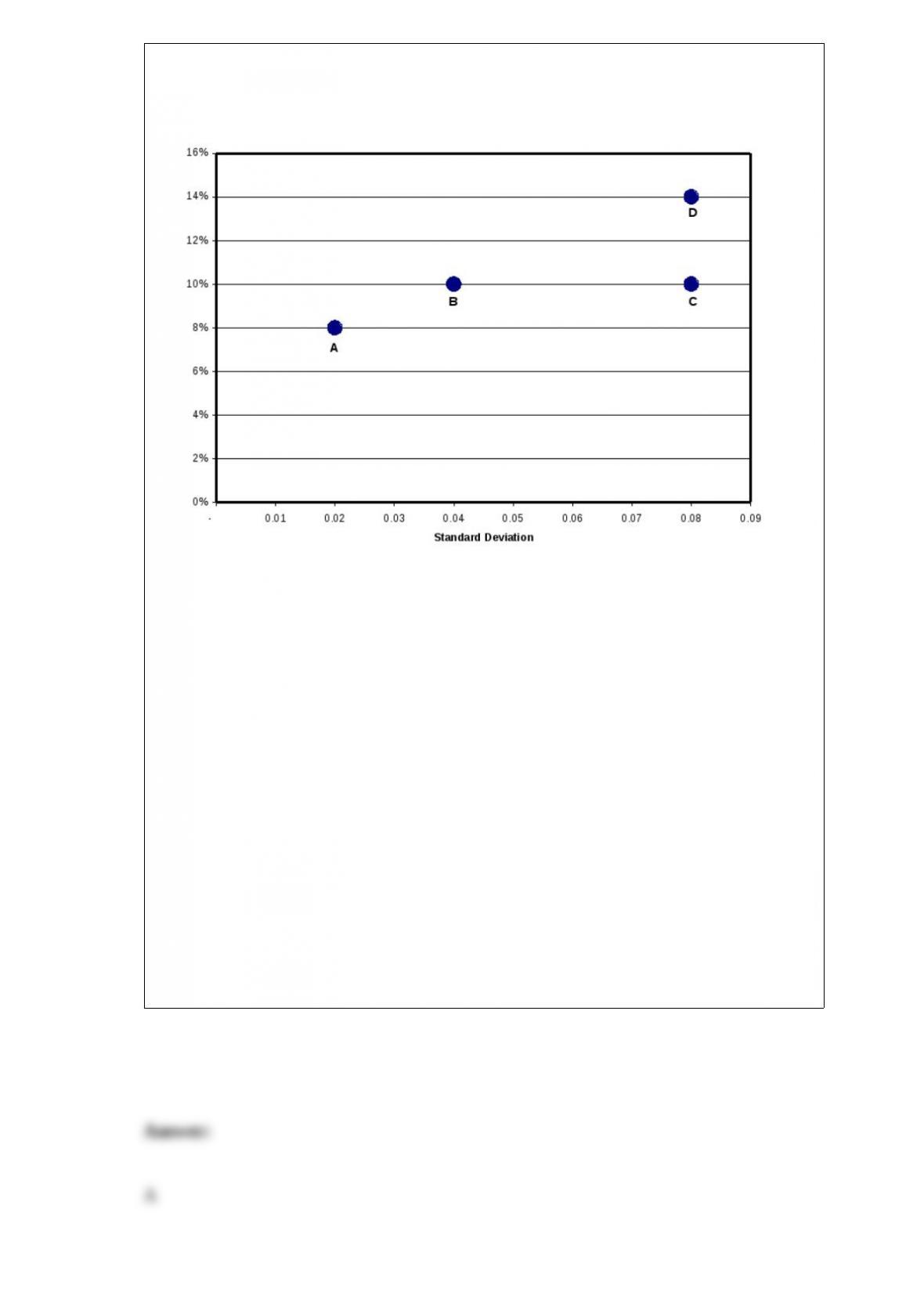
Consider two investments:
Investment 1 has a 50% chance of producing a return of zero and a 50% chance of
producing a return of 40%
Investment 2 has a 50% chance of producing a return of 10% and a 50% chance of
producing a return of 30%
Which of the following statements regarding the investments is TRUE?
(a) Investment 1 is riskier than Investment 2
(b) Investment 2 is riskier than Investment 3
(c) Investment 1 and Investment 2 have the same amount of risk
(d) Investment 1 is a better investment because it has the potential to produce the
highest returns

The APR estimate must be accurate only to the nearest ___ percent.
(A) 1/2
(B) 1/4
(C) 1/8
(D) 1/16
Using the information from the question above, what would the net asset value (NAV)
of the REIT be?
(a) $60.15
(b) $71.89
(c) $153.85
(d) $160.00
(e) $190.00
For real estate investment funds in which the manager has little control over the flow of
cash into and out of the fund, the preferred performance measure is _________.
a. NPV

b. IRR
c. TVM
d. TWR
A hybrid REIT is comprised of what primary classifications of REITs?
(A) UPREITs, mortgage
(B) Mortgage, equity, retail
(C) Mortgage, equity
(D) Healthcare, retail, office
Present Value Factor for Reversion of $1

Using only the information in the table above, approximately how much would you pay
today for an investment that pays $0 annual interest, but earns 8% interest over the next
four years and has a face value at maturity of $13,500?
(a) $8,000
(b) $9,000
(c) $10,000
(d) $11,000
Which of the following groups customarily does NOT attend real estate closing?
(A) The buyer and seller
(B) The buyer’s and seller’s immediate families
(C) Real estate broker(s)
(D) Settlement agent(s)
Duration, as referred to in this chapter, is defined as:
(A) A measure of the extent to which different investments expose an investor to
interest rate risk

(B) A measure of the weighted-average time required before all principal and interest is
received on an investment
(C) A measure that takes into account both the size of cash flows and the timing of their
receipt
(D) All of the above
The investment rating for mortgage-backed bonds depends on each of the following
EXCEPT:
(A) Appraised value and DCR
(B) Interest rates in mortgage pool
(C) Extent of over collateralization
(D) Initial price paid for the security
A property that produces a first year NOI of $80,000 is purchased for $750,000. The
NOI is expected to increase by 15% in the sixth year when some of the leases turnover.
The resale price in year 10 is expected to be $830,000. What is the net present value of
the property based on the 10-year holding period and a discount rate of 9.5%?
(A) $87,433

(B) $87,221
(C) $95,294
(D) $116,490
Mini-perm loans usually refer to financing:
(A) At local coffers
(B) For lease-up period
(C) For construction and all subsequent periods
(D) For construction, lease-up, and one or two subsequent years
For which of the following reasons would a business prefer to own space rather than
lease it?
(a) The business demands specialized or unique facilities
(b) Owning allows the business to develop skills in operating, maintaining, and repair
real estate and the associated facilities
(c) Owning reduces operating flexibility
(d) The capital commitments with owning are lower than the capital commitments

associated with leasing
(e) All of the above are reasons a business would prefer to own space rather than lease it
The difference between the existing stock of space and the equilibrium occupancy is
known as:
(A) Supply
(B) Demand
(C) Equilibrium
(D) Vacancy