
Consider the one-factor APT. The variance of returns on the factor portfolio is 6%. The
beta of a well-diversified portfolio on the factor is 1.1. The variance of returns on the
well-diversified portfolio is approximately
A. 3.6%.
B. 6.0%.
C. 7.3%.
D. 10.1%.
Assume that stock market returns do not resemble a single-index structure. An
investment fund analyzes 150 stocks in order to construct a mean-variance efficient
portfolio constrained by 150 investments. They will need to calculate ____________
covariances.
A. 12
B. 150
C. 22,500
D. 11,175
A year ago, you invested $2,500 in a savings account that pays an annual interest rate of
2.5%. What is your
approximate annual real rate of return if the rate of inflation was 3.4% over the year?
A. 0.9%
B. 0.9%
C. 5.9%
D. 3.4%

The cost of buying and selling a stock consists of
A. broker’s commissions.
B. dealer’s bid-asked spread.
C. a price concession an investor may be forced to make.
D. broker’s commissions and dealer’s bid-asked spread.
E. broker’s commissions, dealer’s bid-asked spread, and a price concession an investor
may be forced to make.
High Speed Company has an expected ROE of 15%. The dividend growth rate will be
________ if the firm follows a policy of paying 50% of earnings in the form of
dividends.
A. 3.0%
B. 4.8%
C. 7.5%
D. 6.0%
The index model has been estimated for stocks A and B with the following results:
RA = 0.01 + 0.5RM + eA.
RB = 0.02 + 1.3RM + eB.
σM = 0.25; σ(eA) = 0.20; σ(eB) = 0.10.
The covariance between the returns on stocks A and B is
A. 0.0384.
B. 0.0406.
C. 0.1920.
D. 0.0050.
E. 0.4000.

___________ a relationship between expected return and risk.
A. APT stipulates
B. CAPM stipulates
C. Both CAPM and APT stipulate
D. Neither CAPM nor APT stipulate
E. No pricing model has been found.
______ must periodically provide the public with information on portfolio composition.
A. Hedge funds
B. Mutual funds
C. ADRs
D. Hedge funds and ADRs
E. Hedge funds and mutual funds
Fly Boy Corporation is expected have EBIT of $800k this year. Fly Boy Corporation is
in the 30% tax bracket, will report $52,000 in depreciation, will make $86,000 in
capital expenditures, and will have a $16,000 increase in net working capital this year.
What is Fly Boy’s FCFF?
A. 510,000
B. 406,000
C. 542,000
D. 596,000
E. 682,000

A program trade is
A. a trade of 10,000 (or more) shares of a stock.
B. a trade of many shares of one stock for one other stock.
C. a trade of analytic programs between financial analysts.
D. a coordinated purchase or sale of an entire portfolio of stocks.
E. not feasible with current technology but is expected to be popular in the near future.
Suppose you purchase one share of the stock of Cereal Correlation Company at the
beginning of year 1 for
$50. At the end of year 1, you receive a $1 dividend and buy one more share for $72. At
the end of year 2, you receive total dividends of $2 (i.e., $1 for each share) and sell the
shares for $67.20 each. The dollar-weighted return on your investment is
A. 10.00%.
B. 8.78%.
C. 19.71%.
D. 20.36%.
The following data are available relating to the performance of Long Horn Stock Fund
and the market portfolio:
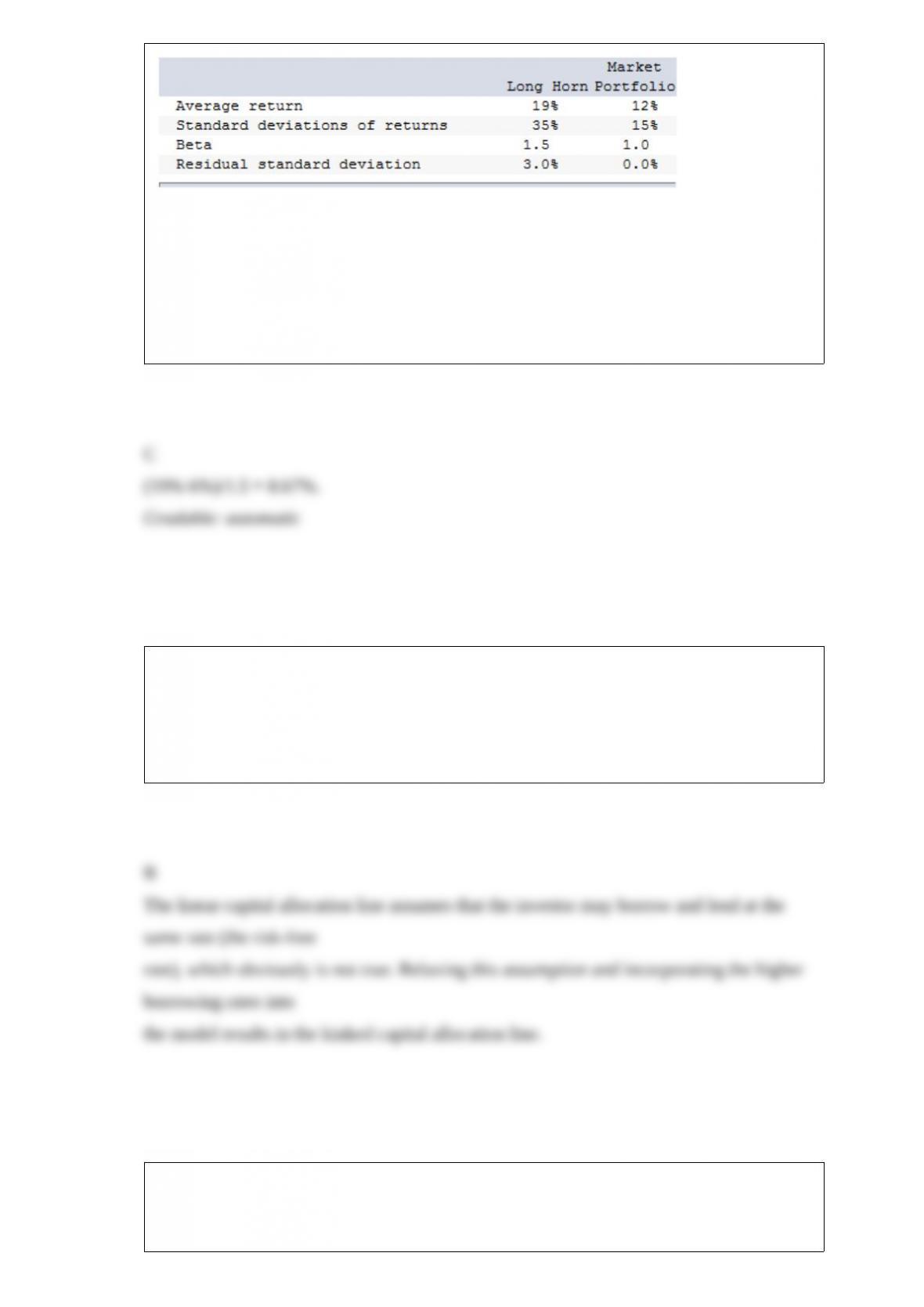
The risk-free return during the sample period was 6%.
What is the Treynor measure of performance evaluation for Long Horn Stock Fund?
A. 1.33%
B. 4.00%
C. 8.67%
D. 31.43%
E. 37.14%
The change from a straight to a kinked capital allocation line is a result of
A. reward-to-volatility ratio increasing.
B. borrowing rate exceeding lending rate.
C. an investor’s risk tolerance decreasing.
D. increase in the portfolio proportion of the risk-free asset.
Which of the following orders instructs the broker to buy at or below a specified price?
A. Limit-loss order
B. Discretionary order

C. Limit-buy order
D. Stop-buy order
E. Market order
A firm has a higher quick (or acid test) ratio than the industry average, which implies
A. the firm has a higher P/E ratio than other firms in the industry.
B. the firm is more likely to avoid insolvency in the short run than other firms in the
industry.
C. the firm may be less profitable than other firms in the industry.
D. the firm has a higher P/E ratio than other firms in the industry, and the firm is more
likely to avoid insolvency in the short run than other firms in the industry.
E. the firm is more likely to avoid insolvency in the short run than other firms in the
industry, and the firm may be less profitable than other firms in the industry.
An inverted yield curve implies that
A. long-term interest rates are lower than short-term interest rates.
B. long-term interest rates are higher than short-term interest rates.
C. long-term interest rates are the same as short-term interest rates.
D. intermediate-term interest rates are higher than either short- or long-term interest
rates.
E. None of the options are correct.

Holding other factors constant, the interest-rate risk of a coupon bond is lower when the
bond’s
A. term to maturity is higher.
B. coupon rate is lower.
C. yield to maturity is higher.
D. term to maturity is higher and coupon rate is lower.
E. All of the options are correct.
Given an optimal risky portfolio with expected return of 16%, standard deviation of
20%, and a risk-free rate of
4%, what is the slope of the best feasible CAL?
A. 0.60
B. 0.14
C. 0.08
D. 0.36
E. 0.31
The yield to maturity reported in the financial pages for Treasury securities
A. is calculated by compounding the semiannual yield.
B. is calculated by doubling the semiannual yield.
C. is also called the bond equivalent yield.
D. is calculated as the yield-to-call for premium bonds.
E. is calculated by doubling the semiannual yield and is also called the bond equivalent
yield.

A callable bond should be priced the same as
A. a convertible bond.
B. a straight bond plus a put option.
C.a straight bond plus a call option.
D. a straight bond plus warrants.
E. a straight bond.
Suppose that the pretax holding period returns on two stocks are the same. Stock A has
a high dividendpayout policy and stock B has a low dividendpayout policy. If you are
an individual in a high marginal tax bracket and do not intend to sell the stocks during
the holding period,
A. stock A will have a higher aftertax holding period return than stock B.
B. the aftertax holding period returns on stocks A and B will be the same.
C. stock B will have a higher aftertax holding period return than stock A.
D. it is impossible to determine which stock will have a higher aftertax holding period
return given the information available.
Hedge funds often have ______ provisions as long as ______, which preclude
redemption.
A. crackdown; 2 months
B. lock-up; 2 months
C. crackdown; several years
D. lock-up; several years

E. None of the options are correct.
Suppose you held a well-diversified portfolio with a very large number of securities,
and that the single index model holds. If the σ of your portfolio was 0.25 and σM was
0.21, the β of the portfolio would be approximately ________.
A. 0.64
B. 1.19
C. 1.25
D. 1.56
The duration of a par-value bond with a coupon rate of 8% (paid annually) and a
remaining time to maturity of 5 years is
A. 5 years.
B. 5.4 years.
C. 4.17 years.
D. 4.31 years.

The risk-free rate is 4%. The expected market rate of return is 11%. If you expect CAT
with a beta of 1.0 to offer
a rate of return of 11%, you should
A. buy CAT because it is overpriced.
B. sell short CAT because it is overpriced.
C. sell short CAT because it is underpriced.
D. buy CAT because it is underpriced.
E. None of the options, as CAT is fairly priced.
The capital asset pricing model assumes
A. all investors are price takers.
B. all investors have the same holding period.
C. investors have homogeneous expectations.
D. all investors are price takers and have the same holding period.
E. all investors are price takers, have the same holding period, and have homogeneous
expectations.
For the CAPM that examines illiquidity premiums, if there is correlation among assets
due to common
systematic risk factors, the illiquidity premium on asset i is a function of
A. the market’s volatility.
B. asset i’s volatility.
C. the trading costs of security i.
D. the risk-free rate.
E. the money supply.

The index model has been estimated for stocks A and B with the following results:
RA = 0.03 + 0.7RM + eA.
RB = 0.01 + 0.9RM + eB.
σM = 0.35; σ(eA) = 0.20; σ(eB) = 0.10.
The covariance between the returns on stocks A and B is
A. 0.0384.
B. 0.0406.
C. 0.1920.
D. 0.0772.
E. 0.4000.
__________ are boundaries that investors place on their choice of investment assets.
A. Investment constraints
B. Investment objectives
C. Investment policies
D. All of the options are correct
E. None of the options are correct.
As a financial analyst, you are tasked with evaluating a capital-budgeting project. You
were instructed to
use the IRR method, and you need to determine an appropriate hurdle rate. The risk-free
rate is 4%, and
the expected market rate of return is 11%. Your company has a beta of 0.67, and the
project that you are
evaluating is considered to have risk equal to the average project that the company has

accepted in the past.
According to CAPM, the appropriate hurdle rate would be
A. 4%.
B. 8.69%.
C. 15%.
D. 11%.
E. 0.75%.
For a taxpayer in the 25% marginal tax bracket, a 20-year municipal bond currently
yielding 5.5% would offer an equivalent taxable yield of
A. 7.33%.
B. 10.75%.
C. 5.5%.
D. 4.125%.
Nicholas Manufacturing just announced yesterday that its fourth quarter earnings will
be 10% higher than last year’s fourth quarter. Nicholas had an abnormal return of 1.2%
yesterday. This suggests that
A. the market is not efficient.
B. Nicholas’ stock will probably rise in value tomorrow.
C. investors expected the earnings increase to be larger than what was actually
announced.
D. investors expected the earnings increase to be smaller than what was actually
announced.
E. earnings are expected to decrease next quarter.