
In 2006, Chairman Greenspan left the Fed because
a. President Bush wanted him to resign.
b. he reached mandatory retirement age.
c. his term as Governor expired.
d. his term as Chairman expired.
Answer:
Suppose the money demand function is MD= P× [(0.25 × Y) − (100 × i)], where Yis
expressed in billions of dollars and iis expressed in percentage points. If P= 2, Y=
5,000, and i= 5, then the nominal quantity of money demanded equals
a.750.
b. 1,000.
c. 1,500.
d. 2,000.
Answer:
According to the capital asset pricing model (CAPM), the return to a stock

a. follows a random walk.
b. depends on oil prices, interest rates, and economic growth.
c. depends on how risky the stock is compared with the market average.
d. depends on the stock’s risk and the risk to bonds.
Answer:
From 1972 to 1974, the expected real interest rate on short-term bonds averaged about
+2 percent, but the realized real interest rate averaged about −2 percent. The main
reason for the difference was that
a. actual inflation was about 4 percentage points lower than expected inflation.
b. actual inflation was about 4 percentage points higher than expected inflation.
c. a monopoly cornered the market on short-term bonds.
d. nominal rate of interest was zero.
Answer:
In 2001, the number of people in the working-age population in a country increased
from 212.6 million to 215.1 million, while the labor force increased from 141.5 million
to 142.3 million. By how much did the labor-force participation rate change?

a. −0.4 percentage point
b. −0.2 percentage point
c. 0.0 percentage point
d. 0.2 percentage point
Answer:
If the Fed decides to tighten monetary policy, it uses____ to ____the money supply.
a. defensive open-market operations; decrease
b. dynamic open-market operations; increase
c. defensive open-market operations; increase
d. dynamic open-market operations; decrease
Answer:
According to the Fisher hypothesis, an increase in the expected inflation rate should
lead to____in the nominal____interest rate and in the expected real interest rate.
a. an increase; a decrease

b. an increase; no change
c. an increase; an increase
d. a decrease; a decrease
Answer:
A model that incorporates time and uncertainty in which prices, wages, and interest
rates adjust to bring all markets to equilibrium and which allows economic agents to
make decisions in their own interest is known as
a. A dynamic, stochastic, generalequilibrium model
b. A structural macroeconomic model
c. A businesscycle model
d. A statistical model
Answer:
Econometrics is
a. a system of measuring economic variables.

b. the study of public finance.
c. the use of statistical techniques on economic data.
d. the use of mathematical techniques on economic data.
Answer:
If stock prices exceed their fundamental values,
a. the stock market is overvalued.
b. the stock market is undervalued.
c. the stock market is rightly valued.
d. investors have rational expectations.
Answer:
Consider the bond market to be in equilibrium according to our complete theory of the
term structure of interest rates. The current interest rate on one-year bonds is 3.0
percent, and you believe, as does everyone in the market, that in one year the interest
rate on one-year bonds will be 3.5 percent. Assume that there is no term premium on a
one-year bond. Suppose there is a term premium equals 0.75 percent × the number of
years to maturity, for the two- year bond. The interest rate today on the two-year bond is
a. 3.25 percent.

b. 4.00 percent.
c. 4.75 percent.
d. 5.00 percent.
Answer:
If the nominal exchange rate is 5 French francs per U.S. dollar, then the exchange rate
can also be written as
a. 5 dollars per franc.
b. 0.5 dollars per franc.
c. 0.25 dollars per franc.
d. 0.2 dollars per franc.
Answer:
In case of business cycles, if output rises above the trend line
a. unemployment and inflation both rise.
b. unemployment and inflation both fall.

c. unemployment rises and inflation falls.
d. unemployment falls and inflation rises.
Answer:
Which of the following happened as a result of inflation targeting in New Zealand ?
a. It made the goals of the central bank explicit.
b. It led to a higher expected inflation rate.
c. It increased the inflation rate in the country.
d. It lowered the credibility of the central bank.
Answer:
Suppose you are an investor with a choice between three securities that are identical in
every way except in terms of their rates of return and risk. Which security has the least
risk? Note: You can answer this question intuitively, without calculating the standard
deviation. However, if you want to calculate the standard deviation, the equation is:
Standard deviation = S =

Investment A: total return = 10 percent with probability 50 percent
total return = 20 percent with probability 50 percent
Investment B: total return = 12 percent with probability 50 percent
total return = 20 percent with probability 50 percent
Investment C: total return = 5 percent with probability 60 percent
total return = 25 percent with probability 40 percent
Investment D: total return = 5 percent with probability 60 percent
total return = 7 percent with probability 40 percent
a. Investment A
b. Investment B
c. Investment C
d. Investment D
Answer:
If the M1 multiplier is 3 and the Fed engages in open-market sales in the amount of $3
billion, then M1 will
a. increase by $1 billion.
b. decline by $1 billion.
c. decline by $9 billion.

d. increase by $9 billion.
Answer:
The Gramm-Leach Bliley Act was passed in the year
a. 1930.
b. 1999.
c. 1956.
d. 1977.
Answer:
Consider a perpetuity that pays $150 every year. If the annual rate of discount is 4
percent, the present value of the perpetuity is
a. $210.00.
b. $3,000.00.
c. $3,600.00.
d. $3,750.00.

Answer:
Credit Unions get slight competitive advantage over commercial banks and thrifts
because they
a. get their charter from the Comptroller of the Currency.
b. get tax exemptions as they are often run as non-profit organizations.
c. are insured by the Federal Deposit Insurance Corporation.
d. can rely on the funds from the Federal Reserve at times of emergency.
Answer:
In an economy, the amount of money held in currency and coins is $3,500, the amount
of money held as traveler’s check is $1,000, the amount of money held as checkable
deposits is $2,000, the amount of money held in savings deposit is $4,000, and the
amount of money held with retailed money market mutual funds is $700. M1 in the
economy equals
a. $3,500.
b. $6,500.
c. $10,500.
d. $11,300.

Answer:
An investor earns dividends of $450 on a stock during the course of the year. At the end
of the year, the stock is worth $10,142. Over the year, the total return on the stock was
12 percent. At the beginning of the year, the stock must have been approximately worth
a. $9,007.
b. $9,457.
c. $9,907.
d. $10,357.
Answer:
Economic research over the last 20 years suggests that expectations are best modeled as
variables.
a. dummy
b. ordinal
c. endogenous
d. preference
Answer:

Suppose the money demand function is MD= P× [(0.25 × Y) − (100 × i)],where Yis
expressed in billions of dollars and iis expressed in percentage points. The term [(0.25 ×
Y) − (100 × i)] is called
a. the nominal money-demand function.
b. the nominal money-supply function.
c. the real money-supply function.
d. the real money-demand function.
Answer:
In the long boom period in the U.S., there have been____ recessions.
a. 0
b. 3
c. 4
d. 6
Answer:

Buying stocks gives an investor
a. a very low but safe return.
b. ownership in corporations.
c. the riskiest asset available in the market.
d. a pure and random speculative gamble.
Answer:
The Act allows national bank to have additional offices in the same city as their main
office.
a. Glass-Steagall
b. McFadden
c. Bank Holding Company
d. National Bank
Answer:

The Open Market Desk is located at
a. the Federal Reserve Bank of Boston.
b. the Federal Reserve Bank of Philadelphia.
c. the Federal Reserve Bank of New York.
d. the Federal Reserve Bank of Chicago.
Answer:
An anomaly is
a. a stock that has greater than average risk.
b. a mutual fund that only invests in government securities.
c. an odd lot of stock.
d. an incident of predictable patterns to stock prices, that investors could exploit.
Answer:
Suppose the only good traded between Mexico, the U.S., and Brazil is beef, which is
produced by all three countries.
If the cost of producing a pound of beef is 5 pesos in Mexico, 2 dollars in the U.S., and

1 real in Brazil, the exchange rates based on the law of one price would be_____ pesos
per dollar and____ dollars per real.
a. 2.5; 2
b. 2.5; 0.5
c. 0.4; 0.5
d. 0.4; 2
Answer:
Voting members of the FOMC include
a. the seven Federal Reserve governors, the presidents of the Federal Reserve Banks of
New York, San
Francisco, and Chicago, and the presidents of four other Federal Reserve Banks, on a
rotating basis.
b. five of the seven Federal Reserve governors and the presidents of five Federal
Reserve Banks on a rotating basis.
c. all of the Federal Reserve governors and the presidents of all Federal Reserve Banks.
d. the seven Federal Reserve governors, the president of the Federal Reserve Bank of
New York, and the presidents of four other Federal Reserve Banks on a rotating basis.
Answer:

An inverted yield curve indicates that
a. an economic expansion has just begun.
b. an economic expansion has been going on for several years.
c. a recession is about to begin.
d. a recession is nearly over.
Answer:
Which of the following is likely to happen according to monetarists if money supply
increases?
a. Unemployment will increase
b. Output will increase
c. Consumption will fall
d. Investment will fall
Answer:
Describe the coin shortage of 1999 and 2000 and describe why it occurred. What ended
the shortage?
Answer:
An increase in the money supply is an example of a(n) policy.
a. countercyclical
b. procyclical
c. contractionary
d. expansionary
Answer:
What are the central banking functions that a Federal Reserve Bank performs?

Answer:
In which period was the rate of output growth the fastest in the U.S. economy?
a. 1929−1949
b. 1949−1970
c. 1970−1982
d. 1982−2010
Answer:
The fact that the Fed is willing to pay interest on reserves gives the Fed another
mechanism for affecting the money supply and the amount of reserves that banks hold.
How might a very low interest rate paid on reserves increase the money supply? (Hint:
Consider the possible uses of excess reserves.)
Answer:
Describe the new neoclassical synthesis.
Answer:
Describe time inconsistency and explain how it can be avoided by a central bank setting
monetary policy.
Answer:
Consider the standard dynamic model of money in which the economy is in a steady
state with constant levels of output, inflation, and the nominal interest rate. Suppose
initially that the steady-state nominal interest rate is 4 percent, the steady-state inflation
rate is 2% percent, and the growth rate of the money supply is 2 percent. How will an
unanticipated permanent decline in the growth rate of the money supply to 0 percent
affect the level of output, the inflation rate, and the nominal interest rate?
Answer:
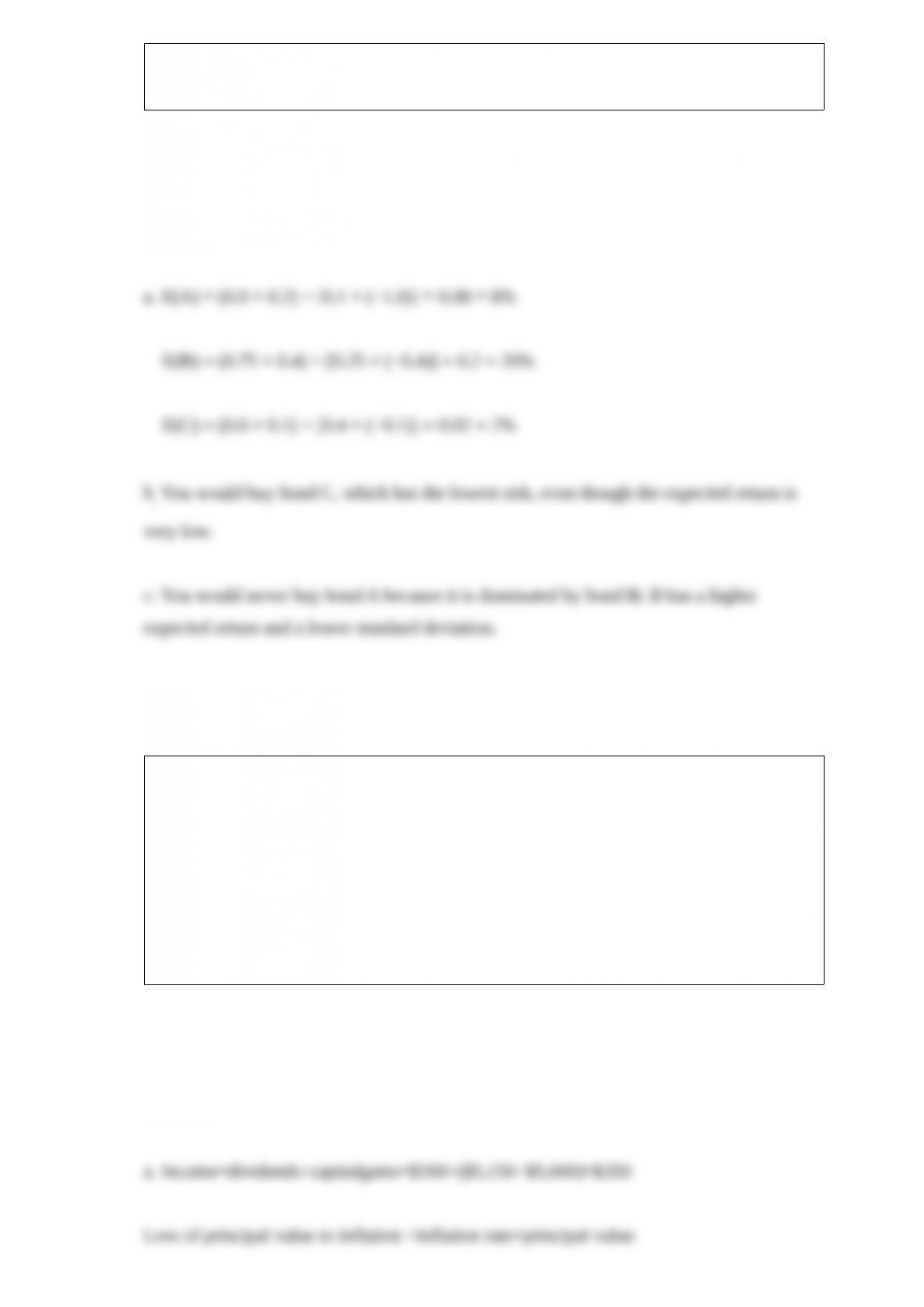
Consider three alternative bonds that you might invest in, each of which matures in one
year. The following table shows the probability that you will receive each possible
return. For example, if you buy bond A, the probability is 90 percent that your return
will be 20 percent and the probability is 10 percent that your return will be −100
percent(in other words,you lose the entire amount invested).
a. Calculate the expected return for all three bonds in percentage terms.
b.The standard deviations of the returns on these bonds are: Bond A, 0 percent; Bond B,
34.6 percent; Bond C, 8 percent. If you are extremely risk averse, which of the three
bonds would you buy? Why?
c. Would a risk-averse investor ever buy Bond A instead of one of the other bonds? Why
or why not?
Explain and show all your work. In your calculations, you may round after three
significant digits.
Answer:
An investor buys stock for $5,000 at the beginning of the year. She earns dividends of
$200 during the course of the year. At the end of the year, the stock is worth $5,150.
The tax rate on dividends and capital gains is 15 percent. The inflation rate is 2 percent.
a. Calculate the investor’s after-tax real return if she does not sell the stock at the end of
the year.
b. Calculate the investor’s after-tax real return if she sells the stock at the end of the
year.
Answer:
What is the reason for a low rated security to generate a high yield to maturity?
Answer:
What step does the Board of governors of the Fed take to ensure that the Fed does not
built itself into an inefficient bureaucracy?
Answer:
Explain why inflation risk is a problem for investors.
Answer:
Suppose a banking market consists of banks that have the following shares of the
market: 34 percent, 28 percent, 16 percent, 10 percent, 8 percent, and 4 percent.
Calculate the HHI.
Answer:

What happens to the Phillips curve if the actual rate of inflation remains above the
expected rate of inflation over time?
Answer:
If the cost of going to the ATM is $1 and the nominal interest rate is 5 percent, someone
who has a 15 percent probability of having his cash lost or stolen and spends $10 each
day will go to the ATM once in every______days approximately.
a. 10
b. 13
c. 16
d. 19
Answer:
In the two-period model, suppose a household’s income in the first period is $50,000,
income in the second period is
$60,000, and the real interest rate is 25 percent. Draw a diagram showing the budget
constraint. Now, suppose the real interest rate declines to 20 percent. Draw the new
budget constraint. For the budget constraints you have drawn, be sure to show the
values of the intercepts on each axis. If the household decides that its consumption in
period 1 should always be one half of the present value of income, determine whether
the household is worse off or better off because of the decline in the real interest rate.
Show your work.
Answer:
Consider a perpetuity that pays $300 every year. If the rate of discount is 6 percent,
calculate the present value of the bond.
Answer: