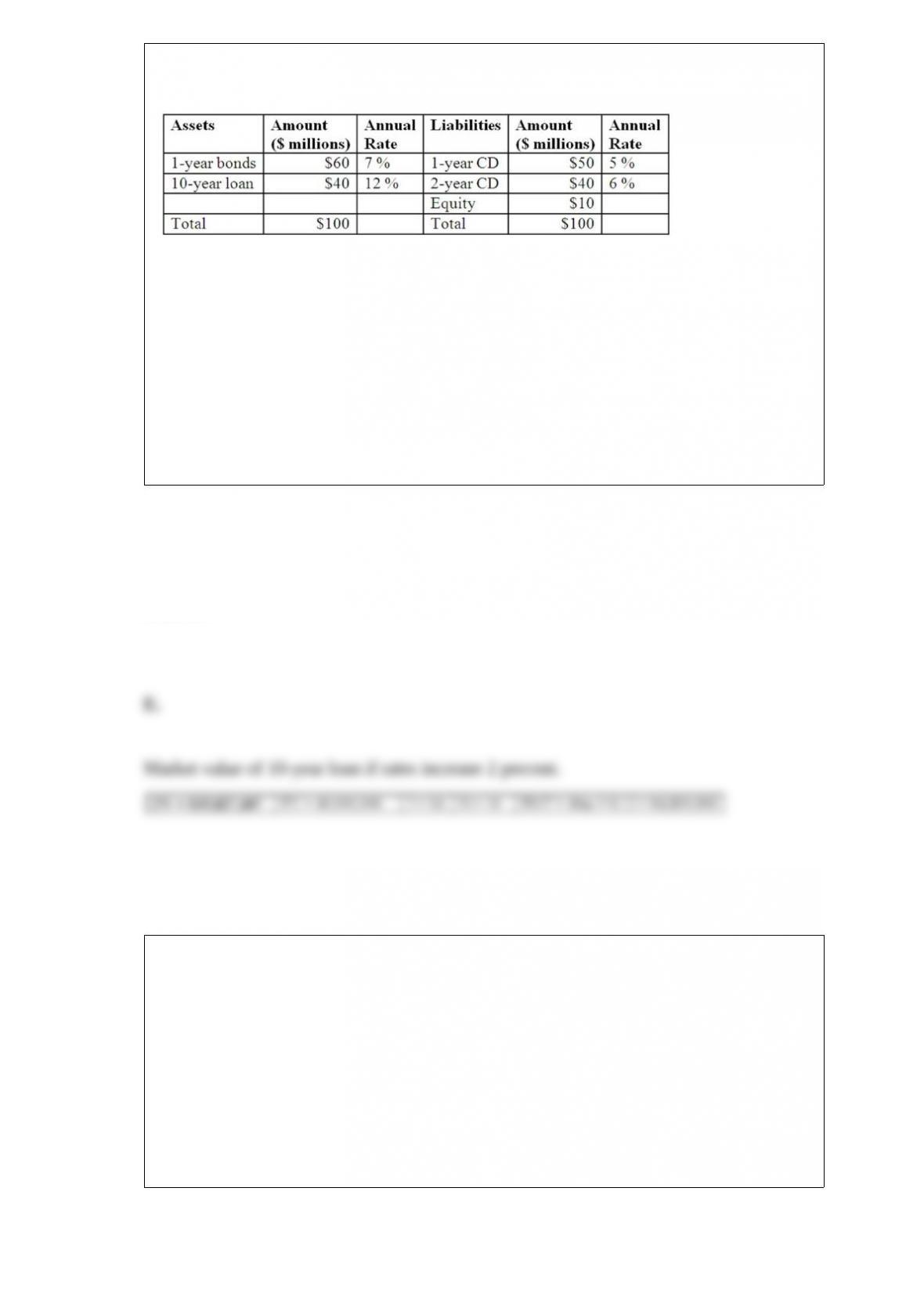
Hadbucks National Bank current balance sheet appears below. All assets and liabilities
are currently priced at par and pay interest annually.
What is market
value of the ten-year loan if all market interest rates increase by 2 percent? A. $40.000
million.
B. $44.916 million.
C. $37.830 million.
D. $42.356 million.
E. $35.827 million.
Answer:
The Government National Mortgage Association A. is a private corporation owned by
shareholders.
B. purchases pools of mortgages originated by FIs.
C. provides timing insurance to investors in mortgage-backed securities.
D. only approves conventional and FHA/VA insured mortgages.
E. was the first agency to securitize residential mortgages.

Answer:
Which of the following factors help explain the decline in FX trading in the early years
of this century? A. Introduction of the euro.
B. Consolidation in the banking industry.
C. Growth of electronic brokering.
D. Mergers in the corporate sector.
E. All of the above.
Answer:
Which is the most important banking area in which technology has had an impact? A.
Cash-management services.
B. Residential mortgage lending.
C. Issuance of certificates of deposit.
D. Credit approval.
E. None of the above.

Answer:
Program trading involvesA. online trading services provided to customers by electronic
trading securities firms.
B. computer-driven buying or selling of baskets of 15 or more stocks by institutional
traders.
C. purchase and sale of assets that are potentially but not necessarily equivalent.
D. buying blocks of securities in anticipation of some information release.
E. providing a platform for customers to trade without the use of a broker.
Answer:
Buying a cap is similar to A. writing a call option on interest rates.
B. buying a call option on interest rates.
C. buying a put option on interest rates.
D. buying a floor on interest rates.
E. buying a collar on interest rates.

Answer:
An insurance policy that protects an individual over an entire lifetime as long as the
premiums are paid is calledA. term life.
B. universal life.
C. whole life.
D. endowment life.
E. variable life.
Answer:
LNW Bank is charging a 12 percent interest rate on a $5,000,000 loan. The bank also
charged $100,000 in fees to originate the loan. The bank has a cost of funds of 8
percent. The borrower has a five percent chance of default, and if default occurs, the
bank expects to recover 90 percent of the principal and interest.
What is the expected return on the loan using the Moody’s Analytics model? A. 6.50
percent.
B. 5.50 percent.
C. 6.00 percent.
D. 14.0 percent.

E. 13.5 percent.
Answer:
Which intermediation function results in an FI’s exposure to liquidity risk? A.
Information production.
B. Asset transformation.
C. Conduit for monetary policy.
D. Lender of last resort.
E. Brokering between funds deficit units and funds surplus units.
Answer:
The risk that a debt security’s price will fall, subjecting the investor to a potential capital
loss is A. credit risk.
B. market risk.

C. currency risk.
D. liquidity risk.
E. political risk.
Answer:
The growth of the commercial paper market has hurt the market for loan sales by A.
offering some borrowers alternatives to bank loans.
B. underpricing the banks that sell loans.
C. fostering the credit crunch.
D. adding another regulatory layer since the SEC requires shelf registration of new
issues.
E. increasing moral hazard concerns in the market.
Answer:
The purchase often of a series of put options with multiple exercise dates results in a A.
open interest.

B. pull-to-par.
C. cap.
D. floor.
E. collar.
Answer:
In total, about the percentage of all retirement plan investments are in institutional
funds. A. 20 percent
B. 40 percent
C. 6.0 percent
D. 80 percent
E. Zero percent
Answer:
Purchasing a succession of call options on interest rates is called a A. open interest.

B. pull-to-par.
C. cap.
D. floor.
E. collar.
Answer:
What is the duration of the bank’s Treasury portfolio? A. 1.07 years.
B. 1.00 year.
C. 0.98 years.
D. 0.92 years.
E. Insufficient information.
Answer:
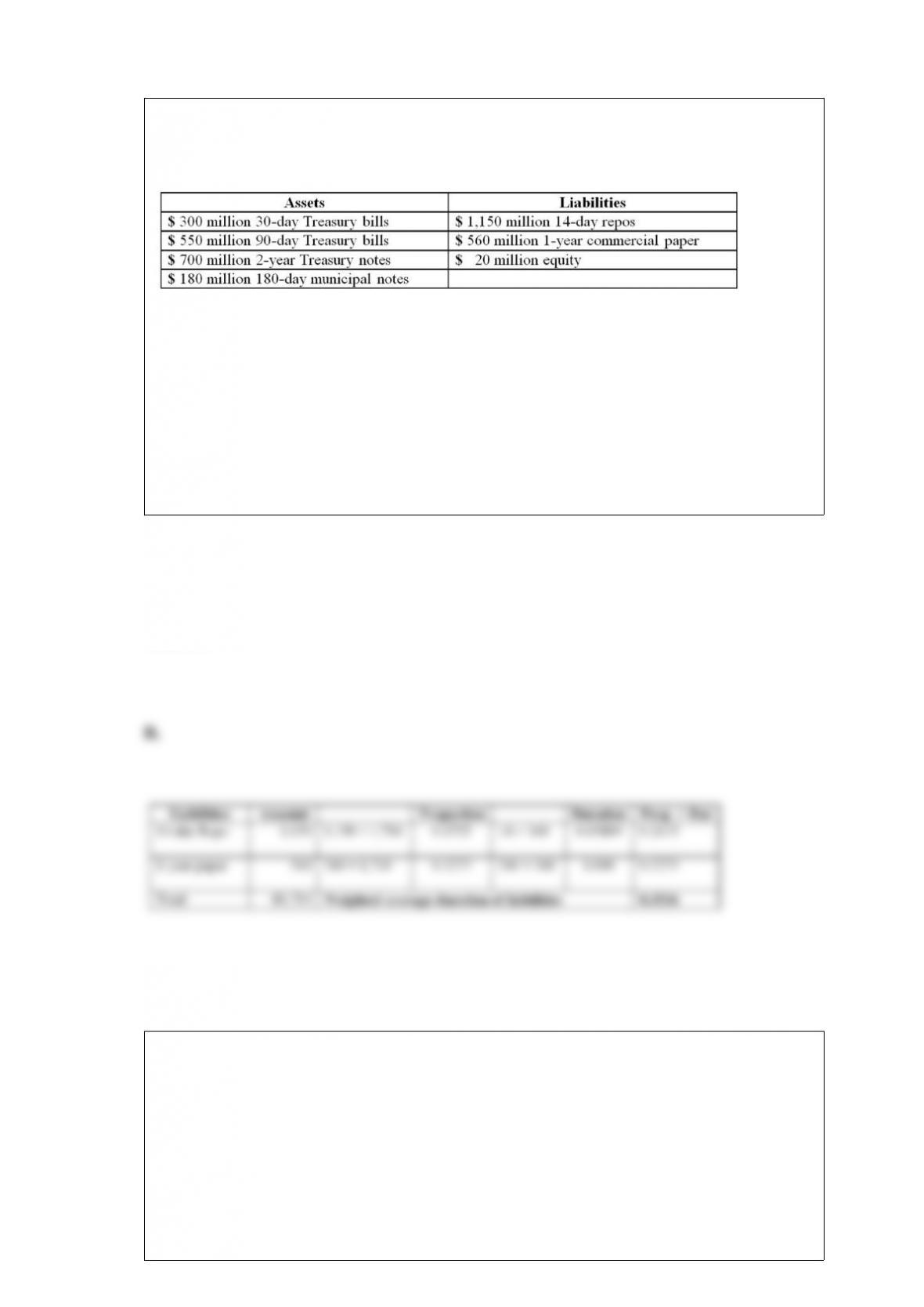
Third Duration Investments has the following assets and liabilities on its balance sheet.
The two-year Treasury notes are zero coupon assets. Interest payments on all other
assets and liabilities occur at maturity. Assume 360 days in a year.
What is
the duration of the liabilities? A. 0.708 years.
B. 0.354 years.
C. 0.350 years.
D. 0.955 years.
E. 0.519 years.
Answer:
The terms of futures contracts traded in the U.S. are set by the exchange on which they
propose to be traded, but are subject to approval by theA. Federal Reserve.
B. Commodity Futures Trading Commission.
C. CME Group (formerly Chicago Mercantile Exchange).
D. Chicago Board of Trade.
E. Securities and Exchange Commission.
Answer:
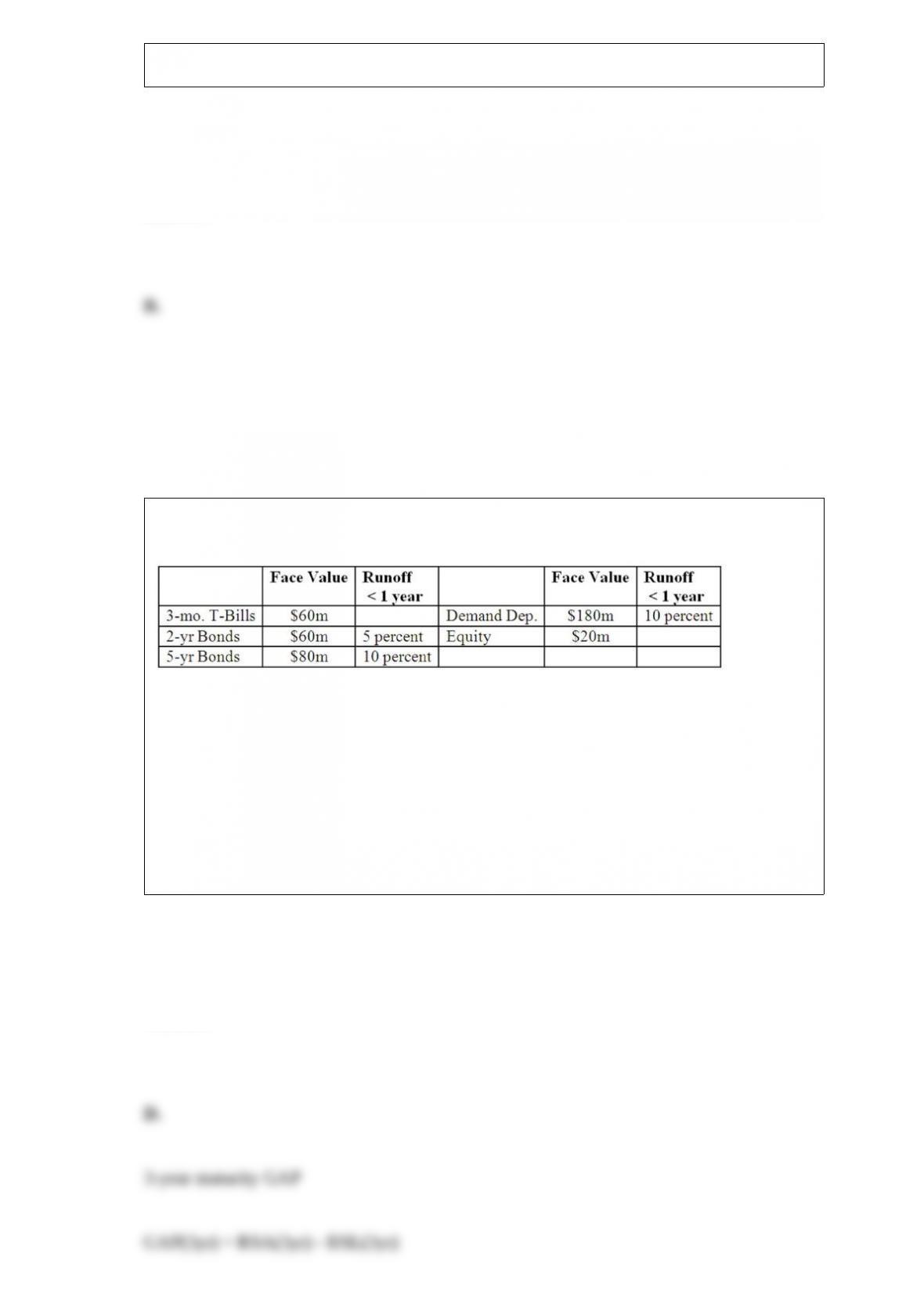
The following is the balance sheet of Boston Bank. The average maturity of demand
deposits is estimated at 2 years.
What is
the repricing gap if a 3-year maturity gap is used? Ignore runoffs. A. $21 million.
B. $44 million.
C. -$80 million.
D. -$60 million.
E. -$120 million.
Answer:

The USA Patriot Act of 2001A. requires U.S. banks to improve their due diligence
reviews to guard against money laundering.
B. prohibits U.S. banks from providing banking services to foreign banks that do not
have a physical presence in any country.
C. gives to federal authorities the power to subpoena the records of a foreign bank’s
U.S. correspondent account.
D. All of the above.
E. Answers B and C only.
Answer:
Estimate the standard deviation of Bank B’s asset allocation proportions relative to the
national benchmark. A. 40.44 percent.
B. 34.32 percent.
C. 29.89 percent.
D. 21.21 percent.
E. 15.00 percent.

Answer:
The current exposure component of the credit equivalent amount of OBS derivative
items reflects A. the probability of an adverse price movement in contracts.
B. the cost of replacing a contract if a counterparty defaults today.
C. the probability today of a counterparty contract default in the future.
D. the maximum price loss for any given position.
E. future volatility of the underlying.
Answer:

A bond is scheduled to mature in five years. Its coupon rate is 9 percent with interest
paid annually. This $1,000 par value bond carries a yield to maturity of 10 percent.
What is the bond’s current market price?A. $962.09.
B. $961.39.
C. $1,000.
D. $1,038.90.
E. $995.05.
Answer:
Buffer reserves at DIs are A. reserves in excess of the minimum required reserves.
B. government securities that do not qualify as required reserves, but that can be
converted to cash quickly.
C. the portion of reserves that are calculated at a rate of ten percent of deposits.
D. non-government securities and loans that must be converted into cash.
E. the portion of life insurance company assets that require minimum reserves.

Answer:
An FI that finances a euro (€) loan with U.S. dollar ($) deposits is exposed to A.
technology risk.
B. interest rate risk.
C. credit risk.
D. foreign exchange risk.
E. off-balance-sheet risk.
Answer:
Catastrophe futures contracts A. are designed to protect life insurance companies from
the effects of natural disasters in which large numbers of lives are lost.
B. are designed to protect property-casualty insurers against the extreme losses that can
occur in hurricanes.
C. are designed to hedge insurance companies from liability law suits.
D. provide a payoff when the actual loss ratio is less than the expected loss ratio.
E. provide a payoff to the seller of the contract that is equal to the loss ratio times the
nominal value of the contract.

Answer:
Routine hedgingA. is a hedging strategy that occurs on a set, predetermined basis by
the FI.
B. always results in excess returns.
C. is a strategy to follow when interest rates are abnormally low.
D. is a strategy used when interest rates are extremely unpredictable.
E. is a strategy to follow when interest rates are abnormally high.
Answer:
Of the ten largest banks in the world at the beginning of 2012, how many were U.S.
banks? A. 0.
B. 1.
C. 2.
D. 4.
E. 8.

Answer:
An investment banker agrees to underwrite an issue of 10 million shares of stock for
Rochester Industries on a best-efforts basis. The investment banker is able to sell 8
million shares for $10.50 per share, and it charges Rochester Industries $0.225 per share
sold.
What would be the profit to the investment banker it were able to sell all 10 million
shares for $12.75 per share?A. Profit of $2,250,000.
B. Loss of $7,500,000.
C. Profit of $7,500,000.
D. Loss of $3,000,000.
E. Profit of $3,750,000.
Answer:
A new computer system is expected to cost $40 million and generate annual savings of
$12 million over the next five years.

Should the bank invest in this project if the discount rate is 12 percent? A. Yes, because
the net present value of the project is $3,257,314.
B. No, because the net present value of the project is -$3,257,314.
C. Yes, because the net present value of the project is $20 million.
D. No, because the net present value of the project is -$20 million.
E. Yes, because the net present value of the project is $4,980,000.
Answer:
In what year did housing prices begin to deteriorate leading to a jump in defaults in the
subprime mortgage markets and the onset of the recent financial crisis? A. 2001.
B. 2003.
C. 2006.
D. 2008.
E. 2010.
Answer: