
Uptown Clothing just paid $1.50 as its annual dividend and increases its dividend by
2.5 percent each year. What will Uptown’s stock price be in ten years at a discount rate
of 12.25 percent?
A. $19.46
B. $22.08
C. $20.19
D. $19.70
E. $21.50
Answer:
As part of an unexpected news announcement, Alpha Co. stated that it is increasing its
annual dividend from $1.04 per share to $1.10 per share. What else must the company
have also announced if its stock price and total expected return remained constant
following this announcement? Assume none of the announcement information was
previously expected by the market.
A. The firm is planning a new period of rapid growth.
B. The firm’s ongoing operations are on track to meet prior expectations.
C. The firm’s rate of growth will be less than previously anticipated.
D. The firm’s dividend payout ratio has been, is, and will continue to be constant.
E. The firm will continue to pays it dividend on an annual basis.
Answer:
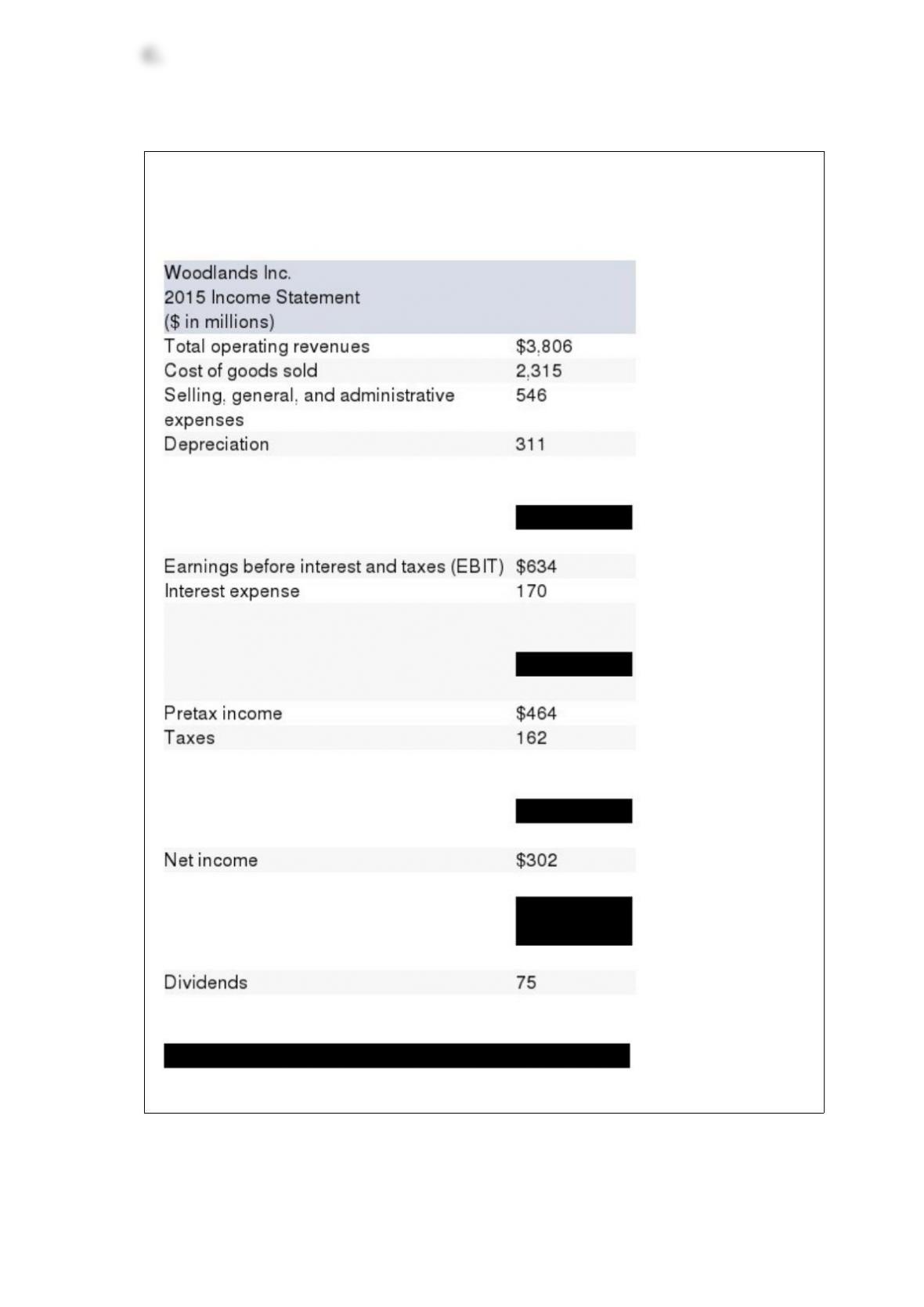
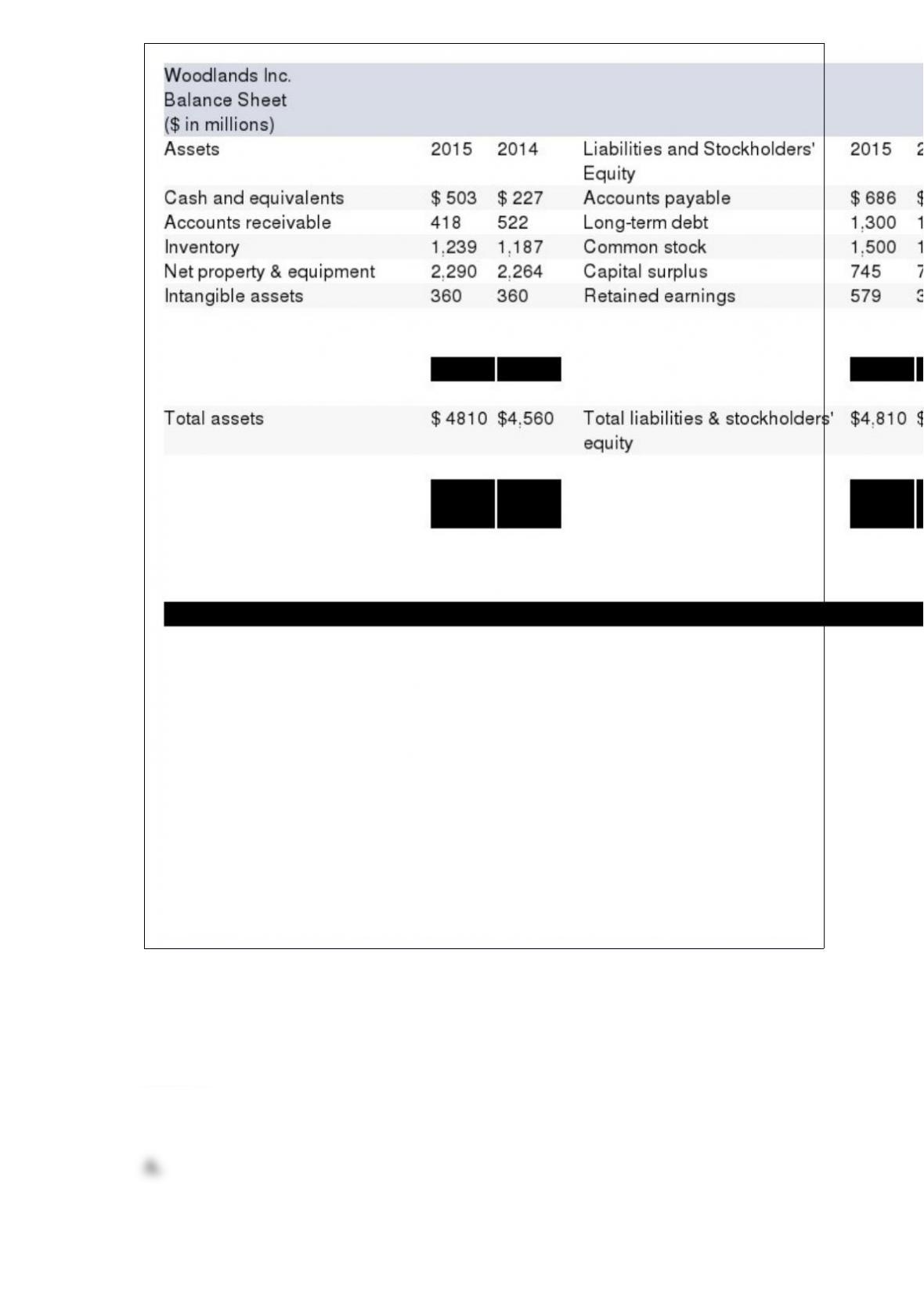
What is the cash flow of the firm for 2015?
A.$295 million
B.$485 million
C.$1,340 million
D.$590 million
E.$310 million
Answer:

You are comparing two annuities with equal present values. The applicable discount
rate is 6.5 percent. One annuity will pay $2,000 annually, starting today, for 20 years.
The second annuity will pay annually, starting one year from today, for 20 years. What
is the annual payment for the second annuity?
A. $2,225
B. $2,075
C. $2,000
D. $2,130
E. $2,405
Answer:
A financial device designed to make unfriendly takeover attempts financially
unappealing, if not impossible, is called:
A. a golden parachute.
B. a standstill agreement.
C. greenmail.
D. a poison pill.
E. a white knight.
Answer:

A project has an initial cost of 80,000 and is expected to return 10,000 the first year,
40,000 the second year, and 50,000 the third and final year. The current spot rate is .56.
The nominal risk-free return is 5 percent in the U.K. and 7 percent in the U.S. The
return relevant to the project is 7.8 percent in the U.K. and 8.1 percent in the U.S.
Assume uncovered interest rate parity exists. What is the net present value of this
project in U.S. dollars?
A. $17,787
B. $14,002
C. $12,312
D. $11,511
E. $12,742
Answer:
Which one of the following statements about preferred stock is true?
A. Unlike dividends paid on common stock, dividends paid on preferred stock are a
tax-deductible expense.
B. Dividends on preferred stock payable during the next twelve months are considered
to be a corporate liability.
C. If preferred dividends are non-cumulative, then preferred dividends not paid in a
particular year will be carried forward to the next year.
D. There is no significant difference in the voting rights granted to preferred and
common shareholders.
E. Preferred stock usually has a stated liquidating value of $100 per share.

Answer:
Which one of these bonds is the most interest-rate sensitive?
A. 5-year zero coupon bond
B. 10-year zero coupon bond
C. 5-year, 6 percent, annual coupon bond
D. 10-year, 6 percent, semiannual coupon bond
E. 10-year, 6 percent, annual coupon bond
Answer:
A friendly suitor that a target firm turns to as an alternative to a hostile bidder is called
a:
A. golden suitor.
B. poison put.
C. white knight.
D. shark repellent.
E. crown jewel.

Answer:
The Fisher formula is expressed as _____ where R is the nominal rate, r is the real rate,
and h is the inflation rate.
A. r = R h
B. R = r h
C. 1 + h = (1 + r) / (1 + R)
D. 1 + R = (1 + r) / (1 + h)
E. 1 + R = (1 + r) (1 + h)
Answer:
Assume that 118.37 equal $1. Also assume that 7.4518SKr equal $1. How many
Japanese yen can you acquire in exchange for 5,000 Swedish krona?
A. 412.29
B. 314.77
C. 41,710.99
D. 46,756.67
E. 79,423.76

Answer:
What is the effective annual rate if your credit card charges you 10.64 percent
compounded daily? (Assume a 365-day year.)
A. 10.79%
B. 11.22%
C. 11.95%
D. 11.48%
E. 12.01%
Answer:
Nu-Tools plans to set aside an equal amount of money each year, starting today, so that
it will have $25,000 saved at the end of three years. If the firm can earn 4.7 percent,
how much does it have to save annually?
A. $7,596.61
B. $7,689.16
C. $8,004.67
D. $8,414.14
E. $8,333.33

Answer:
The beta of a firm is more likely to be high under which two conditions?
A. high cyclical business activity and low operating leverage
B. high cyclical business activity and high operating leverage
C. low cyclical business activity and low financial leverage
D. low cyclical business activity and low operating leverage
E. low financial leverage and low operating leverage
Answer:
As we add more diverse securities to a portfolio, the ____ risk of the portfolio will
decrease while the _____ risk will not.
A. total; unsystematic
B. systematic; unsystematic
C. total; systematic
D. systematic; total
E. unsystematic; total

Answer:
The sale of stock in a wholly owned subsidiary via an initial public offering is referred
to as a(n):
A. split-up.
B. equity carve-out.
C. counter-tender offer.
D. white knight transaction.
E. lockup transaction.
Answer:
The net cash flows of Advantage Leasing for the next three years are $42,000, $49,000,
and $64,000, respectively, after which the growth rate will be a constant 2 percent with
an RWACC of 8 percent. What is the present value of the terminal value?
A. $881,822
B. $863,689
C. $959,259
D. $910,444
E. $828,406

Answer:
The APV method is comprised of the all-equity NPV of a project plus the NPV of
financing effects. The four financing side effects are:
A. tax subsidy of dividends, cost of issuing new securities, subsidy of financial distress,
and cost of debt financing.
B. cost of issuing new securities, cost of financial distress, tax subsidy of debt, and
other subsidies to debt financing.
C. cost of issuing new securities, cost of financial distress, tax subsidy of dividends, and
cost of debt financing.
D. subsidy of financial distress, tax subsidy of debt, cost of other debt financing, and
cost of issuing new securities.
E. cost of financial distress, tax subsidy of debt, increased cost of equity capital, and
cost of issuing new securities.
Answer:
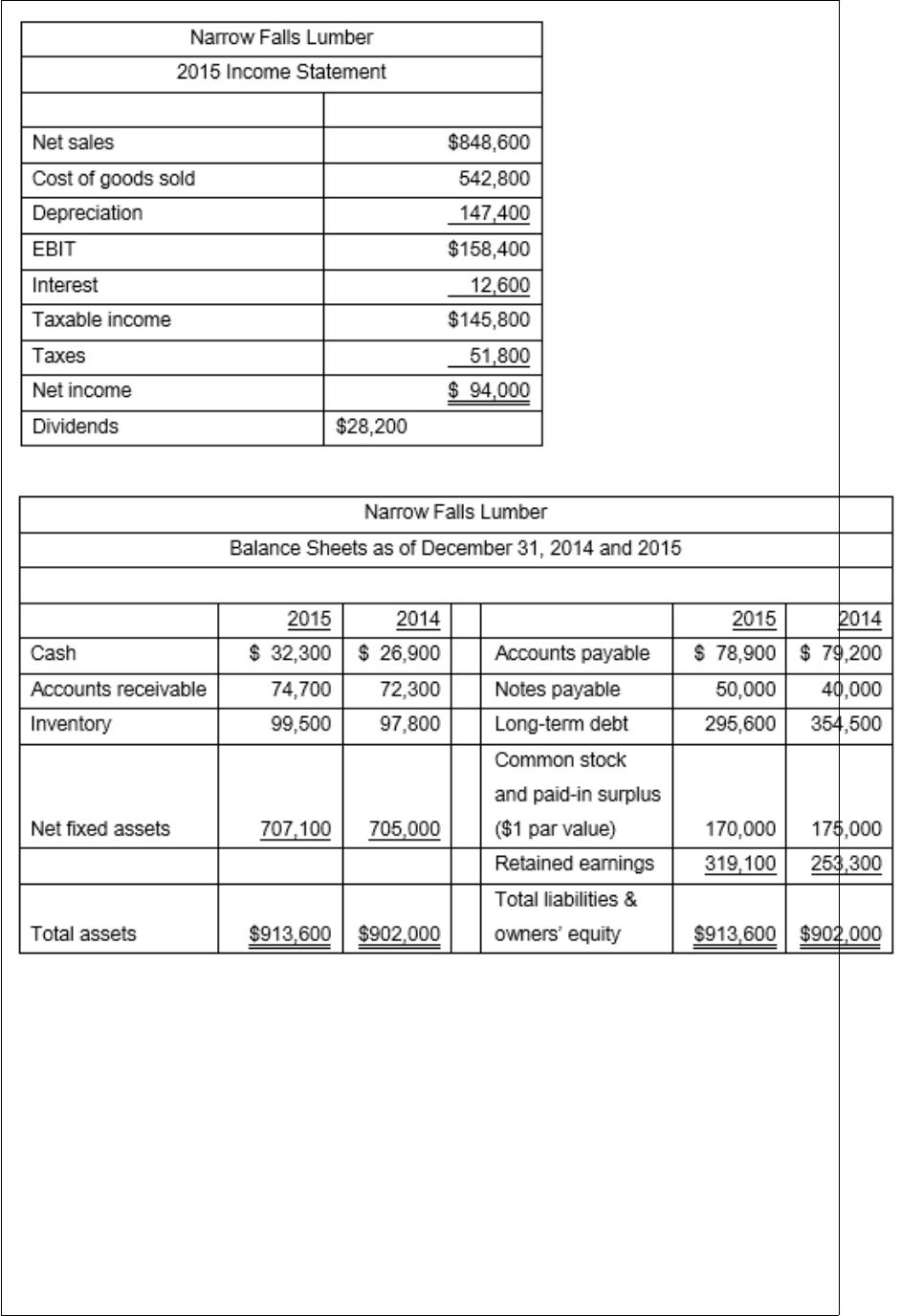
What are the values for the three components of the DuPont identity for 2015?
A. 11.08%; .9289; 1.8679
B. 11.08%; 1.0765; 1.8679
C. 11.08%; .9289; .5354
D. 7.75%; 1.0765; .5354
E. 7.75%; 1.0765; 1.8679
Answer:

An investment is available that pays a tax-free 6 percent. If the corporate tax rate is 30
percent, and you ignore risk, what would you expect the pretax return on taxable bonds
to be?
A. 4.20%
B. 6.00%
C. 7.67%
D. 8.57%
E. 1.80%
Answer:
The theory that real interest rates are equal across countries is called:
A. the unbiased forward rates condition.
B. uncovered interest rate parity.
C. the international Fisher effect.
D. purchasing power parity.
E. interest rate parity.
Answer:

Bonds with attached warrants are frequently issued:
A. with very low coupons.
B. at a greatly discounted price.
C. with an attached share of preferred stock.
D. with a share purchase price set equal to the market price minus the stock’s par value
at time of purchase.
E. with an attached share of common stock.
Answer:
When the Canadian dollar is quoted as $.87, this quote is a(n):
A. triangle rate.
B. indirect rate.
C. direct rate.
D. cross rate.
E. inverse rate.
Answer:

Leslie is charged with determining which small projects should be funded. Along with
this assignment, she has been granted the use of $15,000 for a maximum of two years.
She is considering three projects. Project A costs $7,500 and has cash flows of $4,000 a
year for Years 1 to 3. Project B costs $8,000 and has cash flows of $3,000, $4,000, and
$3,000 for Years 1 to 3, respectively. Project C costs $2,000 and has a cash inflow of
$2,500 in Year 2. What decisions should she make regarding these projects if she
assigns them a mandatory discount rate of 8.5 percent? Explain why.
A. accept either Projects A and C or Projects B and C, but not all three as there is
insufficient financing
B. accept Project C and reject Projects A and B because only Project C has a discounted
payback that is less than two years
C. accept Projects A and C and reject Project B as they have the shortest discounted
payback periods than fit within the $15,000 allocation
D. accept Projects A and C and reject Project B as A and B payback within two years
E. accept Projects B and C and reject Project A as this combination uses the most initial
capital
Answer:
The profitability index:
A. rule often results in decisions that conflict with the decisions based on the net
present value rule.
B. is useful as a decision tool when investment funds are limited and all available funds
are allocated.

C. method is most commonly used when deciding between mutually exclusive projects
of varying size.
D. rule adjusts for a project’s size when determining which one of two projects to
accept.
E. produces results which typically are difficult to comprehend.
Answer:
On September 1, a firm grants credit with terms of 2/10 net 30. The creditor:
A. must pay a penalty of 2/10 of one percent when payment is made later than
October1.
B. must pay a penalty of 10 percent when payment is made later than 2 days after
October 1.
C. receives a discount of 2 percent when payment is made at least 10 days prior to
October 1.
D. receives a discount of 2 percent when payment is made on September 1and pays a
penalty of 10 percent if payment is made after October 1.
E. receives a discount of 2 percent when payment is made within 10 days.
Answer:

I. M. Not. Greedy has been granted options on 50,000 shares. The stock is currently
trading at $17 a share and the options are at the money. The volatility of the stock
returns averages 16 percent. The options mature in 2 years and the risk-free rate is 3.45
percent. N(d1) is .662055 and N(d2) is .576052. Given this information, what is the
value of a call option on one share of this stock?
A. $2.11
B. $1.70
C. $1.89
D. $2.28
E. $2.21
Answer:
A firm in financial distress that reorganizes through the bankruptcy process:
A. will continue to operate as a going concern throughout the entire process.
B. must only have the reorganization plan approved by its primary creditor.
C. cannot issue new securities to either creditors or shareholders.
D. must file a reorganization plan within 90 days of filing the bankruptcy petition.
E. must abide by the Section 363 provisions of Chapter 11.
Answer:

The general purpose of identifying multiple factors in the APT model is to:
A. identify the factors that have the largest impact on the market rate of return.
B. identify and eliminate all systematic risks from a portfolio.
C. identify the quantity of each factor that is needed to reduce a portfolio’s risk, as
measured by beta, to a level equal to that of the overall market.
D. reduce the unsystematic risk to a level where the unsystematic risk of one security is
unrelated to the unsystematic risk of any other security held within the same portfolio.
E. reduce the slope of the security market line, thereby reducing portfolio risk.
Answer:
Which one of the following statements is correct?
A. An equity carve-out generates cash for the parent firm.
B. A split-up frequently follows a spin-off.
C. An equity carve-out is a specific type of acquisition.
D. A spin-off involves an initial public offering.
E. A divestiture means that the original firm ceases to exist.
Answer:

The Winter Wear Company has expected earnings before interest and taxes of $3,800,
an unlevered cost of capital of 15.4 percent and a tax rate of 35 percent. The company
also has $2,600 of debt with a coupon rate of 5.7 percent. The debt is selling at par
value. What is the value of this firm?
A. $15,585.32
B. $16,948.96
C. $12,115.32
D. $12,055.04
E. $17,700.08
Answer:
A business owned by a single individual is called a:
A. corporation.
B. sole proprietorship.
C. general partnership.
D. limited partnership.
E. limited liability company.
Answer: