
1) In the U.S. over the past 30 years, foreign direct investment (FDI) came
overwhelmingly in the form of mergers and acquisitions rather than through
establishments.
2) The overriding goal for merging is the maximization of the owners’ wealth as
reflected in the acquirer’s share price.
3) Whenever the percentage change in earnings per share (EPS) resulting from a given
percentage change in sales is greater than the percentage change in sales, financial
leverage exists.
4) Although preferred stock provides added financial leverage in much the same way as
bonds, it differs from bonds in that the issuer can pass a dividend payment without
suffering the consequences that result when an interest payment is missed on a bond.
5) A $60,000 outlay for a new machine with a usable life of 15 years is an operating
expenditure that would appear as a current asset on a firm’s balance sheet.
6) Higher the coefficient of variation, the greater the risk and therefore the higher the
expected return.
7) The cash conversion cycle is the sum of average age of the inventory and average
collection period minus average payment period.
8) Which type of dividend payment policy has the disadvantage that if a firm’s earnings
drop or if a loss occurs in a given period, dividends may be low or nonexistent?
A) constant-payout-ratio policy
B) regular dividend policy
C) low-regular-and-extra dividend policy
D) stock dividend policy
9) Inflation can distort ________.
A) book value of inventory costs
B) market value of revenue
C) market value of sales
D) book value of revenue
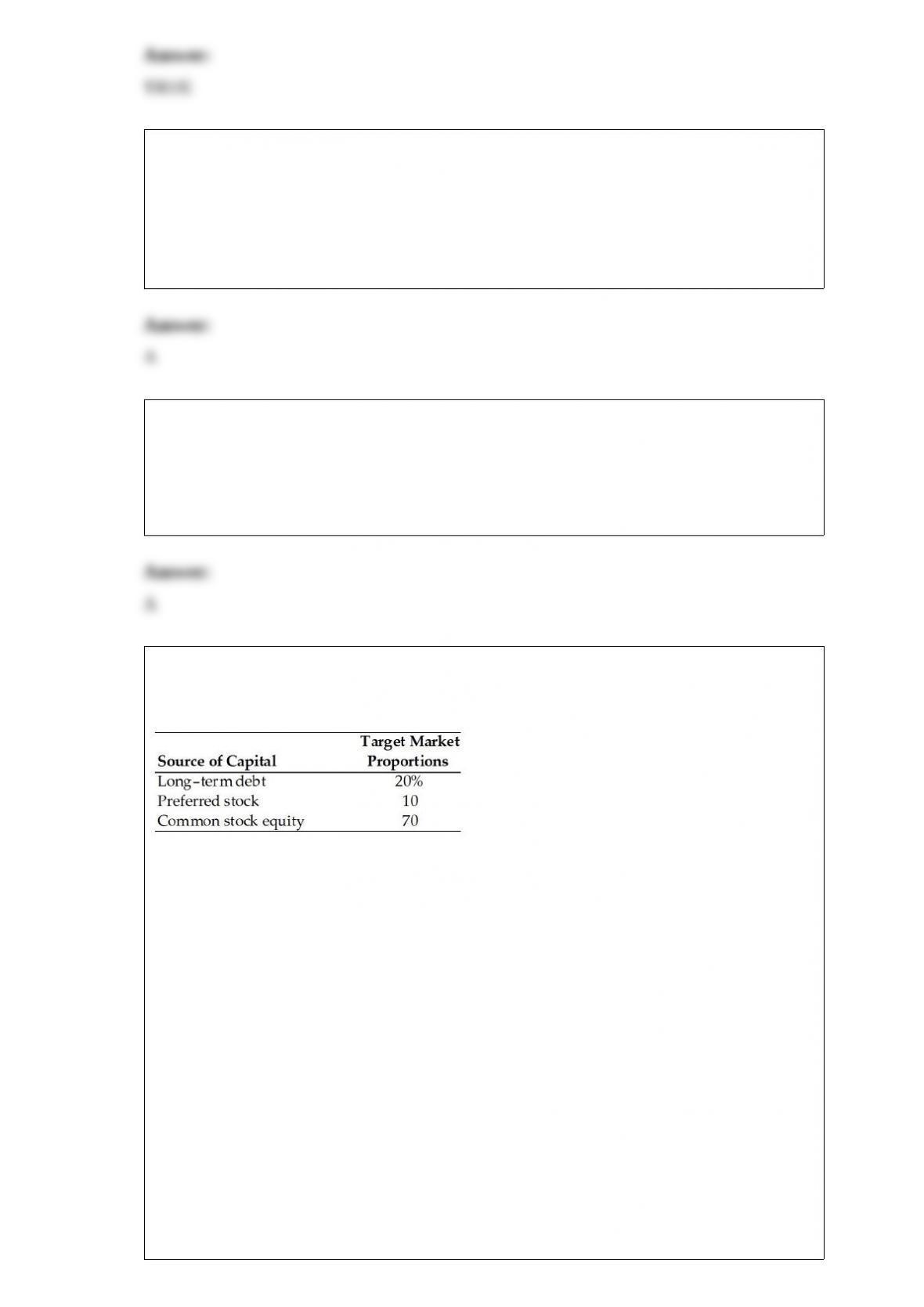
10) Table 9.1
A firm has determined its optimal capital structure which is composed of the following
sources and target market value proportions.
Debt: The firm can sell a 12-year, $1,000 par value, 7 percent bond for $960. A
flotation cost of
2 percent of the face value would be required in addition to the discount of $40.
Preferred Stock: The firm has determined it can issue preferred stock at $75 per share
par value. The stock will pay a $10 annual dividend. The cost of issuing and selling the
stock is $3 per share.
Common Stock: A firm’s common stock is currently selling for $18 per share. The
dividend expected to be paid at the end of the coming year is $1.74. Its dividend
payments have been growing at a constant rate for the last four years. Four years ago,
the dividend was $1.50. It is expected that to sell, a new common stock issue must be
underpriced $1 per share in floatation costs. Additionally, the firm’s marginal tax rate is
40 percent.
The weighted average cost of capital up to the point when retained earnings are
exhausted is ________. (See Table 9.1)
A) 7.5 percent
B) 8.65 percent
C) 10.4 percent
D) 11.9 percent

11) Which of the following is a strength of a corporation?
A) low taxes
B) limited liability
C) low organization costs
D) less government regulation
12) Which of the following is true of preferred stock?
A) It has features of bonds and a common stock
B) It has a claim on assets prior to creditors in the event of liquidation
C) Its dividends can be paid only after paying dividends to the common stockholders
D) It usually has a maturity of thirty years
13) The basic shortcoming of the EBIT-EPS approach to capital structure is ________.
A) that the optimal capital structure is difficult to compute
B) its disregard for the presence of preferred stock in the capital structure
C) its disregard for the firm’s dividend policy
D) that it concentrates on the maximization of EPS rather than the maximization of
owner’s wealth
14) The yield curve in an economic period where higher future inflation is expected
would be ________.
A) upward-sloping
B) flat
C) downward-sloping
D) lognormal
15) The selling of some of a firm’s assets is called ________.
A) leverage buyout
B) consolidation

C) reverse merger
D) divestiture
16) A loss on the sale of an asset that is depreciable and used in business is ________; a
loss on the sale of a non-depreciable asset is ________.
A) deductible from capital gains income; deductible from ordinary income
B) deductible from ordinary income; deductible only against capital gains
C) a credit against the tax liability; not deductible
D) not deductible; deductible only against capital gains
17) Milton Glasses recently paid a dividend of $1.70 per share, is currently expected to
grow at a constant rate of 5%, and has a required return of 11%. Milton Glasses has
been approached to buy a new company. Milton estimates if it buys the company, its
constant growth rate would increase to 6.5%, but the firm would also be riskier,
therefore increasing the required return of the company to 12%. Should Milton go
ahead with the purchase of the new company?
A) Yes, because the value of the Milton Co. will increase by $3.17 per share
B) Yes, because the value of the Milton Co. will increase by $2.56 per share
C) Yes, because the value of the Milton Co. will increase by $4..59 per share
D) No, because the value of the Milton Co. will decrease by $3.17 per share
18) Which of the following is true of NPV profile?
A) It is used for evaluating and comparing independent projects when conflicting
ranking exists
B) It is a graph that illustrates a project’s IRR against various values of NPV
C) It shows an inverse relationship between a project’s IRR and NPV
D) It charts the net present value of a project as a function of the cost of capital
19) Sound cash management techniques would support ________.
A) minimizing collection float, maximizing disbursement float, and minimizing the
cash conversion cycle
B) minimizing collection float, maximizing disbursement float, and minimizing the
cash turnover

C) maximizing collection float, minimizing disbursement float, and minimizing
operating cash flow
D) minimizing collection float, maximizing disbursement float, and maximizing
investing cash flow
20) An external sales forecast is based on ________.
A) the relationships between a firm’s sales and certain key economic indicators such as
GDP and consumer confidence
B) a buildup, or consensus of sales forecasts through a firm’s own sales channels
C) the prediction of a firm’s sales over a given period through the analysis of the sales
trends of its competitors
D) developing the pro forma income statement to forecast sales and then express the
various income statement items as percentage of projected sales
21) Convertible preferred stock is converted into ________.
A) secured bonds
B) debentures
C) shares of common stock
D) warrants
22) Suzy wants to buy a house but does not want to get a loan. The average price of her
dream house is $500,000 and its price is growing at 5 percent per year. How much
should Suzy invest in a project at the end of each year for the next 5 years in order to
accumulate enough money to buy her dream house with cash at the end of the fifth
year? Assume the project pays 12 percent rate of return.
23) Mr. Jackson has been awarded a bonus for his outstanding work. His employer
offers him a choice of a lump-sum of $5,000 today, or an annuity of $1,250 a year for
the next five years. Which option should Mr. Jackson choose if his opportunity cost is 9
percent?
24) Akai has a portfolio of three assets. Find the expected rate of return for the portfolio
assuming he invests 50 percent of its money in asset A with 10 percent rate of return, 30
percent in asset B with a rate of return of 20 percent, and the rest in asset C with 30
percent rate of return.
25) Jia’s Apple Farm uses 12,600 baskets a year for apple shipment. Determine the
optimum order quantity of baskets assuming the order costs per order is $600 and it
costs $2 to carry a unit of basket in inventory per period.
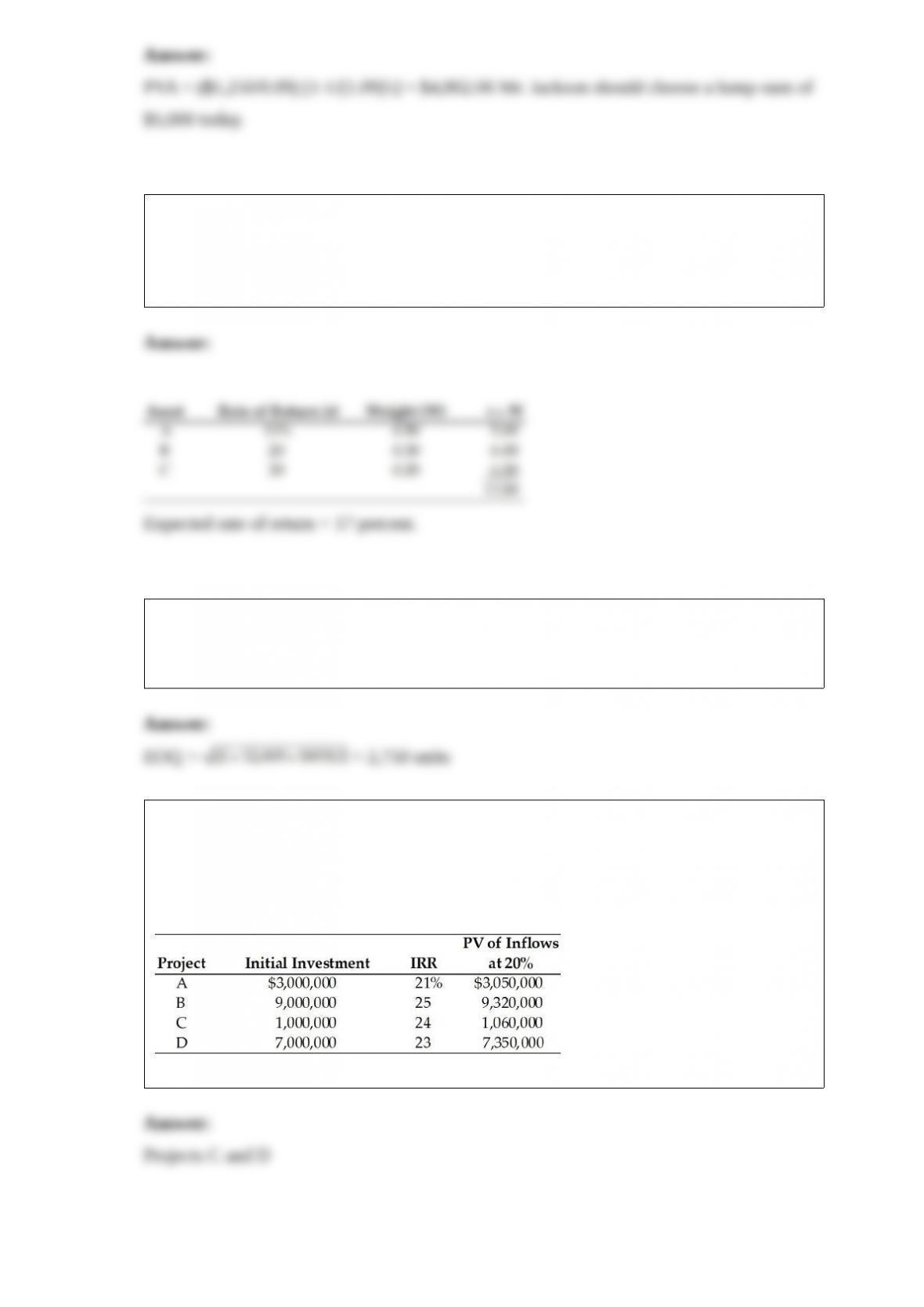
26) Table 10.5
Galaxy Satellite Co. is attempting to select the best group of independent projects
competing for the firm’s fixed capital budget of $10,000,000. Any unused portion of
this budget will earn less than its 20 percent cost of capital. A summary of key data
about the proposed projects follows.
Which projects should the firm implement? (See Table 10.5)