1) A country with fixed exchange rates often faces constraints on growth.
2) Since earnings can affect stock prices, many MNCs are concerned about translation
exposure.
3) When the current exchange rate is less than the strike price, a call option with that
strike price will be in the money and a put option with that strike price will be out of the
money.
4) A weakening of the U.S. dollar with respect to the British pound would likely reduce
U.S. exports to the U.K. and increase U.S. imports from the U.K.
5) Floating-rate bonds are often issued with a floating coupon rate that is tied to
LIBOR.
6) Purchasing power parity (PPP) focuses on the relationship between nominal interest
rates and exchange rates between two countries.
7) Forward contracts are usually negotiated with a commercial bank, while futures
contracts are traded on an organized exchange.
8) Since corporations have specialized needs, they usually prefer futures contracts to
forward contracts for hedging purposes.
9) Institutional investors such as mutual funds or pension funds which have large
holdings of an MNC’s stock do not normally want to take control of it and therefore
have no influence over management of the MNC.
10) If a firm is hedging payables with futures contracts, it may end up paying more for
the payable than it would have had it remained unhedged if the foreign currency
depreciates.
11) MNCs often attempt to set up production in locations where land and labor are
expensive, because expensive factors of production indicate high demand.
12) The World Bank frequently enters into cofinancing agreements. Under these
agreements, financing is provided by the World Bank and/or official aid agencies,
export credit agencies, or commercial banks.
13) There is much evidence to suggest that Japanese investors invest in U.S. Treasury
securities when U.S. interest rates are higher than Japanese interest rates. These
investors most likely believe in the international Fisher effect.
14) Economic exposure represents any impact of exchange rate fluctuations on a firm’s
future cash flows and thus includes transaction exposure.
15) An irrevocable letter of credit can be cancelled or amended if the beneficiary
consents to it.
16) Assume that an MNC has a subsidiary in Italy, which exports its products to various
countries in Europe. Since all of the countries where it exports use Euro as their
currency, this MNC is not subject to the exchange rate risk.
17) The management of economic exposure is normally focused completely on
transactions that will occur in the next three months.
18) The interest rate on yen is 7%. The interest rate in the U.S. is 9%. The yen’s forward
rate should exhibit a premium of about 2%.
19) A straddle represents the purchase of either two call or two put options at the same
exercise price.
20) Which of the following is not a goal of the International Monetary Fund (IMF)?
a.To promote cooperation among countries on international monetary issues
b.To promote stability in exchange rates
c.To enhance a country’s long-term economic growth via the extension of structural
adjustment loans

d.To promote free trade
e.To promote free mobility of capital funds across countries
21) Which of the following is not a payment method used for international trade?
a.consignment
b.open account
c.factoring
d.draft
e.letter of credit
22) Assume that British corporations begin to purchase more supplies from the U.S. as
a result of several labor strikes by British suppliers. This action reflects:
a.an increased demand for British pounds
b.a decrease in the demand for British pounds
c.an increase in the supply of British pounds for sale
d.a decrease in the supply of British pounds for sale
23) If a U.S. parent is setting up a French subsidiary, and funds from the subsidiary will
be periodically sent to the parent, the ideal situation from the parent’s perspective is a
____ after the subsidiary is established.
a.strengthening euro
b.stable euro
c.weak euro
d.B and C are both ideal
24) Which of the following is the most unlikely strategy for a U.S. firm that will be
purchasing Swiss francs in the future and desires to avoid exchange rate risk (assume
the firm has no offsetting position in francs)?
a.purchase a call option on francs
b.obtain a forward contract to purchase francs forward
c.sell a futures contract on francs
d.all of the above are appropriate strategies for the scenario described

25) Assume that Atlanta Co. is producing motorcycles and selling them to U.S.
customers. Atlanta Co. obtains all of its supplies from American firms and has no
competition in the U.S. It has one major competitor in Japan. Now assume that Phoenix
Co. is producing office furniture and obtains its supplies from a Canadian firm. Based
on this information, Atlanta Co. has ____ exposure and Phoenix Co. has ____ exposure.
a.transaction; translation
b.translation; transaction
c.economic; transaction
d.economic; translation
26) The effective yield of investing in a foreign currency depends on both the ____ and
the ____ of the foreign currency.
a.inflation rate; exchange rate movements
b.income level; interest rates
c.interest rates; exchange rate movements
d.interest rates; amount invested
27) An interest rate swap between two firms of different countries enables the exchange
of ____ for ____.
a.fixed-rate payments; floating-rate payments
b.stock; interest deductions on taxes
c.interest payments on loans; ownership of debt of less developed countries
d.interest payments on loans; stock
28) Which of the following is not true regarding covered interest arbitrage?
a.Covered interest arbitrage is a reason for observing interest rate parity (IRP)
b.If the forward rate is equal to the spot rate, conducting covered interest arbitrage will
yield a return that is exactly equal to the interest rate in the foreign country
c.When interest rate parity holds, covered interest arbitrage is not possible
d.When interest rate disparity exists, covered interest arbitrage may not be profitable
e.All of the above are true

29) When a firm perceives that a foreign currency is ____, the firm may attempt direct
foreign investment in that country, as the initial outlay should be relatively ____.
a.overvalued; high
b.overvalued; low
c.undervalued; high
d.undervalued; low
30) If the parent ____ the debt of the subsidiary, the subsidiary’s borrowing capacity
might be ____.
a.does not back; increased
b.backs; reduced
c.does not back; reduced
d.backs; increased
e.C and D
31) The yields offered on newly issued bonds tend to be:
a.lower in less developed countries where labor costs are low
b.relatively high in countries such as Japan and the U.S. because the credit risk
premium is much higher there than in other countries
c.the same across countries at a give point in time
d.none of the above
32) The Working Capital Guarantee Program and the Medium-term Guarantee Program
are offered by the:
a.Export-Import Bank of the United States
b.Private Export Funding Corporation
c.Overseas Private Investment Corporation
d.none of the above
33) Which of the following is the most likely reason for revaluation of a currency?

a.To reduce inflation
b.To stimulate the local economy
c.To increase the amount of exports
d.To increase balance-of-trade surplus
34) The World Bank extends loans only to developed nations, while the International
Development Association (IDA) extends loans only to developing nations.
35) Assume that the government of Krusho requires bribes to approve certain projects.
MNCs that attempt to do business in Krusho must deal with:
a.protective barriers
b.”red tape” barriers
c.ethical differences
d.regulatory barriers
36) Which of the following types of international corporate control transaction is
probably the most difficult to value by an MNC?
a.international acquisition
b.newly privatized foreign business
c.international alliance
d.international divestiture
37) You purchase a call option on pounds for a premium of $.03 per unit, with an
exercise price of $1.64; the option will not be exercised until the expiration date, if at
all. If the spot rate on the expiration date is $1.65, your net profit per unit is:
a.-$.03
b.-$.02
c.-$.01
d.$.02
e.none of the above

38) Also known as the “central banks’ central bank,” the ____ attempts to facilitate
cooperation among countries with regard to international transactions and provides
assistance to countries experiencing a financial crisis.
a.World Bank
b.International Financial Corporation (IFC)
c.World Trade Organization
d.International Development Association (IDA)
e.Bank for International Settlements (BIS)
39) According to your text, U.S. firms pursue more international acquisitions in ____
than in other countries.
a.the U.K
b.Mexico
c.Japan
d.Germany
e.France
40) Which of the following reflects a hedge of net payables on British pounds by a U.S.
firm?
a.purchase a currency put option in British pounds
b.sell pounds forward
c.sell a currency call option in British pounds
d.borrow U.S. dollars, convert them to pounds, and invest them in a British pound
deposit
e.A and B
41) Most MNCs obtain equity funding:
a.in foreign countries
b.in their home country
c.through global offerings
d.through private placements
42) An MNC expects to sell fixed assets it utilizes in Europe in the distant future. In
order to hedge the sale of these assets in the distant future, the MNC could create a(n)
____ that ____ the expected value of the assets in the future.
a.asset; matches
b.asset; exceeds
c.liability; matches
d.liability; is less than
43) With ____, a bank purchases a receivable without recourse to the exporter.
a.accounts receivable financing
b.factoring
c.a banker’s acceptance
d.a letter of credit
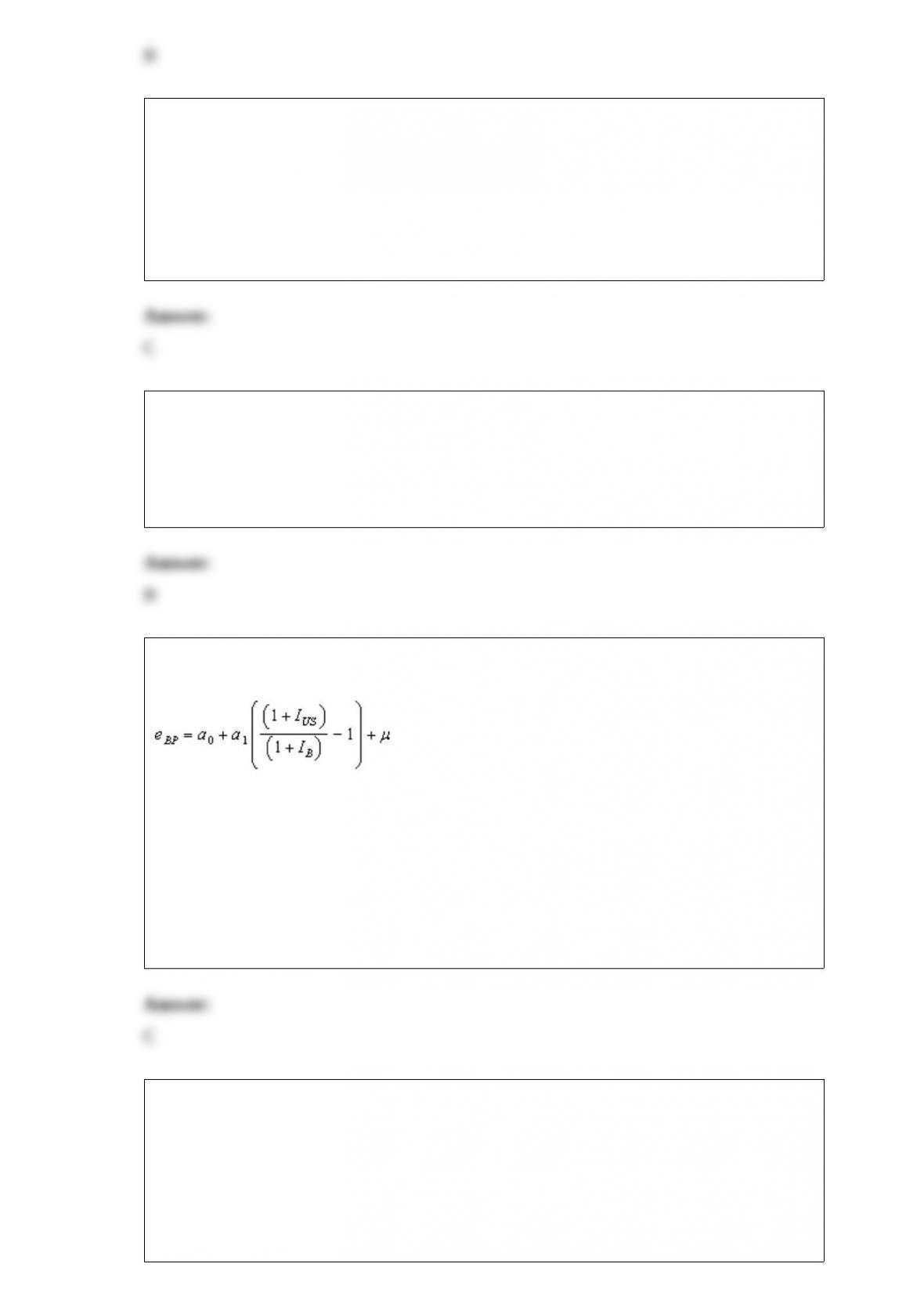
44) The following regression was conducted for the exchange rate of the Cyprus pound
(CYP):
Regression results indicate that a0 = 0 and a1 = 2. Therefore,
a.purchasing power parity holds
b.purchasing power parity overestimated the exchange rate change during the period
under examination
c.purchasing power parity underestimated the exchange rate change during the period
under examination
d.purchasing power parity will overestimate the exchange rate change of the Cyprus
pound in the future
45) Based on the CAPM, the ____ the beta of a project, the ____ the required rate of
return on that project.
a.higher; higher
b.lower; higher
c.higher; lower
d.B and C
e.none of the above