Identify whether the following investor questions are associated with (a) primary or (b)
secondary financial reporting objectives.
a.primary financial reporting objective
b.secondary financial reporting objective
Based on the financial information, should I sell my shares of Apple next quarter?
Match the following characteristics with the statements about each qualitative
characteristic’s importance.
a.Consistency
b.Materiality
c.Conservatism
d.Comparability
e.Reliability
f.Relevance
g.Understandability
Accounting information should use the least optimistic estimate.
The accountant for Casa Corp. was preparing a bank reconciliation as of February 28,
2014. The following items were identified:
There was an error in recording a customer’s check as the check was recorded by Casa
as $110, but the correct
amount of $101 was recorded by the bank. Casa’s adjusted cash balance at February 28,
2014 is
a. $23,591
b. $35,641
c. $35,659
d. $47,691
Match the costs that might be included as part of the cost of inventory to the listed
accounting treatment.
a.Add to inventory cost
b.Subtract from inventory cost
c.Not an inventory cost
Income taxes paid on profits earned from selling goods to customers
All of the following statements about current liabilities are true except:
a.current liabilities are normally recorded at face value.
b.current liabilities are obligations which will be satisfied within one year.
c.current liabilities finance the working capital of the company.
d.the current liability section never contains any portion of long-term liabilities.
Martinez Produce sells fresh vegetables and fruits in Sutton County. The following
unadjusted amounts were taken from the company’s accounting records at December
31, 2015:
Note Payable, 12%, 4-month, dated December 1, 2015, for $20,000 Note Receivable,
10%, 6-month, dated October 1, 2015, for $12,000
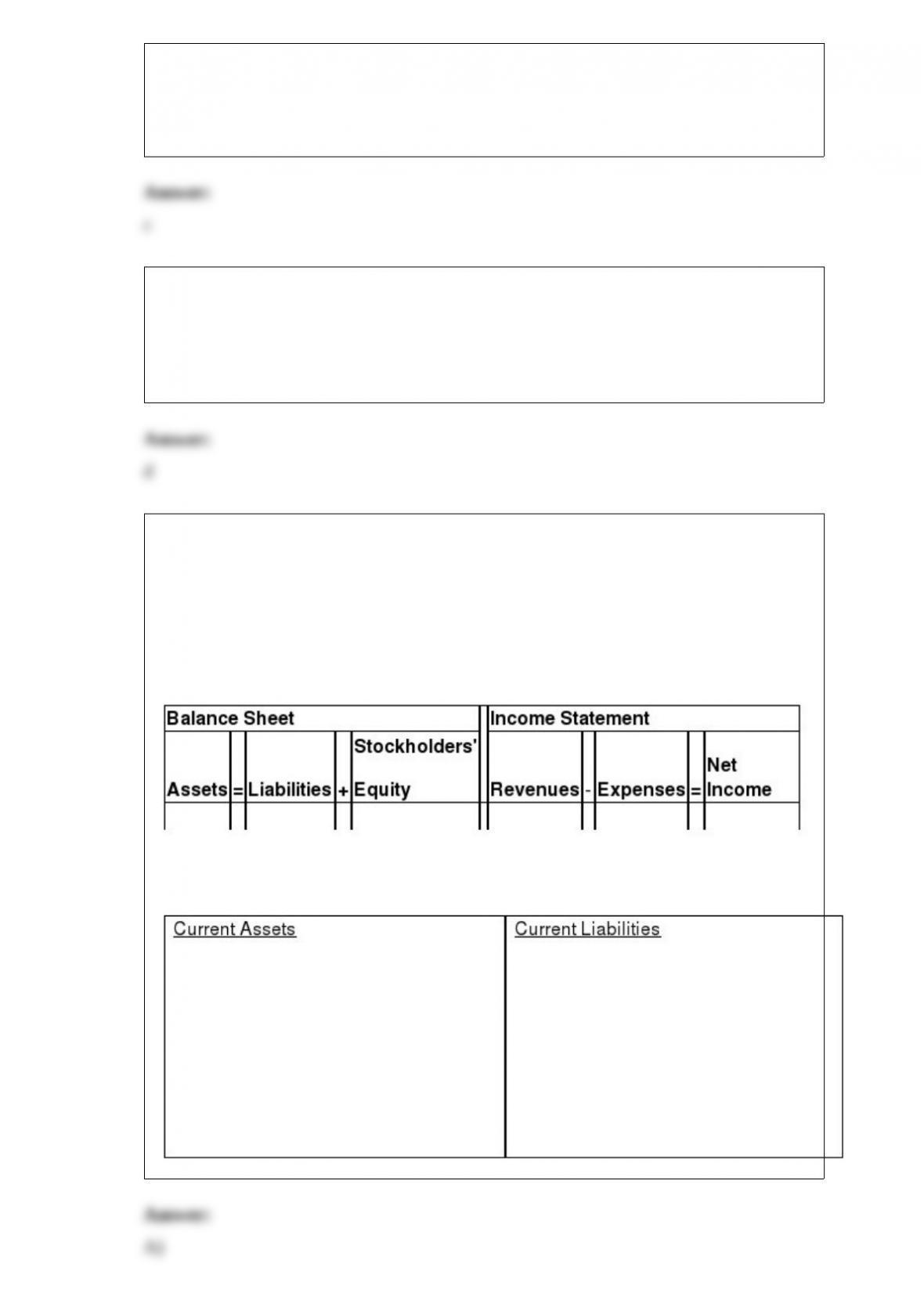
A)Determine the effects on the accounting equation of any adjusting entries that would
be necessary at December 31, 2015, for the notes.
B)Fill in the partial balance sheet below by showing the notes and the effects of any
adjustments related to the notes.
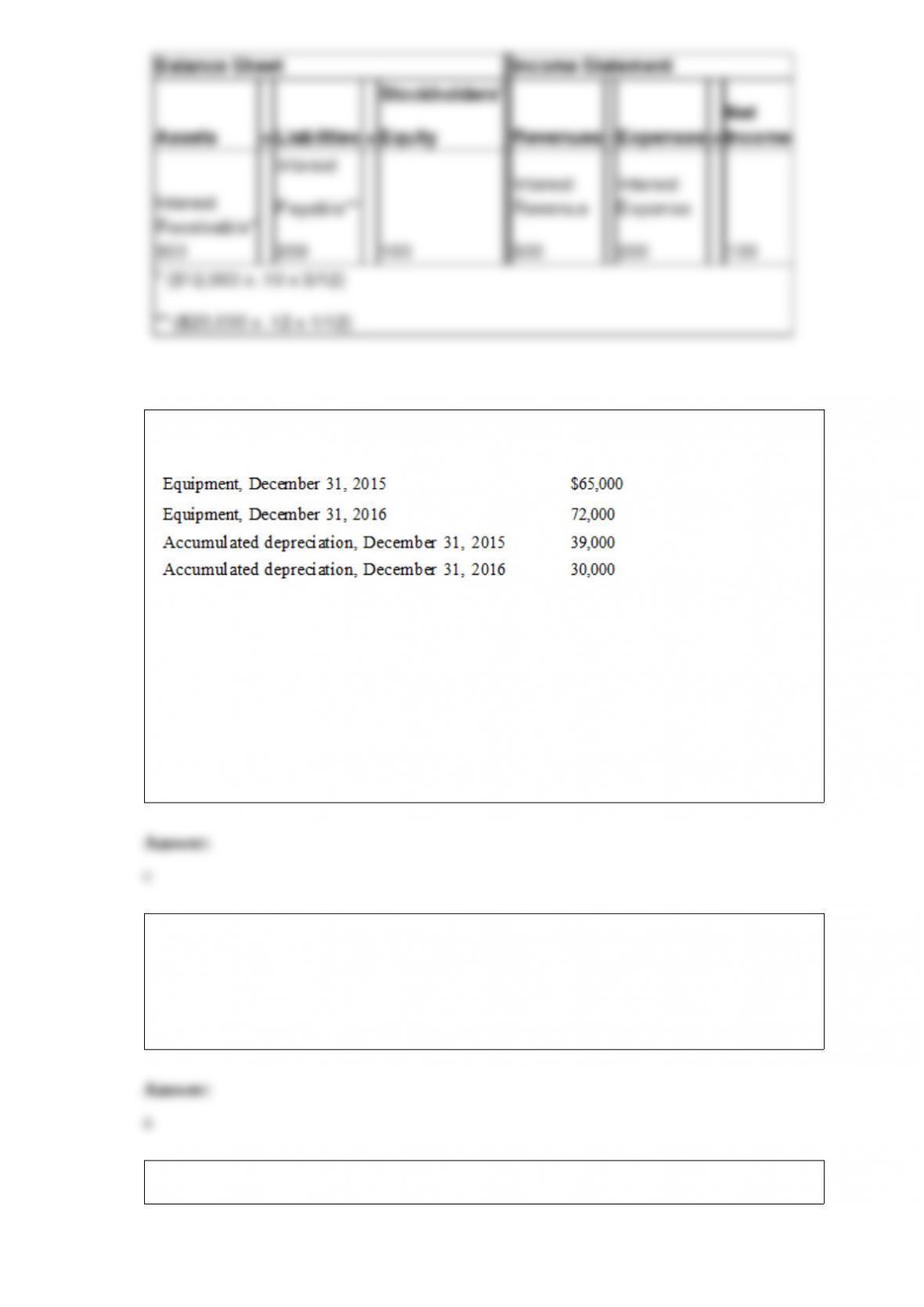
Use the information below for Shorter Inc. for 2015 and 2016 to answer the following
question.
During 2016, Shorter Inc. sold equipment with a cost of $30,000 and accumulated
depreciation of $25,000. A gain of $3,000 was recognized on the sale of the equipment
this was the only equipment sale during the year.
Assume that all purchases of equipment were paid with cash. How much cash was paid
by Shorter for the purchase of equipment during 2016?
a. $7,000
b. $30,000
c. $37,000
d. $72,000
For each of the following items, indicate whether each would be treated as a
a.capital expenditure
b.revenue expenditure
Costs related to acquiring an asset, such as sales or excise taxes, transportation,
insurance during shipment.
Presented below is a partially completed income statement of Deep Sea, Inc. for 2015.
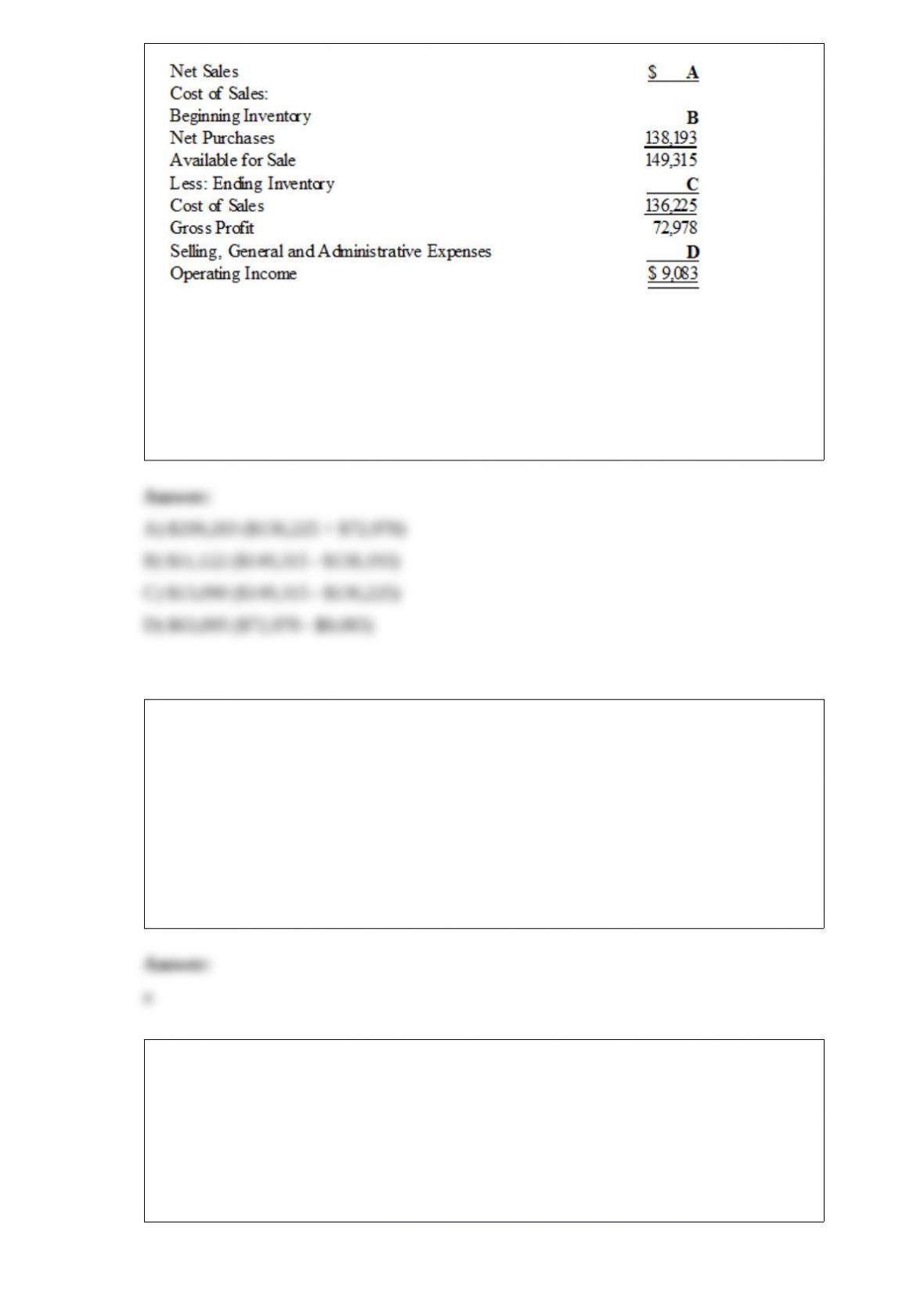
Using the partially completed income statement for Deep Sea, Inc., determine each of
the following for 2015.
A)Net Sales
B)Beginning Inventory
C)Ending Inventory
D)Selling, General and Administrative Expenses
The solution to this problem requires time value of money calculations. Reference to
Tables 9-1 through 9-4 in the text is necessary to complete the calculations.
Josh and Sara want to buy a house in 4 years. If the house will cost $180,000, how
much must they deposit at the end of every year for the next 4 years at 5% compounded
annually in order to buy the house?
a. $41,763
b. $32,040
c. $36,990
d. $45,000
Carrying value is computed annually when a bond is issued for other than its face value.
For a bond issued at a premium, how will this component change as the bond
approaches maturity?
a.Decrease
b.Increase
c.Remain constant
d.Not enough information given to decide.
Each account has a normal balance. For the following list of accounts, indicate whether
the normal balance of each is a debit or a credit.
a.Debit
b.Credit
Prepaid Insurance
Select the correct revenue recognition principle for each of the following.
a.Recognize revenue over the passage of time.
b.Recognize revenue when the customer takes possession of the product.
c.Recognize revenue when cash is collected.
d.Recognize revenue when service is performed.
Carpet cleaning
Identify where each of the following accounts would be reported on CocaCola’s
financial statements
a.Balance Sheet – Property, Plant, and Equipment
b.Balance Sheet – Intangible Assets
c.Balance Sheet – Current Assets
d.Balance Sheet – Other Assets
e.Income Statement – Operating Section
f.Income Statement – Other Revenue and Expense Section
g.Statement of Cash Flows
Research and development costs
Select the correct revenue recognition principle for each of the following.
a.Recognize revenue over the passage of time.
b.Recognize revenue when the customer takes possession of the product.
c.Recognize revenue when cash is collected.
d.Recognize revenue when service is performed.
Subscription to a magazine
Match the following characteristics with the statements about each qualitative
characteristic’s importance.
a.Consistency
b.Materiality
c.Conservatism
d.Comparability
e.Reliability
f.Relevance
g.Understandability
This quality refers to an amount large enough to affect a decision.
Read the information about Fellsmere Corporation.
(A)Did Fellsmere’s current ratio increase or decrease from 2013 to 2014? Make any
necessary calculations and
explain your answer. Which financial statement users are most concerned with this
ratio?
(B)The balance sheets show a large increase in retained earnings during 2014. Identify
the possible reason(s) for this increase.
In preparing financial statements, accountants should consider all of the following
except:
a.the objectives of financial reporting.
b.the characteristics that make accounting information useful.
c.the most useful way to display the information found on the financial statements.
d.the presentation of the value of a company.
Read the information about Hopper, Inc. Which ratio are you able to calculate given
only the information provided by Hopper?
a.Profit margin
b.Current ratio
c.Working capital
d.Gross profit percentage