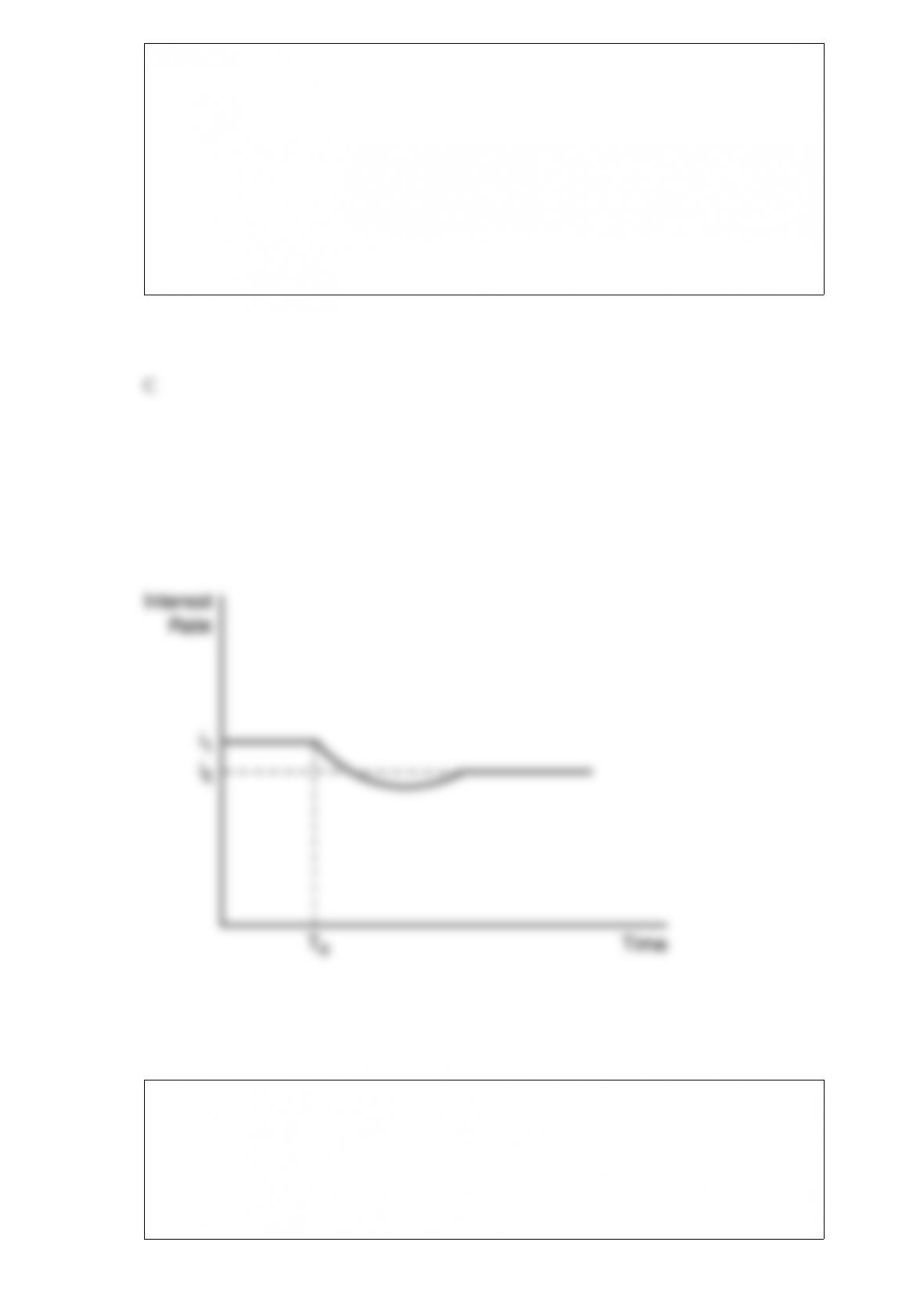
In the figure above, illustrates the effect of an increased rate of money supply growth at
time period 0. From the figure, one can conclude that the
A) Fisher effect is dominated by the liquidity effect and interest rates adjust slowly to
changes in expected inflation.
B) liquidity effect is dominated by the Fisher effect and interest rates adjust slowly to
changes in expected inflation.
C) liquidity effect is dominated by the Fisher effect and interest rates adjust quickly to
changes in expected inflation.
D) Fisher effect is smaller than the expected inflation effect and interest rates adjust
quickly to changes in expected inflation.
Under the Sarbanes-Oxley Act of 2002, the clause that makes it unlawful for a
registered public accounting firm to provide any nonaudit service to a client
contemporaneously with an impermissible audit is an example of which remedy of
conflicts of interest?
A) regulate for transparency
B) supervisory oversight

C) separation of functions
D) socialization of information production
Evidence suggests that the market ________ take into account the credibility of
analyst’s recommendations of IPOs that were underwritten at the analyst’s investment
bank because the performance of these recommendations was about 50% ________
compared to recommendations made by other analysts at different investment banks.
A) does; better
B) does; worse
C) does not; better
D) does not; worse
If a bank’s liabilities are more sensitive to interest rate movements than are its assets,
then
A) an increase in interest rates will reduce bank profits.
B) a decrease in interest rates will reduce bank profits.
C) interest rates changes will not impact bank profits.
D) an increase in interest rates will increase bank profits.
Everything else constant, a stronger dollar will mean that
A) vacationing in England becomes more expensive.
B) vacationing in England becomes less expensive.
C) French cheese becomes more expensive.

D) Japanese cars become more expensive.
In the Governing Council, the decision of what policy to implement is made by
A) majority vote of the Executive Board members.
B) majority vote of the heads of the National Banks.
C) consensus.
D) majority vote of all members of the Governing Council.
The most important developments that reduced banks’ income advantages include
A) the increase in off-balance sheet activities.
B) the growth of securitization.
C) the elimination of Regulation Q ceilings.
D) the competition from money market mutual funds.
When interest rates fall, a bank that perfectly hedges its portfolio of Treasury securities
in the futures market
A) suffers a loss.
B) experiences a gain.
C) has no change in its income.
D) may either gain, lose or see no change in its income.

When the policy rate hits its lower bound and inflation keeps falling, this portion of the
aggregate demand curve is
A) downward sloping.
B) upward sloping.
C) flat.
D) undetermined.
Which of the following is a long-term financial instrument?
A) a negotiable certificate of deposit
B) a repurchase agreement
C) a U.S. Treasury bond
D) a U.S. Treasury bill
When the federal funds rate equals the discount rate
A) the supply curve of reserves is vertical.
B) the supply curve of reserves is horizontal.
C) the demand curve for reserves is vertical.
D) the demand curve for reserves is horizontal.

Everything else held constant, a shift in tastes in the U.S. toward Mexican goods will
________ net exports in the U.S. and cause the quantity of aggregate output demanded
to ________ in Mexico.
A) decrease; rise
B) decrease; fall
C) increase; rise
D) increase; fall
In the absence of regulation, banks would probably hold
A) too much capital, reducing the efficiency of the payments system.
B) too much capital, reducing the profitability of banks.
C) too little capital.
D) too much capital, making it more difficult to obtain loans.
By looking at aggregate demand via its component parts, we can conclude that the
aggregate demand curve is downward sloping because
A) a lower inflation rate causes the real interest rate to fall, and stimulates planned
investment spending.
B) a lower inflation rate causes the real interest rate to rise, and stimulates planned
investment spending.
C) a higher inflation rate causes the real interest rate to fall, and stimulates planned
investment spending.
D) a higher inflation rate causes the real interest rate to rise, and stimulates planned
investment spending.

Nonfinancial businesses in Germany, Japan, and Canada raise most of their funds
A) by issuing stock.
B) by issuing bonds.
C) from nonbank loans.
D) from bank loans.
When a corporation wishes to sell new securities, it usually employs
A) a takeover specialist.
B) a finance company.
C) an investment bank.
D) a commercial bank.
If the expected path of 1-year interest rates over the next four years is 5 percent, 4
percent, 2 percent, and 1 percent, then the expectations theory predicts that today’s
interest rate on the four-year bond is
A) 1 percent.
B) 2 percent.
C) 3 percent.
D) 4 percent.
If the yield curve slope is flat for short maturities and then slopes steeply upward for
longer maturities, the liquidity premium theory (assuming a mild preference for
shorter-term bonds) indicates that the market is predicting

A) a rise in short-term interest rates in the near future and a decline further out in the
future.
B) constant short-term interest rates in the near future and further out in the future.
C) a decline in short-term interest rates in the near future and a rise further out in the
future.
D) constant short-term interest rates in the near future and a decline further out in the
future.
Countries with surpluses in their balance of payments frequently do not want to see
their currencies ________ because it makes their goods ________ expensive abroad.
A) appreciate; less
B) appreciate; more
C) depreciate; less
D) depreciate; more
The economic hardship resulting from a financial crises is severe, however, there are
also social consequences such as
A) increased crime.
B) difficulty getting a loan.
C) currency devaluations.
D) loss of output.
When the government has a surplus, as occurred in the late 1990s, the ________ curve

of bonds shifts to the ________, everything else held constant.
A) supply; right
B) supply; left
C) demand; right
D) demand; left
Before 1970, mutual funds invested almost solely in
A) corporate bonds.
B) corporate common stocks.
C) United States government bonds.
D) municipal bonds and money market securities.
Everything else held constant, if aggregate output is to the left of the LM curve, then
there is an excess ________ of money which will cause the interest rate to ________.
A) supply; fall
B) supply; rise
C) demand; fall
D) demand; rise
Equity contracts account for a small fraction of external funds raised by American
businesses because
A) costly state verification makes the equity contract less desirable than the debt
contract.

B) of the reduced scope for moral hazard problems under equity contracts, as compared
to debt contracts.
C) equity contracts do not permit borrowing firms to raise additional funds by issuing
debt.
D) there is no moral hazard problem when using a debt contract.
The more willing monetary policymakers are to raise interest rates when faced with
inflation, the ________ the AD curve is, and the ________ responsive equilibrium
output is to the inflation rate.
A) steeper; more
B) steeper; less
C) flatter; more
D) flatter; less
Reasons for holding Eurodollars include
A) the fact that Eurodollar deposits are insured by the FDIC.
B) the fact that dollars are widely used to conduct international transactions.
C) the fact that minimum transaction sizes are very low, making Eurodollars an
attractive savings instrument for consumers.
D) the fact that Eurodollar deposits are heavily regulated.
Compared to an economy that uses a medium of exchange, in a barter economy
A) transaction costs are higher.

B) transaction costs are lower.
C) liquidity costs are higher.
D) liquidity costs are lower.
When one party to a transaction has incentives to engage in activities detrimental to the
other party, there exists a problem of
A) moral hazard.
B) split incentives.
C) ex ante shirking.
D) pre-contractual opportunism.
If bad credit risks are the ones who most actively seek loans and, therefore, receive
them from financial intermediaries, then financial intermediaries face the problem of
A) moral hazard.
B) adverse selection.
C) free-riding.
D) costly state verification.
Futures differ from forwards because they are
A) used to hedge portfolios.
B) used to hedge individual securities.
C) used in both financial and foreign exchange markets.
D) a standardized contract.