
Based on the most recent survey information presented in your textbook, CFOs tend to
use which two methods of investment analysis the most frequently?
A. Payback and net present value
B. Payback and internal rate of return
C. Internal rate of return and net present value
D. Net present value and profitability index
E. Profitability index and internal rate of return
Answer:
Which one of the following statements concerning annuities is correct?
A. The present value of an annuity is equal to the cash flow amount divided by the
discount rate.
B. An annuity due has payments that occur at the beginning of each time period.
C. The future value of an annuity decreases as the interest rate increases.
D. If unspecified, you should assume an annuity is an annuity due.
Answer:
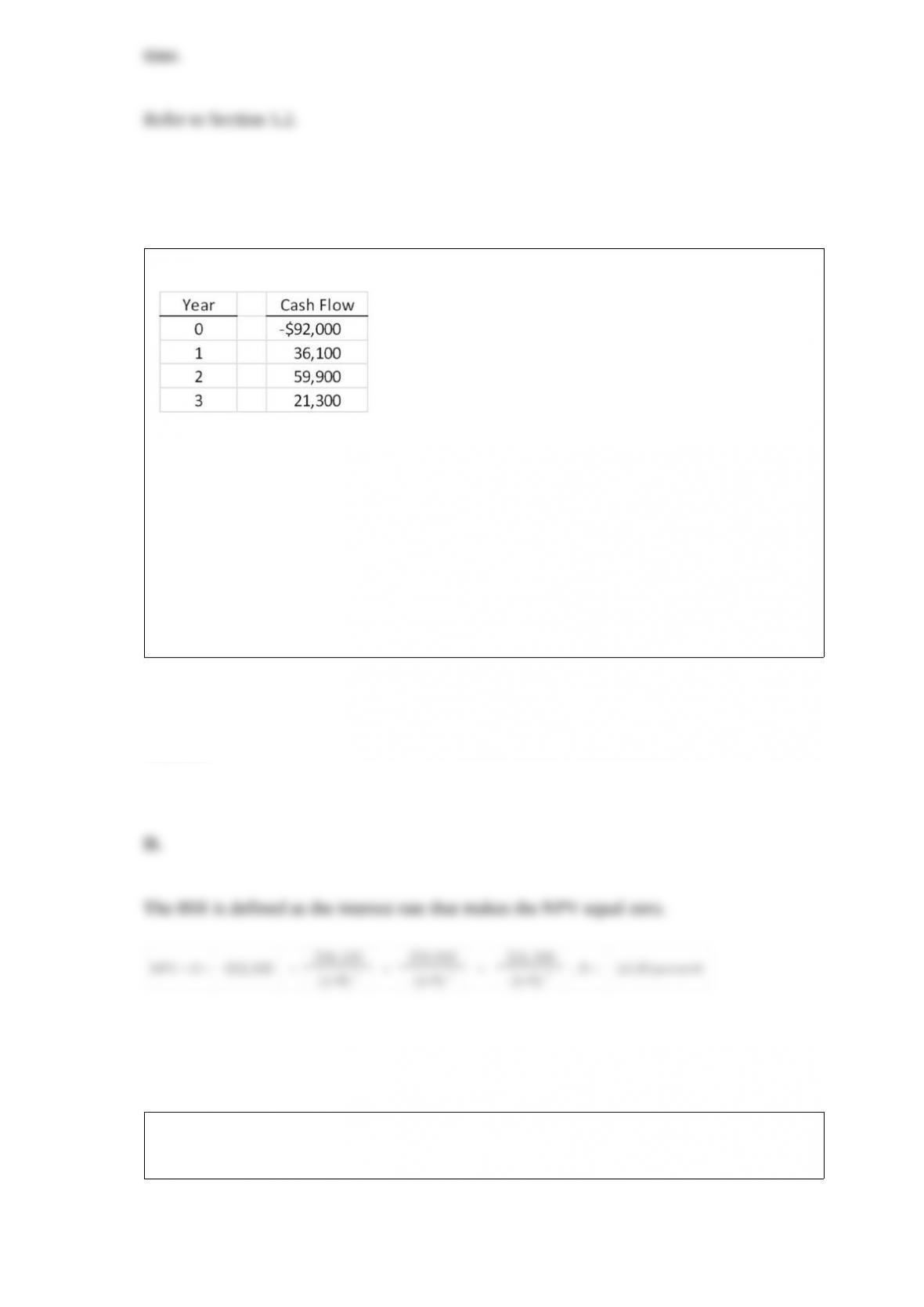
A project has the following cash flows. What is the internal rate of return?
A. 12.21 percent
B. 12.47 percent
C. 13.72 percent
D. 14.09 percent
E. 14.19 percent
Answer:
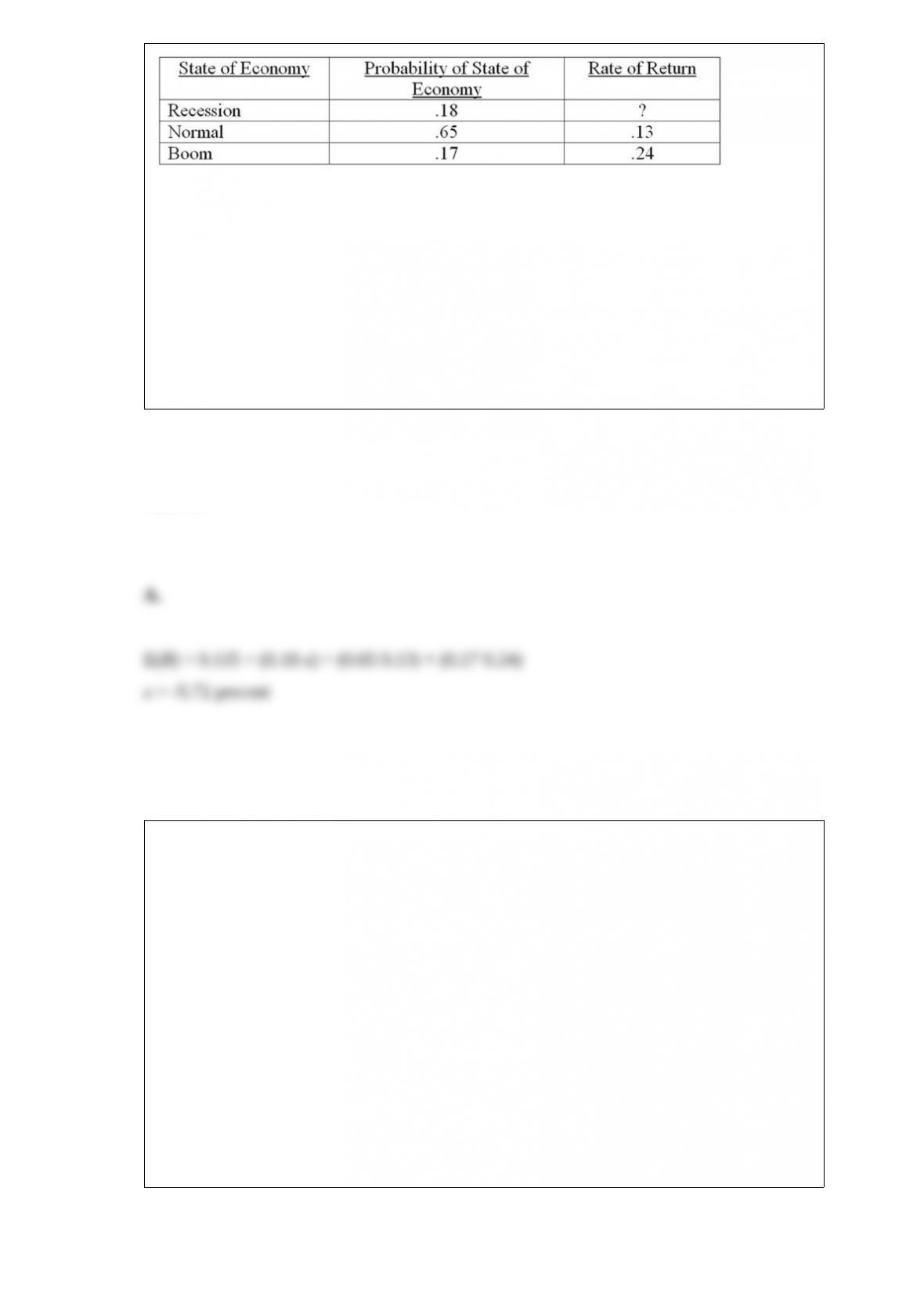
Beasley Enterprises stock has an expected return of 11.5 percent. Given the information
below, what is the expected return if the economy is in a recession?
A. -5.72 percent
B. -11.71 percent
C. -11.28 percent
D. -10.76 percent
E. 5.72 percent
Answer:
Lester had $6,270 in his savings account at the beginning of this year. This amount
includes both the $6,000 he originally invested at the beginning of last year plus the
$270 he earned in interest last year. This year, Lester earned a total of $282.15 in
interest even though the interest rate on the account remained constant. This $282.15 is
best described as:
A. simple interest.
B. interest on interest.
C. discounted interest.
D. complex interest.
E. compound interest.

Answer:
Standards Life Insurance offers a perpetuity that pays annual payments of $100,000.
This contract sells for $2,750,000 today. What is the interest rate?
A. 3.64 percent
B. 3.87 percent
C. 4.10 percent
D. 4.21 percent
E. 4.39 percent
Answer:
Your favorite running shoes cost $91 in the U.S. while the identical shoes cost
Can$114.50 in Canada. According to purchasing power parity, what is the Can$/$
exchange rate?
A. Can$0.7948/$1
B. Can$0.8426/$1
C. Can$0.9108/$1

D. Can$1.2582/$1
E. Can$1.3305/$1
Answer:
Phil is reviewing ABC Company’s dividend policy as it relates to the firm’s
shareholders. As part of this review, he wants to divide shareholders into two basic
categories in respect to dividend payments. The first group will be shareholders who are
taxed on dividend income and the second group will be shareholders who receive some
form of tax break on dividend income. Which of the following types of shareholders
should be placed in the tax-favored second group?
I. Corporate
II. Pension fund
III. Individuals
IV. Trust funds
A. I only
B. III only
C. I and III only
D. II and IV only
E. I, II, and IV only
Answer:

If the financial markets are semistrong form efficient, then:
A. only the most talented analysts can determine the true value of a security.
B. only individuals with private information have a marketplace advantage.
C. technical analysis provides the best tool to use to gain a marketplace advantage.
D. no one individual has an advantage in the marketplace.
Answer:
Which one of the following best illustrates the concept of derived demand?
A. A minimum wage worker tends to buy more off-brand products than do more highly
paid professionals.
B. A windshield company has to step up production because auto sales are increasing.
C. A grocery store is selling more fresh fruits and vegetables because people are
improving their diets.
D. Restaurant sales are rising because unemployment is falling.

E. Retail stores have higher sales around the holiday season than in other seasons of the
year.
Answer:
Stock A has an expected return of 15.6 percent and a beta of 1.27. Stock B has an
expected return of 11.4 percent and a beta of 0.89. Both stocks have the same
reward-to-risk ratio. What is the risk-free rate?
A. 1.56 percent
B. 2.28 percent
C. 2.79 percent
D. 3.35 percent
E. 3.92 percent
Answer:

A project will reduce costs by $34,000 but increase depreciation by $16,500. What is
the operating cash flow of this project based on the tax shield approach if the tax rate is
40 percent?
A. $5,775
B. $9,275
C. $15,625
D. $20,400
E. $27,000
Answer:
Which one of the following statements is true, all else constant?
A. A decrease in the accounts receivable turnover rate decreases the cash cycle.
B. Paying a supplier within the discount period, rather than waiting until the end of the
normal credit period, will decrease the cash cycle.
C. The cash cycle can never be negative.
D. An increase in the inventory turnover rate will decrease the cash cycle.
Answer:

A bond dealer sells at the _____ price and buys at the _____ price.
A. clean; dirty
B. dirty; clean
C. bid; asked
D. asked; bid
E. asked; asked
Answer:
A stock produced returns of 16 percent, 9 percent, and 21 percent over three of the past
four years, respectively. The arithmetic average for the past four years is 10 percent.
What is the standard deviation of the stock’s returns for the four-year period?
A. 6.82 percent
B. 8.54 percent
C. 9.09 percent
D. 10.83 percent
E. 11.75 percent

Answer:
Phil and Terry started a new business three years ago. Two years ago, they incorporated
the business and issued themselves each 20,000 shares of stock. Last year, they took the
company public in an IPO and issued an additional 100,000 shares of stock at that time.
The offer price was $14 a share, the spread was 8 percent, and the lockup period was
six months. The stock closed at $17 a share at the end of the first day of trading. During
the first six months of trading, the stock had a price range of $13 to $23 per share.
During the second six months of trading, the stock sold between $15 and $21 per share.
Both Tracie and Amy purchased 100 shares at the offer price. Given this, which one of
the following statements is correct? Ignore trading costs and taxes.
A. Tracie could have earned a maximum profit of 100($23 – 17) on her investment.
B. Phil could have sold 5,000 shares at $23 per share.
C. The underwriters earned a spread equal to 8 percent of $17.
D. The maximum price at which Terry could have sold shares is $21.
E. Amy paid 108 percent of $14 per share to purchase her 100 shares.
Answer:

You will receive annual payments of $2,400 at the end of each year for 15 years. The
first payment will be received in year 6. What is the present value of these payments if
the discount rate is 7 percent?
A. $11,465.20
B. $12,018.52
C. $13,299.80
D. $15,585.16
E. $16,856.60
Answer:
Which one of the following statements is correct?
A. Dividends are irrelevant.
B. Flotation costs are a good reason to support a high-dividend payout.
C. Current tax laws favor high current dividends for individual investors.
D. Dividend policy is the time pattern of dividend payout.
E. Corporate investors tend to prefer low-dividend payouts on securities they own.
Answer:
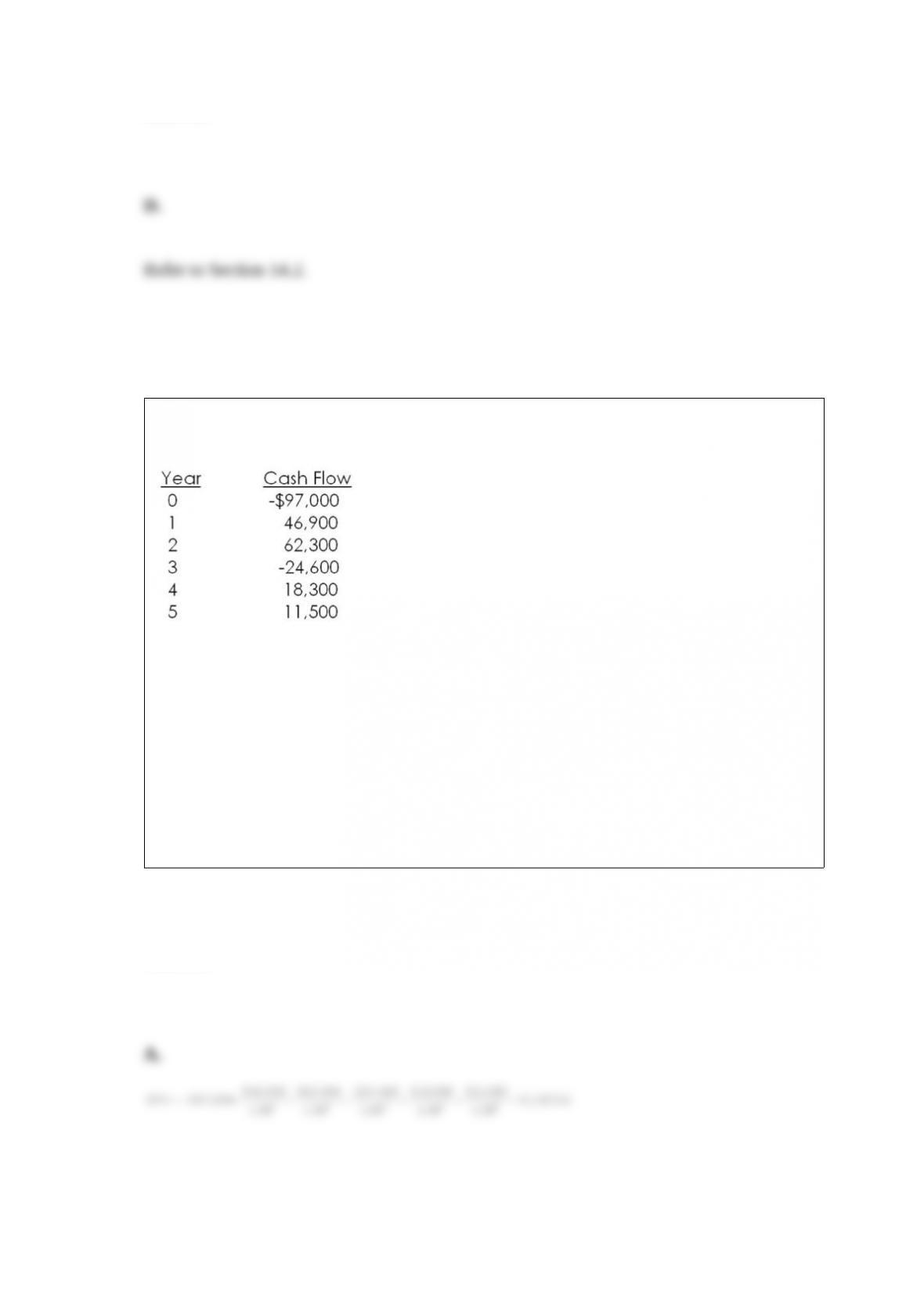
What is the net present value of the following cash flows if the relevant discount rate is
8 percent?
A. $1,587.61
B. $2,311.92
C. $2,900.15
D. $3,248.87
E. $3,545.60
Answer:

The market rate of return is 14.8 percent and the risk-free rate is 4.45 percent. Galaxy
Co. has 54 percent more systematic risk than the overall market and has a dividend
growth rate of 5.5 percent. The firm’s stock is currently selling for $39 a share and has a
dividend yield of 3.6 percent. What is the firm’s cost of equity?
A. 14.84 percent
B. 15.31 percent
C. 15.82 percent
D. 16.28 percent
E. 20.39 percent
Answer:
Firms that compile financial statements according to GAAP:
A. record income and expenses at the time they affect the firm’s cash flows.
B. have no discretion over the timing of recording either revenue or expense items.
C. must record all expenses when incurred.
D. can still manipulate their earnings to some degree.
Answer:

A proposed project will increase a firm’s accounts payables. This increase is generally:
A. treated as an erosion cost.
B. treated as an opportunity cost.
C. a sunk cost and should be ignored.
D. a cash outflow at time zero and a cash inflow at the end of the project.
E. a cash inflow at time zero and a cash outflow at the end of the project.
Answer:
Jenny needs to borrow $16,000 for 3 years. The loan will be repaid in one lump sum at
the end of the loan term. Which one of the following interest rates is best for Jenny?
A. 8 percent simple interest
B. 8 percent interest, compounded annually
C. 8.5 percent simple interest
D. 8.5 percent interest, compounded annually

E. 9 percent interest, compounded annually
Answer:
Which of the following characteristics will tend to cause a firm to adopt a more liberal
credit policy?
I. Repeat customers
II. Excess capacity
III. High variable costs
IV. Limited competition
A. I and II only
B. III and IV only
C. I, II, and III only
D. II, III, and IV only
E. I, II, III, and IV
Answer: