
Currently, you can purchase either 128 Canadian dollars or 10,050 Japanese yen for
$100. What is the /Can$ cross-rate?
A. 78.52/Can$1
B. 79.94/Can$1
C. 81.23/Can$1
D. 86.27/Can$1
E. 87.08/Can$1
Answer:
The net present value profile illustrates how the net present value of an investment is
affected by which one of the following?
A. Project’s initial cost
B. Discount rate
C. Timing of the project’s cash inflows
D. Inflation rate
E. Real rate of return
Answer:

Which one of the following statements concerning financial leverage is correct?
A. Financial leverage increases profits and decreases losses.
B. Financial leverage has no effect on a firm’s return on equity.
C. Financial leverage refers to the use of common stock.
D. Financial leverage magnifies both profits and losses.
E. Increasing financial leverage will always decrease the earnings per share.
Answer:
Weston Mines has a cost of equity of 20.8 percent, a pretax cost of debt of 9.4 percent,
and a return on assets of 17.1 percent. Ignore taxes. What is the debt-equity ratio?
A. 0.39
B. 0.41
C. 0.48
D. 0.56
E. 0.62
Answer:

The Blue Lagoon has a return on equity of 18.9 percent, an equity multiplier of 1.9, and
a total asset turnover of 1.45. What is the profit margin?
A. 2.76 percent
B. 3.57 percent
C. 4.90 percent
D. 6.85 percent
E. 14.60 percent
Answer:
Which one of the following will reduce the disbursement float of a firm?
A. Mailing a check from a very remote location
B. Mailing an unsigned check so that it must be returned for a signature
C. Paying a loan payment at the bank rather than mailing a check to the bank
D. Requiring that all checks be held one day before mailing so they can be reviewed by

a manager
E. Writing checks on a zero-balance account rather than on the master account
Answer:
A project has an annual operating cash flow of $45,000. Initially, this four-year project
required $3,800 in net working capital, which is recoverable when the project ends. The
firm also spent $21,500 on equipment to start the project. This equipment will have a
book value of $4,300 at the end of year 4. What is the cash flow for year 4 of the project
if the equipment can be sold for $5,400 and the tax rate is 34 percent?
A. $51,724
B. $52,038
C. $53,826
D. $53,862,900
E. $53,900
Answer:

Which one of the following premiums is paid on a corporate bond due to its tax status?
A. Interest rate risk premium
B. Inflation premium
C. Liquidity premium
D. Taxability premium
E. Default risk premium
Answer:
Graphic Designs has 120,000 shares of cumulative preferred stock outstanding.
Preferred shareholders are supposed to be paid $1.50 per quarter per share in dividends.
However, the firm has encountered financial problems and has not paid any dividends
for the past three quarters. How much will the firm have to pay per share of preferred
next quarter if the firm also wishes to pay a common stock dividend?
A. $3.00
B. $4.50
C. $6.00
D. $7.50
E. $9.00
Answer:

Rock Haven has a proposed project that will generate sales of 1,680 units annually at a
selling price of $22 each. The fixed costs are $12,700 and the variable costs per unit are
$5.95. The project requires $28,000 of fixed assets that will be depreciated on a
straight-line basis to a zero book value over the four-year life of the project. The
salvage value of the fixed assets is $6,900 and the tax rate is 34 percent. What is the
operating cash flow for year 4?
A. $11,794
B. $12,417
C. $14,258
D. $16,348
E. $16,971
Answer:
Madison Square Stores has a $20 million bond issue outstanding that currently has a
market value of $18.6 million. The bonds mature in 6.5 years and pay semiannual
interest payments of $35 each. What is the firm’s pretax cost of debt?
A. 4.21 percent
B. 8.42 percent
C. 7.58 percent

D. 7.74 percent
E. 7.80 percent
Answer:
A U.S. firm has total assets valued at 890,000 located in London. This valuation did not
change from last year. Last year, the exchange rate was 0.62 = $1. Today, the exchange
rate is 0.68 = $1. By what amount did these assets change in value on the firm’s U.S.
financial statements?
A. -$126,660.34
B. $-113,511.03
C. $-87,248.91
D. $113,511.03
E. $126,660.34
Answer:

Which one of the following methods of analysis has the greatest bias toward short-term
projects?
A. Net present value
B. Internal rate of return
C. Average accounting return
D. Profitability index
E. Payback
Answer:
Which one of the following statements concerning market and book values is correct?
A. The market value of accounts receivable is generally higher than the book value of
those receivables.
B. The market value tends to provide a better guide to the actual worth of an asset than
does the book value.
C. The market value of fixed assets will always exceed the book value of those assets.
D. Book values represent the amount of cash that will be received if an asset is sold.
E. The current book value of equipment purchased last year is equal to the initial cost of
the equipment.

Answer:
Given an interest rate of zero percent, the future value of a lump sum invested today
will always:
A. remain constant, regardless of the investment time period.
B. decrease if the investment time period is shortened.
C. decrease if the investment time period is lengthened.
D. be equal to $0.
E. be infinite in value.
Answer:
What is the name given to the model that computes the present value of a stock by
dividing next year’s annual dividend amount by the difference between the discount rate
and the rate of change in the annual dividend amount?
A. Stock pricing model
B. Equity pricing model
C. Capital gain model

D. Dividend growth model
E. Present value model
Answer:
Which one of the following is a working capital decision?
A. How should the firm raise additional capital to fund its expansion?
B. What debt-equity ratio is best suited to the firm?
C. What is the cost of debt financing?
D. Which type of debt is best suited to finance the inventory?
E. How much cash should the firm keep in reserve?
Answer:
Portfolio diversification eliminates which one of the following?
A. Total investment risk
B. Portfolio risk premium
C. Market risk
D. Unsystematic risk
E. Reward for bearing risk
Answer:
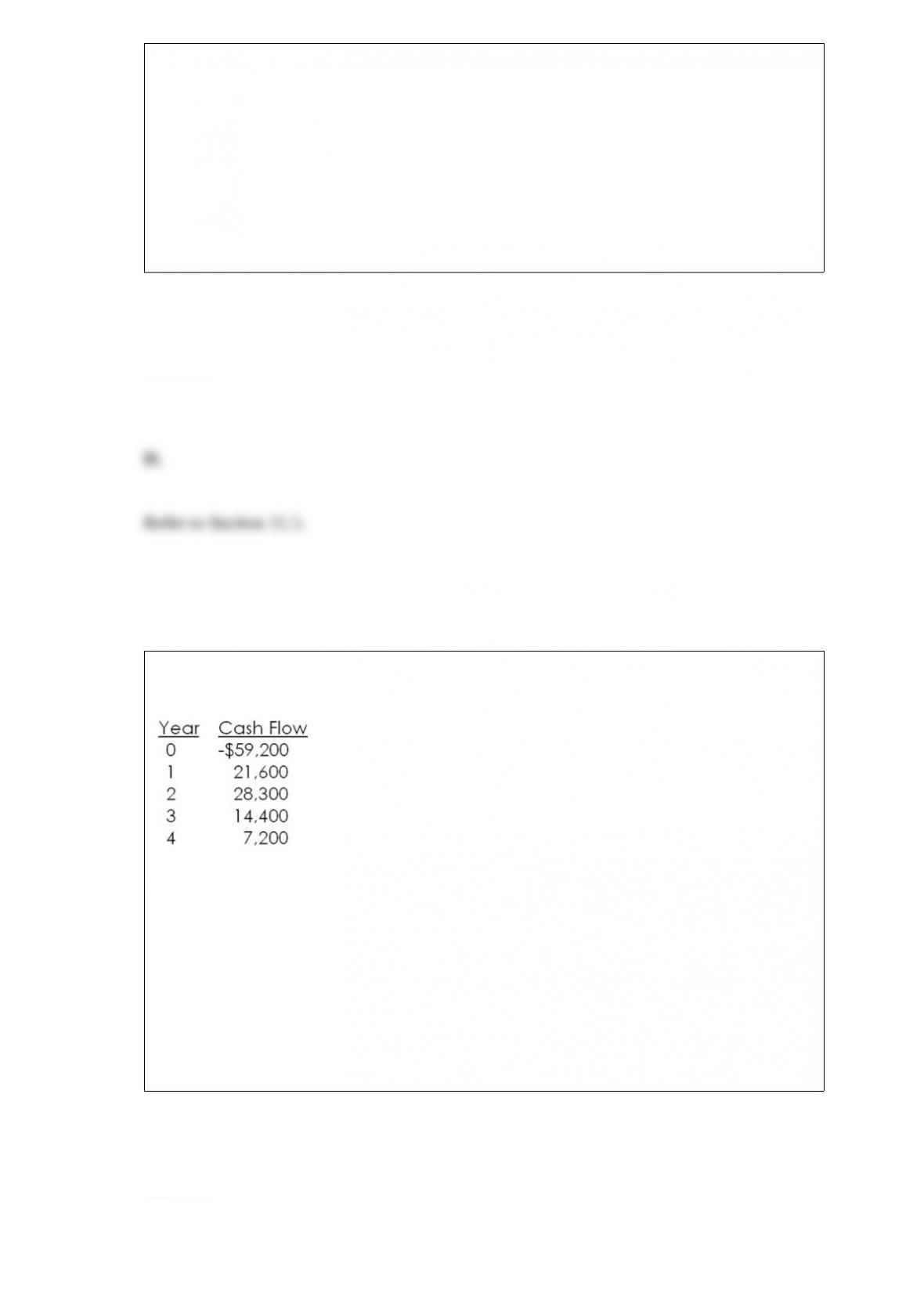
What is the net present value of a project with the following cash flows if the discount
rate is 15 percent?
A. -$8,406.11
B. -$5,433.67
C. -$3,089.16
D. $1,407.92
E. $5,433.67
Answer:

Bruce Moneybags owns several restaurants and hotels near a local interstate. One
restaurant, Beef and More, needs modernized. He is trying to decide whether to accept
an offer and sell Beef and More as is for the offer price of $1.1 million or renovate the
restaurant himself. The projected renovation cost is $1.3 million. The restaurant would
need to be shut down completely during the renovation which would cause a net
operating cash flow loss of $210,000 in today’s dollars. The estimated present value of
the cash inflows from the renovated restaurant are $3.2 million. When analyzing the
renovation project, what opportunity cost, if any, should be included for the current
restaurant? Assume the restaurant is totally paid for and any future costs will be paid in
cash.
A. There is no opportunity cost since the current restaurant is owned free and clear.
B. The opportunity cost is the value of the current offer to buy the restaurant.
C. The opportunity cost is the cost of the needed improvements.
D. The opportunity cost is the present value of the loss of operating cash flows while
the restaurant is closed for renovation.
E. The opportunity cost is the cost of the renovations plus the loss of the operating cash
flows during the renovation.
Answer:
Steve is considering investing $3,600 a year for 40 years. How much will this
investment be worth at the end of the 40 years if he earns an average annual rate of
return of 11.6 percent? Assume Steve invests his first payment of the end of this year.

A. $1,887,411.26
B. $1,919,200.08
C. $2,103,018.90
D. $2,311,416.67
E. $2,471,685.70
Answer:
A project has the following cash flows. What is the internal rate of return?
A. 10.53 percent
B. 10.58 percent
C. 10.60 percent
D. 10.67 percent
E. 11.10 percent
Answer:

Which one of the following is a general characteristic of a securities broker?
A. Trades from his or her own inventory
B. Trades only foreign securities
C. Trades listed securities in an auction market
D. Trades electronically from any geographic location
E. Is the principal trader of debt securities
Answer:
You are using a net present value profile to compare Project A and B, which are
mutually exclusive. Which one of the following statements correctly applies to the
crossover point between these two?
A. The internal rate of return for Project A equals that of Project B, but generally does
not equal zero.
B. The internal rate of return of each project is equal to zero.

C. The net present value of each project is equal to zero.
D. The net present value of Project A equals that of Project B, but generally does not
equal zero.
E. The net present value of each project is equal to the respective project’s initial cost.
Answer: