
1) Boone Brothers remodels homes and replaces windows. Ace Builders constructs new
homes. If Boone Brothers considers expanding into new home construction, it should
evaluate the expansion project using which one of the following as the required return
for the project?
A.Boone Brothers’ cost of capital
B.Ace Builders’ cost of capital
C.Average of Boone Brothers’ and Ace Builders’ cost of capital
D.Lower of Boone Brothers’ or Ace Builders’ cost of capital
E.Higher of Boone Brothers’ or Ace Builders’ cost of capital
2) Western Beef stock is valued at $62.10 a share. The company pays a constant annual
dividend of $4.40 per share. What is the total return on this stock?
A.6.62 percent
B.6.81 percent
C.7.09 percent
D.7.49 percent
E.7.82 percent
3) Which one of the following is the abbreviation for the U.S. government coding
system that classifies a firm by its specific type of business operations?
A.BEC
B.SED
C.BID
D.SIC
E.SBC
4) Financial planning:
A.focuses solely on the short-term outlook for a firm
B.is a process that firms employ only when major changes to a firm’s operations are
anticipated
C.is a process that firms undergo once every five years
D.considers multiple options and scenarios for the next two to five years
E.provides minimal benefits for firms that are highly responsive to economic changes
5) True Blue Transport has a current stock price of $27. For the past year, the company
had net income of $2,187,400, total equity of $13,892,300, sales of $26,511,000, and
2.5 million shares outstanding. What is the market-to-book ratio?
A.3.54
B.3.81
C.3.99
D.4.27
E.4.86
6) Tressler Industries opted to repurchase 5,000 shares of stock last year in lieu of
paying a dividend. The cash flow statement for last year must have which one of the
following assuming that no new shares were issued?
A.Positive operating cash flow
B.Negative cash flow from assets
C.Negative cash flow to stockholders
D.Negative operating cash flow
E.Positive cash flow to stockholders
7) Key facts and assumptions concerning FM Foods, Inc. at December 31, 2011, appear
below.
Estimate the appropriate weight of equity to be used when calculating FM’s weighted
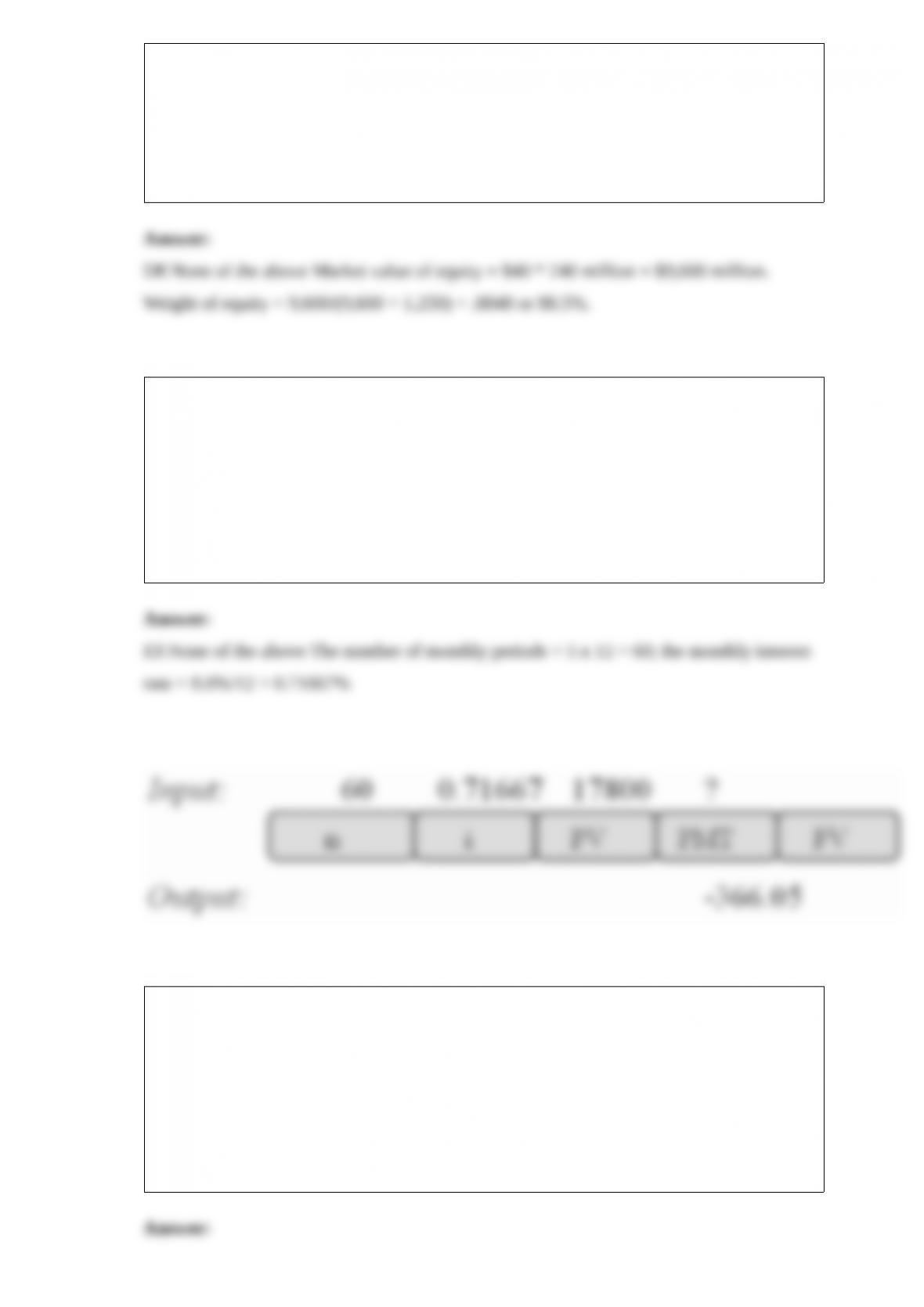
average cost of capital.
A.11.5%
B.19.3%
C.80.7%
D.88.5%
E.100.0%
8) Your brother will borrow $17,800 to buy a car. The terms of the loan call for monthly
payments for 5 years at an 8.6 percent annual interest rate, compounded monthly. What
is the amount of each payment?
A.$287.71
B.$296.67
C.$301.12
D.$342.76
E.$366.05
9) Baxter’s, Inc. generally holds $125,000 in cash in case an unexpected investment
opportunity arises. Which one of the following refers to holding cash for this type of
purpose?
A.Precautionary motive
B.Opportunistic motive
C.Speculative motive
D.Reserve motive
E.Transaction motive

10) The historical returns on large-company stocks, as reported by Ibbotson and
Sinquefield and reported in your textbook, are based on the:
A.largest 20 percent of the stocks traded on the NYSE
B.stock returns for the largest 10 percent of the publicly traded firms in the U.S
C.returns of the 100 largest firms in the U.S
D.returns of all of the stocks listed on the NYSE
E.stocks of the 500 companies included in the S&P 500 index
11) Which one of the following is the best example of systematic risk?
A.Discovery of a major gas field
B.Decrease in textile imports
C.Increase in agricultural exports
D.Decrease in gross domestic product
E.Decrease in management bonuses for banking executives
12) Shareholders’ equity is equal to:
A.total assets plus total liabilities
B.net fixed assets minus total liabilities
C.net fixed assets minus long-term debt plus net working capital
D.net working capital plus total assets
E.total assets minus net working capital
13) Which of the following is NOT a likely financing policy for a rapidly growing
business?
A.Adopt a modest dividend payout policy that enables the company to finance most of
its growth externally
B.Borrow funds rather than limit growth, thereby limiting growth only as a last resort
C.Maintain a conservative leverage ratio to ensure continuous access to financial
markets
D.If external financing is necessary, use debt to the point it does not affect financial
flexibility
E.None of the above
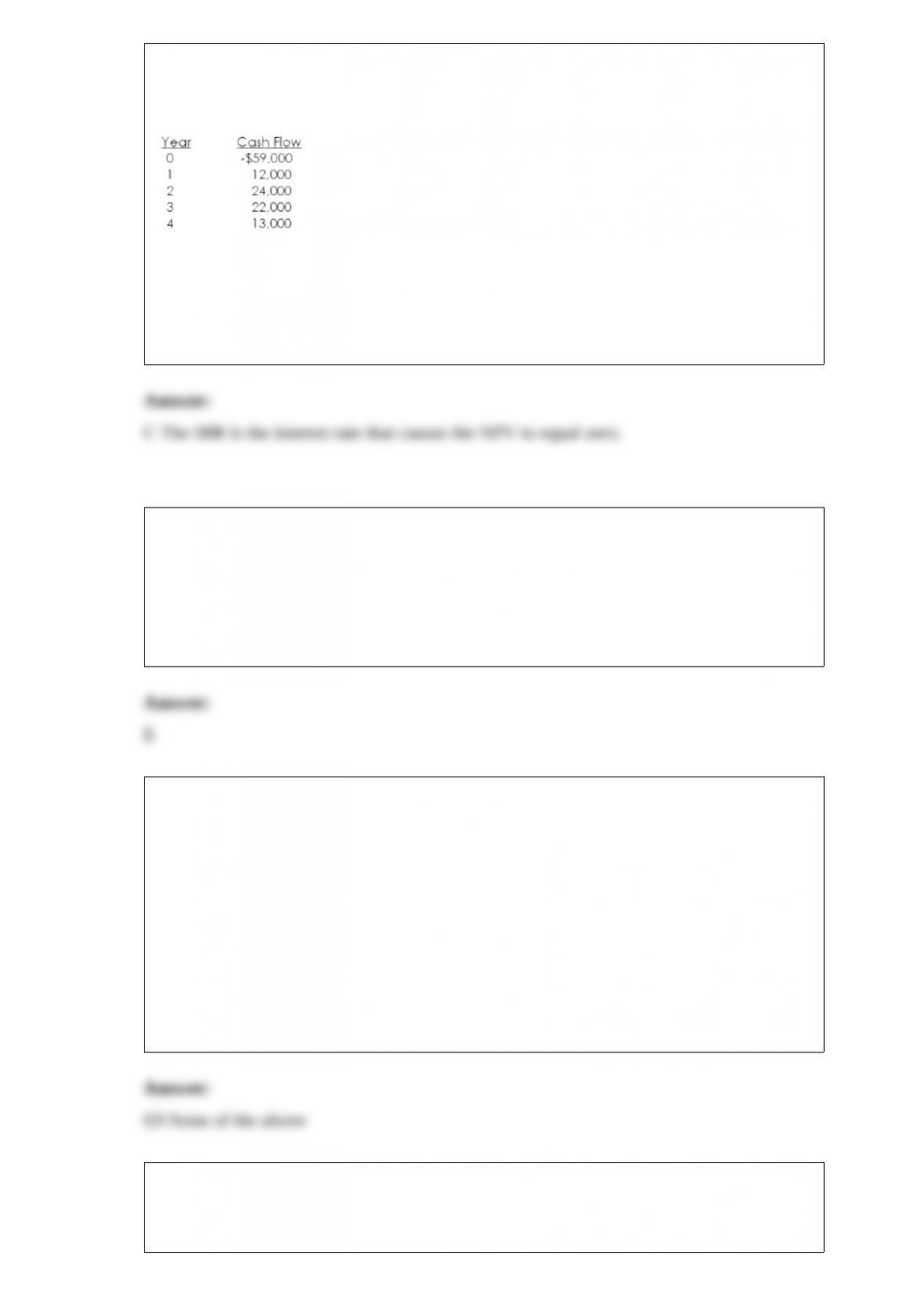
14) The Flour Baker is considering a project with the following cash flows. Should this
project be accepted based on its internal rate of return if the required return is 11
percent?
A.Yes; the project’s rate of return is 7.78 percent
B.Yes; the project’s rate of return is 9.36 percent
C.No; the project’s rate of return is 7.78 percent
D.No; the project’s rate of return is 9.36 percent
E.No; the project’s rate of return is 13.08 percent
15) Which one of the following factors favors a high dividend payout?
A.Low transaction costs on stock trades
B.Lower taxes on capital gains than on dividends
C.Tax deferment on capital gains, but not on dividend income
D.Flotation costs
E.Corporate shareholders
16) Which of the following can affect a firm’s sustainable rate of growth?
I. Asset turnover ratio
II. Profit margin
III. Dividend policy
IV. Financial leverage
A.III only
B.I and III only
C.II, III, and IV only
D.I, II, and IV only
E.I, II, III, and IV
17) Marti had an unexpected surprise when she ate her Lotsa Good cereal this morning.
She found a piece of metal mixed in her cereal. The potential claim which Marti has
against this firm is that of a(n):
A.general creditor
B.debtholder
C.shareholder
D.stakeholder
E.agent
18) Which one of the following terms best refers to the practice of investing in a variety
of diverse assets as a means of reducing risk?
A.Systematic
B.Unsystematic
C.Diversification
D.Security market line
E.Capital asset pricing model
19) Which one of the following statements concerning debt issues is correct?
A.Firms often pay higher interest rates on term loans than on public issues of debt
B.The only difference between a term loan and a private placement is the size of the
issue
C.A prospectus is required for equity issues but not for debt issues
D.The flotation costs of issuing debt tend to be more expensive than for issuing equity
E.Direct long-term loans must be registered with the SEC
20) Over the last four years, a stock has had an arithmetic average return of 8.8 percent.
Three of those four years produced returns of 16.3 percent, 10.2 percent, and -14.1
percent. What is the geometric average return for this 4-year period?
A.7.83 percent
B.8.39 percent
C.8.67 percent
D.9.40 percent
E.9.97 percent
21) A stock produced returns of 19 percent, 27 percent, and -38 percent over three of
the past four years. The arithmetic average for the past four years is 7 percent. What is
the standard deviation of the stock’s returns for the 4-year period?
A.11.63 percent
B.15.94 percent
C.19.70 percent
D.26.25 percent
E.30.21 percent
22) Derek’s is a brick-and-mortar toy store. The firm is considering expanding its
operations to include Internet sales. Which one of the following would be the best firm
to use in a pure play approach to analyzing this proposed expansion?
A.Another brick-and-mortar store that also sells online
B.A wholesale toy distributor
C.A toy store that only sells online
D.The oldest online retailer of any product
E.Derek’s own store
23) A project has the following cash flows. What is the payback period?
A.2.38 years
B.2.49 years
C.2.60 years
D.3.01 years
E.3.33 years
24) What is the effective annual rate of 11 percent compounded semi-annually?
A.11.26 percent

B.11.30 percent
C.11.37 percent
D.11.41 percent
E.11.45 percent
25) Working capital management includes which one of the following?
A.Deciding which new projects to accept
B.Deciding whether to purchase a new machine or fix a current machine
C.Determining which customers will be granted credit
D.Determining how many new shares of stock should be issued
E.Establishing the target debt-equity ratio
26) Which one of the following statements correctly applies to a sole proprietorship?
A.The business entity has an unlimited life
B.The ownership can easily be transferred to another individual
C.The owner enjoys limited liability for the firm’s debts
D.Debt financing is easy to arrange in the firm’s name
E.Obtaining additional equity is dependent on the owner’s personal finances
27) A firm expects to increase its annual dividend by 20 percent per year for the next
two years and by 15 percent per year for the following two years. After that, the
company plans to pay a constant annual dividend of $3 a share. The last dividend paid
was $1.00 a share. What is the current value of this stock if the required rate of return is
12 percent?
A.$17.71
B.$18.97
C.$20.50
D.$21.08
E.$21.69
28) Which one of the following is a unique characteristic of an income bond?
A.Interest income is tax-free
B.Interest income is paid at the time of issuance
C.Coupon payments are dependent upon the issuer’s income
D.Coupon payments are paid on a regular monthly basis
E.Coupon payments can be converted into equity shares
29) The most popular yardstick of financial performance among investors and senior
managers is the:
A.profit margin
B.return on equity
C.return on assets
D.times burden covered ratio
E.earnings yield
30) The Hot Dog Shack wants to raise $1.2 million by selling some coupon bonds at
par. Comparable bonds in the market have a 6.5 percent annual coupon, 15 years to
maturity, and are selling at 97.687 percent of par. What coupon rate should The Hot
Dog Shack set on its bonds?
A. 6.25 percent
B. 6.38 percent
C. 6.50 percent
D. 6.67 percent
E. 6.75 percent
31) The financial statement that summarizes a firm’s accounting value as of a particular
date is called the:
A.income statement

B.cash flow statement
C.liquidity position
D.balance sheet
E.periodic operating statement