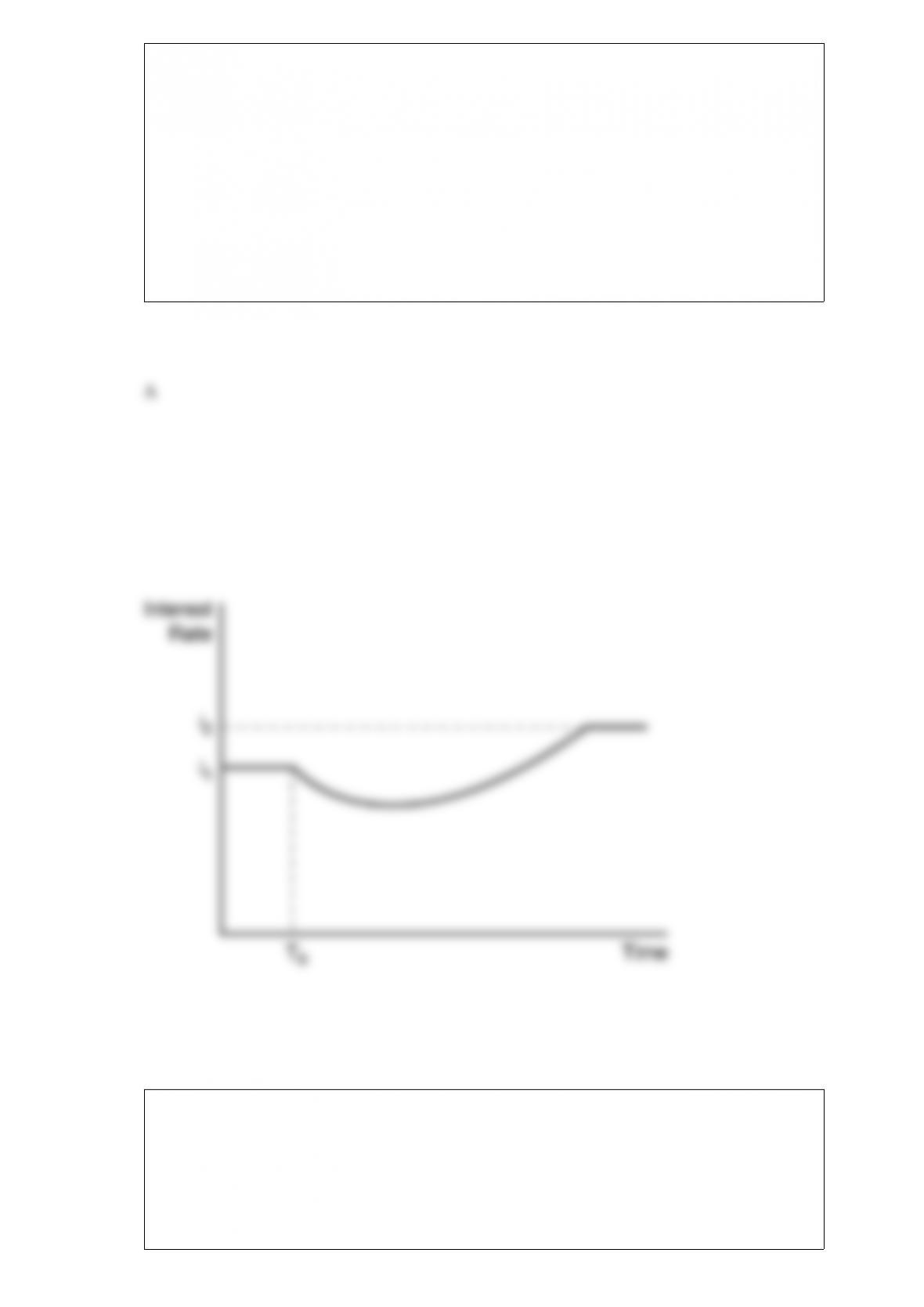
The figure above illustrates the effect of an increased rate of money supply growth at
time period T0. From the figure, one can conclude that the
A) Fisher effect is dominated by the liquidity effect and interest rates adjust slowly to
changes in expected inflation.
B) liquidity effect is dominated by the Fisher effect and interest rates adjust slowly to
changes in expected inflation.
C) liquidity effect is dominated by the Fisher effect and interest rates adjust quickly to
changes in expected inflation.
D) Fisher effect is smaller than the expected inflation effect and interest rates adjust
quickly to changes in expected inflation.
Of the sources of external funds for nonfinancial businesses in the United States, stocks
account for approximately ________ of the total.
A) 2%
B) 11%
C) 20%
D) 40%

Everything else held constant, an autonomous tightening of monetary policy will cause
A) the quantity of aggregate demand to increase.
B) the quantity of aggregate demand to decrease.
C) aggregate demand to increase.
D) aggregate demand to decrease.
When economists say that money promotes ________, they mean that money
encourages specialization and the division of labor.
A) bargaining
B) contracting
C) efficiency
D) greed
The most important advantage of discount policy is that the Fed can use it to
A) precisely control the monetary base.
B) perform its role as lender of last resort.
C) control the money supply.
D) punish banks that have deficient reserves.

Everything else held constant, in the market for reserves, when the demand for federal
funds intersects the reserve supply curve on the vertical section, increasing the discount
rate
A) increases the federal funds rate.
B) lowers the federal funds rate.
C) has no effect on the federal funds rate.
D) has an indeterminate effect on the federal funds rate.
When the Fed wants to raise interest rates after banks have accumulated large amounts
of excess reserves, it would
A) increase the interest rate paid on excess reserves.
B) increase discount rate.
C) increase the required reserve ratio.
D) conduct massive open market purchase.
Which of the following statements is CORRECT?
A) If most shocks to the economy are aggregate demand shocks or permanent aggregate
supply shocks, then policy that stabilizes inflation will also stabilize economic activity,
even in the short run.
B) If temporary supply shocks are more common, then a central bank must choose
between stabilizing inflation and stabilizing output in the short run.
C) Stabilizing economic activity in response to a temporary supply shock results in a
larger deviation of inflation from the inflation target rather than a stabilization of
inflation.
D) all of the above.

The purpose of the disclosure requirements of the Securities and Exchange Commission
is to
A) increase the information available to investors.
B) prevent bank panics.
C) improve monetary control.
D) protect investors against financial losses.
An increase in the monetary base that goes into ________ is not multiplied, while an
increase that goes into ________ is multiplied.
A) deposits; currency
B) excess reserves; currency
C) currency; excess reserves
D) currency; deposits
________ examines whether one variable affects another by using data to build a model
that explains the channels through which this variable affects the other.
A) Indirect-model evidence
B) Organizational-model evidence
C) Reduced-form evidence
D) Structural-model evidence

A ________ is a provision that restricts or specifies certain activities that a borrower
can engage in.
A) residual claimant
B) risk hedge
C) restrictive barrier
D) restrictive covenant
If your nominal income in 2014 is $50,000, and prices increase by 50% between 2014
and 2017, then to have the same real income, your nominal income in 2017 must be
A) $50,000.
B) $75,000.
C) $100,000.
D) $150,000.
If you buy a call option on Treasury futures at 115, and at expiration the market price is
110, the ________ will ________ exercised.
A) call; be
B) put; be
C) call; not be
D) put; not be
In the basic closed-economy ISLM model, as the interest sensitivity of money demand
increases, fiscal policy has ________ effect on output and monetary policy has

________ effect on output.
A) less; less
B) more; more
C) more; less
D) less; more
Everything else held constant, aggregate demand increases when
A) net exports decrease.
B) taxes increase.
C) planned investment spending increases.
D) the money supply decreases.
The evidence from banking crises in other countries indicates that
A) deposit insurance is to blame in each country.
B) a government safety net for depositors need not increase moral hazard.
C) regulatory forbearance never leads to problems.
D) deregulation combined with poor regulatory supervision raises moral hazard
incentives.
The legislative lag represents
A) the time it takes for policy makers to obtain data indicating what is happening in the
economy.
B) the time it takes for policy makers to be sure of what the data are signaling about the

future course of the economy.
C) the time it takes to pass legislation to implement a particular policy.
D) the time it takes for policy makers to change policy instruments once they have
decided on the new policy.
E) the time it takes for the policy actually to have an impact on the economy.
Everything else held constant, an increase in wealth will cause the holdings of
checkable deposits to the holdings of currency to ________ and the currency ratio will
________.
A) increase; increase
B) increase; decrease
C) decrease; increase
D) decrease; decrease
When a financial institution hedges the interest-rate risk for a specific asset, the hedge
is called a
A) macro hedge.
B) micro hedge.
C) cross hedge.
D) futures hedge.
The account that shows international transactions involving financial transactions
(stocks, bonds, bank loans, etc.) is called the

A) trade balance.
B) current account.
C) balance of payments.
D) capital account.
Policy makers cannot achieve both price stability and economic activity stability when
facing
A) temporary supply shocks.
B) permanent supply shocks.
C) demand shocks.
D) all of the above.
The money market is in equilibrium
A) at any point on the IS curve.
B) at any point on the LM curve.
C) at only one point on the LM curve.
D) only at the intersection of the IS and LM curves.
The ratio that relates the change in the money supply to a given change in the monetary
base is called the
A) money multiplier.
B) required reserve ratio.
C) deposit ratio.

D) discount rate.
The riskiness of an asset that is unique to the particular asset is
A) systematic risk.
B) portfolio risk.
C) investment risk.
D) nonsystematic risk.
In a world with few impediments to capital mobility, the domestic interest rate equals
the sum of the foreign interest rate and the expected depreciation of the domestic
currency, a situation known as the
A) interest parity condition.
B) purchasing power parity condition.
C) exchange rate parity condition.
D) foreign asset parity condition.
________ in the foreign interest rate causes the demand for domestic assets to shift to
the right and the domestic currency to ________, everything else held constant.
A) An increase; appreciate
B) An increase; depreciate
C) A decrease; appreciate
D) A decrease; depreciate

The time-inconsistency problem with monetary policy tells us that, if policymakers use
discretionary policy, there is a higher probability that the ________ will be higher,
compared to policy makers following a behavior rule.
A) inflation rate
B) unemployment rate
C) interest rate
D) foreign exchange rate
Although debt contracts require less monitoring than equity contracts, debt contracts are
still subject to ________ since borrowers have an incentive to take on more risk than
the lender would like.
A) moral hazard
B) agency theory
C) diversification
D) the “lemons” problem
________ in the domestic interest rate causes the demand for domestic assets to shift to
the ________ and the domestic currency to appreciate, everything else held constant.
A) An increase; right
B) An increase; left
C) A decrease; right
D) A decrease; left

The mound-shaped yield curve in the figure above indicates that the inflation rate is
expected to
A) remain constant in the near-term and fall later on.
B) fall moderately in the near-term and rise later on.
C) rise moderately in the near-term and fall later on.
D) remain unchanged in the near-term and rise later on.
Analysis of the transmission mechanisms of monetary policy provides four basic
lessons for a central bank’s conduct of monetary policy. Which of the following is NOT
one of these lessons?
A) Rising interest rates indicate a tightening of monetary policy, whereas falling interest
rates indicate an easing of monetary policy.
B) Monetary policy can be highly effective in reviving a weak economy even if
short-term interest rates are already near zero.
C) Avoiding unanticipated fluctuations in the price level is an important objective of
monetary policy, thus providing a rationale for price stability as the primary long-run
goal for monetary policy.
D) Other asset prices beside those on short-term debt instruments do not contain
important information about the stance of monetary policy because they are important
elements in various monetary policy transmission mechanisms.
A consol paying $20 annually when the interest rate is 5 percent has a price of
A) $100.
B) $200.
C) $400.
D) $800.