
Which of the following statements about the loan in the question above are TRUE?
(a) The market value of the loan is higher than the book value of the loan because the
market rate of interest is lower than the interest rate on the loan
(b) The market value of the loan is lower than the book value of the loan because the
market rate of interest is lower than the interest rate on the loan
(c) The market value of the loan is higher than the book value of the loan because the
market rate of interest is higher than the interest rate on the loan
(d) The market value of the loan is lower than the book value of the loan because the
market rate of interest is higher than the interest rate on the loan
An investor purchased a building in 1982 when the building could be depreciated over
19 years. A new investor is interested in purchasing the building in 1992 when the
depreciable life according to tax laws is 31.5 years. Assuming both investors are in the
same tax bracket and that everything else is equal, what can be said about the after-tax
cash flow received by the new investor as compared to the after-tax cash flow that
would be received by the original owner of the building?
(A) The new investor will have a higher after-tax cash flow because the depreciation
expense will be lower
(B) The new investor will have a higher after-tax cash flow because the depreciation
expense will be higher
(C) Both investors will have to use the 31.5 year depreciable life after 1986 so the
after-tax cash flow will be equal
(D) The new investor will have a lower after-tax cash flow because the depreciation
expense will be lower

An appraisal usually contains three approaches to valuation. Which of the following is
NOT one of those approaches?
(A) The Market Approach
(B) The Ratio Approach
(C) The Cost Approach
(D) The Income Approach
For which of the following investments does the issuer bear prepayment risk?
(A) CMOs
(B) MBBs
(C) MPTs
(D) MPTBs
Assuming all APRs equal, the effective interest rate on a loan is highest when:

(A) The loan has no points and a 30 year maturity and is prepaid in five years
(B) The loan has no points and is prepaid at maturity
(C) Points are charged and the loan is paid off at maturity in 30 years
(D) Points are charged and the loan has a 30 year maturity but prepaid in five years
A 25-year maturity mortgage-backed bond is issued. The bond has a par value of
$10,000 and promises to pay an 8percent annual coupon. At issue, bond market
investors require a 12 percent interest rate on the bond. What is the initial price on the
bond?
(a) $588
(b) $6,835
(c) $6,863
(d) $14,270
Which of the following is NOT a minimum mortgage requirement?
(A) Description of the property
(B) Covenant of warranty

(C) Prepayment clause
(D) Covenant of seizing
One of the first amortizing mortgages was the constant amortization mortgage. Which
of the following characterized the components of the CAM payment over the life of the
loan?
Interest Amortization Payment
(A) Decreasing Decreasing Decreasing
(B) Constant Decreasing Decreasing
(C) Decreasing Constant Decreasing
(D) Constant Constant Constant
The return calculated assuming the property is held for one additional year is referred to
as the: (B)
(A) After-tax cash flow from sale
(B) Marginal rate of return
(C) Reinvestment rate

(D) None of the above
A loan in which the borrower arranges in advance with a total amount that will be
advanced in stages, such as a construction loan is said to have which type of mortgage
loan:
(a) Assumption
(b) Non-recourse
(c) Open-end
(d) Subordination
A clause in a non-anchor tenant’s lease requiring the presence of an anchor tenant is
referred to as a:
(A) Non-compete clause
(B) Co-tenancy clause
(C) Joint tenancy clause
(D) Anchor clause

The dollar amount by which total rent exceeds base rent under a percentage lease for
retail is referred to as:
(A) Overage rent
(B) Excess rent
(C) Percentage rent
(D) Marginal rent
The Federal Housing Administration (FHA) provides mortgage insurance, but does not
make loans.
It is estimated that corporate users control as much as ___ percent of all commercial
real estate.
(A) 10
(B) 25
(C) 75
(D) 100
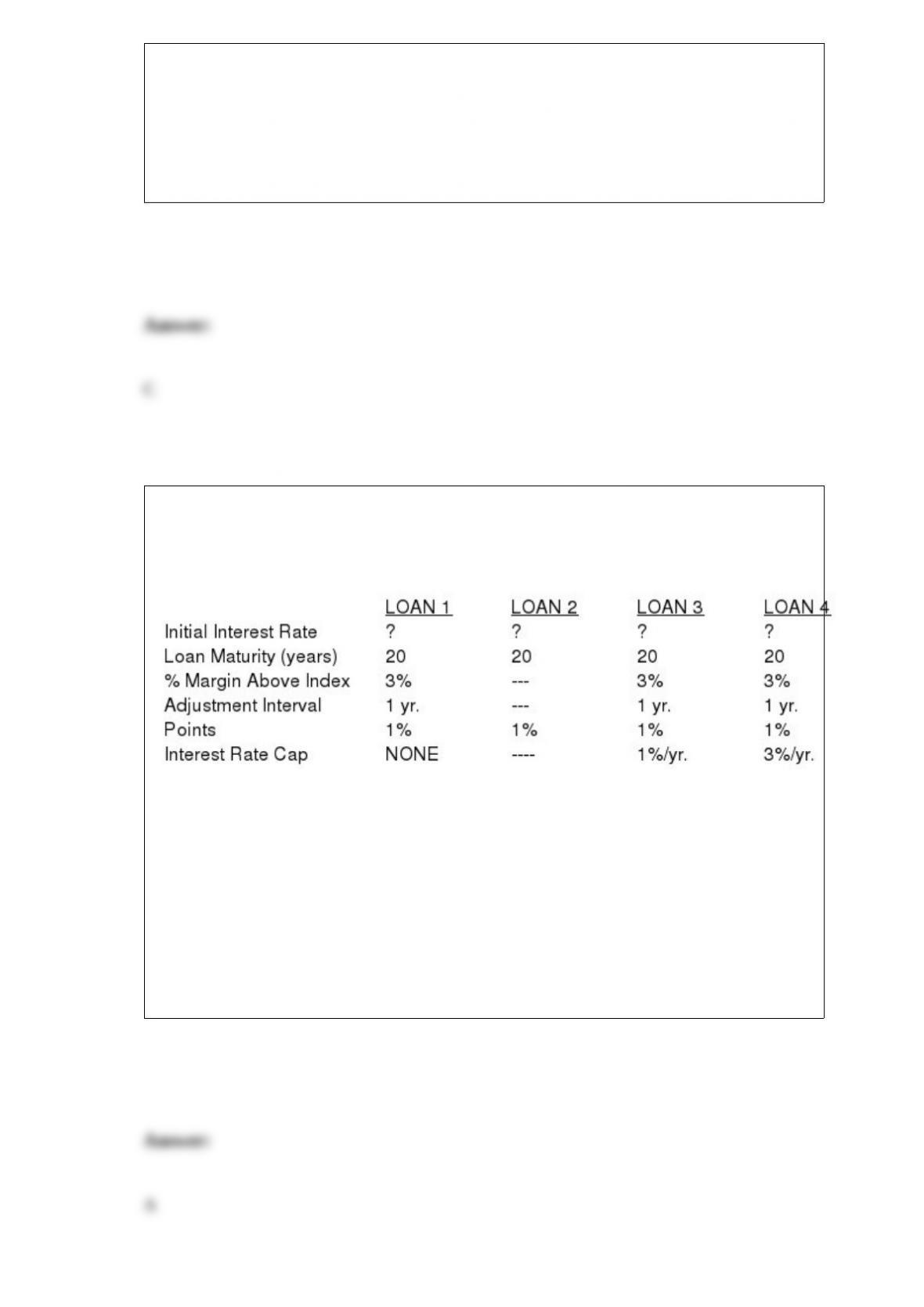
With which loan in the above table does the lender have the lowest interest rate risk?
(A) Loan 1
(B) Loan 2
(C) Loan 3
(D) Loan 4

How should interest prepayments (including points) for income-producing real estate be
handled for tax purposes?
(A) They should be expensed over the first year
(B) They should be amortized over a period of no less than 60 months
(C) They should be amortized over the life of the loan
(D) They should be capitalized and deducted once the loan is paid off
During the period before a fund manager begins to physically purchase properties,
investors are typically asked to make capital _______________.
a. calls
b. commitments
c. contributions
d. assurances
A property is purchased for $200,000 with an 80percent LTV. After five years, the
owner’s equity is $80,000. What would be the approximate annual expected
appreciation rate on home equity (annual EAHE)?

(a) 13.9%
(b) 14.9%
(c) 20.0%
(d) 80.0%
(e) 100%
Which of the following leads to rent premiums?
(A) Apartments on periphery of site, higher floors with no elevators
(B) Second or third levels in multi-level malls
(C) Middle floors in office building
(D) Apartments on higher floors with elevators
Once an entity has been terminated as a REIT, the entity cannot make a new election to
be taxed as a REIT until __ years after the termination.
(A) 2
(B) 3

(C) 4
(D) 5
The cash flows considered in a lease versus own analysis are:
(A) Purchase price, difference in cash flow from operations over the holding period,
and cash flow from sale
(B) Purchase price, lease payments, and cash flow from future sale
(C) Cash flow from sale, differences in future operating expenses, and cash flow from
future sale
(D) Cash flow from sale, future lease payments, and differences in future operating
expenses
The term “usable area” is typically synonymous with “leaseable area.”

A lender requires a 1.20 debt coverage ratio as a minimum. If the net operating income
of a property is $60,000, what is the maximum amount of debt service the lender would
allow?
(a) $30,000
(b) $50,000
(c) $60,000
(d) $72,000
Which of the following REIT types is NOT likely to own real property?
(A) Hybrid REIT
(B) Mortgage REIT
(C) Equity REIT
(D) All of the above
Which of the following is likely to occur upon the sale of a REIT-owned property?
(A) If a capital gain is realized, the REIT can retain the gain for future investment and

be taxed at the appropriate corporate capital gains tax rate
(B) If a capital gain is realized, the REIT can retain the gain for future investment and
be taxed at the shareholder’s capital gains tax rate
(C) If a capital gain is realized, the REIT can distribute the gain as a dividend to
shareholders who will realize it as dividend income for individual tax reporting
purposes
(D) If a capital loss is realized, the loss can be passed through to individual investors
Which of the following is NOT a type of fee commonly charged by a real estate
investment fund manager:
a. acquisition fees
b. disposition fees
c. commitment fees
d. performance fees
Investors may be concerned if a fund manager deviates from the stated investment
strategy by purchasing properties that do not fall within the parameters of the stated
objectives of the firm. This practice is referred to as:
a. Overage

b. Plan Deviation
c. Style drift
d. Eccentricity
Noncumulative pari passu distribution refers to:
(a) The payment of dividends by S-corps
(b) A preferred payment received by money partners and operating partners
(c) Payments distributed when the enterprise has negative cash flows
(d) The difference in payments received by partners and the payments received by
bondholders
Including REITs in a portfolio containing S&P 500 securities produces diversification
benefits. Why?
(a) Real estate investment returns are highly correlated with returns for stocks
(b) Real estate investment returns are not highly correlated with returns for stocks
(c) Real estate investment returns are not subject to federal income taxes

(d) Real estate investment returns do not change much from year to year
Besides an estimate of costs, a construction loan submission package includes many
other components. Which of the following is NOT one of those components?
(A) Pro Forma Statement of Cash Flows for an investor’s portfolio
(B) Pro Forma Statement of Cash Flows
(C) Pro Forma Operating Statement
(D) Ratio and Sensitivity Analysis
The appraised value of a property usually represents the:
(A) Actual value of the property
(B) Actual selling price of the property
(C) Actual opinion of an appraiser
(D) Actual replacement value of the property

Which of the following common contingencies is NOT usually included with a
permanent financing agreement?
(A) Completion date for construction phase
(B) Minimum rent-up requirements
(C) Materials used in construction phase
(D) Cleanliness of work area