
d’Anconia Copper has $200 million in cash that it can use for a share repurchase.
Suppose instead that d’Anconia Copper invests the funds in an account paying 5%
interest for one year. Assume that the corporate tax rate is 35%, the individual capital
gains rate is 15% and the individual rate on ordinary income is 30%.
Net of capital gains taxes, the amount the total value of d’Anconia Copper shares
increase is closest to:
A) $5.5 million
B) $6.5 million
C) $7.0 million
D) $10.0 million
Rearden Metal needs to order a new blast furnace that will be delivered in one year. The
$1,000,000 price for the blast furnace is due in one year when the new furnace is
installed. The blast furnace manufacturer offers Rearden Metal a discount of $50,000 if
they pay for the furnace now. If the interest rate is 7%, then the NPV of paying for the
furnace now is closest to:
A) ($15,421)
B) $15,421
C) ($46,729)
D) $46,729
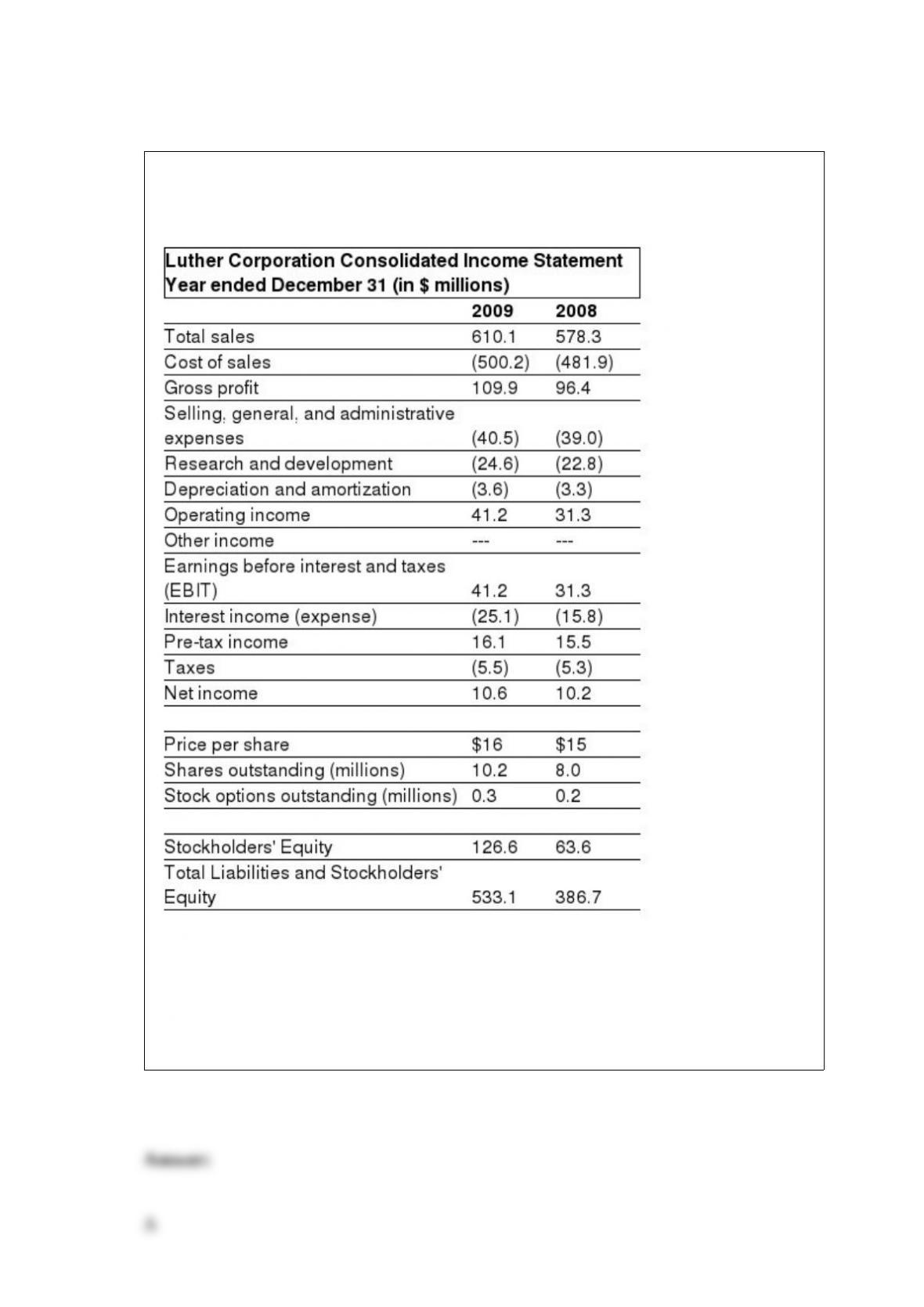
Assuming that Luther has no convertible bonds outstanding, then for the year ending
December 31, 2009 Luther’s diluted earnings per share are closest to:
A) $1.01
B) $1.04
C) $1.28
D) $1.33

Two years ago the Krusty Krab Restaurant purchased a grill for $50,000. The owner,
Eugene Krabs, has learned that a new grill is available that will cook Krabby Patties
twice as fast as the existing grill. This new grill can be purchased for $80,000 and
would be depreciated straight line over 8 years, after which it would have no salvage
value. Eugene Krab expects that the new grill will produce EBITDA of $50,000 per
year for the next eight years while the existing grill produces EBITDA of only $35,000
per year. The current grill is being depreciated straight line over its useful life of 10
years after which it will have no salvage value. All other operating expenses are
identical for both grills. The existing grill can be sold to another restaurant now for
$30,000. The Krusty Krab’s tax rate is 35%. If the Krusty Krab’s opportunity cost of
capital is 12%, then the NPV for upgrading to the new grill is closest to:
A) -22,875
B) -15,025
C) 7,130
D) 10,630
Ideko’s Planned Debt

If Ideko’s loans will have an interest rate of 6.8%, then the interest expense paid in 2008
is closest to:
A) $6,800
B) $7,310
C) $7,820
D) $7,990
d’Anconia Copper is an all-equity firm with 60 million shares outstanding, which are
currently trading at $20 per share. Last month, d’Anconia announced that it will change
its capital structure by issuing $300 million in debt. The $200 million raised by this
issue, plus another $200 million in cash that d’Anconia already has, will be used to
repurchase existing shares of stock. Assume that capital markets are perfect.
The market capitalization of d’Anconia Copper before this transaction takes place is
closest to:
A) $800 million
B) $900 million
C) $1,100 million
D) $1,200 million

John Galt is a mutual fund manager at Atlas Asset Management. He can generate an
alpha of 2% a year up to $500 million of invested capital. After that amount his skills
are spread too thin, so he cannot add value and his alpha is zero for all investments over
$500 million. Atlas Asset Management charges a fee of 0.80% on the total amount of
money under management. Assume that there are always investors looking for positive
alpha investments and no investor would invest in a fund with a negative alpha. Assume
that the fund is in equilibrium, meaning that no investor either takes out money or
wishes to invest new money into the fund.
The amount of fee income that Galt’s fund will generate is closest to:
A) $3.75 million
B) $8.00 million
C) $10.00 million
D) $25.00 million
Ideko Sales and Operating Cost Assumptions
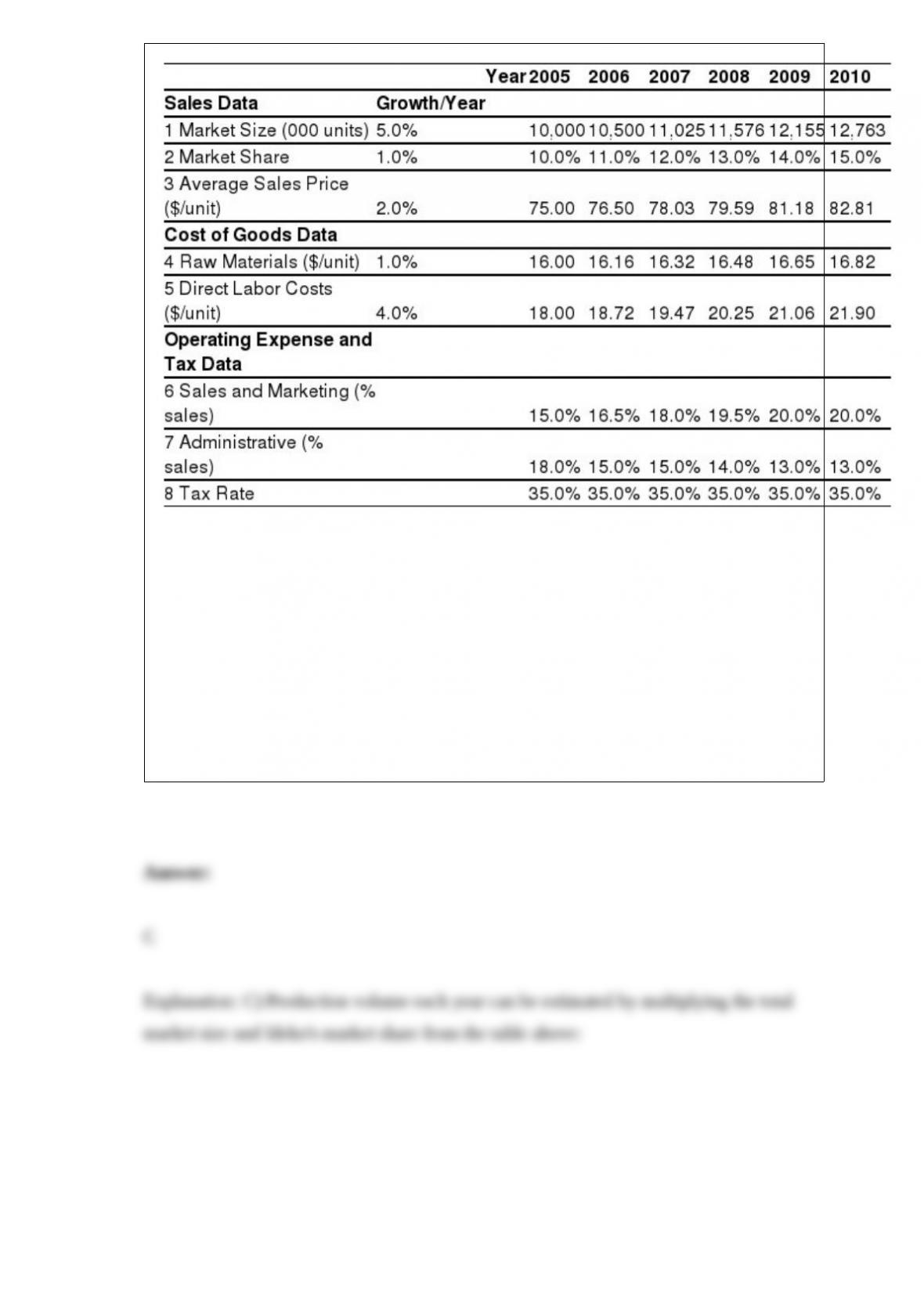
Based upon Ideko’s Sales and Operating Cost Assumptions, what production capacity
will Ideko require in 2008?
A) 1,702 units
B) 1,323 units
C) 1,505 units
D) 1,914 units

Consider a project with the following cash flows:
Assume the appropriate discount rate for this project is 15%. The payback period for
this project is closest to:
A) 3.0
B) 2.5
C) 2.0
D) 4.0
Suppose that the market portfolio is equally likely to increase by 24% or decrease by
8%. Security “X” goes up on average by 29% when the market goes up and goes down
by 11% when the market goes down. Security “Y” goes down on average by 16% when
the market goes up and goes up by 16% when the market goes down. Security “Z” goes
up on average by 4% when the market goes up and goes up by 4% when the market
goes down.
The expected return on security with a beta of 1.2 is closest to:
A) 4.8%

B) 8.0%
C) 8.8%
D) 9.6%
If managed effectively, Rearden Metal will have assets with a market value of $200
million, $300 million, or $400 million next year, with each outcome being equally
likely. Managers, however, may decided to engage in wasteful empire building, which
will reduce Rearden’s market value by $20 million in all cases. Managers may also
increase the risk of the firm, changing the probability of each outcome to 50%, 5%, and
45% respectively.
Suppose that the managers at Rearden Metal will increase risk to maximize the
expected payoff to equity holders. If Rearden has $230 million in debt due in one year,
then the expected value of Rearden’s assets are closest to:
A) $280 million
B) $295 million
C) $300 million
D) $900 million

Consider a growing perpetuity that will pay $100 in one year. Each year after that, you
will receive a payment on the anniversary of the last payment that is 6% larger than the
last payment. This pattern of payments will continue forever. If the interest rate is 11%,
then the value of this perpetuity is closest to:
A) $1,667
B) $588
C) $2,000
D) $909
Consider the following formula:
Ï„* =
The term Ï„e is:
A) the effective personal tax rate on equity.
B) the effective tax advantage of debt.

C) the effective corporate tax rate on income.
D) the effective personal tax rate on interest income.
Which of the following statements is FALSE?
A) Once investors know the recap will occur, the share price will rise immediately to a
level that reflects the value of the interest tax shield that the firm will receive from its
recapitalization.
B) When securities are fairly priced, the original shareholders of a firm capture the full
benefit of the interest tax shield from an increase in leverage.
C) In the presence of corporate taxes, we do not include the interest tax shield as one of
the firm’s assets on its market value balance sheet.
D) We can analyze the recapitalization using the market value balance sheet; it states
that the total market value of a firm’s securities must equal the total market value of the
firm’s assets.
Wyatt oil presently pays no dividend. You anticipate Wyatt Oil will pay an annual
dividend of $0.56 per share two years from today and you expect dividends to grow by
4% per year thereafter. In Wyatt Oil’s equity cost of capital is 12%, then the value of a
share of Wyatt oil today is:
A) $4.67
B) $5.00

C) $6.25
D) $7.00
In practice which market index is most widely used as a proxy for the market portfolio
in the CAPM?
A) Dow Jones Industrial Average
B) Wilshire 5000
C) S&P 500
D) U.S. Treasury Bill
Which of the following statements is FALSE?
A) Because interest rates may be quoted for different time intervals, it is often
necessary to adjust the interest rate to a time period that matches that of our cash flows.
B) The effective annual rate indicates the amount of interest that will be earned at the
end of one year.
C) The annual percentage rate indicates the amount of simple interest earned in one
year.
D) The annual percentage rate indicates the amount of interest including the effect of
compounding.
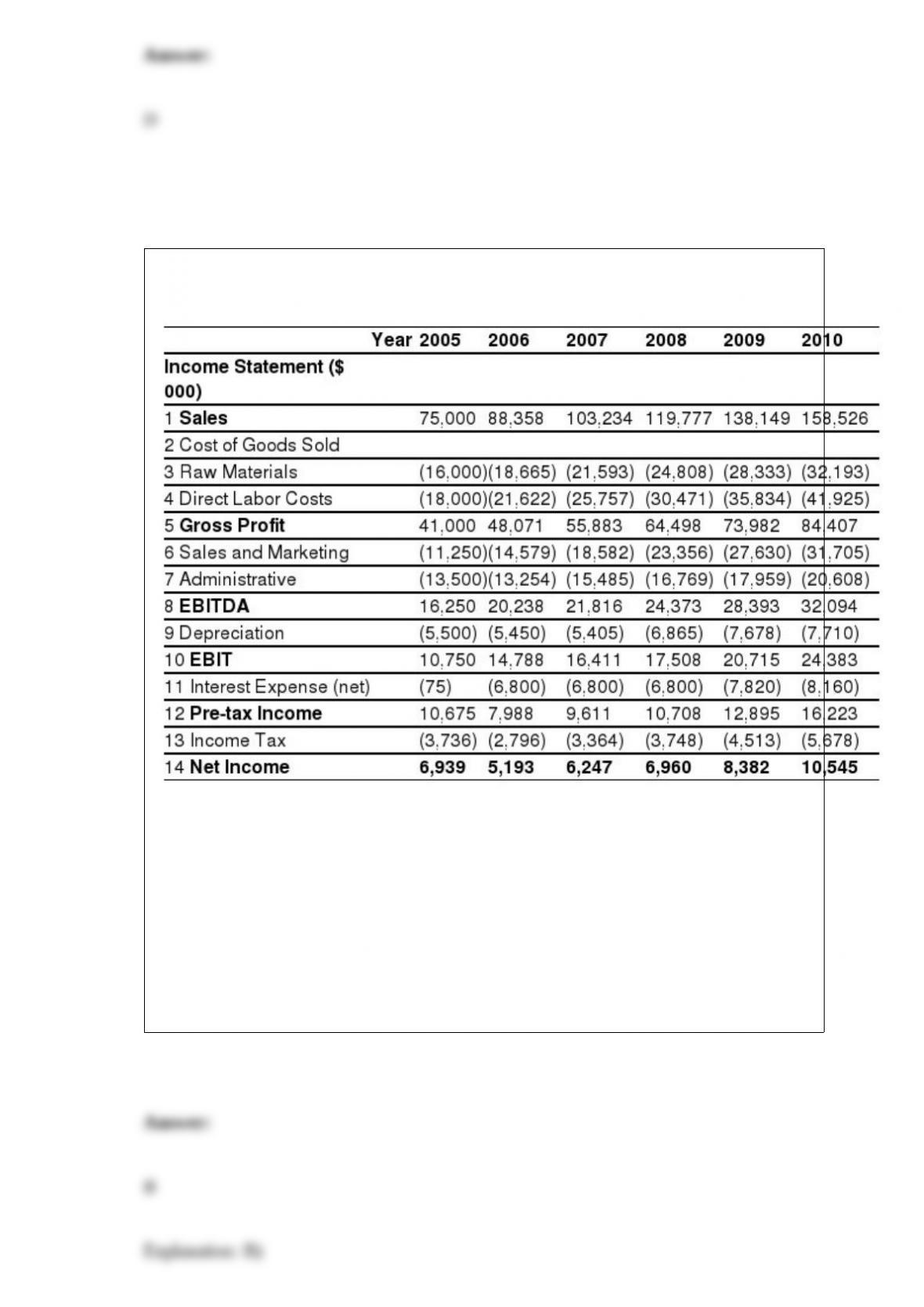
Pro Forma Income Statement for Ideko, 2005-2010
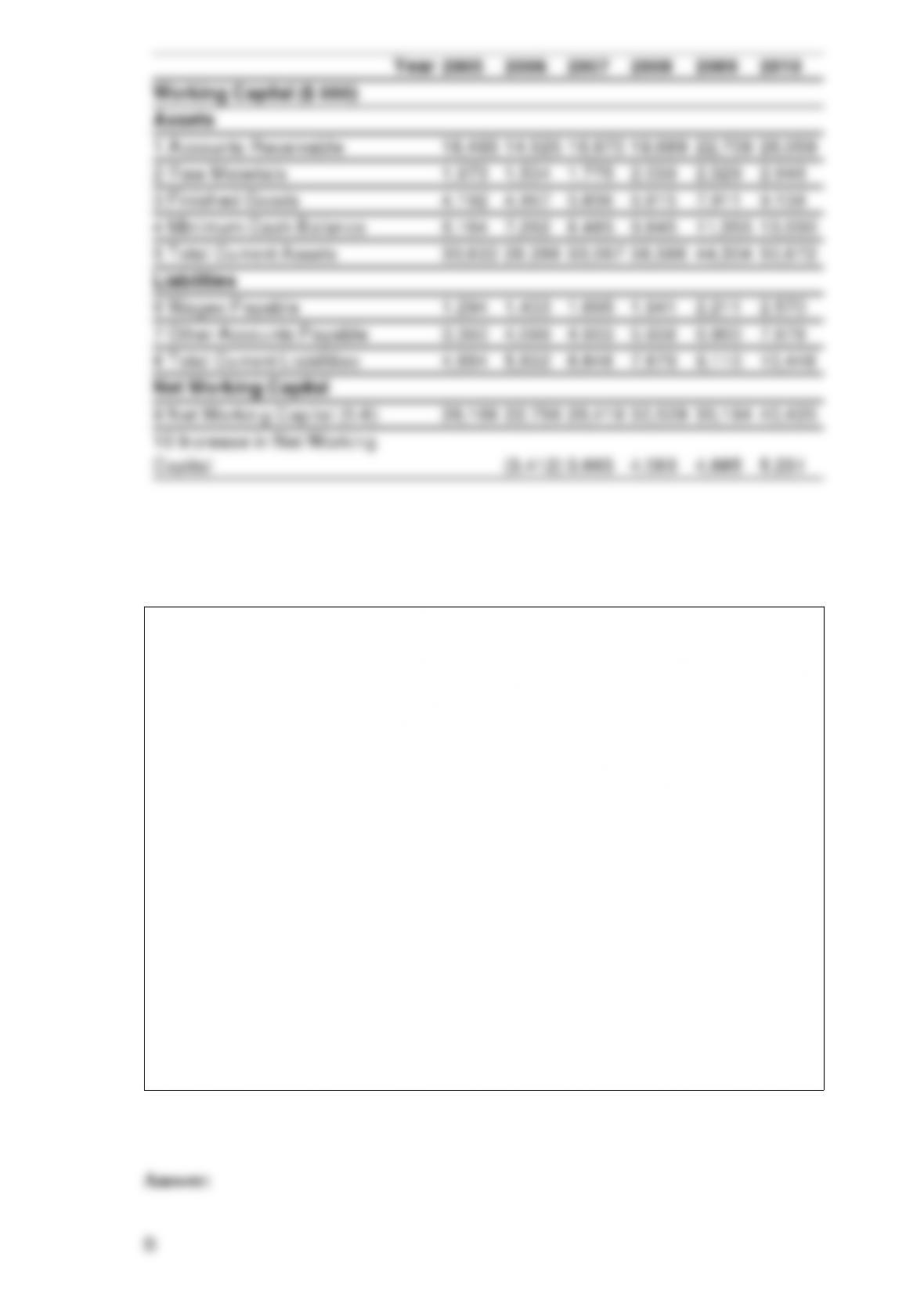
The amount of net working capital for Ideko in 2007 is closest to:
A) $30,510
B) $26,420
C) $22,170
D) $35,195
The Sisyphean Corporation is considering investing in a new cane manufacturing
machine that has an estimated life of three years. The cost of the machine is $30,000
and the machine will be depreciated straight line over its three-year life to a residual
value of $0.
The cane manufacturing machine will result in sales of 2,000 canes in year 1. Sales are
estimated to grow by 10% per year each year through year three. The price per cane that
Sisyphean will charge its customers is $18 each and is to remain constant. The canes
have a cost per unit to manufacture of $9 each.
Installation of the machine and the resulting increase in manufacturing capacity will
require an increase in various net working capital accounts. It is estimated that the
Sisyphean Corporation needs to hold 2% of its annual sales in cash, 4% of its annual
sales in accounts receivable, 9% of its annual sales in inventory, and 6% of its annual
sales in accounts payable. The firm is in the 35% tax bracket, and has a cost of capital
of 10%.
The incremental EBIT in the first year for the Sisyphean Corporation’s project is closest
to:
A) $18,000
B) $8,000
C) $11,700
D) $5,200
Which of the following statements regarding the NPV decision rule is FALSE?
A) Reject projects with a NPV of zero, as accepting them is equivalent to reducing firm
value.
B) When faced with a set of alternatives, choose the one with the highest NPV.
C) Accept those projects with a positive NPV, as accepting them is equivalent to
receiving their NPV in cash today.
D) Reject those projects with a negative NPV.
Which of the following statements is most correct?
A) An advantage to incorporation is that it allows for less regulation of the business.
B) An advantage of a corporation is that it is subject to double taxation.
C) Unlike a partnership, a disadvantage of a corporation is that has limited liability.
D) Corporations face more regulations when compared to partnerships.
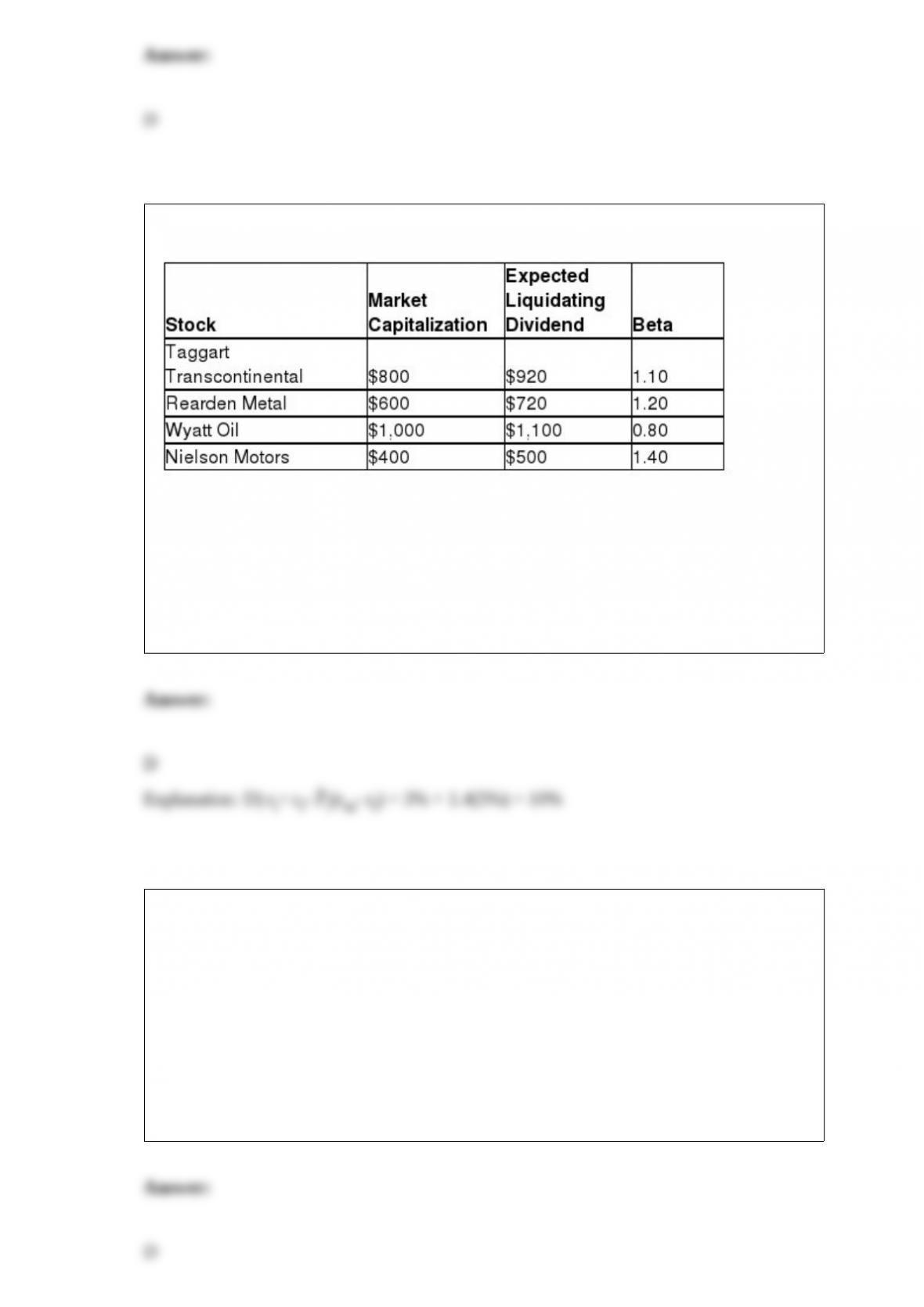
All amounts are in millions.
If the risk-free rate is 3% and the market risk premium is 5%, then the CAPM’s
predicted expected return for Nielson Motors is closest to:
A) 8.5%
B) 9.0%
C) 9.5%
D) 10.0%
Which of the following statements is FALSE?
A) Beta is the expected percent change in the excess return of the security for a 1%
change in the excess return of the market portfolio.
B) Beta represents the amount by which risks that affect the overall market are
amplified for a given stock or investment.
C) It is common practice to estimate beta based on the historical correlation and
volatilities.
D) Beta measures the diversifiable risk of a security, as opposed to its market risk, and
is the appropriate measure of the risk of a security for an investor holding the market
portfolio.

Assets $200 million
Shareholder Equity $100 million
Sales $300 million
Net Income $15 million
Interest Expense $2 million
If ECE’s stock is currently trading at $24.00 and ECE has 25 million shares outstanding,
then ECE’s market-to-book ratio is closest to:
A) 0.24
B) 4
C) 6
D) 30