
1) Which of the following statements is true regarding the Fed’s procedures for
operating the discount window?
A) The Fed’s operating procedures and paying interest on reserves contains the federal
funds rate between the interest rate paid on reserves and the discount rate
B) The Fed’s operating procedures and paying interest on reserves creates more
fluctuation in the federal funds rate than if they simply didn’t pay interest on reserves
C) The Fed’s operating procedures and paying interest on reserves has no impact on the
fluctuation of the federal funds rate.
D) None of the above is correct
2) The largest depository institution (value of assets) at the end of 2009 was
A) commercial banks
B) pension funds
C) credit unions
D) mutual funds
3) The main advantage of using options on futures contracts rather than the futures
contracts themselves is that interest-rate risk is
A) controlled while preserving the possibility of gains
B) controlled while removing the possibility of losses
C) not controlled but the possibility of gains is preserved
D) not controlled but the possibility of gains is lost
4) ________ issues participation certificates, and ________ provides federal insurance
for participation certificates.
A) Freddie Mac; Freddie Mac
B) Freddie Mac; Ginnie Mae
C) Ginnie Mae; Freddie Mac
D) Ginnie Mae; Ginnie Mae
E) Freddie Mac; no one
5) Measured by assets, the most popular type of bond fund is the ________ bond fund.
A) state municipal

B) strategic income
C) government
D) high-yield
6) Large-denomination CDs are ________, so that like a bond they can be resold in a
________ market before they mature.
A) nonnegotiable; secondary
B) nonnegotiable; primary
C) negotiable; secondary
D) negotiable; primary
7) A typical venture capital firm has a ________ number of investors who each
contribute a ________ amount of money to the fund.
A) large; small
B) small; large
C) large; large
D) small; small
8) All other things held constant, premiums on both put and call options will increase
when the
A) exercise price increases
B) volatility of the underlying asset increases
C) term to maturity decreases
D) futures price increases
9) The ________ the costs associated with deposit outflows are, the ________ excess
reserves banks will want to hold.
A) lower; more
B) higher; less
C) higher; more
D) none of the above, since deposit outflows cannot be anticipated

10) The money market is the market in which ________ are traded.
A) new issues of securities
B) previously issued securities
C) short-term debt instruments
D) long-term debt and equity instruments
11) The risk structure of interest rates is explained by
A) default risk
B) liquidity
C) tax considerations
D) all of the above
12) Which regulatory body charters national banks?
A) the Federal Reserve
B) the Federal Deposit Insurance Corporation
C) the Comptroller of the Currency
D) none of the above
13) Since yield curves are usually upward sloping, the ________ indicates that, on
average, people tend to prefer holding short-term bonds to long-term bonds.
A) market segmentation theory
B) expectations theory
C) liquidity premium theory
D) both A and B of the above
E) both A and C of the above
14) (I) Firms issue common stock in far greater amounts than preferred stock.
(II) In a given year, the total volume of stock issued is much less than the volume of
bonds issued.
A) (I) is true, (II) false

B) (I) is false, (II) true
C) Both are true
D) Both are false
15) Most financial crises in the United States have begun with
A) a steep stock market decline
B) an increase in uncertainty resulting from the failure of a major firm
C) a steep decline in interest rates
D) all of the above
E) only A and B of the above
16) If the expected path of one-year interest rates over the next five years is 2 percent, 4
percent, 1 percent, 4 percent, and 3 percent, then the pure expectations theory predicts
that the bond with the lowest interest rate today is the one with a maturity of
A) one year
B) two years
C) three years
D) four years
17) Which of the following long-term bonds should have the lowest interest rate?
A) Corporate Baa bonds
B) U.S. Treasury bonds
C) Corporate Aaa bonds
D) Municipal bonds
18) A put option gives the seller the ________ to ________ the underlying security.
A) right; sell
B) obligation; sell
C) right; buy
D) obligation; buy

19) Which of the following can be described as involving indirect finance?
A) A bank buys a U.S. Treasury bill from one of its depositors
B) A corporation buys commercial paper issued by another corporation
C) A pension fund manager buys commercial paper in the primary market
D) Both A and C of the above
20) Bonds whose term to maturity is shorter than the holding period are also subject to
A) default.
B) reinvestment risk
C) both of the above
D) none of the above
21) To prevent adverse selection, health and life insurance companies may do all the
following except
A) charge higher premiums to people with certain preexisting health conditions
B) require potential policyholders to submit medical records
C) refuse to sell policies to people with certain pre-existing health conditions
D) charge the same premiums to all policyholders
22) The Fed can lower the federal funds interest rate by ________ securities, thereby
________ reserves.
A) selling; adding
B) selling; lowering
C) buying; adding
D) buying; lowering
23) For a given return on assets, the lower the bank capital is,
A) the lower the return for the owners of the bank will be
B) the higher the return for the owners of the bank will be
C) the lower the credit risk for the owners of the bank will be

D) both A and C of the above will happen
24) The bailout of the savings and loan industry was much delayed and, therefore, much
more costly to taxpayers because
A) of regulators’ initial attempts to downplay the seriousness of problems within the
thrift industry
B) politicians who received generous campaign contributions from the savings and loan
industry, like regulators, hoped that the problems in the industry would ease over time
C) Congress encouraged, and thrift regulators acceded to, a policy of regulatory
forbearance
D) of all of the above
E) of only A and B of the above
25) The Securities Acts of 1933 and 1934 did not
A) regulate the activities of investment funds
B) require funds to register with the SEC
C) include antifraud rules covering the purchase and sale of fund shares
D) apply to investment funds
26) The major provisions of the Financial Institutions Reform, Recovery, and
Enforcement Act of 1989 included
A) abolishing the Federal Home Loan Bank Board and the FSLIC
B) transferring the regulatory role of the Federal Home Loan Bank Board to the Office
of Thrift Supervision, a bureau within the U.S. Treasury Department
C) establishing the Resolution Trust Corporation to manage and resolve insolvent thrifts
placed in conservatorship or receivership
D) all of the above
E) only A and B of the above
27) Money market instruments
A) are usually sold in large denominations
B) have low default risk
C) mature in one year or less

D) are characterized by all of the above
E) are characterized by only A and B of the above
28) The first country to mandate that its central bank adopt inflation targeting was
A) the United States
B) the United Kingdom
C) Canada
D) New Zealand
29) Stage Two of a financial crisis in an advanced economy usually involves a
________ crisis.
A) currency
B) stock market
C) banking
D) commodities
30) If the Federal Reserve wants to lower the monetary base and the money supply, it
will
A) increase bank reserves
B) lower the discount rate
C) sell government securities
D) lower reserve requirements
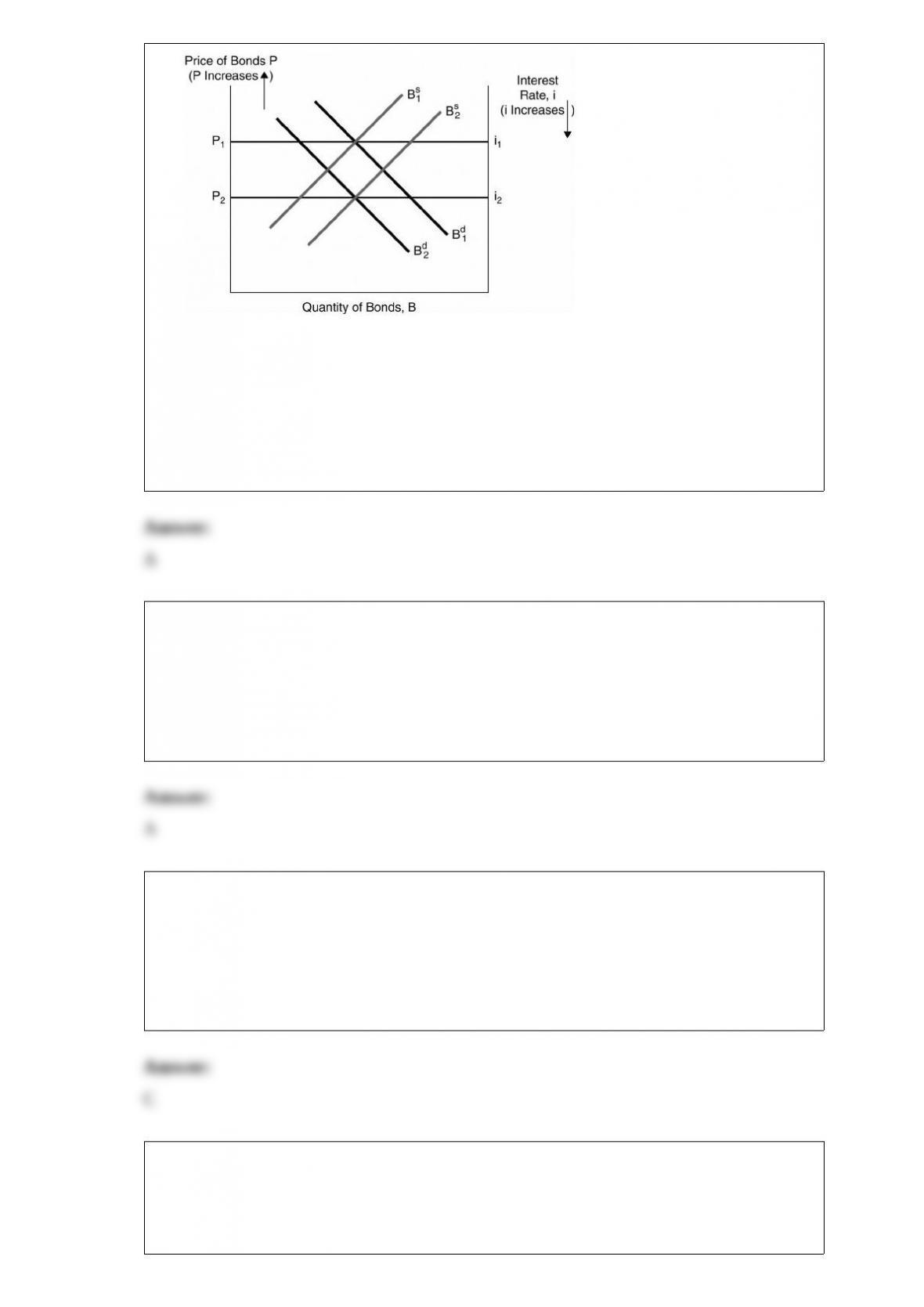
31)
Figure 4.1
In Figure 4.1, the most likely cause of the increase in the equilibrium interest rate from
i1 to i2 is a(n) ________ in the ________.
A) increase; expected inflation rate
B) decrease; expected inflation rate
C) increase; government budget deficit
D) decrease; government budget deficit
32) The government institution that has responsibility for the amount of money and
credit supplied in the economy as a whole is the
A) central bank
B) commercial bank
C) bank of settlement
D) Treasury Department
33) During a recession, the supply of bonds ________ and the supply curve shifts to the
________.
A) increases, left
B) increases, right
C) decreases, left
D) decreases, right
34) With an interest rate of 10 percent, the present value of a security that pays $1,100
next year and $1,460 four years from now is approximately
A) $1,000
B) $2,000

C) $2,560
D) $3,000
35) Which of the following is a likely reason for a portfolio manager to sell a stock
index future short?
A) He believes the market will rise
B) He wants to lock in current prices
C) He wants to reduce stock market risk
D) Both B and C are correct
36) Which of the following statements is false?
A) Checkable deposits are usually the lowest-cost source of bank funds
B) Checkable deposits are the primary source of bank funds
C) Checkable deposits are payable on demand
D) Checkable deposits include NOW accounts