
Mergers with anticompetitive effects cannot go unchallenged by federal authorities
unless the banks can show that the combined bank would have significant public
benefits.
Answer:
A put option on currency futures is often used to protect against a rise in currency
prices.
Answer:
State-chartered banks in the United States represent about a quarter of all
U.S.-chartered banks, while national banks account for approximately three quarters of
all U.S. chartered banks.
Answer:

Insurance companies are one of the principal sellers of credit derivatives.
Answer:
As a result of many bank mergers in the last few decades, research indicates that
goodwill as an asset on many bank’s balance sheets has grown exponentially.
Answer:
NOW accounts can be held by businesses and individuals and are interest-bearing
checking accounts.
Answer:

Accounts receivable financing entails a bank actually taking over the ownership of
receivables, whereas factoring entails a bank merely lending money against a
borrowing customer’s receivables and the customer still retains the ownership of the
receivables.
Answer:
Federal funds today consist exclusively of deposits held at the Federal Reserve banks.
Answer:
Except for commercial banks, savings & loans and savings banks hold the most
deposits.
Answer:

A short-term IOU offered by major corporations that is of short maturity (most of these
lOUs mature in 90 days or less) is known as a CMO.
Answer:
According to the textbook, new car loans have a lower interest rate than used car loans.
Answer:
Securitization raises the level of competition for the best-quality loans among banks.
Answer:

One of the elements used in the FICO credit scoring system is the borrower’s
employment history and salary.
Answer:
Investment securities are expected to help stabilize a financial institution’s income.
Answer:
Long hedges in currency futures are designed to protect a bank or its customer from
increases in the price of the currency it must eventually acquire.
Answer:

A financial institution confronted with a negative interest-sensitive gap could avoid
unacceptable losses from rising interest rates by covering the gap with a short hedge.
Answer:
“Painting the tape” refers to the practice whereby banks understate their nonperforming
loans.
Answer:
Asset liquidity management (asset conversion) involves storing liquidity in assets, such
as land and buildings.
Answer:

Longer-term federal funds contracts which are automatically renewed each day unless
either the borrower or the lender decides to end the agreement are called term loans.
Answer:
Shorter-term cash loans to consumers are normally secured, but longer-term consumer
loans are usually unsecured.
Answer:
A Roth IRA allows an individual to accumulate investment earnings tax free and also
pay no tax on their investment earnings when withdrawn provided the taxpayer follows
the rules on this new account.
Answer:

One attractive feature of investment banking is that it is generally less risky than
commercial banking.
Answer:
The Federal Reserve changes reserve requirements frequently because the effect of
these changes is small.
Answer:
Banks acquired by holding companies are referred to as affiliated banks.
Answer:

Under U.S. federal law, an institution making only loans to households and offering
uninsured checkable deposits and savings deposits qualifies as a commercial bank.
Answer:
The role performed by banks in the economy in which they transform savings into
credit is known as the intermediation role.
Answer:
The number of independently owned banks has risen in the United States over the last
decade.
Answer:

Smaller banks rely more heavily on internally generated capital than larger banks.
Answer:
The contention that there are certain banking services (such as small loans or savings
and checking accounts) that every citizen should have access to is usually called
socialized banking.
Answer:
In looking at comparative balance sheets, it can be seen that large banks rely more
heavily on nondeposit borrowings while small banks rely more heavily on deposits.
Answer:

On a bank’s income statement (Report of Income) deposit costs are financial inputs.
Answer:
To close a bank branch office in the United States, a bank must give its customers 30
days advance notice.
Answer:
Troubled loans normally are subject to more frequent reviews than sound loans.
Answer:

Third State Bank wants to add a new branch office. It has determined that the cost of
construction of the new facility will be $1.5 million with another $500,000 in
organizational costs. The bank has estimated that it will generate $319,522 per year in
net revenues for 20 years. If Third State requires a 17% return on its money, what is this
project’s net present value?
A. $201,805
B. -$201,805
C. $1,798,195
D. -$1,798,195
E. $298,195
Answer:
The most aggressive investment maturity strategy that calls for the bank to continually
shift the maturities of its securities in response to changes in forecasts of interest rates
and other economic conditions is known as:
A. barbell strategy.
B. rate expectations approach.
C. front-end loaded policy.
D. ladder approach.
E. None of the options is correct.

Answer:
Banks generate their largest portion of income from:
A. loans.
B. short-term investments.
C. demand deposits.
D. trading account gains & fees.
E. certificates of deposits.
Answer:
In determining the balance on which interest earnings are figured, a depository
institution must use the ___________________ in the deposit.
A. minimum balance amount
B. maximum balance amount
C. full amount of the principal
D. average monthly balance

E. average daily balance
Answer:
________________________ refers to the movement of two or more industries over
time toward each other, resulting in different firms offering many of the same services.
A. Divergence
B. Convergence
C. Consortium
D. Diversification
E. Consolidation
Answer:
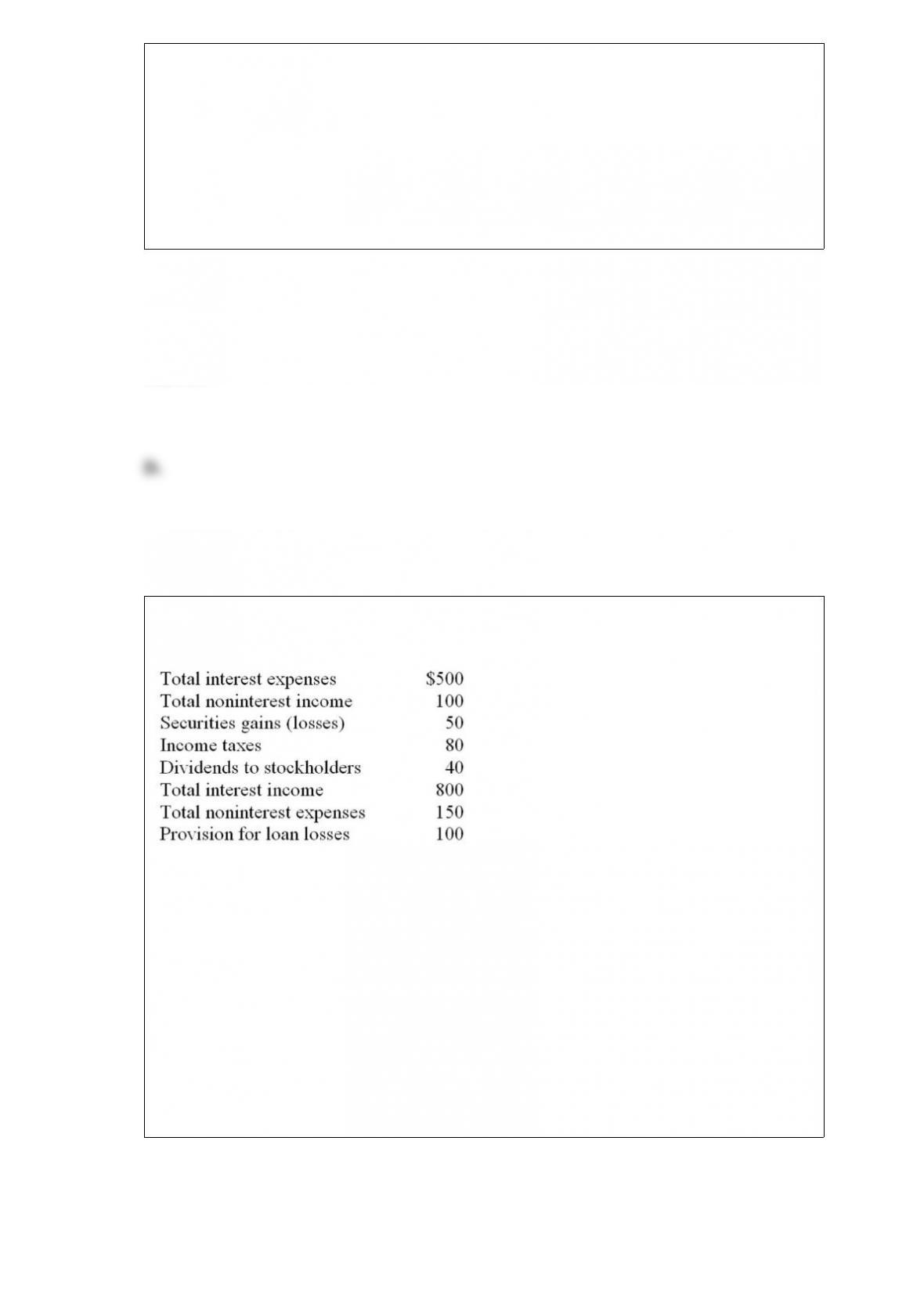
Following data pertains to Castle State Bank.

What is Castle State Bank’s ROE? A. 20.45%
B. 18.33%
C. 12.22%
D. 7.33%
E. 2.5%
Answer:
Mortgage prepayment risk:
A. is higher on high interest rate mortgages.
B. is felt most dramatically when interest rates rise.
C. is eliminated by the use of mortgage backed securities.
D. is eliminated by the purchase of a stripped mortgage obligation.
E. All the options are true.
Answer:

Real estate loans made by national banks in the U.S. cannot exceed:
A. 15 percent of that bank’s total assets or 25 percent of its total capital.
B. that bank’s total capital and surplus or 70 percent of its time and savings deposits,
whichever is greater.
C. 20 percent of that bank’s capital and surplus or 80 percent of its savings deposits,
whichever is lesser.
D. 25 percent of capital or 10 percent of core deposits of the bank, whichever is higher.
E. None of the options is correct.
Answer:
Conditional deposit pricing may involve all of the following factors except:
A. the level of interest rates.
B. the number of transactions passing through the account.
C. the average balance in the account.
D. the maturity of the account.
E. All of the options are used.

Answer:
The Lancaster State Bank is thinking about purchasing a corporate bond that pays a
coupon of 8.5%. The bank has a marginal tax rate of 25%. What is the after-tax yield on
this bond?
A. 11.33%
B. 8.5%
C. 6.375%
D. 2.125%
E. None of the options is correct
Answer:
The amount that is used to determine the mark-to-market for a futures contract at the
end of each day is called the: A. open price.
B. high price.
C. settlement price.
D. low price.
E. day average.

Answer:
A financial institution that sells a particular futures contract and later purchases the
same contract back is executing: A. a long hedge.
B. a short hedge.
C. a sideways hedge.
D. an up-side-down hedge.
E. None of the options are correct
Answer:
When a loan is considered uncollectible, the bank’s accounting department will write
(charge) it off the books by reducing the ______ and the ______ accounts. Which
choice below correctly fills in the blanks in the preceding sentence?
A. PLL, gross loans
B. ALL, net loans
C. ALL, gross loans
D. PLL, net loans

E. None of the options are correct.
Answer:
Which of the following would be an example of interest rate risk? A. A bank manager
embezzles $1,000,000 from the bank.
B. A bank that loses $500,000 from trading in foreign currencies.
C. A $1,000,000 loan given to a business on which no interest or principal has been
collected in 2 years.
D. A bank manager predicts interest rates will rise. However, interest rates fall causing
the bank’s net income to fall by $250,000.
E. All of the options are examples of interest rate risk.
Answer:
When some of a bank’s expected demand for liquidity are stored in its assets, while
other unexpected cash needs are met from near-term borrowings, the approach to
liquidity management is known as:
A. liability management.
B. asset conversion.
C. borrowed liquidity management.
D. balanced liquidity management.
E. None of the options is correct
Answer:
You know the following information about the Davis National Bank:
Given this information, what is the value of this firm’s net interest income?
A. $300
B. $150
C. ($50)
D. $120
E. $80
Answer:
Harrison Bank has the following financial information:
What is the bank’s asset utilization ratio?
A. 1.6%
B. 10%
C. 12.8%
D. 16%
E. None of the options is correct
Answer:
The U.S. government wants to prevent money laundering by drug cartels. To promote
this goal, they have asked banks to report any cash deposits greater than $10,000 to the
government. Which of the following roles is the bank performing?
A. The intermediation role
B. The payments role

C. The risk management role
D. The guarantor role
E. The policy role
Answer:
A bank that is judged as needing to improve under the performance requirements of the
Community Reinvestment Act will receive an examiner rating of:
A. 0.
B. S.
C. N.
D. SN.
E. None of the options is correct
Answer:
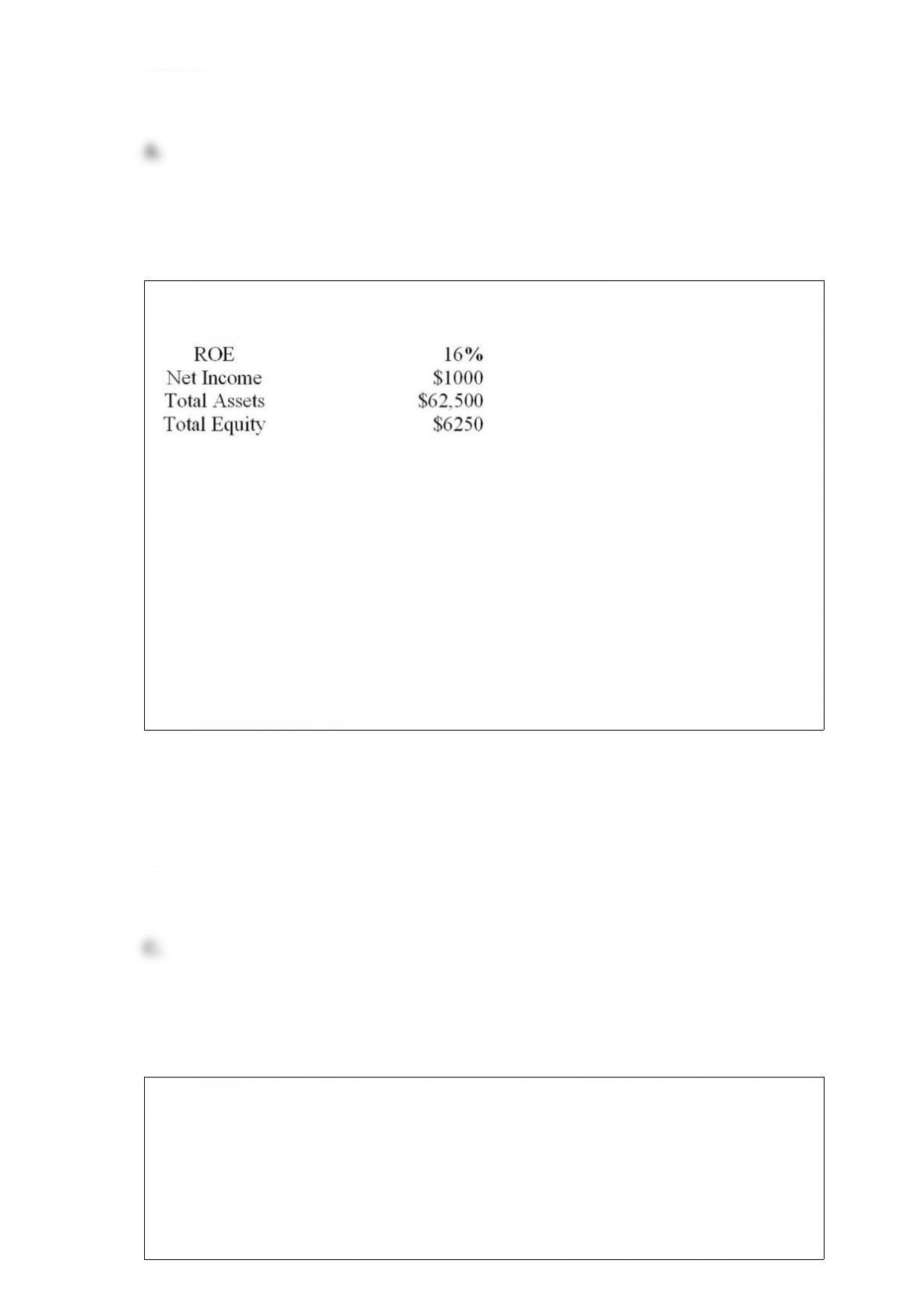
Following is the information for Carter State Bank. What is the bank’s ROE?

A. 8.46 percent
B. 16.03 percent
C. 15.71 percent
D. 1.36 percent
E. None of the options is correct
Answer:
In lending, ARM is an abbreviation used for: A. automatic rate modulation.
B. amortization rate method.
C. adjustable rate mortgage.
D. adaptable readjusted mortgage.
E. None of the options is correct.
Answer:

Why are securitized loans often issued through a special-purpose entity?
A. Because the securitized loans often add risk to the bank and need to be held
separately
B. Because the securitized loans are not profitable for the bank and need to be held
separately
C. Because the special-purpose entity might fail and this prevents the failure of the
bank
D. Because the bank might fail and this protects the credit status of the securitized
loans
E. All of the options are correct
Answer:
A business receives a three year line of credit against which it can borrow, repay, and
borrow again if necessary during the loan’s three year term. What type of loan is this?
A. Self-liquidating inventory loan
B. Working capital loan
C. Security dealer financing
D. Revolving credit financing
E. None of the options is correct.
Answer:

A bank has a prime rate of 6 percent for its best customers. It has determined that the
default risk premium for a particular customer is 0.4 percent and the term-risk premium
for this loan is 0.25 percent. If this customer wants to borrow $5.0 million from the
bank, how much in interest will this customer pay in one year?
A. $332,500
B. $665,000
C. $300,000
D. $320,000
E. None of the options is correct.
Answer:
Which of the following statements is (are) correct regarding duration?
A. In comparing two bonds with the same yield to maturity and the same maturity, a
bond with a higher coupon rate will have a longer duration.
B. In comparing two loans with the same maturity and the same interest rate, a fully
amortized loan will have a shorter duration than a loan with a balloon payment.
C. The duration will always be shorter than the maturity for all debt instruments.
D. All of the options are correct.
E. B and C

Answer:
A bank expects to raise $30 million in new money if it pays a deposit rate of 7%, $60
million in new money if it pays a deposit rate of 7.5%, $80 million in new money if it
pays a deposit rate of 8%, and $100 million in new money if it pays a deposit rate of
8.5%. The bank expects to earn 9% on all money that it receives in new deposits. What
deposit rate should the bank offer on its deposits, if it uses the marginal cost method of
determining deposit rates?
A. 7%
B. 7.5%
C. 8%
D. 8.5%
E. None of the options is correct
Answer:
The Tidewater State Bank has $1,000 in total assets (all of which are earning assets),
$700 of which will be repriced within the next 90 days. This bank also has $800 in total
liabilities, $400 of which will be repriced within the next 90 days. Currently, the bank is
earning 8 percent on its assets and is paying 5 percent on its liabilities.If interest rates
on both assets and liabilities decrease by 2 percent in the next 90 days, what should

happen to this bank’s net interest margin? A. It should fall by 2 percent.
B. It should fall by 0.6 percent.
C. It should fall by 4 percent.
D. It should fall by 1 percent.
E. It should not show any fall.
Answer:
The First National Bank of Summerville has opened an office in Turkey. This is a
limited service office that can market services of the home office in Turkey and can
identify Turkish customers but cannot take deposits or book loans. What type of office
has the First National Bank of Summerville opened in Turkey?
A. A representative office
B. A shell branch
C. A branch office
D. A subsidiary
E. An export trading company
Answer:

The following financial information pertains to Harrison Bank.
What is the bank’s ROA? A. 1.6%
B. 10%
C. 12.8%
D. 16%
E. None of the options is correct
Answer:
The person who executes orders in the futures market for the public is called a:
A. day trader.
B. floor broker.
C. clearing member.
D. speculator.
E. scalper.
Answer:

Dick Dowen needs a loan to buy plants and fertilizer for his nursery for the spring
planting season. This loan will automatically be paid off as the plants and fertilizer are
sold to his customers. What type of loan does Dick need?
A. Self-liquidating inventory loan
B. Asset-based financing
C. Interim construction financing
D. Security dealer financing
E. Retailer and equipment financing
Answer:
One of the benefits of securing a state charter instead of a federal charter for a bank is
that:
A. it brings added prestige.
B. it results in the automatic receipt of federal deposit insurance.
C. it is often able to lend a higher percentage of its capital to a single borrower.
D. state laws can pre-empt federal laws.
E. None of the options are correct.

Answer:
The TRC Company is required by its bank to pay no dividend over $3 per share. What
is this restraint known as?
A. An affirmative covenant
B. A negative covenant
C. A special covenant
D. A horizontal covenant
E. None of the options is correct
Answer:
________________ manage and care for the property of businesses, individuals, and
non-profit organizations.
A. Insurance companies
B. Holding companies
C. Real estate companies
D. Trust companies
E. Factoring companies

Answer:
Even if individual banks are good at forecasting risk using VaR models, there may still
be problems because losses may occur at several banks at the same time due to the
interdependency of the financial system, magnifying each bank’s risk exposure and
possibly causing a major problem for regulators. The book calls this:
A. systemic risk.
B. operational risk.
C. credit risk.
D. market risk.
E. liquidity risk.
Answer:
Most lending institutions tend to do better when the yield curve is upward-sloping
because they tend to have ____________ maturity gap positions.
Answer:

When a customer is charged a fixed cost per check, per period, or both, it is called
__________________ pricing.
Answer:
The fact that a bank may suffer deficiencies in quality control, inefficiencies in
producing and delivering of services, natural disasters, terrorist acts, weather damage,
aging or faulty computer systems, errors in judgment by management, and fluctuations
in economy that could adversely affect the bank’s performance, is known as
_________________________ risk.
Answer:
_________________________ arise from the potential cost savings that result from
being able to use the same management, advertising, and physical resources to offer
multiple services.

Answer:
A(n) ________ buys and sells securities on behalf of their customers and for their own
accounts. Examples of this type of financial service provider include Merrill Lynch and
Charles Schwab.
Answer:
_________________________ are designed to attract funds from customers who wish
to set aside money in anticipation of future expenditures or financial emergencies.
Answer:
One of the three types of loans in the Fed Funds market, __________________ loans

are unwritten agreements, negotiated via wire or telephone, with the borrowed funds
returned the next day.
Answer:
A(n) __________________________ means that the bank has more interest-sensitive
liabilities than interest-sensitive assets.
Answer:
Answer:
A(n) __________________________ is related to a credit option and is usually aimed
at lenders who are able to handle comparatively limited declines in value but want
insurance against serious losses.

Answer:
A(n) __________________________________ is generally used to finance the
purchase of inventory to sell and take advantage of the firm’s normal cash cycle to
repay the loan.
Answer:
__________________________ is the risk that shifting interest rates in the market will
adversely affect a financial institution’s net income or the value of its assets or equity.
Answer:
Banks which supply both debt and equity capital to businesses are known as _________
banks.

Answer:
One tool that the Federal Reserve uses to control the money supply is
________________. The Federal Reserve will change the interest rate they charge for
short-term loans when they are using this tool of monetary policy.
Answer:
One of the reasons for a merger is _________________. This is where the merger is
encouraged by the FDIC as a way to conserve scarce federal deposit insurance
resources.
Answer: