
1) a financial intermediary that can engage in a broad range of financial service
activities is termed a universal fi.
2) a mortgage pass-through security is a bond issue backed by a group of mortgages
that pays fixed semi-annual coupon payments where the principle is repaid only at
maturity.
3) a purchaser of a bond call option gains if interest rates fall.
4) at equilibrium a security’s required rate of return will be less than its expected rate of
return.
5) when money market interest rates are higher than deposit rates, using purchased
liquidity to replace deposit drains can reduce a bank’s profit margin.
6) a u.s. firm agrees to import textiles from hong kong and pay in 90 days. the invoice
requires payment in hong kong dollars. the u.s. importer could hedge this currency risk
by buying the hk dollar forward.
7) the bond equivalent yield times 365/360 is equal to the single payment yield.

8) collateral on a mortgage is normally only considered if the applicant has enough
income to service the loan.
9) a stock broker acts as a principal on behalf of the customer.
10) core deposits are deposits that are
a.at the bank solely for the interest rate earned
b.very stable funds sources
c.typically for larger denominations than hot money sources
d.very frequently turned over
11) by convention, a swap buyer on an interest rate swap agrees to
a.periodically pay a fixed rate of interest and receive a floating rate of interest
b.periodically pay a floating rate of interest and receive a fixed rate of interest
c.swap both principle and interest at contract maturity
d.back both sides of the swap agreement
e.act as the dealer in the swap agreement
12) an investment banker agrees to a firm commitment offering of 1.2 million shares of
bally stock. the offer price is set at $25.50 and the spread is 30 cents per share. if the
stock is actually sold to the public at $26.00 however, what is the amount of funds bally
receives? (ignore any other fees or expenses.)
a.$31,200,000
b.$30,600,000
c.$30,240,000
d.$29,280,000
e.$28,120,000

13) the edf model uses the borrower’s current market value of equity and assets and the
option-pricing model to
a.determine if the equity is mispriced
b.calculate the market value of the lender’s investment
c.assess the implied riskiness of the firm’s investments
d.estimate the likelihood that the z-score model is correct
14) vesting refers to
a.how long until an employee owns any employer contributions to the employee’s
pension plan
b.how long until an employee can transfer any of their own contributions to a new plan
if they switch jobs
c.eligibility requirements to retire early
d.restrictions on asset allocations within a defined contribution plan
e.the extent to which an employee materially participated in a given business in a given
year
15) the swap market’s primary direct government regulator is the
a.sec
b.cftc
c.nyse
d.wto
e.nobody
16) bank’s net foreign exposure is equal to
a.net foreign assets
b.net fx bought
c.net foreign assets + net fx bought
d.assets – liabilities
e.none of the above

17) an investment banker agrees to a firm commitment offering of 1.2 million shares of
bally stock. the offer price is set at $25.50 and the spread is 30 cents per share. if the
stock is actually sold to the public at $26.00 however, what is the amount of funds bally
receives? (ignore any other fees or expenses.)
a.$31,200,000
b.$30,600,000
c.$30,240,000
d.$29,280,000
e.$28,120,000
18) after interest rate and yield curve changes, a bank’s market value of assets increased
$4 million and the market value of its liabilities fell $6 million. the book value of equity
_____________ and the market value of equity ____________.
a.increased $2 million; was unchanged
b.fell $2 million; was unchanged
c.was unchanged; fell $2 million
d.was unchanged; fell $10 million
e.was unchanged; increased $10 million
19) you purchase a $325,000 town home and you pay 25% down. you obtain a 30-year
fixed-rate mortgage with an annual interest rate of 5.75%. after 5 years you refinance
the mortgage for 25 years at a 5.1% annual interest rate. after you refinance, what is the
new monthly payment (to the nearest dollar)?
a.$1,422
b.$1,401
c.$1,366
d.$1,335
e.$1,296
20) which one of the following types of transactions leaves the assets on the balance
sheet?
a.loan sale without recourse
b.gnma pass-throughs backed by mortgages placed in trust

c.cmos issued using mortgage pool as collateral
d.mortgage-backed bonds issued
e.none of the above
21) _________ and __________ allow a financial intermediary to offer safe, liquid
liabilities such as deposits while investing the depositors’ money in riskier, illiquid
assets.
a.diversification; high equity returns
b.price risk; collateral
c.free riders; regulations
d.monitoring; diversification
e.primary markets; foreign exchange markets
22) a bank has invested in u.s. treasury investments that mature in 2 years. they will be
held until maturity. the investments are funded with 3-year maturity time deposits. the
primary risk this bank faces is
a.refinancing risk
b.reinvestment risk
c.liquidity risk
d.credit risk
e.off-balance-sheet risk
23) an individual is considering contributing $4,000 per year to either a traditional or a
roth ira. payments would begin in one year. if she uses the traditional ira, her
contributions would be fully deductible. she is 40 years old and is in a 28% tax bracket.
on either ira she can earn 7%. when she retires at age 65 she believes she will be in a
28% tax bracket. which type of ira should she choose if she invests not only the $4,000
per year, but any tax savings due to the deductibility of her contributions in a taxable
investment earning a pretax rate of 7%? she will withdraw all her money upon
retirement and may owe taxes then, depending on the type of ira chosen.

24) from 1990 to 2010, which one of the following money market securities actually
declined in terms of dollar amount outstanding?
a.commercial paper
b.treasury bills
c.federal funds and repos
d.negotiable cds
e.banker’s acceptances
25) the federal reserve does all but which one of the following?
a.conduct monetary policy
b.supervise and regulate bank activities
c.serve as the commercial bank for the u.s. treasury
d.operate check clearing and wire transfer facilities
e.insure deposits
26) private pension funds are funds administered by
i. the federal government
ii. state and local governments
iii. insurance companies
iv. banks and mutual funds
a.i and ii only
b.ii and iii only
c.iii and iv only
d.ii, iii, and iv only
e.i and iii only

27) policy reserves are a(n)
a.balance sheet liability
b.balance sheet asset
c.separate account item
d.insurance guarantee fund payment
e.income statement revenue item
28) a u.s. investor has borrowed pounds, converted them to dollars, and invested the
dollars in the united states to take advantage of interest rate differentials. to cover the
currency risk, the investor should
a.sell pounds forward
b.buy dollars forward
c.buy pounds forward
d.sell pounds spot
e.none of the above
29) as a small (minority) stockholder would you prefer to have cumulative voting or
straight voting shares? as a majority shareholder?
30) what changes to foreign bank operations in the united states have been brought
about by the foreign bank supervision and enhancement act of 1991?
31) an investor is considering two mutual funds. fund a has a 5.75% front-end load and
a 1.25% expense ratio. fund b is no-load, but has a 2.25% expense ratio. if the investor
plans on being in either fund for 6 years, which should they choose given that they have
$16,000 to invest and both funds have gross returns of 12% per year? fees are applied at
each year-end to year-end asset values, but the load is taken out up-front only once.
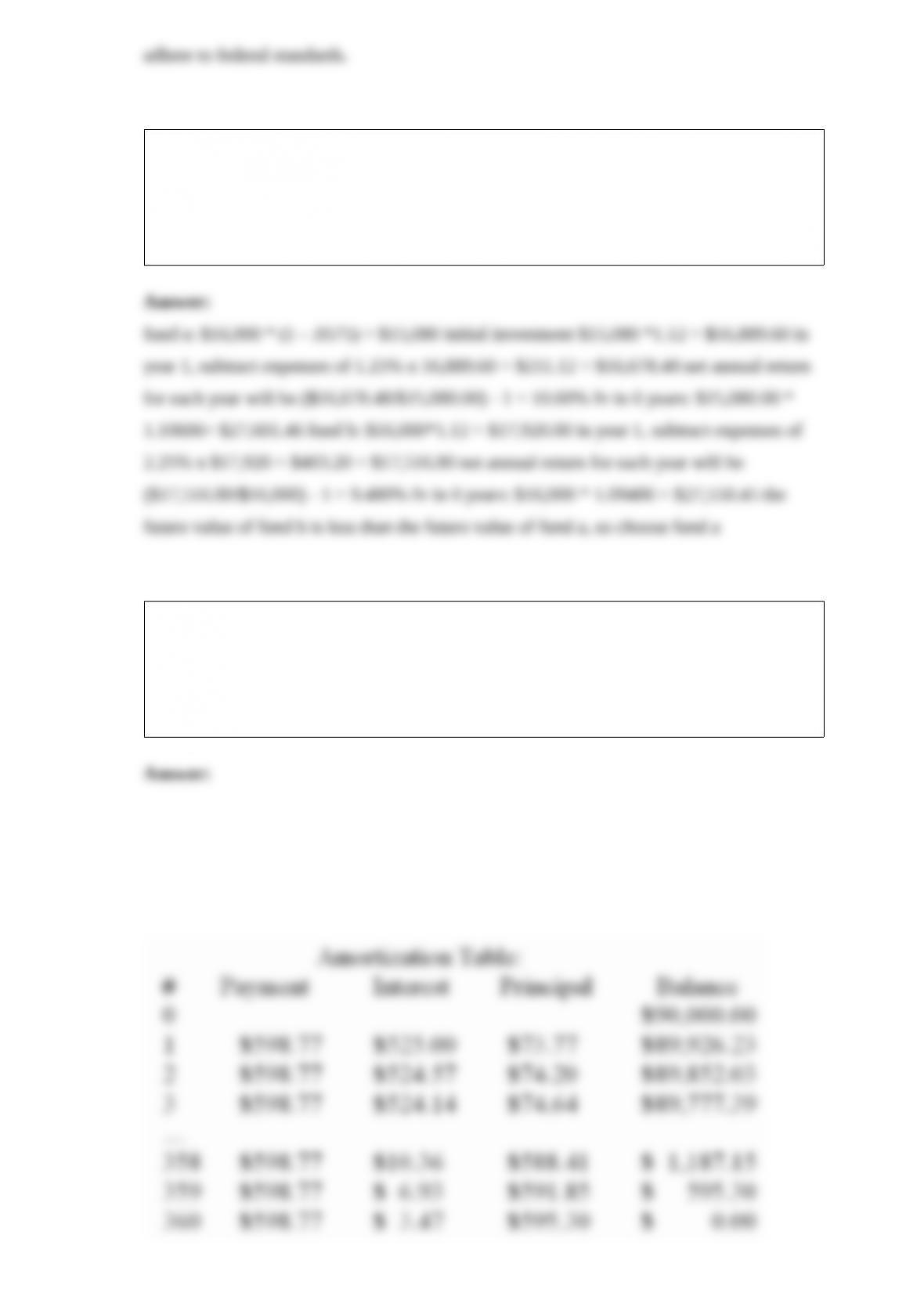
32) construct an amortization schedule for the first three months and the final three
months of payments for a 30-year, 7% mortgage in the amount of $90,000. what
percentage of the third payment is principle? what percentage of the final payment is
principle? what do these differences imply? (hint: the balance after the 357th payment
is $1,775.56.)
33) what is the difference between general obligation and revenue bonds?
34) a government securities dealer needs to make a 7% pre-tax annual return on $10
million of capital employed to make it worthwhile to make a market in t-bills. if the bid
discount on $10,000 face value, ninety day t-bills is 3.50%, and the dealer can expect to
do 5200 round trip deals today what must the ask discount be? hint: a round trip is a
buy and a sell transaction.
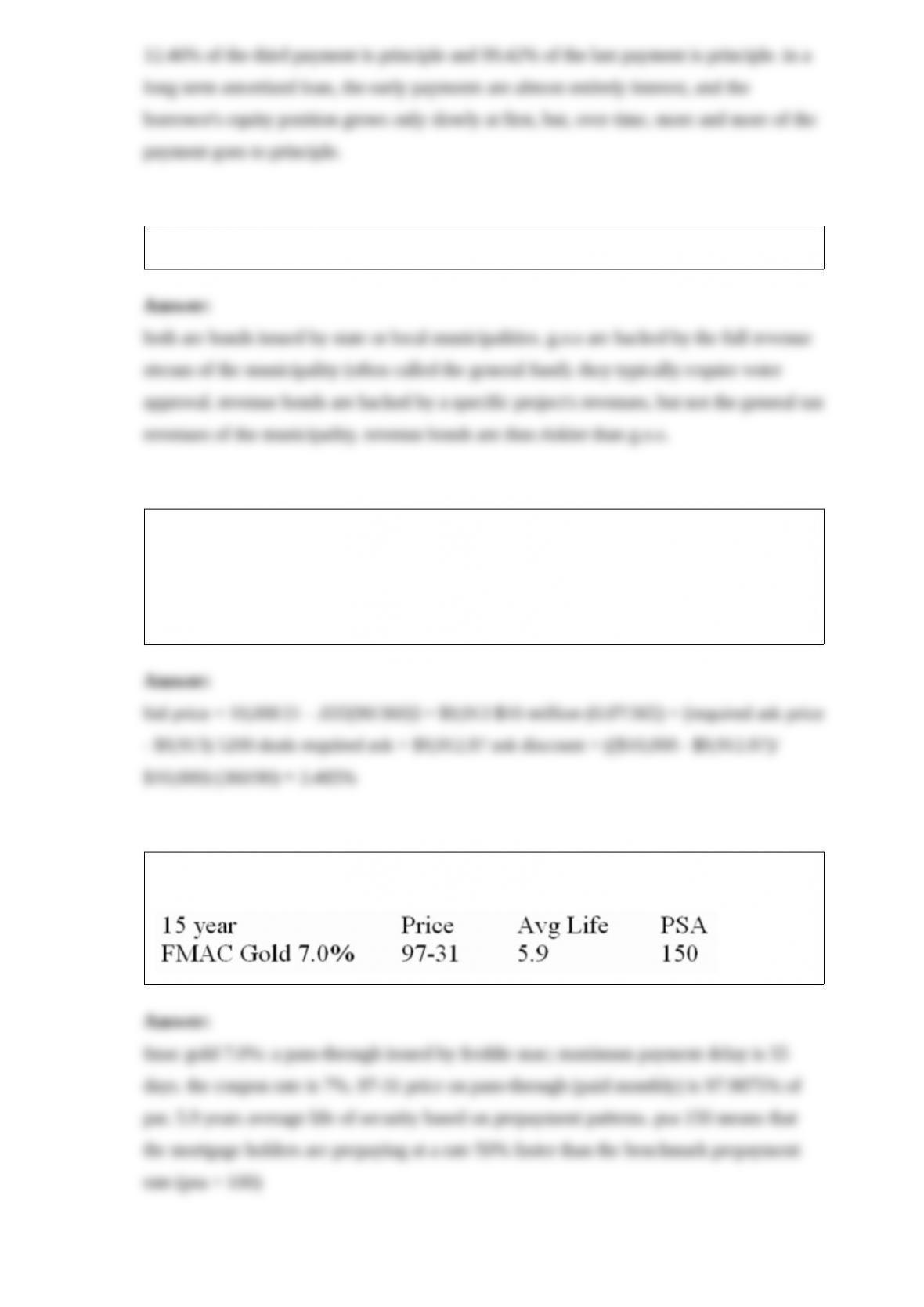
35) explain each term of the following pass-through quote:
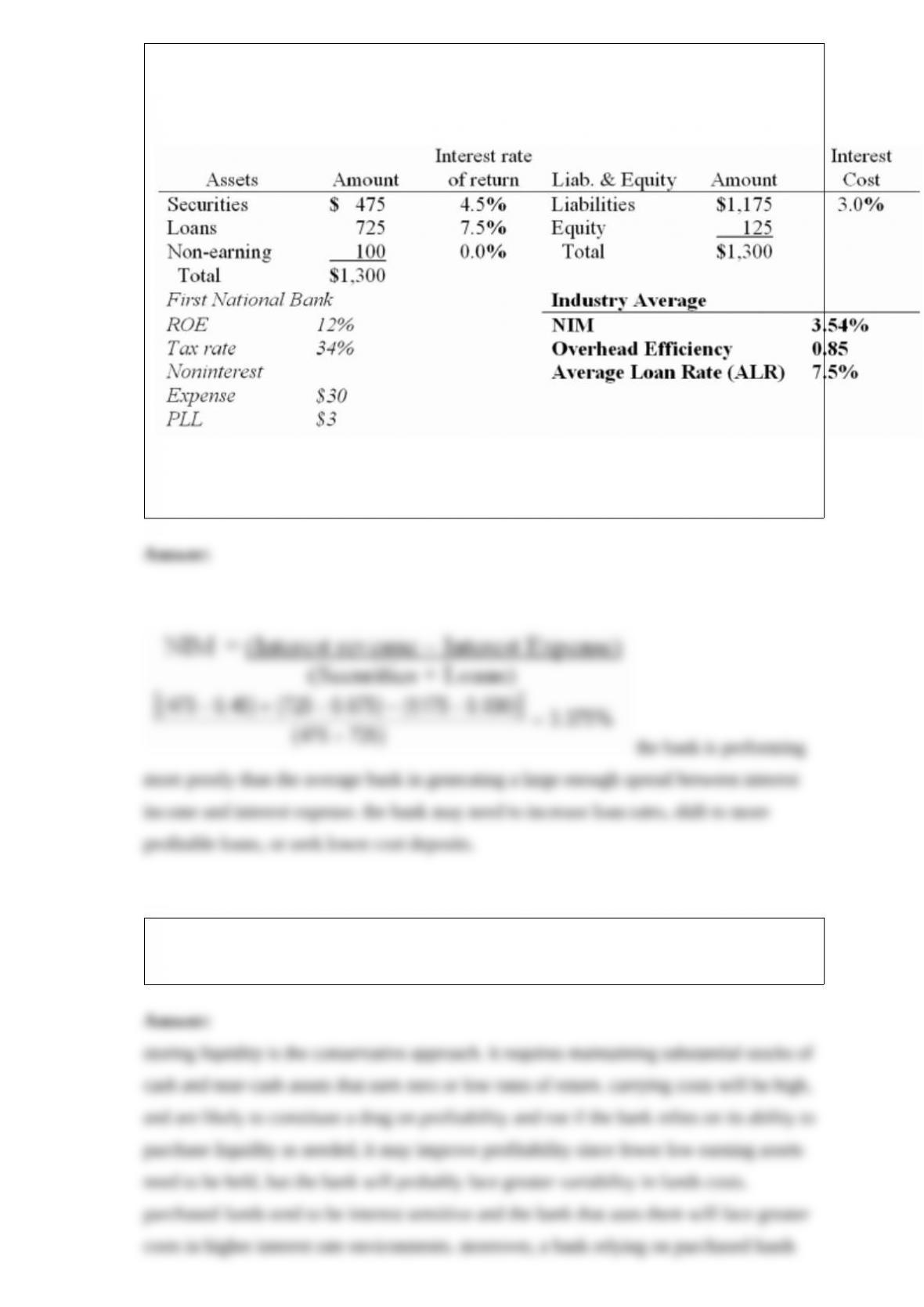
36) figure 12-2
first national bank of beverly hills (millions $)
what is the bank’s nim? is the bank performing better or worse than average? in what
area is the bank performing better or worse than average? how could the bank improve
if necessary?
37) what are the tradeoffs involved between storing liquidity and purchasing liquidity as
needed for a bank?