
Which one of the following statements related to stock buybacks is correct?
A. Stock buybacks are a means of obtaining shares for employee stock option grants.
B. Stock buybacks are becoming rare and may soon disappear totally.
C. In 2007 and 2008, U.S. companies issued more shares than they repurchased.
D. Firms are permitted only one large share repurchase program.
E. Share repurchases are limited to 10 percent of the firm’s outstanding shares.
Answer:
An increase in the accounts receivable period will do which one of the following?
A. Lengthen the accounts payable period
B. Shorten the inventory period
C. Shorten the operating cycle
D. Lengthen the cash cycle
E. Shorten the accounts payable period
Answer:

The Outlet Mall has a cost of equity of 16.8 percent, a pretax cost of debt of 8.1
percent, and a return on assets of 14.5 percent. Ignore taxes. What is the debt-equity
ratio?
A. 0.18
B. 0.39
C. 0.44
D. 0.52
E. 0.57
Answer:
Which of the following features are advantages of the dividend growth model?
I. Easy to understand
II. Model simplicity
III. Constant dividend growth rate
IV. Model’s applicability to all common stocks
A. II only
B. I and III only
C. II and IV only

D. I and II only
E. I, II, and III only
Answer:
The current spot rate between the UK and the U.S. is 0.6528 per $1. The expected
inflation rate in the U.S. is 1.8 percent. The expected inflation rate in the UK is 3.4
percent. If relative purchasing power parity exists, what will the exchange rate be two
years from now?
A. 0.6549/$1
B. .0.6632/$1
C. .0.6739/$1
D. 0.6982/$1
E. 0.5331/$1
Answer:

An all-equity firm has a return on assets of 15.3 percent. The firm is considering
converting to a debt-equity ratio of 0.40. The pretax cost of debt is 8.1 percent. Ignoring
taxes, what will the cost of equity be if the firm switches to the levered capital
structure?
A. 15.30 percent
B. 16.28 percent
C. 16.67 percent
D. 17.46 percent
E. 18.18 percent
Answer:
Western Hardwood Sales has total equity of $79,000, a profit margin of 4.8 percent, an
equity multiplier of 1.5, and a total asset turnover of 1.3. What is the amount of the
firm’s sales?
A. $154,050
B. $173,550
C. $181,430
D. $185,620
E. $739,440
Answer:
Scenario analysis is best described as the determination of the:
A. most likely outcome for a project.
B. reasonable range of project outcomes.
C. variable that has the greatest effect on a project’s outcome.
D. effect that a project’s initial cost has on the project’s net present value.
Answer:
Organic Foods, Inc. has a cash cycle of 13.5 days, an operating cycle of 21 days, and an
inventory period of 2 days. The company reported cost of goods sold in the amount of
$280,000, and credit sales were $430,000. What is the company’s average balance in
accounts payable?
A. $5,753
B. $8,414
C. $10,203
D. $11,844
E. $13,515

Answer:
Which one of the following terms refers to a bond’s rate of return that is required by the
marketplace?
A. Coupon rate
B. Yield to maturity
C. Dirty yield
D. Call yield
E. Discount rate
Answer:
A new project you are considering is expected to generate an operating cash flow of
$45,620 and will initially free up $22,000 in net working capital. Purchases of fixed
assets costing $68,800 will be required to start up the project. What is the total cash
flow for this project at time zero?
A. -$68,800

B. -$46,800
C. -$1,040
D. -$26,580
E. -$41,220
Answer:
Which one of the following tends to be the primary attitude of firms’ toward their
dividend policy?
A. Dividends should be increased annually no matter what.
B. Dividends should be flexible and adjusted annually in response to changes in the
firm’s earnings.
C. The costs associated with cutting dividends are perceived to be less than the costs of
obtaining external financing.
D. Once a dividend is increased, it should not be decreased.
E. Dividend smoothing is talked about but is not really a factor that affects dividend
decisions.
Answer:
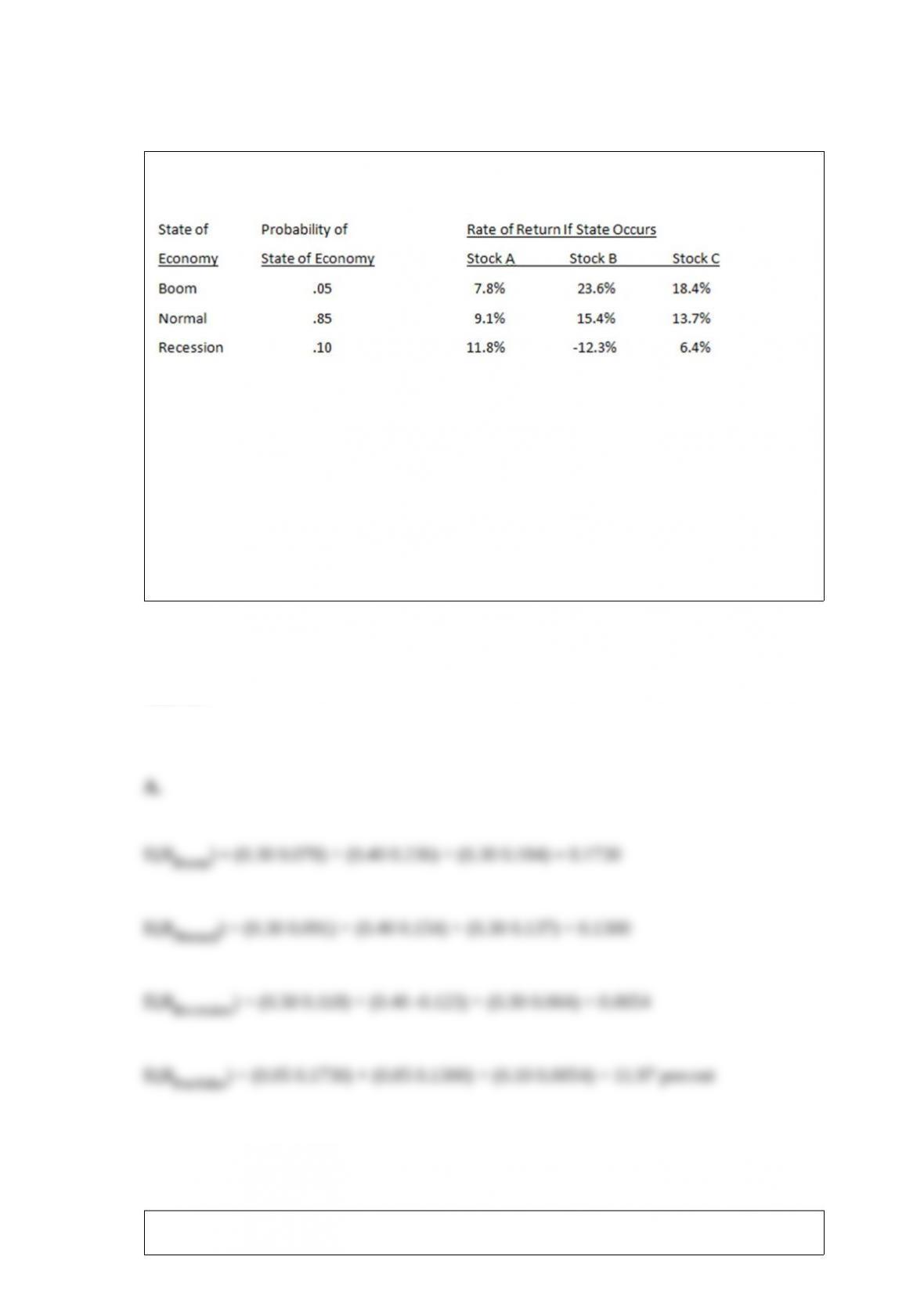
Given the following information, what is the expected return on a portfolio that is
invested 30 percent in both Stocks A and C, and 40 percent in Stock B?
A. 11.97 percent
B. 12.94 percent
C. 13.33 percent
D. 13.84 percent
E. 14.42 percent
Answer:
Which one of the following terms best refers to the practice of investing in a variety of

diverse assets as a means of reducing risk?
A. Systematic
B. Unsystematic
C. Diversification
D. Security market line
E. Capital asset pricing model
Answer:
Payback is best used to evaluate which type of projects?
A. Low-cost, short-term
B. High-cost, short-term
C. Low-cost, long-term
D. High-cost, long-term
E. Any size of long-term project
Answer:

Delfino’s expects to pay an annual dividend of $1.50 per share next year. What is the
anticipated dividend for year 5 if the firm increases its dividend by 2 percent annually?
A. $1.50 (1.02)1
B. $1.50 (1.02)2
C. $1.50 (1.02)3
D. $1.50 (1.02)4
E. $1.50 (1.02)5
Answer:
The modified internal rate of return is specifically designed to address the problems
associated with which one of the following?
A. Mutually exclusive projects
B. Unconventional cash flows
C. Long-term projects
D. Negative net present values
E. Crossover points
Answer:

Which one of the following is a key provision of the Bankruptcy Abuse Prevention and
Consumer Protection Act of 2005?
A. Disallowance of bankruptcy prepacks
B. Right granted to creditors to file their own reorganization plan once a firm is in
bankruptcy for 18 months
C. Disallowance of all management bonus payments while a firm is in bankruptcy
D. Requirement that only creditors can file reorganization plans for a bankrupt firm
E. Requirement for all Chapter 11 bankruptcies to be converted to Chapter 7
bankruptcies after 18 months
Answer:
The Bermuda Triangle Store pays a constant dividend. Last year, the dividend yield was
5.4 percent when the stock was selling for $15 a share. What must the stock price be
today if the market currently requires a 3.8 percent dividend yield on this stock?
A. $21.32
B. $12.30

C. $11.59
D. $19.22
E. $22.48
Answer:
As of 2003, the maximum tax rate on long-term capital gains for high-income
individuals was which one of the following rates?
A. 10 percent
B. 15 percent
C. 20 percent
D. 35 percent
E. 39 percent
Answer:

The Food Store is planning a major expansion for four years from today. In preparation
for this, the company is setting aside $35,000 each quarter, starting today, for the next
four years. How much money will the firm have when it is ready to expand if it can
earn an average of 6.25 percent on its savings?
A. $528,409.29
B. $540,288.16
C. $610,411.20
D. $640,516.63
E. $662,009.14
Answer:
For the period 1926-2011, small-company stocks had a risk premium of 12.6 percent.
What does the term risk premium mean? Is the risk premium on these stocks considered
to be relatively high or relative low as compared to other investment classes? Explain
why.
Answer:
What is the difference between a tender offer and a targeted repurchase?
Answer:
Explain what is meant when a news broadcaster states “the value of the dollar fell today
relative to all currencies.” How will this change in value affect U.S. imports and
exports?
Answer:
How should a firm determine whether a restrictive or a flexible financial policy is best
given its current situation?
Answer:
Explain the primary goal of the Sarbanes-Oxley Act in 2002 and discuss whether or not
this act appears to be effectively meeting that goal.
Answer:
Which type of financial market, dealer or auction, is best suited to expanding
internationally and why?
Answer:
Explain how the forward exchange market can help reduce short-run exposure to
exchange rate risk.
Answer:
Explain the concept of incremental cash flow analysis and its purpose.
Answer:
Kate is the sole founder of the exclusive retail store, Kate’s Interiors. Kate identified
additional locations that she believed offered profitable opportunities for expansion so
decided to take her firm public in order to finance her expansion plans. Bob is an
investor who purchased shares of Kate’s Interiors stock at the offer price. After one
month as a public firm, Kate realized that Bob had earned $1.1 million in profit on his
investment and had already cashed out and moved on. Kate, on the other hand, had
made no profit and still owns her shares. Explain how this could happen.
Answer: