
1) households generally supply more funds to the markets as their income and wealth
increase, ceteris paribus.
2) due to convexity problems, banks are actually better off using the simpler repricing
model to manage interest rate risk rather than the duration model.
3) a drop in value of the dollar hurts u.s. importers and helps u.s. exporters, ceteris
paribus.
4) assets in 401(k) plans are now greater than assets in private defined benefit plans.
5) t-notes and t-bonds are issued in minimum denominations of $1,000 or multiples of
$1,000.
6) the more variable are a borrower’s cash flows, the lower the fixed charge coverage
ratio should be to limit risk.
7) the dirty price plus accrued interest is called the clean price of the security.
8) eurobonds are bonds denominated in the issuer’s home currency, but are issued
outside their home country.
9) profitability at investment banking firms has been very stable each year since 2001 .
10) liability lawsuits related to asbestos claims are an example of long tail losses.
11) figure 20-2
balance sheet big valley enterprises
interest is big valley’s only fixed cash charge.
big valley’s market value of equity to book value of debt ratio = 1.5
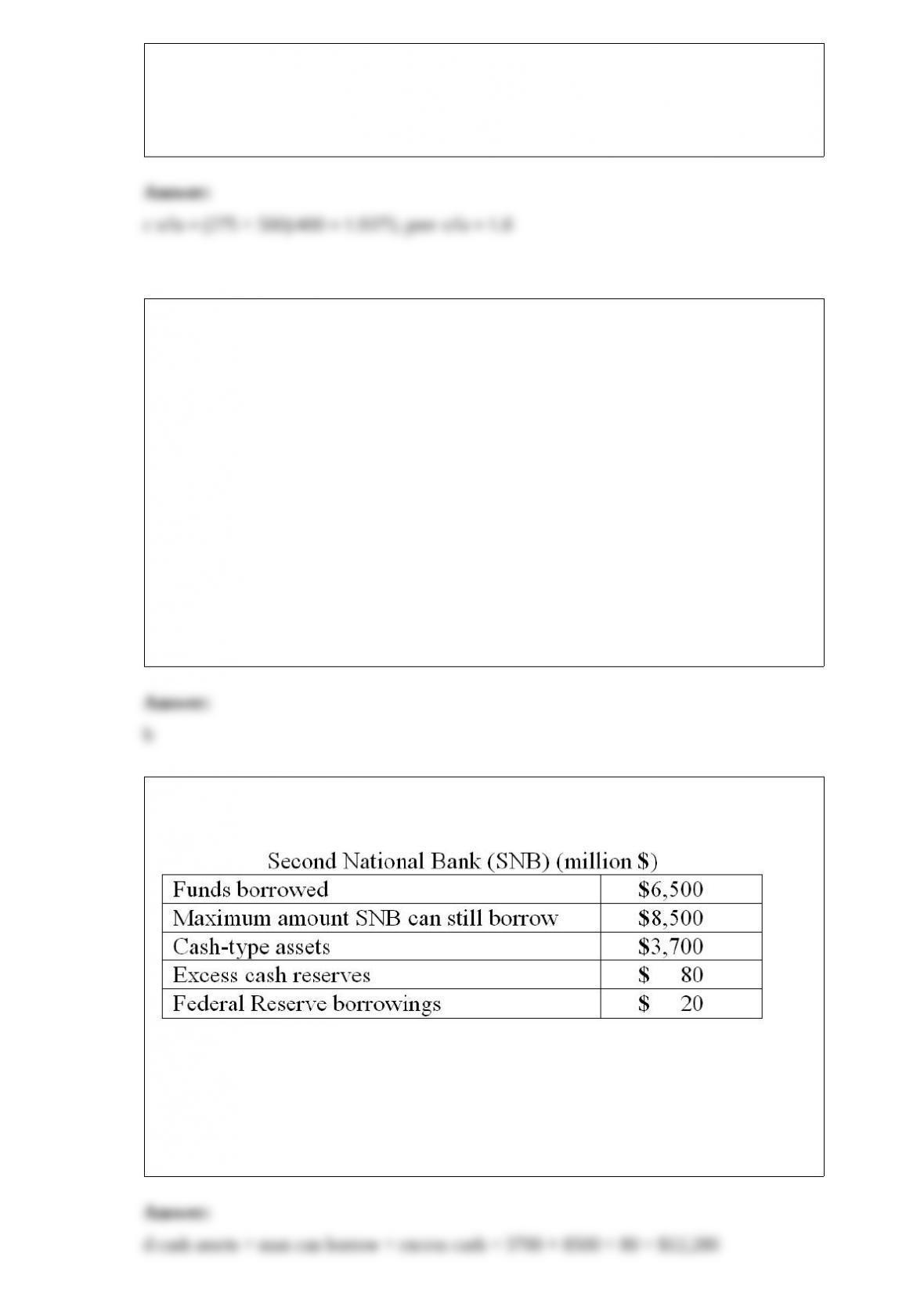
big valley’s fixed asset efficiency is ___________ the typical firm in the industry.
a.the same as
b.lower than
c.higher than
12) business credit-scoring models suffer from several weaknesses. these include which
of the following?
i. credit-score models are not statistically sound tools to use in making a lending
decision.
ii. the appropriate weights on a credit-score model are likely to change unpredictably
over time.
iii. these models ignore non-quantifiable behavioral factors, such as a relationship with
the bank and reputation.
iv. credit-scoring models discriminate against minorities.
a.i and ii only
b.ii and iii only
c.ii, iii, and iv only
d.i, ii, and iii only
e.i, ii, iii, and iv
13) figure 21-2
what are second national bank’s total sources of liquidity?
a.$6,520
b.$13,500
c.$14,200
d.$12,280
e.$5,760

14) the major asset of the federal reserve is
a.u.s. treasury securities
b.depository institution reserves
c.currency outside banks
d.vault cash of commercial banks
e.gold and foreign exchange
15) insurance industry guarantee funds do not eliminate runs on insurers because
i. the funds are not backed by the federal government.
ii. the funds lack permanent reserves to back policies.
iii. the funds have low maximum annual contribution amounts that limit insurer’s
liability.
a.i only
b.ii only
c.iii only
d.i and iii only
e.i, ii, and iii
16) the age group that holds the most stock is the ____________ group.
a.under 35
b.35-44
c.45-64
d.65 and older
17) as of december 2005, trading licenses are required to conduct trades on the floor of
the nyse. which of the following statements about these trading licenses is/are correct?
i. licenses are auctioned off in a special type of auction called a dutch auction.
ii. the nyse determines the minimum bid price.
iii. the sec determines the maximum bid price.
iv. trading licenses are good for 10 years.
a.ii and iii only
b.i and ii only
c.i and iii only

d.ii and iv only
e.i, ii, iii, and iv
18) a bank meets a deposit withdrawal with one of the following alternatives. which one
of the following is an example of using stored liquidity to meet a deposit withdrawal?
a.increase in euro dollar deposits
b.contacting an investment banker to find new corporate deposits
c.increasing fed funds borrowed
d.issuance of a negotiable cd
e.selling the bank’s holdings of t-bills
19) a corporate customer obtains a $1.5 million loan from a bank. the customer agrees
to pay a 6.25% interest rate and agrees to make compensating balances of 4% of the
loan amount. these will be held in non-interest-bearing transactions deposits at the bank
for one year. the bank charges a 1% loan origination fee on the amount borrowed.
reserve requirements are 10%. what is the expected rate of return to the bank (k) (to the
nearest basis point)?
a.6.95%
b.7.52%
c.7.99%
d.8.01%
e.8.45%
20) the quoted ask yield on a 30-year $1000 par t-bond with a 6.25% coupon and a
price quote of 106:16 is ___________ (use semiannual compounding).
a.2.94%
b.2.90%
c.5.79%
d.5.87%
e.4.95%

21) nationally chartered banks receive chartering and merger approval from the
a.federal deposit insurance corporation
b.office of comptroller of the currency
c.federal reserve system
d.office of thrift supervision
e.any of the above may grant a charter and approve a merger
22) as of 2010, which one of the following derivatives instruments had the greatest
amount of notional principle outstanding?
a.futures
b.swaps
c.options
d.bonds
e.forwards
23) depository institutions (dis) play an important role in the transmission of monetary
policy from the federal reserve to the rest of the economy because
a.loans to corporations are part of the money supply
b.bank and thrift loans are tightly regulated
c.u.s. dis compete with foreign financial institutions
d.di deposits are a major portion of the money supply
e.thrifts provide a large amount of credit to finance residential real estate
24) figure 24-1
a bank originates $150,000,000 worth of 30-year single-family mortgages funded by
demand deposits and the required amount of capital. reserve requirements are 10% and
the bank pays 32 basis points in deposit insurance premiums. the bank is earning a
6.25% coupon on the mortgages. the mortgages are priced at par and total monthly
payments on the mortgages are $923,576.
if the bank can originate and securitize this amount of mortgages with the same terms
four times over the next year (including the existing mortgages) and the bank earns a
servicing fee each month equal to 3.5% of the monthly payments, what will be the
bank’s monthly fee income 12 months from now?
a.$110,456
b.$116,432
c.$122,673
d.$129,301
e.$133,444
25) currently the fed sets monetary policy by targeting
a.the fed funds rate
b.the prime rate
c.the level of non-borrowed reserves
d.the level of borrowed reserves
e.the stock market
26) figure 20-1
gds cutoff: 30%
tds cutoff: 35%
using only the tds criteria, which one of the following statements is true?
a.joe gets the loan but not bill
b.bill gets the loan but not joe
c.both get the loan
d.neither gets the loan
27) for large interest rate declines, duration ___________ the increases in the bond’s
price, and for large interest rate decreases, it ____________ the decline in the bond’s
price.
a.underpredicts; overpredicts
b.overpredicts; underpredicts
c.underpredicts; underpredicts
d.overpredicts; overpredicts

28) the ask yield on a 6% coupon treasury bond maturing in 8 years is 5.488%. if the
face value is $1000, what should be the quoted cost of the bond today (use semiannual
compounding)?
a.103:6
b.103:7
c.103:8
d.103:9
e.103:10
29) for a loan sold with recourse,
a.the loan seller has no further obligation at all to the loan buyer
b.the loan seller removes the assets from the balance sheet and does not report a
contingent liability in the footnotes
c.the loan buyer cannot collect from the loan seller in the event of borrower default
d.no reserve requirement is imposed
e.none of the above
30) the large u.s. current account deficit implies that
a.u.s. interest rates are too high
b.the value of the dollar is too weak
c.dollar foreign currency reserves at asian central banks are too low
d.the presidential administration desires to improve growth of overseas economies
e.the united states must rely on foreigners to be willing to invest in the united states
31) one-hundred-eighty-day commercial paper can be bought at a 3.75% discount. what
are the bond equivalent yield and the effective annual rate on the commercial paper?
why do these rates differ?

32) a firm desires to sell stock to the public. the underwriter charges $0.45 million in
fees and offers to buy 6 million shares from the firm at a price of $35 per share. in
addition, registration and audit fees total $130,000, and marketing and miscellaneous
fees add up to another $75,000. the underwriter expects to earn gross proceeds per share
of $38. what is the issuing firm’s out-of-pocket dollar transaction cost to issue the
stock? immediately after the stock was issued, the stock price rose to $40. what is the
issuing firm’s opportunity cost? what is the total issuance cost, including opportunity
costs, as a percentage of the total funds available to the issuing firm?
33) explain how a change in open market operations can affect a new college graduate.
34) buying an at the money call option and writing an at the money put option are two
ways to make money when prices rise. when would each be the preferable strategy?
35) as a corporate treasurer who is unsure how soon funds will be needed, which type
of money market investment might you prefer? explain the trade-offs. would your
answer differ if you had a definite time period during which you would not need the
money? explain.
36) what have been the major factors contributing to growth in the foreign financial
markets?
37) figure 15-1
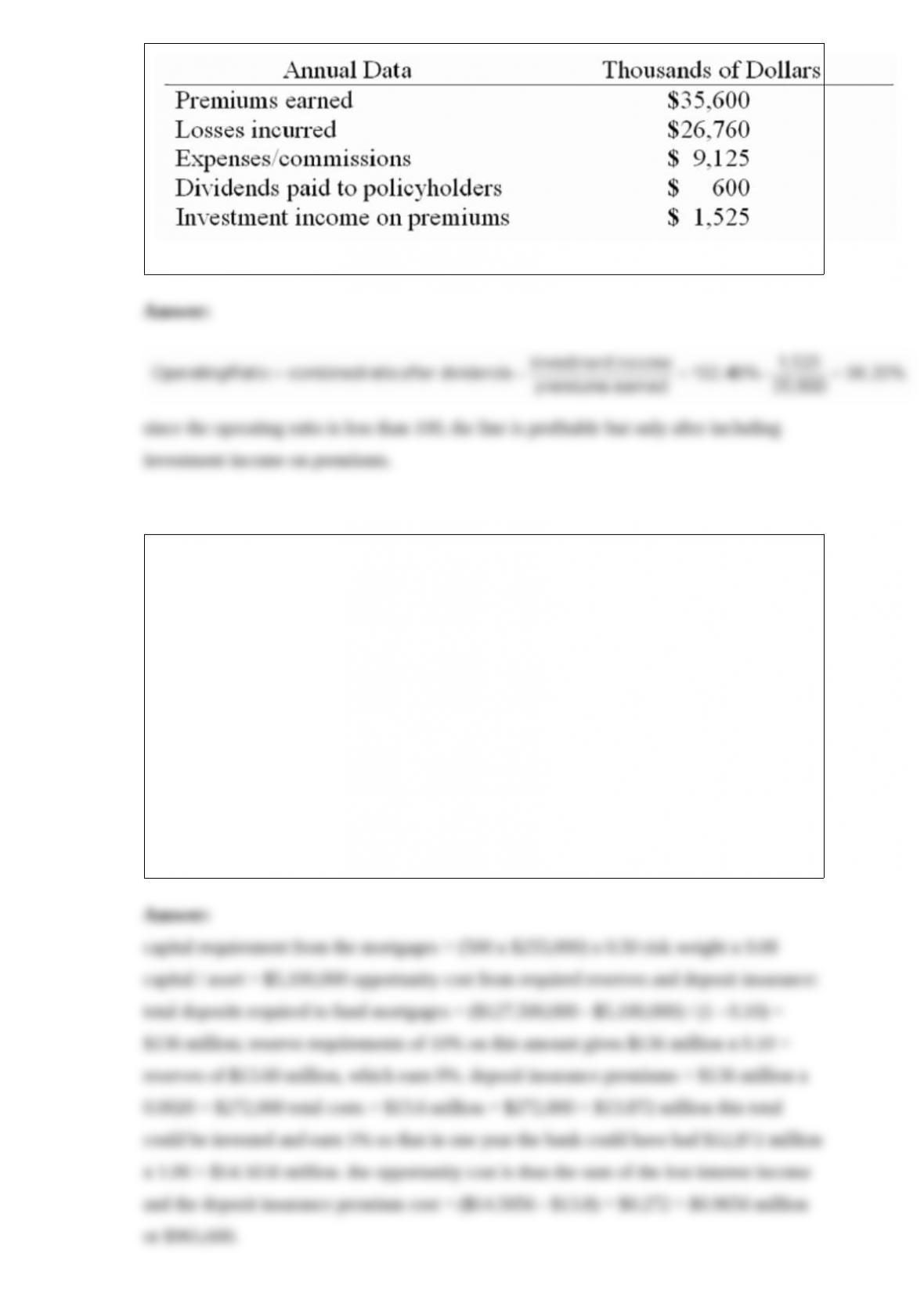
what is the operating ratio for this line? is the line profitable?
38) figure 24-2
on january 1 a bank had originated 500 30-year fixed rate mortgages with a 6.25%
coupon at par. the average mortgage size is $255,000. the bank charges a 1%
origination fee for each mortgage but processing costs amount to 0.4%. after
securitization the bank will retain 35 basis points in fee income for servicing the
mortgage payments. the cost of this processing is 12 basis points.
the bank keeps a capital-to-asset ratio of 8%. if the bank does not securitize the
mortgages, they will be fully funded with demand deposits that have a reserve
requirement of 10%. the demand deposits also have a deposit insurance premium of
0.20 cents per $100 of deposits. if the bank securitizes the mortgages, how much less
capital will the bank require? if the savings from not having the required reserves and
the deposit insurance premiums could be invested at 5%, what is the dollar opportunity
cost of not securitizing?

39) why have larger credit unions experienced greater profitability than smaller credit
unions? do you expect this to continue? why or why not?