
1) Liquidity refers to the ability to quickly convert an asset into cash without lowering
the selling price.
2) Common-sized income statements restate the numbers in the income statement as a
percentage of sales to assist in the comparison of a firm’s financial performance across
time and with competitors.
3) If you only earned interest on your initial investment, and not on previously earned
interest, it would be called simple interest.
4) The first step in a corporation’s financial forecasting process is the determination of
the firm’s financing needs.
5) Common stockholders may use financial ratios to monitor manager actions to help
lessen agency problems.
6) The need for extensive regulation of investment banking firms is limited due to the
highly competitive nature of that industry.
7) Foreign currency forward rates aid traders by reducing uncertainty regarding future
market fluctuations.

8) If an old asset is sold for less than its book value the resulting loss will save the
company taxes, hence lowering the cost of the project.
9) Positive NPV projects may be rejected when capital must be rationed.
10) If a firm currently has excess capacity, then using the percent of sales method to
forecast its fixed asset balance will likely result in an overestimate of the fixed asset
balance and an inflated amount of discretionary financing needed.
11) The internal rate of return will equal the discount rate when the net present value
equals zero.
12) Current assets in order of liquidity are cash, marketable securities, inventory, and
accounts receivable.
13) According to the moderate view of capital structure theory, the cost of common
equity is constant regardless of the debt financing level.
14) Statutory restrictions may prevent a company from paying dividends if the firm’s
assets are less than the firm’s liabilities.

15) Break-even analysis assumes that a multiproduct firm maintains a constant
production and sales mix.
16) The percent of sales method provides a more detailed plan for future financing
needs than the cash budget because both pro forma income statements and balance
sheets are used in the analysis.
17) Changes in capital spending are not incorporated directly into capital budgeting
problems because the amounts are included in the operating cash flows through the
inclusion of depreciation expense.
18) Financial forecasting is the process of attempting to estimate a firm’s future
financing requirements.
19) A firm’s weighted average cost of capital is determined using all of the following
inputs EXCEPT
A) the firm’s capital structure
B) the amount of capital necessary to make the investment
C) the firm’s after tax cost of debt
D) the probability distribution of expected returns
20) A “normal” yield curve is
A) downward sloping
B) downward sloping, then upward sloping

C) upward sloping
D) upward sloping, then downward sloping
21) A large corporation has annual sales revenues of $6 billion. The corporation
currently earns 2.25% on its money market account. If the corporation can reduce its
float by three days by making its billing and collection functions more efficient, the
company’s operating profits will increase by approximately
A) $3,069,863
B) $2,196,500
C) $1,350,000
D) $1,109,589
22) Wendy purchased 800 shares of Genetics Stock at $3 per share on 1/1/12 . Wendy
sold the shares on 12/31/12 for $3.45. Genetics stock has a beta of 1.9, the risk-free rate
of return is 4%, and the market risk premium is 9%. Wendy’s holding period return is
A) 15.0%
B) 16.5%
C) 17.6%
D) 21.1%
23) Which of the following is a disadvantage of the use of current liabilities to finance
assets?
A) greater risk of illiquidity
B) less flexibility
C) higher interest costs
D) the hedging principle
24) Graystone bonds have a maturity value of $1,000. The bonds carry a coupon rate of
12 percent. Interest is paid semiannually. The bonds will mature in nine years. If the
current market price is $976.50,
a.what is the yield to maturity on the bond?
b.what is the current yield on the bond?

25) Suppose the current spot rate in New York is .0119 dollars per yen. Inflation for the
coming year in the United States is expected to be 3%, while inflation for the coming
year is Japan is expected to be only 1%. Using the purchasing power parity theory, what
is the expected spot rate at the end of the year should be
A) .0110147 dollars per yen
B) .0108159 dollars per yen
C) .0138373 dollars per yen
D) .0121356 dollars per yen
26) Discretionary financing accounts include all of the following EXCEPT
A) long-term debt
B) notes payable
C) accrued liabilities
D) common stock
27) When deciding upon how much debt financing to employ, most practitioners would
cite which of the following as the most important influence on the level of the debt
ratio?
A) providing a borrowing reserve
B) maintaining desired bond rating
C) ability to adequately meet financing charges
D) exploiting advantages of financial leverage
28) Which of the following would NOT be found in a cash budget?
A) interest expense
B) taxes
C) depreciation
D) cash sales

29) The disadvantage of the IRR method is that
A) the IRR deals with cash flows
B) the IRR gives equal regard to all returns within a project’s life
C) the IRR will always give the same project accept/reject decision as the NPV
D) the IRR requires long, detailed cash flow forecasts
30) An increase in flotation costs will most likely result in which of the following?
A) smaller dividend payments so that less external equity financing is needed
B) larger dividend payments so shareholders are able to earn their required returns
C) larger dividend payments to offset higher taxes paid by investors
D) no change in dividend policies because flotation costs are paid by purchasers of
common stock
31) All of the following affect the value of a share of common stock EXCEPT
A) the dollar amount of the dividends
B) investors’ required rate of return
C) the future growth rate for dividends
D) the stock and paid-in-capital amounts on the balance sheet
32) Castle, Inc. paid a dividend yesterday of $2 per share. Castle management expects
the dividend to increase next year to $3 annually. If the dividend is expected to stay at
$3 per year for the foreseeable future, what is the value of the stock to an investor with
a required rate of return of 10%?
A) $7.50
B) $30.00
C) $32.00
D) $50.00
33) Considerations in the selection of a proper marketable-securities mix include all of
the following EXCEPT

A) financial risk
B) interest rate risk
C) maturity
D) liquidity
34) Total float consists of each of the following elements EXCEPT
A) mail float
B) processing float
C) transit float
D) audit float
35) Fred and Ethel are both considering buying a corporate bond with a coupon rate of
8%, a face value of $1,000, and a maturity date of January 1, 2025. Which of the
following statements is MOST correct?
A) Because both Fred and Ethel will receive the same cash flows if they each buy a
bond, they both must assign the same value to the bond
B) If Fred decides to buy the bond, then Ethel will also decide to buy the bond, if
markets are efficient
C) Fred and Ethel will only buy the bonds if the bonds are rated BBB or above
D) Fred may determine a different value for a bond than Ethel because each investor
may have a different level of risk aversion, and hence a different required return
36) The appropriate measure for risk according to the capital asset pricing model is
A) the standard deviation of a firm’s cash flows
B) alpha
C) the standard deviation of a firm’s stock returns
D) beta
37) Rogue Industries reported the following items for the current year: Sales =
$3,000,000; Cost of Goods Sold = $1,500,000; Depreciation Expense = $170,000;
Administrative Expenses = $150,000; Interest Expense = $30,000; Marketing Expenses
= $80,000; and Taxes = $300,000. Rogue’s gross profit is equal to
A) $770,000
B) $1,070,000
C) $1,100,000
D) $1,500,000
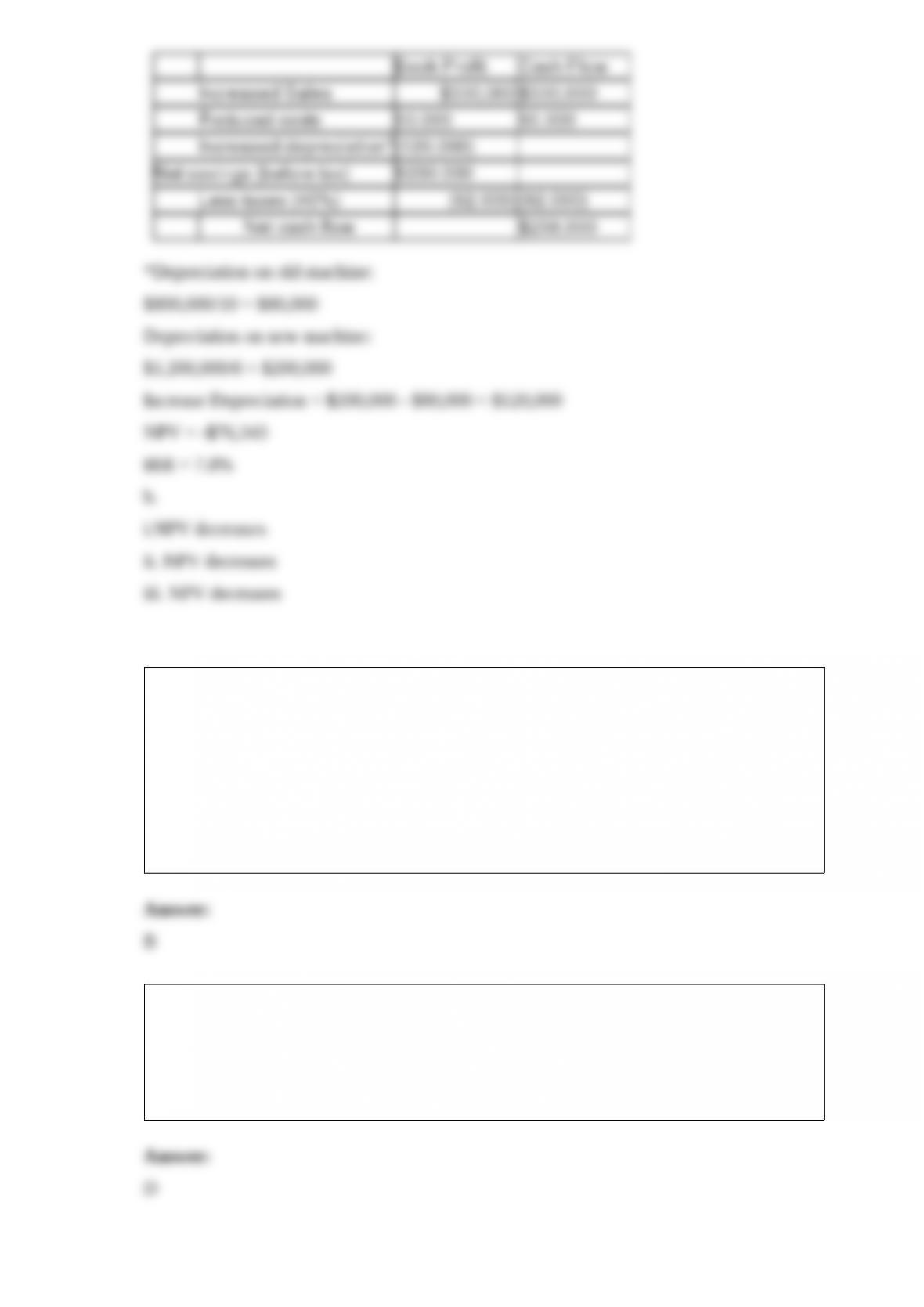
38) Premium Pie Company needs to purchase a new baking oven to replace an older
oven that requires too much energy to run. The industrial size oven will cost
$1,200,000. The oven will be depreciated on a straight-line basis over its six-year useful
life. The old oven cost the company $800,000 just four years ago. The old oven is being
depreciated on a straight-line basis over its expected ten-year useful life. (That is, the
old oven is expected to last six more years if it is not replaced now.) Due to changes in
fuel costs, the old oven may only be sold today for $100,000. The new oven will allow
the company to expand, increasing sales by $300,000 per year. Expenses will also
decrease by $50,000 per year due to the more energy efficient design of the new oven.
Premium Pie Company is in the 40% marginal tax bracket and has a required rate of
return of 10%.
a.Calculate the net present value and internal rate of return of replacing the existing
machine
b.Explain the impact on NPV of the following:
i.Required rate of return increases
ii.Operating costs of new machine are increased
iii.Existing machine sold for less
39) Your daughter is born today and you want her to be a millionaire by the time she is
40 years old. open an investment account that promises to pay 11.5% per year. How
much money must you deposit today so your daughter will have $1,000,000 by her 35th
birthday?
A) $28,575
B) $22,150
C) $20,100
D) $18,940
40) The correct relationship for a premium bond is
A) current yield > yield to maturity > coupon rate
B) current yield > coupon rate > yield to maturity
C) coupon rate > yield to maturity > current yield
D) coupon rate > current yield > yield to maturity

41) The two principal sources of financing for corporations are
A) debt and accounts payable
B) debt and equity
C) common equity and preferred equity
D) cash and common equity
42) The Sarbanes-Oxley Act of 2002 holds all of the following groups strictly
accountable in a legal sense for any instances of misconduct EXCEPT
A) company officers
B) outside members of the board of directors
C) lawyers
D) investors
43) Table 4-2
Drummond Company
Balance Sheet
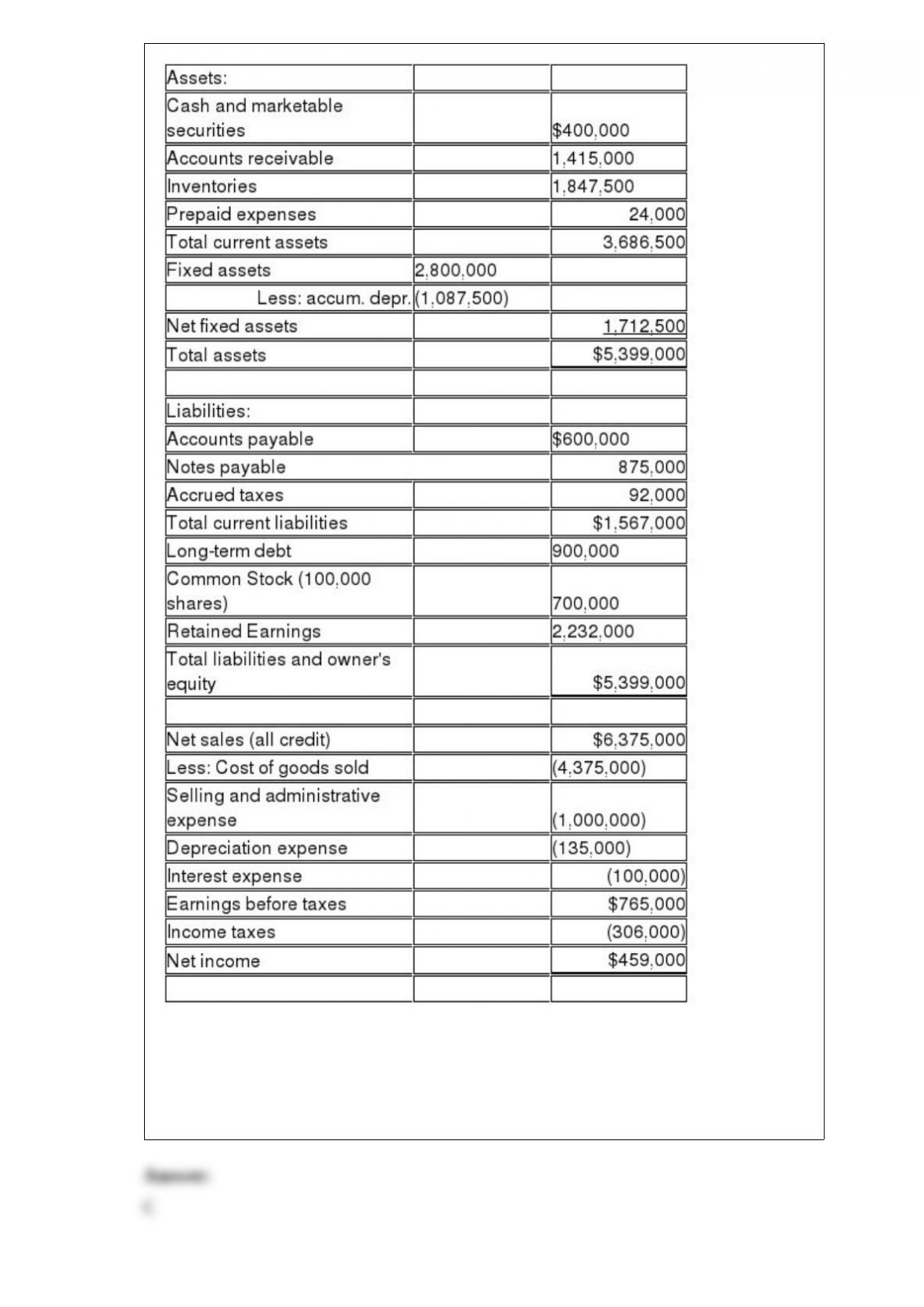
The debt ratio is
A) 28.12%
B) 34.74%
C) 45.69%
D) 42.03%

44) Calculate the effective cost of the following trade credit terms if the discount is
forgone and payment is made on the net due date.
a.2/10 net 50
b.2/15 net 60
c.2/20 net 45
45) Financial leverage is distinct from operating leverage since it accounts for
A) use of debt and preferred stock
B) variability in fixed operating costs
C) variability in sales
D) changes in EBIT
46) Cabell Corp. bonds pay an annual coupon rate of 10%. If investors’ required rate of
return is now 12% on these bonds, they will be priced at
A) par value
B) a premium to par value
C) a discount to par value
D) Cannot be determined without knowing the number of years to maturity
47) Which of the following represents the correct ordering of standard deviation of
returns over the period 1926 to 2011 (from highest to lowest standard deviation of
returns)?
A) Treasury bills, long-term corporate bonds, common stocks, small firm common
stocks
B) small firm common stocks, common stocks, long-term corporate bonds, Treasury
bills

C) Treasury bills, common stocks, long-term corporate bonds, small firm common
stocks
D) Treasury bills, common stocks, small firm common stocks, long-term corporate
bonds
48) Rogue Corp. has sales of $4,250,000; the firm’s cost of goods sold is $2,500,000;
and its total operating expenses are $600,000. The firm’s interest expense is $250,000,
and the corporate tax rate is 40%. What is Rogue’s tax liability?
A) $258,000
B) $260,000
C) $360,000
D) $600,000
49) J.B. Enterprises purchased a new molding machine for $85,000. The company paid
$8,000 for shipping and another $7,000 to get the machine integrated with the
company’s existing assets. J.B. must maintain a supply of special lubricating oil just in
case the machine breaks down. The company purchased a supply of oil for $4,000. The
machine is to be depreciated on a straight-line basis over its expected useful life of 8
years. Which of the following statements concerning the change in working capital is
most accurate?
A) The $4,000 paid for oil is added to the initial outlay, offset by the tax savings $1600
B) The $4,000 may be expensed each year over the life of the project as part of the
incremental free cash flows
C) The $4,000 is added to the initial outlay and recaptured during the terminal year,
hence having no impact on the projects NPV or IRR
D) Even if the $4,000 is fully recovered at the end of the project, the project’s NPV and
IRR will be lower if the change in working capital is included in the analysis
50) How much money must you pay into an account at the beginning of each of 20
years in order to have $10,000 at the end of the 20th year? Assume that the account
pays 12% per year, and round to the nearest $1.
A) $1,195
B) $111
C) $124
D) $139

51) California Retailing Inc. has sales of $4,000,000; the firm’s cost of goods sold is
$2,500,000; and its total operating expenses are $600,000. The firm’s interest expense is
$250,000, and the corporate tax rate is 40%. What is California Retailing’s net income?
A) $288,000
B) $350,000
C) $377,000
D) $390,000
52) A financial analyst tells you that investing in stocks will allow you to double your
money in 7 years. What annual rate of return is the analyst assuming you can earn?
A) 8.76%
B) 9.87%
C) 10.01%
D) 10.41%
53) Rogue Industries reported the following items for the current year: Sales =
$3,000,000; Cost of Goods Sold = $1,500,000; Depreciation Expense = $170,000;
Administrative Expenses = $150,000; Interest Expense = $30,000; Marketing Expenses
= $80,000; and Taxes = $300,000. Rogue’s operating income is equal to
A) $770,000
B) $1,070,000
C) $1,100,000
D) $1,500,000
54) DYI Construction Co. is considering a new inventory system that will cost
$750,000. The system is expected to generate positive cash flows over the next four
years in the amounts of $350,000 in year one, $325,000 in year two, $150,000 in year
three, and $180,000 in year four. DYI’s required rate of return is 8%. What is the
internal rate of return of this project?
A) 10.87%
B) 11.57%
C) 13.68%
D) 15.13%

55) Advantages of using simulation include
A) adjustment for risk in the resulting distribution of net present values
B) a range of possible outcomes presented
C) is good only for single period investments since discounting is not possible
D) graphically displays all possible outcomes of the investment
56) What is the payback period for a project with an initial investment of $180,000 that
provides an annual cash inflow of $40,000 for the first three years and $25,000 per year
for years four and five, and $50,000 per year for years six through eight?
A) 5.80 years
B) 5.20 years
C) 5.40 years
D) 5.59 years
57) Suppose XYZ Corporation is traded on the New York Stock Exchange. XYZ’s
closing price on Monday is $20 per share. After the market closes on Monday, XYZ
makes a surprise announcement that it has obtained a major new customer. XYZ’s stock
will likely
A) open at $20 per share on Tuesday and then increase as more investors read the
announcement in the Wall Street Journal
B) remain at $20 per share because in efficient markets the price already reflects all
information
C) open above $20 because the positive news will result in a higher valuation even
though the stock has not yet traded
D) open below $20 because the surprise announcement creates more uncertainty