Which one of the following can occur if the operating cycle decreases while both the
accounts receivable and the accounts payable periods remain constant?
A. Inventory period remains constant
B. Cash cycle increases
C. Inventory turnover rate increases
D. Accounts receivable turnover rate increases
E. Cash cycle remains constant
You own a portfolio that has $2,200 invested in Stock A and $1,300 invested in Stock
B. If the expected returns on these stocks are 11 percent and 17 percent, respectively,
what is the expected return on the portfolio?
A. 12.57 percent
B. 11.14 percent
C. 14.96 percent
D. 13.23 percent
E. 13.07 percent
Assume that PE is the euro price of a product, PUS is the U.S. price of the identical
product, and S0 is the spot exchange rate, quoted as the amount of foreign currency per
dollar. Given this, which one of the following correctly expresses absolute purchasing
power parity?
A. PUS = S0/PE
B. PUS = S0 ×PE
C. PUS = S0 + PE
D. PE = S0/PUS
E. PE = S0 ×PUS
Julie is borrowing $14,950 to purchase a car. The loan terms are 48 months at 6.95
percent interest, compounded monthly. How much interest, rounded to the nearest
dollar, will she pay on this loan if she pays the loan as agreed?
A. $2,338
B. $2,414
C. $1,959
D. $1,806
E. $2,217
The Green Balloon just paid its first annual dividend of $.87 a share. The firm plans to
increase the dividend by 3.2 percent per year indefinitely. What is the firm’s cost of
equity if the current stock price is $4.75 a share?
A. 20.35 percent
B. 22.10 percent
C. 24.42 percent
D. 18.79 percent
E. 19.98 percent
High Road Transport has a current stock price of $5.60. For the past year, the company
had net income of $287,400, total equity of $992,300, sales of $1,511,000, and 750,000
shares outstanding. What is the market-to-book ratio?
A. 3.54
B. 3.81
C. 3.99
D. 4.47
E. 4.23
Cinram Machines has the following estimates for its new gear assembly project: price =
$1,870 per unit; variable costs = $949 per unit; fixed costs = $1.4 million; quantity =
42,000 units. Suppose the company believes all of its estimates are accurate only to
within ± 3 percent. What value should the company use for its total variable costs
when performing its best-case scenario analysis?
A. $38,578,064
B. $39,822,128
C. $38,216,051
D. $41,802,137
E. $40,864,538
Which statement is correct?
A. The financial market generally reacts the same to a new issue of equity as it does to a
new issue of debt as long as the issuer is the same.
B. Issuing new equity shares is always viewed by the market as a positive event.
C. Informed managers tend to issue new securities when the existing securities are
underpriced.
D. A decline in the price of existing stock when a new issue is released is a direct cost
of selling securities.
E. A firm’s existing shareholders would prefer that new securities be issued when those
securities are overpriced rather than underpriced.
The common stock of GT Enterprises is selling for $63.09 a share. The company pays a
constant annual dividend and has a total return of 11.64 percent. What is the amount of
the dividend?
A. $5.02
B. $4.04
C. $7.34
D. $7.70
E. $6.81

The primary goal of inventory management is to minimize the:
A. number of orders per year.
B. average inventory level.
C. total costs of holding inventory.
D. level of inventory for the most expensive items.
E. total opportunity costs.
An increase in a levered firm’s tax rate will:
A. decrease the cost of preferred stock.
B. increase both the cost of preferred stock and debt.
C. decrease the firm’s cost of capital.
D. decrease the cost of equity capital.
E. increase the firm’s WACC.
Which one of the following methods of analysis is most similar to computing the return
on assets (ROA)?
A. Internal rate of return
B. Profitability index
C. Average accounting return
D. Net present value
E. Payback
Kelsey International declared a dividend on Friday, November 13, that is payable on
Friday, December 11, to holders of record on Monday, November 30. What is the latest
date that you can purchase this stock if you wish to receive this dividend? Assume there
are no banking holidays within this period of time.
A. Tuesday, November 24
B. Wednesday, November 25
C. Thursday, November 26
D. Friday, November 27
E. Monday, November 30
The Five and Dime Store has a cost of equity of 14.8 percent, a pretax cost of debt of
6.7 percent, and a tax rate of 34 percent. What is the firm’s weighted average cost of
capital if the debt-equity ratio is .46?
A. 10.18 percent
B. 11.72 percent
C. 11.53 percent
D. 13.49 percent
E. 14.93 percent
Net working capital includes:
A. a land purchase.
B. an invoice from a supplier.
C. non-cash expenses.
D. fixed asset depreciation.
E. the balance due on a 15-year mortgage.
Letitia borrowed $6,000 from her bank two years ago. The loan term is four years. Each
year, she must repay the bank $1,500 plus the annual interest. Which type of loan does
she have?
A. Amortized
B. Blended discount
C. Interest-only
D. Pure discount
E. Complex
A 30-year home mortgage is a classic example of:
A. a set of unequal cash flows.
B. an ordinary annuity.

C. a perpetuity.
D. an annuity due.
E. a consol.
All else held constant, the future value of a lump sum investment will decrease if the:
A. amount of the lump sum investment increases.
B. time period is increased.
C. interest is left in the investment.
D. interest rate increases.
E. interest is changed to simple interest from compound interest.
Which one of the following is an example of long-run exposure to exchange rate risk?
Ignore all fees and transaction costs.
A. A U.S. firm owns land in Mexico valued at three million pesos. That value has
remained constant in Mexican pesos for the past year. However, the firm’s financial
statement reflects a 3 percent decrease in the value of that land for last year.
B. A U.S. firm sells $250,000 worth of goods to Peru. However, when the payment for
those goods arrives and the U.S. firm exchanges the foreign currency, it receives only
$248,700.
C. A U.S. firm purchases $120,000 worth of goods from Canada. However, by the time
the goods arrive and the invoice is payable, the cost of those goods has increased to
$120,400.
D. A few years ago, a U.S. firm built a factory in Asia to take advantage of the lower
labor costs. Today, the Asian labor costs have increased such that the Asian factory no
longer provides a cost advantage over a U.S. factory.
E. A U.S. traveler withdrew an extra $2,000 in cash from her savings account to take
with her as emergency funds when she traveled to Mexico. Before leaving on her trip,
she exchanged this money into Mexican pesos. She never used any of this money
during her vacation, so exchanged all of it back into U.S. dollars on her return and
received $1,960.
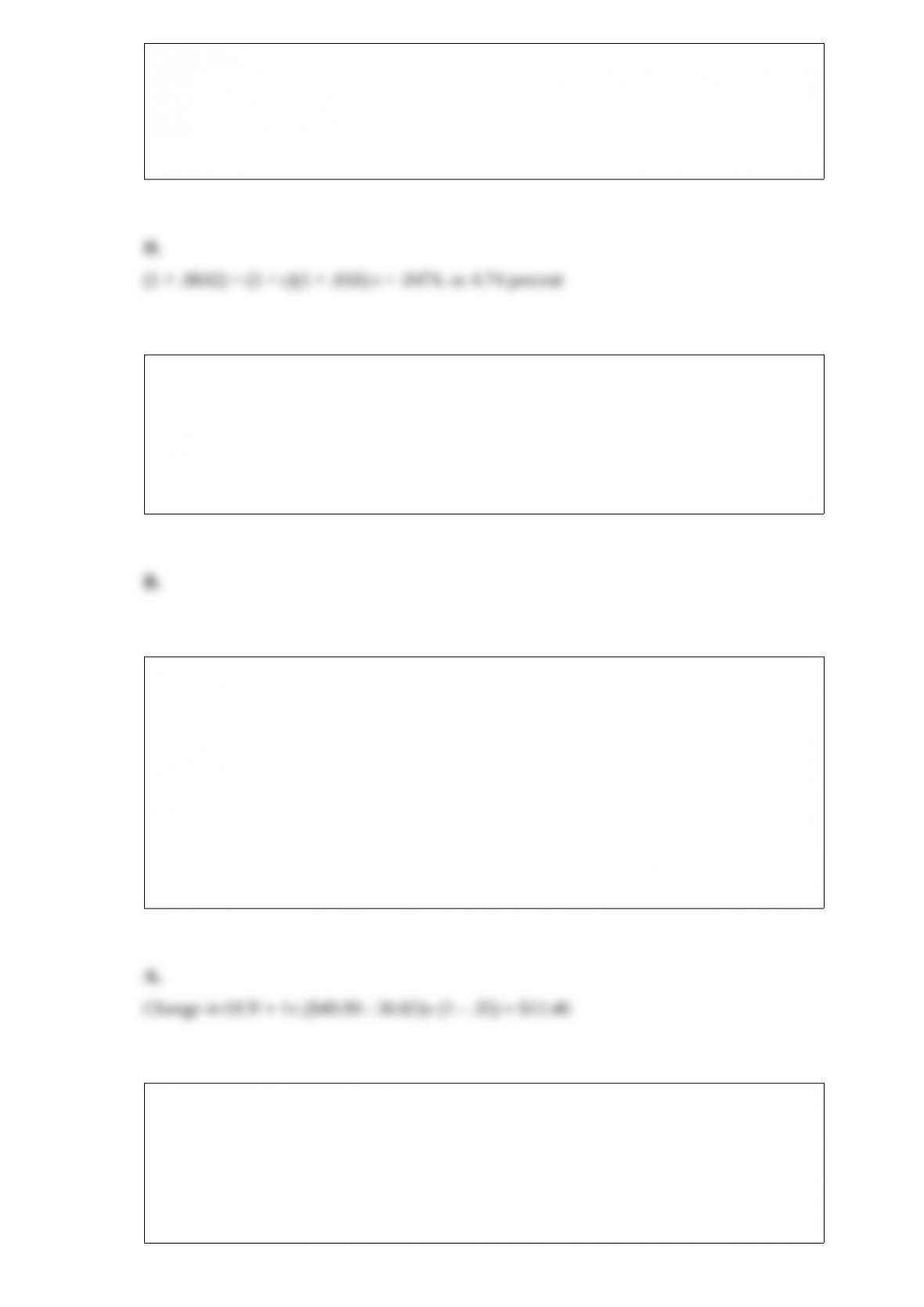
Last year, you earned a rate of return of 6.42 percent on your bond investments. During
that time, the inflation rate was 1.6 percent. What was your real rate of return?
A. 4.69 percent
B. 4.80 percent
C. 4.83 percent
D. 4.74 percent
E. 4.71 percent
Which one of the following will tend to increase the length of the credit period?
A. Decrease in product cost
B. Decrease in consumer demand
C. Decrease in collateral value
D. Increase in credit risk
E. Increase in product standardization
Consider a three-year project with the following information: initial fixed asset
investment = $347,600; straight-line depreciation to zero over the three-year life; zero
salvage value; price per unit = $49.99; variable costs per unit = $30.82; fixed costs per
year = $187,000; quantity sold per year = 65,500 units; tax rate = 35 percent. How
sensitive is OCF to an increase of one unit in the quantity sold?
A. $12.46
B. $11.67
C. $8.67
D. $9.08
E. $13.40
Goshen Industrial Sales has sales of $487,600, total equity of $367,700, a profit margin
of 5.1 percent, and a debt-equity ratio of .34. What is the return on assets?
A. 5.89 percent
B. 5.05 percent
C. 6.76 percent
D. 8.80 percent
E. 7.33 percent
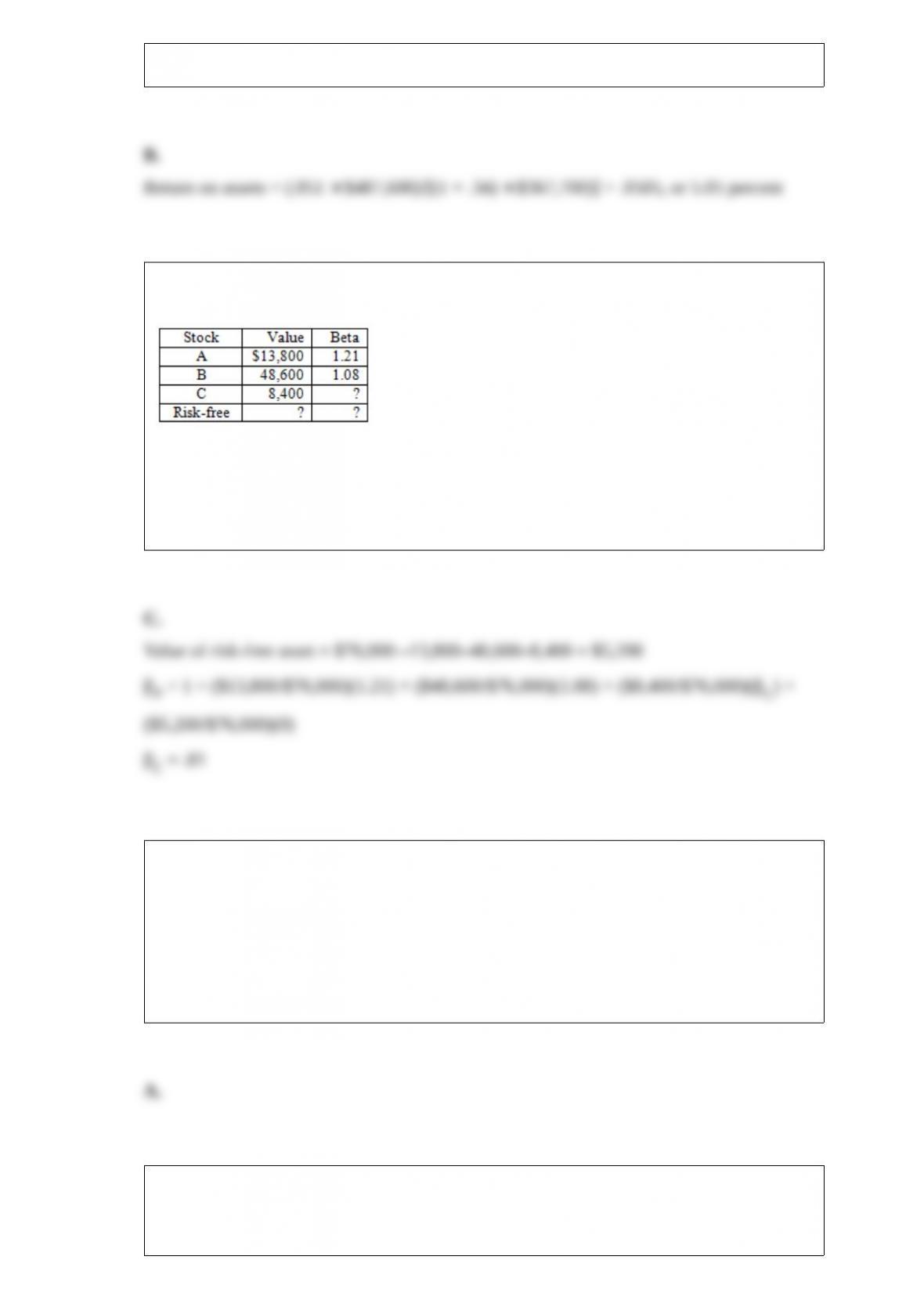
You currently own a portfolio valued at $76,000 that is equally as risky as the market.
Given the information below, what is the beta of Stock C?
A. .91
B. .95
C. .81
D. 1.03
E. 1.06
Lee pays 1 percent per month interest on his credit card account. When his monthly rate
is multiplied by 12, the resulting answer is referred to as the:
A. annual percentage rate.
B. compounded rate.
C. effective annual rate.
D. perpetual rate.
E. simple rate.
The Grain and Feed Store purchases are equal to 68 percent of the following quarter’s
sales. The accounts receivable period is 15 days and the accounts payable period is 30
days. Assume there are 30 days in each month. The store has estimated quarterly sales

for the next year, starting with Quarter 1, of $16,750, $18,220, $17,560, and $19,710,
respectively. How much will the store owe its suppliers at the end of Quarter 3?
A. $3,992.20
B. $3,807.40
C. $4,467.60
D. $4,508.10
E. $4,300.27
All else held constant, the present value of an annuity will decrease if you:
A. increase the annuity’s future value.
B. increase the payment amount.
C. increase the time period.
D. decrease the discount rate.
E. decrease the annuity payment.
Boone Brothers remodels homes and replaces windows. Ace Builders constructs new
homes. If Boone Brothers considers expanding into new home construction, it should
evaluate the expansion project using which one of the following as the required return
for the project?
A. Boone Brothers’ cost of capital
B. Ace Builders’ cost of capital
C. Average of Boone Brothers’ and Ace Builders’ cost of capital
D. Lower of Boone Brothers’ or Ace Builders’ cost of capital
E. Higher of Boone Brothers’ or Ace Builders’ cost of capital
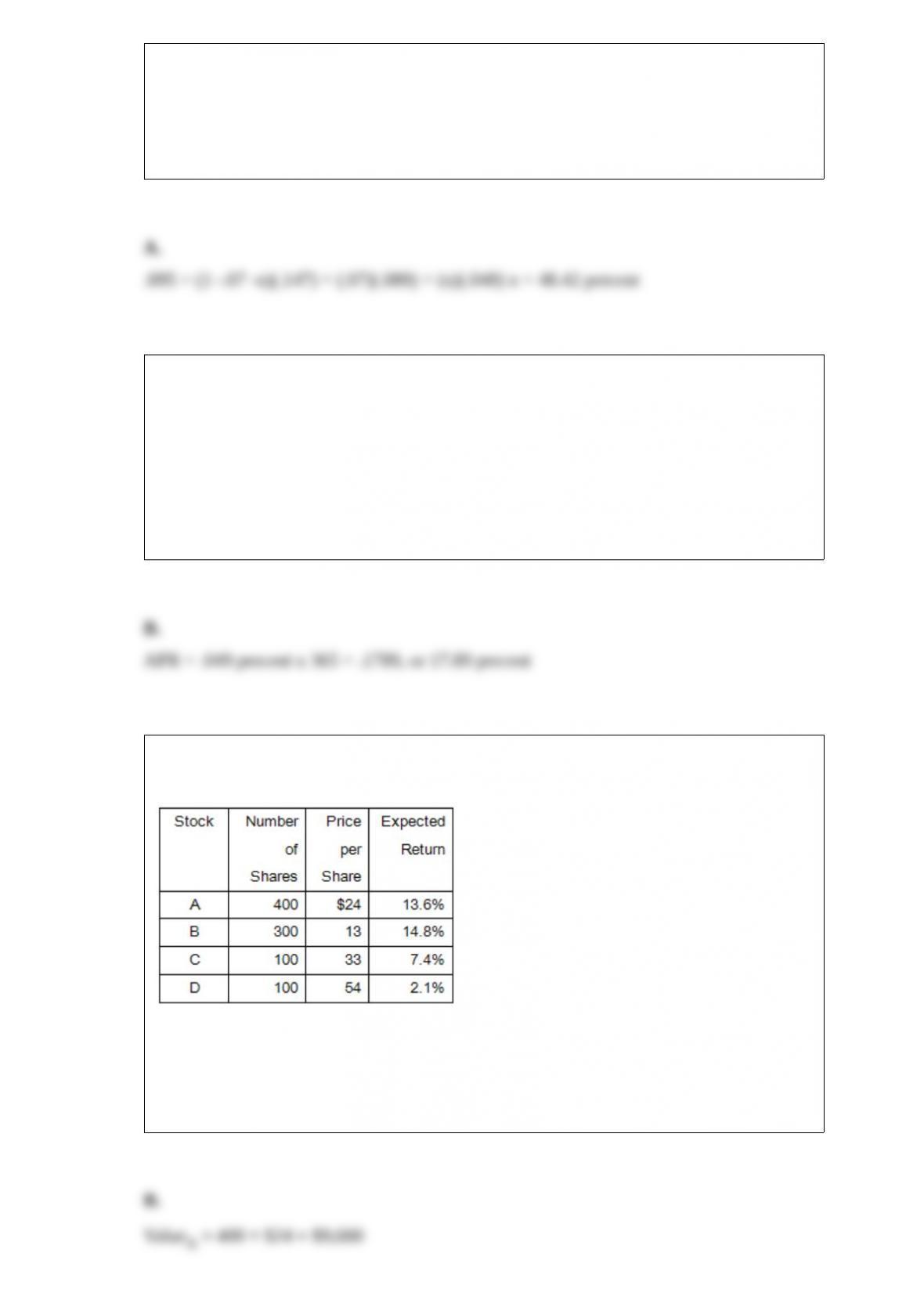
The Color Box uses a combination of common stock, preferred stock, and debt
financing. The company wants preferred stock to represent 7 percent of the total
financing. It also wants to structure the firm in a manner that will produce a weighted
average cost of capital of 9.5 percent. The aftertax cost of debt is 4.8 percent, the cost of
preferred is 8.9 percent, and the cost of common stock is 14.7 percent. What percentage
of the firm’s capital funding should be debt financing?
A. 48.42 percent
B. 52.03 percent
C. 54.15 percent
D. 44.78 percent
E. 39.21 percent
Walker’s charges a daily rate of .049 percent on its store credit cards. What interest rate
is the company required by law to report to potential customers? Assume each quarter
has exactly 91.25 days.
A. 15.98 percent
B. 17.89 percent
C. 16.67 percent
D. 17.45 percent
E. 16.65 percent
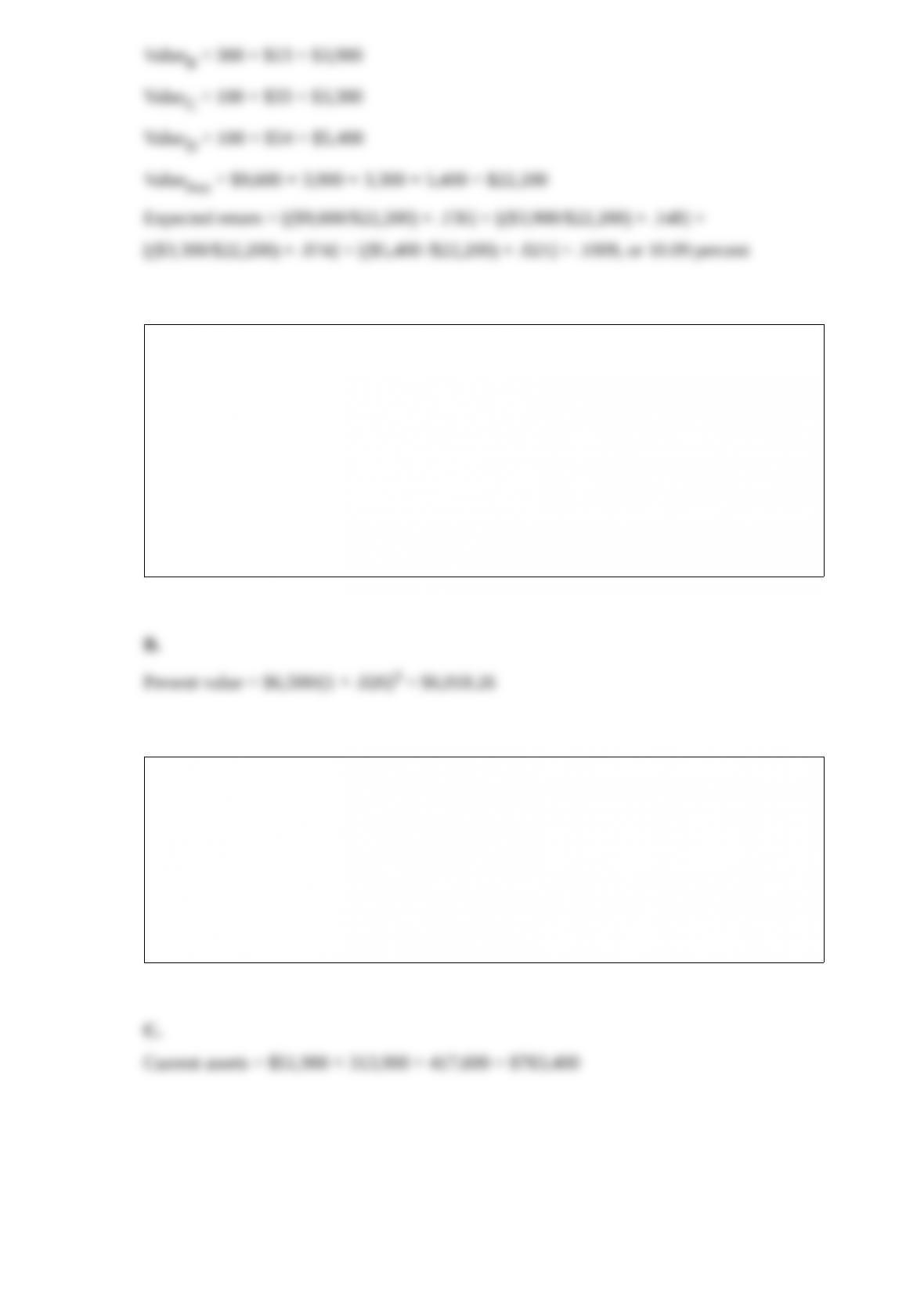
You have compiled the following information on your investments. What rate of return
should you expect to earn on this portfolio?
A. 10.54 percent
B. 10.09 percent
C. 10.84 percent
D. 10.27 percent
E. 10.58 percent
You and your sister are planning a large anniversary party 3 years from today for your
parents’ 50<sup>th</sup> wedding anniversary. You have estimated that you will need
$6,500 for this party. You can earn 2.6 percent compounded annually on your savings.
How much would you and your sister have to deposit today in one lump sum to pay for
the entire party?
A. $6,076.55
B. $6,018.26
C. $6,308.16
D. $5,934.90
E. $5,868.81
Blythe Industries reports the following account balances: inventory of $417,600,
equipment of $2,028,300, accounts payable of $224,700, cash of $51,900, and accounts
receivable of $313,900. What is the amount of the current assets?
A. $46,700
B. $56,000
C. $783,400
D. $975,000
E. $699,700