
One way in which a mortgage pay-through bond (MPTB) is similar to a
mortgage-backed bond (MBB) is that the pay-through bond is a debt obligation of the
issuer.
Home equity loans do not require a mortgage lien on the property.
Holdbacks are used by construction lenders to be sure that a developer has met all of his
or her obligations before all of the funds from the construction loan are given to the
developer.
A loan with biweekly payments will have more interest than a monthly loan with the
same interest rate and loan term.

A clause which specifies that the mortgagee will obtain and maintain property insurance
is typically included in a mortgage.
A portion of a REIT’s dividend may be a non-taxable return of capital.
When constructing a convertible mortgage, the lender will require a contract interest
rate equal to or greater than the market rate on a similar mortgage without conversion
option.

Joint ventures typically involve a large number of individual investors joining together
to purchase real estate.
Residential appraisers use only the sales comparison approach to determine value of the
homes they appraise.
A non-recourse loan is one in which the borrower is personally liable for payment of all
amounts due under the terms of the note.
A borrower finds that the incremental cost of borrowing an extra $10,000 is 14%. The
borrower can earn 12% on alternative investments of comparable risk so he would be
better off by not borrowing the extra 14%.

One factor an investor should consider when trying to decide whether to dispose of a
property he or she has owned for several years is the expected IRR for holding versus
sale of the property.
The residual value at the end of the holding period should be based on the market value
of the real estate and not the book value.
Determining the APR for federal truth-in-lending purposes is more complicated for a
adjustable rate mortgage loan is more difficult than for a fixed rate mortgage loan.

Real property refers to the ownership rights associated with real estate.
In general, equity buildup tends to lower the marginal rate of return of holding a
property.
When a pass-through security investor makes repetitive requests of a mortgagor it is
referred to as a nuisance call.
The marginal rate of return on a property usually increases until sale of the property.
Equity buildup should always be avoided if possible.

PLAMs have been very popular with lenders.
Unrealized returns are important to investors in assessing the performance of their
investments and of their fund manager(s).
An IRR preference will always give the investor a return that is equal to or better than
what the return would be with an IRR lookback.

A CMO does not completely eliminate prepayment risk.
In CMO terminology, planned amortization classes (PACs) are also known as
companion tranches.
An option contract does not preclude the landowner from selling the property to
someone else after the expiration date.
An operating lease does not affect a corporate balance sheet.

Investments that are held “in trust” on behalf of a pension plan’s beneficiaries cause the
fiduciary duties and responsibilities of pension plan sponsors to “carry over” to
managers of these real estate investment funds.
For refinancing to be profitable, the effective cost of the debt must be less than the
unlevered return on the projects being financed.
Lenders typically finance the development of a project as a percentage of completed
appraised value, including the price of the site.

Compared to stock and bond funds, real estate investment funds are typically much
easier to value due to the availability of real estate appraisals.
Lenders typically insist on a loan repayment rate that equal to the rate for which parcels
are expected to sell.
ARMs eliminate all the lender’s interest rate risk.
A derivative security derives its value from another security, index, or financial claim.

The equity dividend rate is an accurate measure of investment yield because it takes
into account future cash flows.
Cash flows remaining after all CMO tranches have been paid off are referred to as
REMICs.
The benefits of equity buildup in a property are lessened over time because with an
amortizing mortgage, an investor will lose some tax benefits each year as the interest
portion of the payments decreases.

One disadvantage of refinancing a property instead of selling the property is that taxes
have to be paid on funds received by additional borrowing, but no taxes would have to
be paid if the property is sold.
With a reverse mortgage the borrower receives payments from the bank.
A residential real estate closing involves two actual closings: the loan closing and the
sales transaction closing.
Someone with a credit score of 900 is likely to only qualify for a subprime loan.
Which of the following is NOT a measure of risk related to real estate investment
funds?
a. Tracking error
b. Beta
c. TWR
d. Jensen’s Alpha
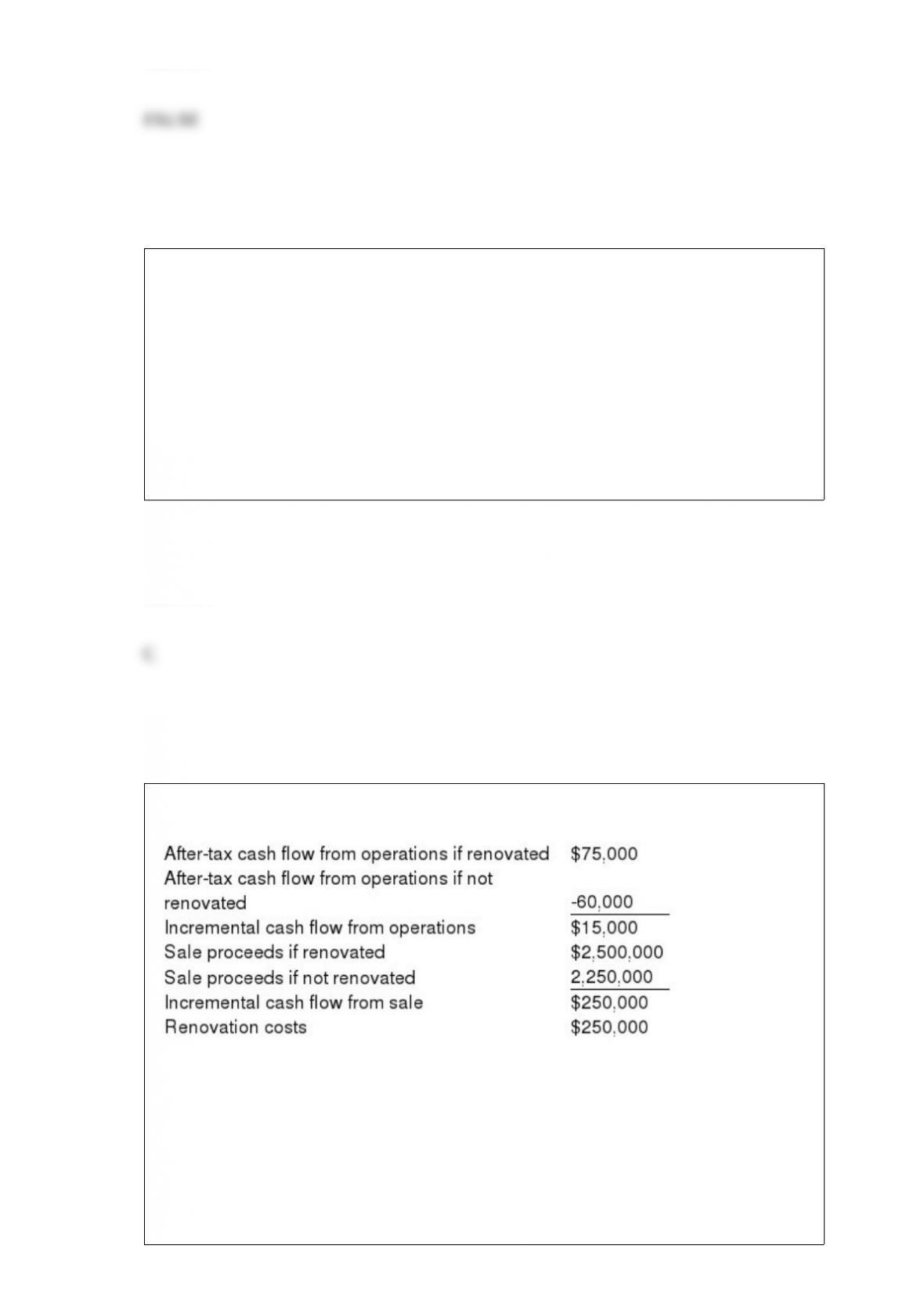
Consider the information in the table above. What is the rate of return the investor
would earn on the additional funds invested in renovating the property, assuming that
the investor would not borrow any additional funds?
(a) 6.0%
(b) 106%

(c) $15,000
(d) $265,000
What term applies to third-party financing that is used between funds advanced by the
permanent lender and funds needed to repay the construction loan?
(A) Interim loan
(B) Mini-perm financing
(C) Gap financing
(D) Partial financing
Which of the following represents the formula for the annual marginal rate of return
(MRR) when trying to decide whether to hold or sell a property (ATCFS equals the
after-tax cash flow from sale and ATCFO equals the after-tax cash flow from
operations)?
(A) MRR = (ATCFS (year t + 1) + ATCFO (year t + 1) – ATCFS (year t) – ATCFO (year
t) / ATCFS (year t)
(B) MRR = (ATCFS (year t + 1) – ATCFO (year t + 1) + ATCFS (year t)) / ATCFS (year
t)

(C) MRR = (ATCFS (year t + 1) + ATCFO (year t + 1) – ATCFS (year t)) / ATCFS (year
t)
(D) MRR = (ATCFS (year t + 1) + ATCFO (year t + 1) + ATCFS (year t)) / ATCFS
(year t)
Refer to the question above. What is the balance of Tom’s capital account at the end of
year 4?
(A) – $9,900
(B) $24,000
(C) $69,000
(D) $70,100
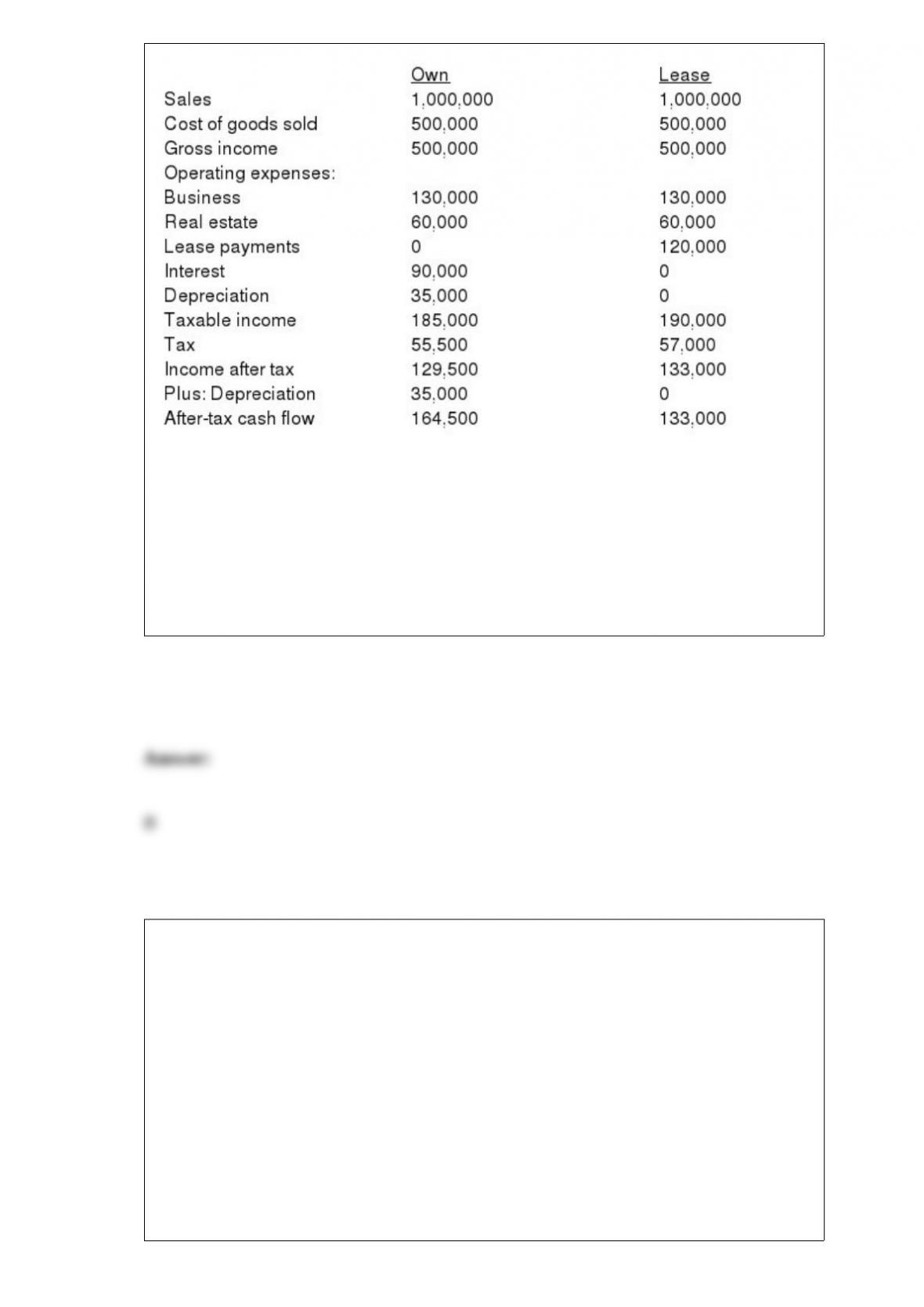
A company is planning to move to a larger office and is trying to decide if the new
office should be owned or leased. Cash flows for owning versus leasing are estimated
as follows. Assume that the cash flows from operations will remain level over a 10 year
holding period. If purchased, the company will invest $385,000 in equity and finance
the remainder with an interest-only loan that has a balloon payment due in year 10. The
after-tax cash flow from sale of the property at the end of year 10 is expected to be
$750,000. What is the incremental rate of return on equity to the company, if the
property is owned instead of leased?
(A) 17.99%
(B) 13.26%
(C) 10.32%
(D) 12.62%
Consider an investment in which a developer plans to begin construction of a building
one year if, at that point, rent levels make construction feasible and the building will
cost $1million to construct. There is a 50 percent chance that NOI will be $160,000 and
a 50percent chance that NOI will be $80,000. Using the traditional approach, similar to
the “highest and best use” approach, what would be the land value of the property
assuming a cap rate of 10 percent (12 percent discount rate and an NOI growth rate of 2
percent)?
(a) $120,000
(b) $200,000
(c) $300,000

(d) $833,333
(e) $1,000,000
The land development industry is best characterized by which of the following
statements?
(A) The land development industry is dominated by relatively few national competitors
(B) The land development industry is highly fragmented, localized, and extremely
competitive
(C) Land development and project development are synonymous
(D) The production technologies and market risks involved in land development are
essentially the same as those in project development
Which of the following provides a measure of the extent to which returns tend to move
together or have no relationships?
(A) The coefficient of determination
(B) The variance
(C) The coefficient of variation

(D) The covariance
Which of the following is FALSE concerning Mechanic’s Liens?
(A) Gives the right to attach a lien on real estate
(B) Can get money through forcing judicial sale
(C) Lasts even after the bill for labor and materials has been paid
(D) Might not be disclosed by the public records
A mortgage is BEST defined as a legal document that:
(A) Creates an obligation to repay a loan under specific terms
(B) Names real estate as the security or collateral for the repayment of a loan
(C) Defines a possessory interest in real estate
(D) Conveys ownership of a property to its purchaser

Which of the following costs should NOT be included in a net present value analysis of
a land development project?
(A) Land purchase price
(B) Property tax
(C) General overhead such as personnel costs
(D) Developer’s profit
Federal income tax policy has generally been thought to:
(A) Discourage homeownership
(B) Encourage renting
(C) Increase interest rates
(D) Encourage homeownership

In jurisdiction where a deed of trust is used to finance real estate, there are three parties
to the loan secured by the deed of trust. Which of the following is NOT one of those
three parties?
(A) Borrower
(B) Trustee
(C) Holder of the note
(D) Grantor
Which of the following is NOT a guarantee of Ginnie Mae (GNMA)?
(A) Timely payments of principal and interest
(B) Settling accounts with servicer
(C) All mortgages would be paid off at maturity
(D) Upon default they will repay outstanding loan balance
A(n) ___ estate represents the most complete form of ownership of real estate; the
owner is free to divide it up into lesser estates and sell, lease, or borrow against them as
he or she wishes.
(a) Fee simple

(b) Freehold
(c) Leasehold
(d) Life
(e) Outright
An escrow account:
(a) Ensures that a default insurance policy does not lapse if a borrower is in danger of
default
(b) Ensures that sufficient funds are collected to make annual hazard insurance and
property tax payments
(c) Is a non-interest-bearing account into which a borrower prepays certain fees and
taxes
(d) All of the above
(e) None of the above
Mr. Smith has allowed Mrs. Jones to run a sewer line through Mr. Smith’s backyard so
that Mrs. Jones has access to the city sewer system. This is an example of a(n):

(a) Easement
(b) Encumberance
(c) Estate for years
(d) Title assurance
Which of the following statements regarding negative amortization in the previous
question is true?
(a) The Year3 payments are less than the interest assessed on the loan, so the
outstanding balance at the end of Year3 is higher than at the end of Year2.
(b) The Year3 payments are more than the interest assessed on the loan, so the
outstanding balance at the end of Year3 is higher than at the end of Year2.
(c) The Year3 payments are less than the interest assessed on the loan, so the
outstanding balance at the end of Year3 is lower than at the end of Year2.
(d) The Year3 payments are more than the interest assessed on the loan, so the
outstanding balance at the end of Year3 is lower than at the end of Year2.
Interest and real estate tax incurred during construction of real property improvements
must be:
(A) Deducted from the resale price of the property

(B) Included in depreciable basis of the property
(C) Expensed over the construction period
(D) Not be included as value of improvements
The future value of a single deposit of $1,000 will be greater when this amount is
compounded:
(a) Annually
(b) Semi-annually
(c) Quarterly
(d) Monthly
The unit of measure that is used by portfolio managers to measure returns for individual
securities on a periodic basis is the:
(A) Return on investment (ROI)
(B) Holding period return (HPR)
(C) Geometric mean return

(D) Arithmetic mean return
Which of the following would NOT be considered an advantage that an investor might
consider under a sale-leaseback of land?
(A) The sale-leaseback in effect provides 100% financing on the land
(B) Lease payments are tax deductible
(C) The sale-leaseback provides the same depreciation deductibility with a smaller
equity investment
(D) The land may appreciate over the holding period
Which of the following statements is FALSE regarding foreclosure
(A) In judicial foreclosure, property subject to attachment and execution is limited to
the mortgaged property
(B) If the sale of the mortgaged property realizes a price above the claims of the
mortgage and expense of the sale, the balance goes to the mortgagor
(C) Redemption can be accomplished by paying 95% of the debt, interest and costs due
to mortgage
(D) All of the above
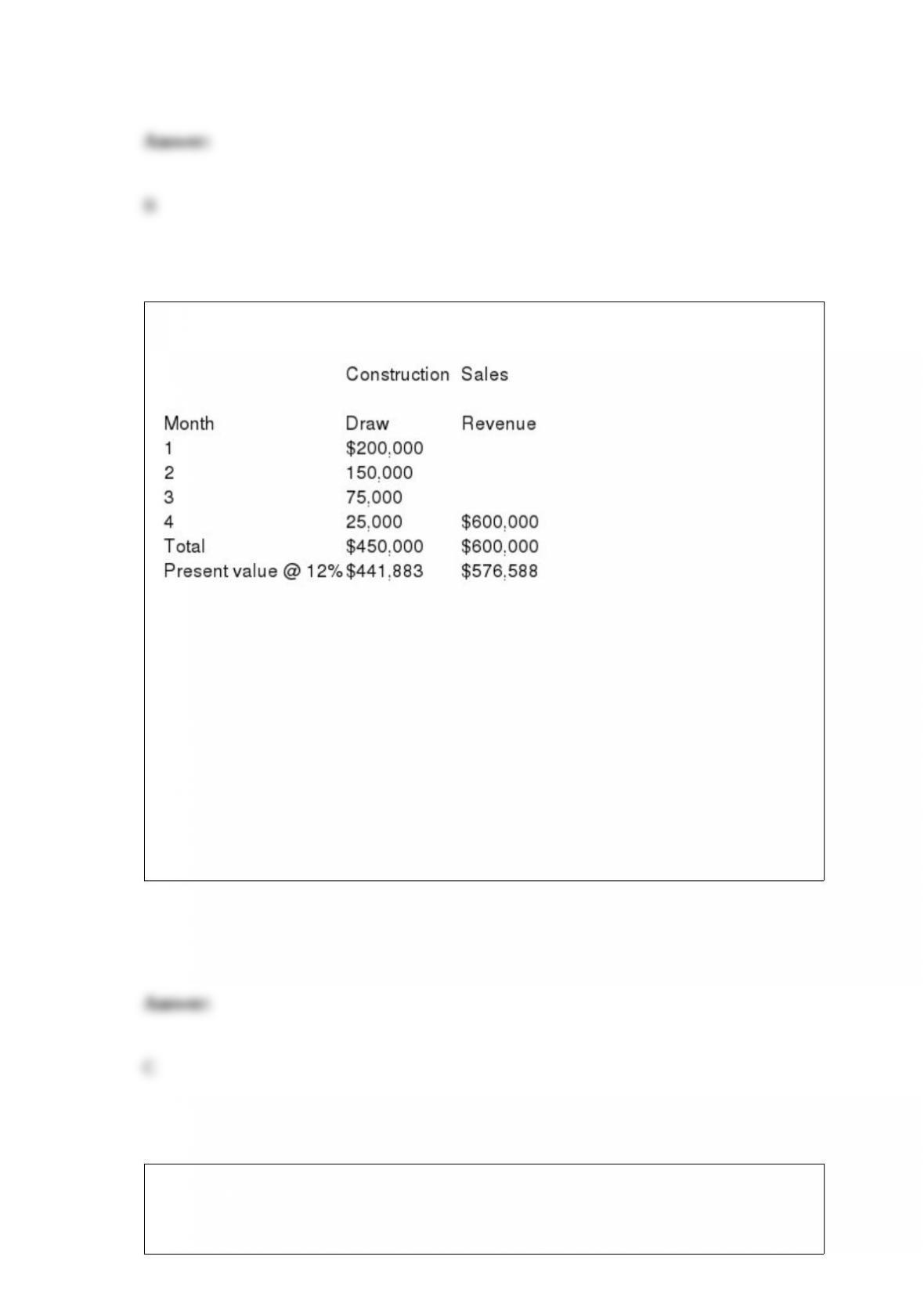
Consider the table above, which summarizes monthly construction draws and sales
revenues. What is the percent of lot sales revenue that needs to be used to repay the
loan?
(a) 4.0%
(b) 75.0%
(c) 76.6%
(d) 33.3%
Given the following fee structure, what is the total amount of fees that would be paid to
a fund manager if the actual NOI was $45 million annually:

5.5% up to $20 million in annual NOI
5.0% for the next $35 million in annual NOI
4.5% for the next $45 million in annual NOI
4.0% for all over $45 million in annual NOI
A. $2.3 million
B. $1.1 million
C. $2.0 million
D. $1.8 million
As mentioned in the text, the data sources used to produce investment returns on real
estate include the:
(A) National Association of Real Estate Professionals (NAREP)
(B) National Association of Real Estate Investment Trusts (NAREIT)
(C) National Board of Realtors (NBR)
(D) All of the above

On January 1st, an investor purchases security A for $105. Over the next four months,
dividends totaling $15 were paid on security A. On March 31st, security A was sold for
$120. What is the holding period return for security A?
(A) 0.0%
(B) 14.3%
(C) 25.0%
(D) 28.5%
A 1,000 square foot office space is leased at $15.00 per square foot during the first year
with $2.00 step-up provisions each of the following years. The lease is gross with an
expense stop set at $6.65 per square foot, and yearly expenses per square foot are as
follows: $6.00, $6.65, and $7.05. The lease provides for two months of free rent at the
end of the lease term. If the lease term is three years and the discount rate is 10%, what
is the effective rent per square foot?
(A) $9.38
(B) $9.50
(C) $10.22
(D) $10.46

Which of the following is NOT a type of commercial property?
(A) Single-tenant office building
(B) Regional shopping center
(C) Warehouse
(D) Office/showroom