
Which of the following statements is true of the U.S. economy?
a. In the second half of the 1960s, the output gap was mostly negative while in the first
half of the 1990s, the output gap was mostly positive.
b. In the second half of the 1960s, the output gap was mostly positive while in the first
half of the 1990s, the output gap was mostly negative.
c. In the second half of the 1960s and the first half of the 1990s, the output gap was
mostly negative. d. In the second half of the 1960s and the first half of the 1990s, the
output gap was mostly positive.
Answer:
Output and employment in Country Y has fallen below its equilibrium level. Which of
the following groups of economists is likely to believe that output and employment will
return to its equilibrium level without government intervention?
a. Keynesian economists
b. Post-modern economists
c. Monetarists
d. Classical economists
Answer:

According to the theory underlying the present-value formula, would a rational
individual prefer to receive (a) $75 one year from now, (b) $85 two years from now, or
(c) $90 three years from now, or would he be indifferent between all three choices?
Assume that the relevant annual market interest rate is 20 percent and will remain at 20
percent for the next three years?
a. He will prefer $75 one year from now.
b. He will prefer $85 two years from now.
c. He will prefer $90 three years from now.
d. He will be indifferent between all three choices.
Answer:
Suppose the quantity demanded for a security is
BD= 100 − 1b,
and the quantity supplied of the security is
BS= 50 + 1b,
where bis the price of the security in dollars.
a. Calculate the equilibrium price and quantity of the security.
b. Suppose demand increases by 50, so that BD= 150 − 1b. Now, calculate the new
equilibrium price and quantity of the security.
Answer:

Consider a bond that has a present value of $1,500. If the annual rate of interest is 4
percent, the future value of the bond after a year is
a. $1,560.00.
b. $1,540.00.
c. $1,440.00.
d. $1,442.31.
Answer:
Consider a bond that has a present value of $1,000. If the annual rate of interest is 7
percent, the future value of the bond after a year is
a. $930.00.
b. $934.58.
c. $1,000.00.
d. $1,070.00.

Answer:
Consider a two-year coupon bond that has a present value of $10,000. If the rate of
discount is 3 percent, and the payment made at the end of each year is $300, the
principal amount to be repaid at the end of two years is
a. $10,000.00.
b. $10,300.00.
c. $33,333.33.
d. $333,333.33.
Answer:
Which of the following is a difference in the views of Keynesian and classical
economists?
a. Keynesians believe that prices and wages adjust quickly, whereas the classicals
believe they adjust slowly. b. Keynesians believe that policymakers have full
knowledge about the state of an economy, whereas the classicals believe they don’t.
c. Keynesians believe that policymakers cannot offset shocks to an economy, whereas
the classicals believe they can.
d. Keynesians believe that most shocks to an economy are to long-run aggregate supply,
whereas the classicals believe the shocks are to aggregate demand.

Answer:
Suppose that a change in the expected inflation rate leads supply and demand to adjust
so that the after-tax expected real interest rate is unchanged at 2.0 percent. The tax rate
is 30 percent. Initially, the expected inflation rate is 3.0 percent. If the expected inflation
rate rises from 3 percent to 6 percent, the nominal interest rate
a. rises by 3 percent.
b. rises by 4.25 percent.
c. falls by 4.25 percent.
d. falls by 3 percent.
Answer:
Which of the following risks is only faced by investors in debt securities?
a. Default risk
b. Upward risk
c. Downward risk
d. Risk due to inflation
Answer:

Which of the following is likely to lead to a recession according to Keynesian
economists?
a. An decrease in money supply
b. An increase in the price of oil
c. A decrease in the rate of inflation
d. A fall in spending by consumers
Answer:
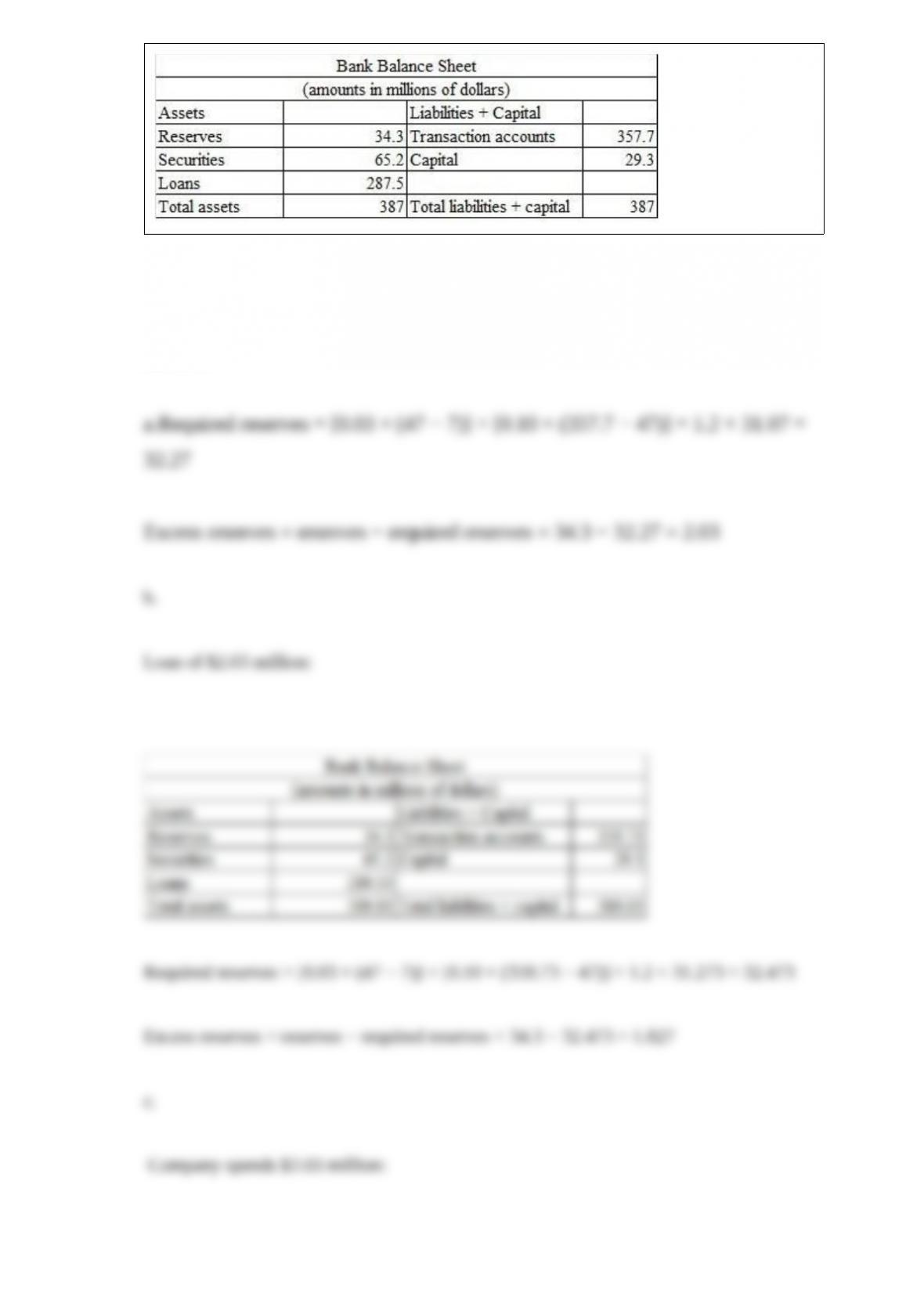
A bank has reserves of $34.3 million, securities of $65.2 million, and loans of $287.5
million. It has transaction accounts totaling $357.7 million and capital of $29.3 million.
The reserve requirement is 0 percent on the first $7 million of transaction accounts, 3
percent on transaction accounts from $7 million to $47 million, and 10 percent on
transaction accounts above $47 million.
a. Draw up the bank’s balance sheet and calculate the bank’s excess reserves.
b.Suppose the bank makes a loan equal to the amount of its excess reserves that you
calculated in part a. Draw up the bank’s balance sheet before the customer spends the
proceeds of the loan.Whatarethebank’sexcessreserves?
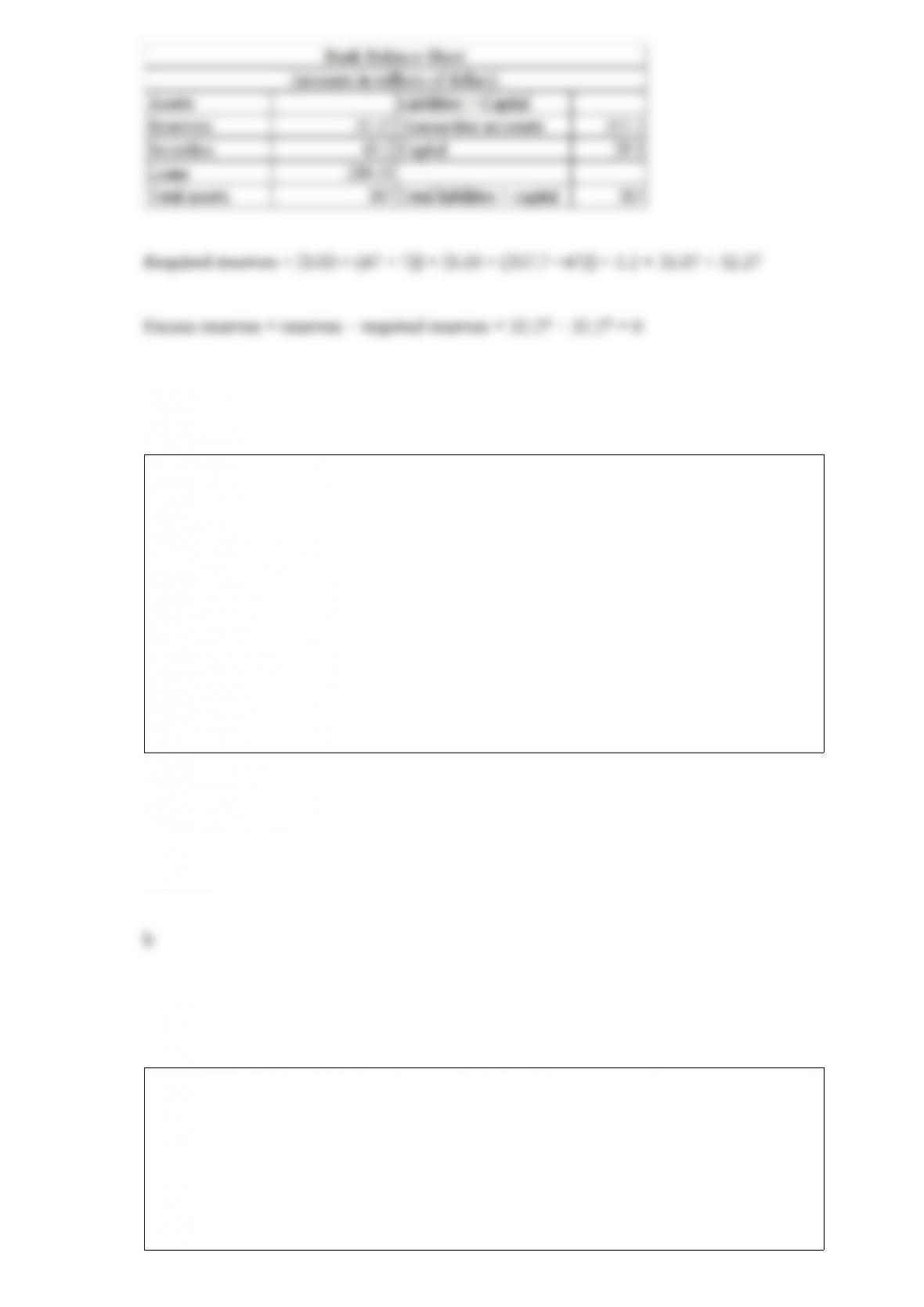
c. Now suppose the customer spends the proceeds of the loan. Draw up the bank’s
balance sheet and calculate its excess reserves.
Answer:
The reserve requirement is 0 percent on the first $8 million in transaction deposits, 3
percent on amounts between $8 million and $50 million, and 10 percent on amounts
above $50 million. A bank with transaction deposits totaling $83 million has required
reserves equal to
a. $2.49 million.
b. $4.56 million.
c. $6.54 million.
d. $8.30 million.
Answer:
Consider a perpetuity that pays $100 every year. If the annual rate of discount is 7
percent, the present value of the perpetuity is
a. $107.00.
b. $1,300.00.

c. $1,428.57.
d. $1,700.00.
Answer:
A bank borrows funds from its depositors by paying them 2% interest on the funds. It
lends those funds to borrowers by charging an interest of 5% on the loans. The bank’s
spread is
a. 2 percent.
b. 3 percent.
c. 4 percent.
d. 5 percent.
Answer:
DSGE models that contain many different types of households and firms are known as
a. heterogeneous-agent models.
b. homogeneous-agent models.
c. dynamic models.

d. multi-layered models.
Answer:
Which of the following is likely to happen if people expect the inflation rate to be high
and the central bank follows a
tight monetary policy?
a. The economy will enter into a recession.
b. The level of economic activity will increase.
c. The actual inflation rate will rise.
d. The federal funds rate will fall.
Answer:
A rise in future consumption spending, everything else remaining unchanged, will cause
business investment spending to
a. decline.
b. not change.
c. rise.

d. fall at first, then rise later.
Answer:
If the population in a country is 182 million, the working-age population is 134 million,
the number of employed people is 73 million, and the number of unemployed people is
14 million, then the unemployment rate in the country is
a. 3.7 percent.
b. 7.7 percent.
c. 10.4 percent.
d. 16.1 percent.
Answer:
A country engages in a contractionary monetary policy that causes its income to decline
and its interest rate to rise. This causes investors from other countries to increase their
financial investments in that country, causing the interest rate in the investors’ countries
to rise. In this case, the business cycle is being transmitted internationally through____
effect.
a. a trade
b. an interest-rate

c. an exchange-rate
d. an expected-inflation
Answer:
A national bank that is part of a financial holding company or a bank holding company
is mainly supervised by the
a. Federal Deposit Insurance Corporation.
b. Federal Reserve.
c. Office of the Comptroller of the Currency.
d. National Credit Union Administration.
Answer:
a.What measure is used by banking authorities who wish to calculate the degree of
monopoly power in a banking market (give the name or the acronym)? Write the
equation that is used and describe what each term means.
b.Suppose the banking market in Charlottesville consists of five banks that each having
a market share of 15 percent and five more banks each having a market share of 5
percent.
Calculate the measure of monopolypower.
c.Three of the banks that currently have 15 percent of the market would like to merge
and form First Super Bank of Charlottesville. If the merger were allowed, calculate the
new measure of monopolypower.
d.Under the standard set of guidelines of the U.S. Department of Justice, would the
merger be allowed? Explain why or why not, describing the guidelines and your results
from parts (b) and(c).
Answer:
The funds used to pay for FDIC insurance coverage come from

a. insurance premiums paid by depositors.
b. insurance premiums paid by banks.
c. U.S. government tax revenue.
d. taxes imposed on interest income.
Answer:
The lock-in effect occurs when
a. the price of all stocks traded in an exchange appreciates.
b. short selling of stocks is not allowed.
c. stock prices decline more than 5 percent in one day.
d. an investor doesn’t sell a stock so she can avoid paying capital-gains taxes.
Answer:
Taylor’s rule implies that monetary policy should have been easier than the Fed’s actual
policy in the
a. 1950s
b. 1960s

c. 1970s
d. 1980s
Answer:
If one country is hit with a shock that increases its income and its demands for imported
goods and services from other countries, thus increasing aggregate demand in those
countries, then the business cycle is being transmitted internationally through____
effect.
a. a trade
b. an interest-rate
c. an exchange-rate
d. an expected-inflation
Answer:
In the United States, the biggest investors in equity securities are
a. households.
b. business firms.

c. governments.
d. financial intermediaries.
Answer:
A bank is said to have________ when its average costs decline when it offers a wider
variety of products.
a. economies of scope.
b. economies of scale.
c. cost diminution.
d. decreasing returns to scale.
Answer:
If you observe that the current yield curve is upward sloping, it is likely that
a. an economic expansion has just begun.
b. an economic expansion has been going on for several years.
c. a recession is about to begin.
d. a recession is nearly over.

Answer:
If the growth rate of the money supply is 5 percent, the inflation rate is 2 percent, and
real output growth is 2 percent, what is the growth rate of the velocity of money?
a. −5 percent
b. −1 percent
c. +1 percent
d. +5 percent
Answer: