
1) investors in corporate bonds would still be interested in sovereign credit ratings
a.because the sovereign credit rating usually represents a ceiling on corporate credit
ratings within that country
b.because they might play the ted spread
c.because they are the rating assigned by the country’s regulators
d.none of the above
2) japan has experienced large trade surpluses. japanese investors have responded to
this by
a.liquidating their positions in stocks to buy dollar denominated bonds
b.investing heavily in u.s. and other foreign financial markets
c.lobbying the u.s. government to depreciate its currency
d.lobbying the japanese government to allow the yen to appreciate
3) xyz corporation, located in the united states, has an accounts payable obligation of
¥750 million payable in one year to a bank in tokyo. the current spot rate is ¥116/$1.00
and the one year forward rate is ¥109/$1.00. the annual interest rate is 3 percent in
japan and 6 percent in the united states. xyz can also buy a one-year call option on yen
at the strike price of $0.0086 per yen for a premium of 0.012 cent per yen. the future
dollar cost of meeting this obligation using the money market hedge is
a.$6,450,000
b.$6,545,400
c.$6,653,833
d.$6,880,734
4) assume that a country is on the gold standard. in order to support unrestricted
convertibility into gold, banknotes need to be backed by a gold reserve of some
minimum stated ratio. in addition,
a.the domestic money stock should rise and fall as gold flows in and out of the country
b.the central bank can control the money supply by buying or selling the foreign
currencies
c.both a and b
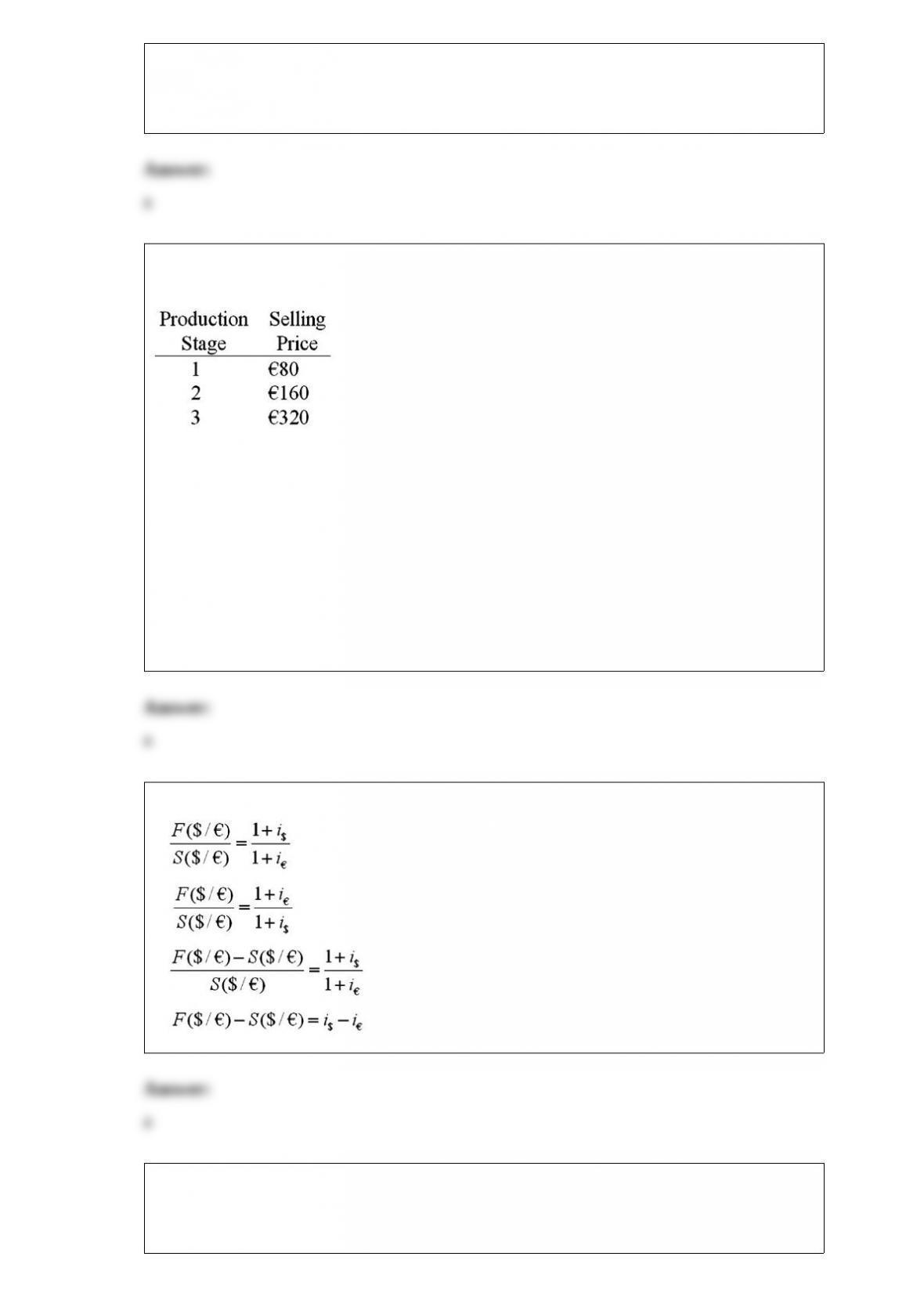
5) assume that a product has the following three stages of production:
if the value-added tax (vat) rate is 20%, what would be the vat over all stages of
production?
a.64
b.120
c.465
d.225
6) which equation is used to define the futures price?
a.
b.
c.
d.
7) a withholding tax is defined by your textbook as
a.the money that the government takes for every worker’s paycheck

b.social security taxes
c.a tax levied on income earned by an individual (or corporation) of one country within
the tax jurisdiction of another county
d.a tax levied on passive income earned by an individual (or corporation) of one
country within the tax jurisdiction of another county
8) a balance sheet hedge seeks to
a.eliminate any mismatch of net assets and net liabilities denominated in the same
currency
b.transfer accounting exposure to transaction exposure
c.create cumulative translation adjustment
d.none of the above
9) exchange rate fluctuations contribute to the risk of foreign investment through three
possible channels:
(i) – the volatility of the investment due to the volatility of the exchange rate
(ii) – the contribution of the cross-product term
(iii) – its covariance with the local market returns
which of the following contributes and accounts for most of the volatility?
a.(i) and (ii)
b.(ii) and (iii)
c.(i) and (iii)
d.only (ii)
10) suppose that you are a swap bank and you notice that interest rates on coupon bonds
are as shown. develop the 3-year bid price of a euro swap quoted against flat usd libor.
the current spot exchange rate is $1.50 per 1.00. the size of the swap is 40 million

versus $60 million.
in other words, what you be willing to pay in euro against receiving usd libor?
a.7%
b.6%
c.5%
d.none of the above
11) you are a u.s.-based treasurer with $1,000,000 to invest. the dollar-euro exchange
rate is quoted as $1.50 = 1.00 and the dollar-pound exchange rate is quoted at $2.00 =
£1.00. if a bank quotes you a cross rate of £1.00 = 1.25 how can you make money?
a.no arbitrage is possible
b.buy euro at $1.50/, buy £ at 1.25/£, sell £ at $2/£
c.buy £ $2/£, buy at 1.25/£, sell at $1.50/
12) the euro
a.is the common currency of europe
b.is divisible into 100 cents, just like the u.s. dollar
c.may eventually have a transaction domain larger than the u.s. dollar
d.all of the above
13) the first adrs began trading ________ as a means of eliminating some of the risks,
delays, inconveniences, and expenses of trading the actual shares.
a.in 1997
b.in 1987

c.in 1977
d.in 1927
14) in theory,
a.managers are hired by the shareholders at the annual stockholders meeting. if the
managers turn in a bad year, new ones get hired
b.shareholders hire the managers to oversee the board of directors
c.managers are hired by the board of directors; the board is accountable to the
shareholders
d.none of the above
15) suppose that the british pound is pegged to gold at £6 per ounce, whereas one ounce
of gold is worth 12. under the gold standard, any misalignment of the exchange rate will
be automatically corrected by cross border flows of gold. calculate the possible gains
for buying 1,000, if the british pound becomes undervalued and trades for 1.80. (assume
zero shipping costs).
(hint: gold is first purchased using the devalued british pound from the bank of england,
then shipped to france and sold for 1,000 to the bank of france).
a.£55.56
b.£65.56
c.£75.56
d.£85.56