
Each stock’s rate of return in a given year consists of a dividend yield (which might be
zero) plus a capital gains yield (which could be positive, negative, or zero). Such
returns are calculated for all the stocks in the S&P 500. A simple average of those
returns (which gives equal weight to each company in the S&P 500) is then calculated.
That average is called “the return on the S&P Index,” and it is often used as an indicator
of the “return on the market.”
a.True
b.False
Assume that the risk-free rate remains constant, but the market risk premium declines.
Which of the following is most likely to occur?
a.The required return on a stock with beta = 1.0 will not change.
b.The required return on a stock with beta > 1.0 will increase.
c.The return on “the market” will remain constant.
d.The return on “the market” will increase.
e.The required return on a stock with a positive beta < 1.0 will decline.
Which of the following statements is CORRECT?
a.Depreciation is included in the estimate of free cash flows (FCF = EBIT(1 – T) +
Depreciation – [Capital expenditures + NOWC]), hence depreciation is set forth on a
separate line in the cash budget.
b.If cash inflows from collections occur in equal daily amounts but most payments must
be made on the 10th of each month, then a regular monthly cash budget will be
misleading. The problem can be corrected by using a daily cash budget.
c.Sound working capital policy is designed to maximize the time between cash
expenditures on materials and the collection of cash on sales.
d.If a firm wants to generate more cash flow from operations in the next month or two,
it could change its credit policy from 2/10, net 30 to net 60.
e.If a firm sells on terms of net 90, and if its sales are highly seasonal, with 80% of its
sales in September, then its DSO as it is typically calculated (with sales per day = Sales
for past 12 months/365) would probably be lower in October than in August.
For a stock to be in equilibrium, that is, for there to be no long-term pressure for its
price to depart from its current level, then
a.the expected future return must be less than the most recent past realized return.
b.the past realized return must be equal to the expected return during the same period.
c.the required return must equal the realized return in all periods.

d.the expected return must be equal to both the required future return and the past
realized return.
e.the expected future return must be equal to the required return.
On its 12/31/14 balance sheet, Barnes Inc showed $510 million of retained earnings,
and exactly that same amount was shown the following year. Assuming that no earnings
restatements were issued, which of the following statements is CORRECT?
a.If the company lost money in 2014, it must have paid dividends.
b.The company must have had zero net income in 2014.
c.The company must have paid out half of its 2014 earnings as dividends.
d.The company must have paid no dividends in 2014.
e.Dividends could have been paid in 2014, but they would have had to equal the
earnings for the year.
Which of the following events is likely to decrease the value of call options on the
common stock of GCC Company?
a.An increase in GCC’s stock price.
b.An increase in the exercise price of the option.
c.An increase in the amount of time until the option expires.
d.An increase in the risk-free rate.
e.GCC’s stock price becomes more risky (higher variance).
Maxvill Motors has annual sales of $15,000. Its variable costs equal 60% of its sales
and its fixed costs equal $1,000. If the company’s sales increase 10%, what will be the
percentage increase in the company’s earnings before interest and taxes (EBIT)?
a.12.00%
b.12.60%
c.13.23%
d.13.89%
e.14.59%
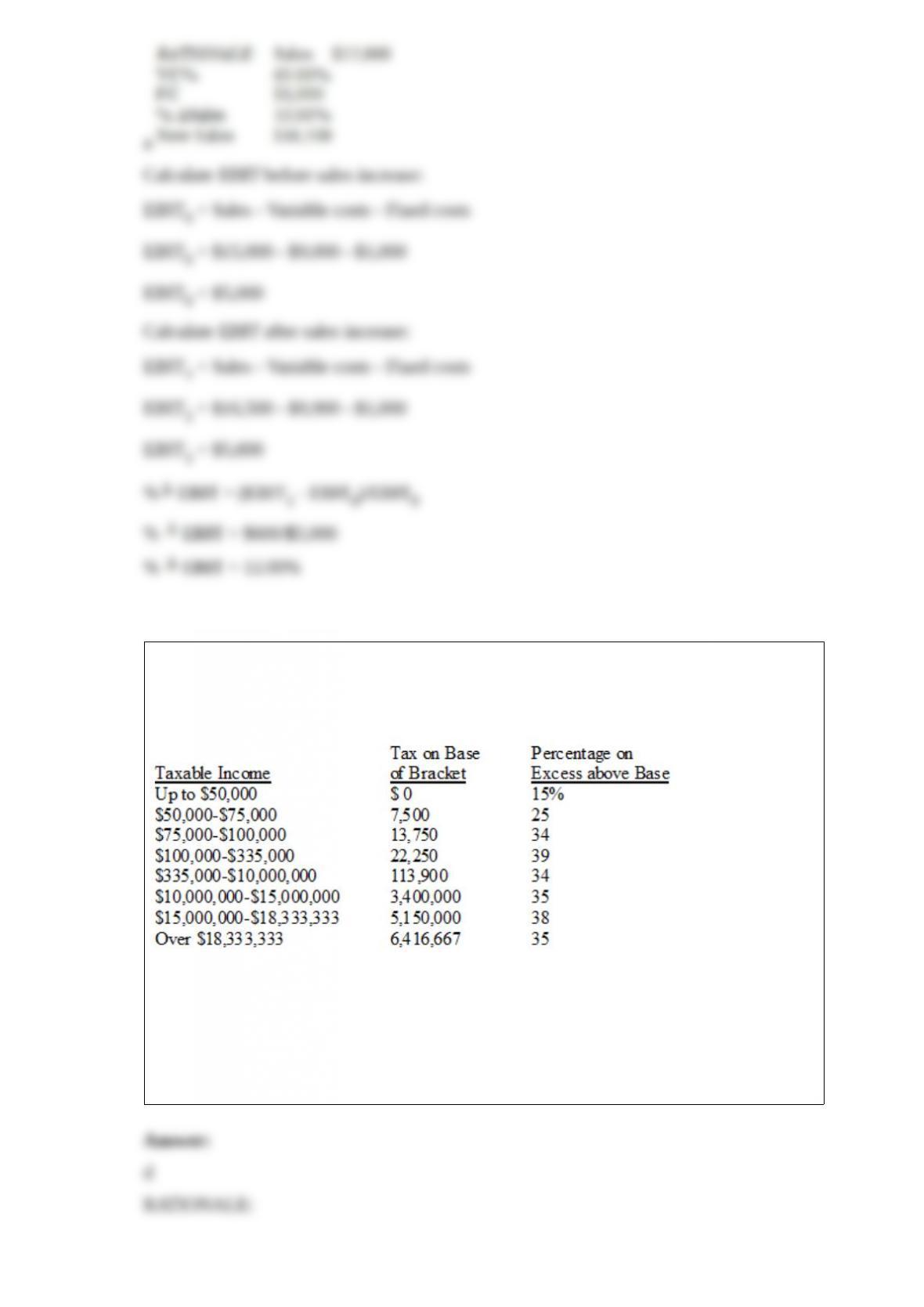
Griffey Communications recently realized $125,000 in operating income. The company
had interest income of $25,000 and realized $70,000 in dividend income. The
company’s interest expense was $40,000.
Using the corporate tax schedule above, what is Griffey’s tax liability?
a.$29,442
b.$30,992
c.$32,623
d.$34,340
e.$36,057
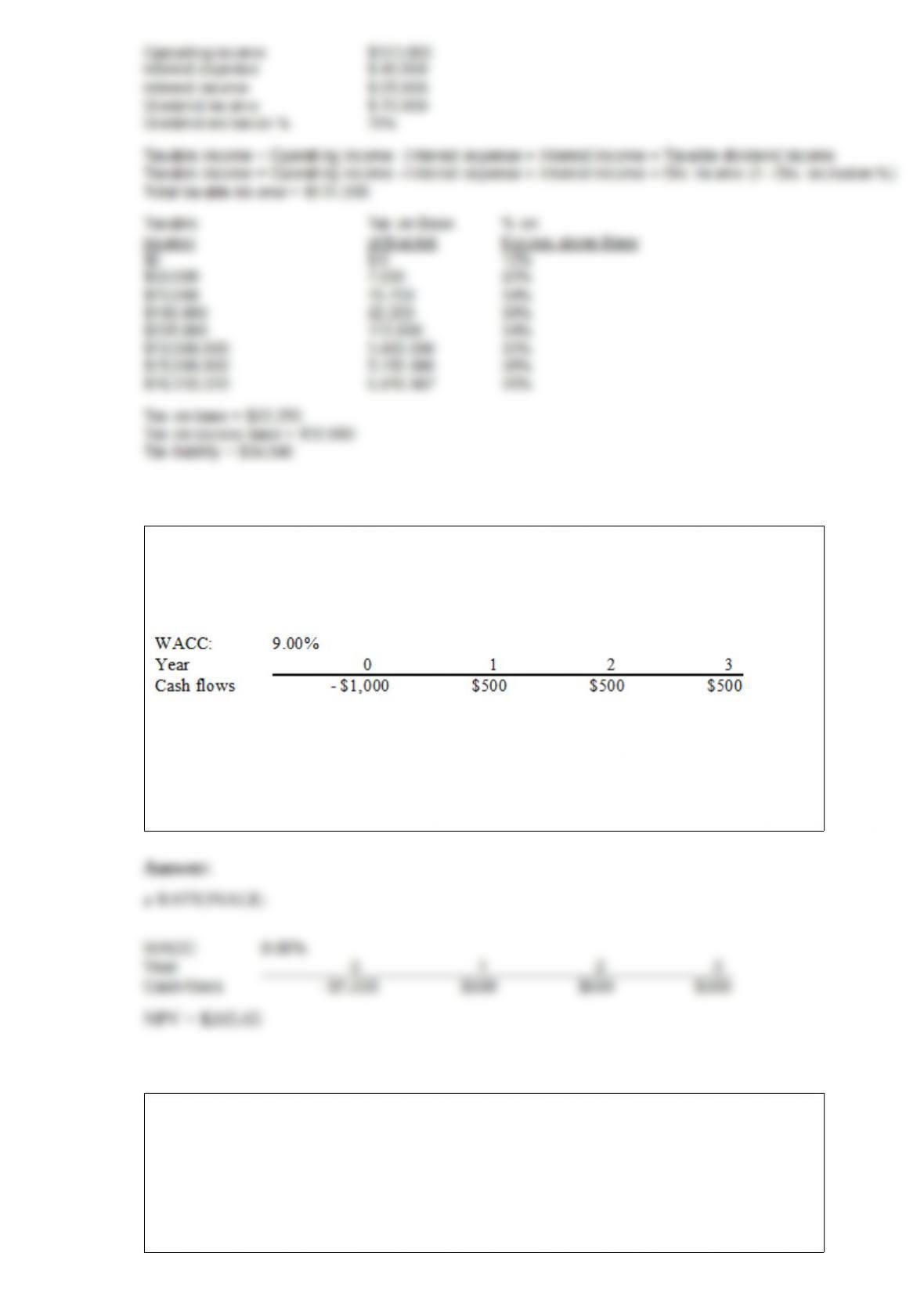
Anderson Systems is considering a project that has the following cash flow and WACC
data. What is the project’s NPV? Note that if a project’s projected NPV is negative, it
should be rejected.
a.$265.65
b.$278.93
c.$292.88
d.$307.52
e.$322.90
Which of the following statements is CORRECT?
a.If Congress lowered corporate tax rates while other things were held constant, and if
the Modigliani-Miller tax-adjusted theory of capital structure were correct, this would
tend to cause corporations to decrease their use of debt.
b.A change in the personal tax rate should not affect firms’ capital structure decisions.
c.”Business risk” is differentiated from “financial risk” by the fact that financial risk
reflects only the use of debt, while business risk reflects both the use of debt and such
factors as sales variability, cost variability, and operating leverage.
d.The optimal capital structure is the one that simultaneously (1) maximizes the price of
the firm’s stock, (2) minimizes its WACC, and (3) maximizes its EPS.
e.If changes in the bankruptcy code made bankruptcy less costly to corporations, this
would likely reduce the average corporation’s debt ratio.
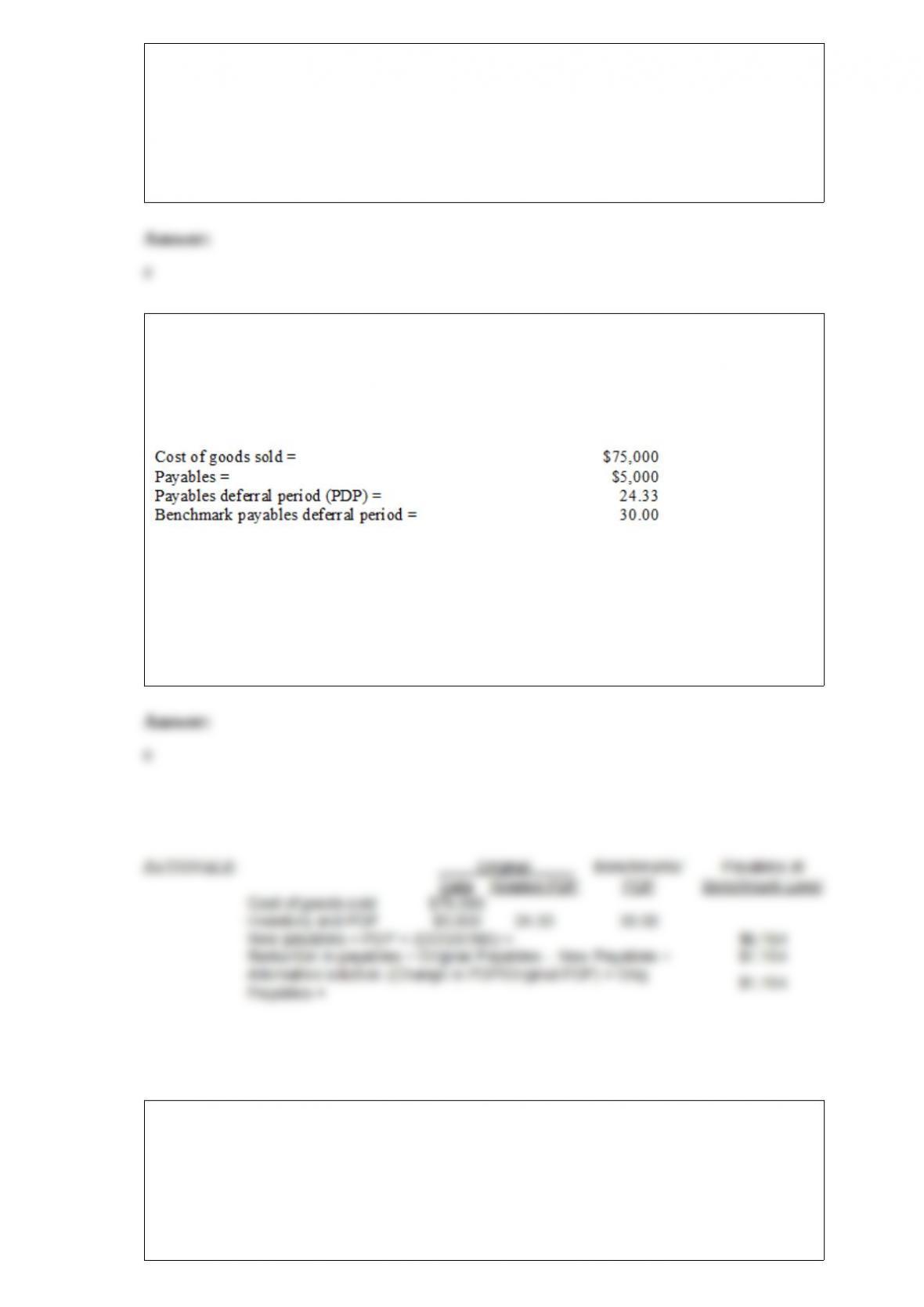
Data on Wentz Inc. for last year are shown below, along with the payables deferral
period (PDP) for the firms against which it benchmarks. The firm’s new CFO believes
that the company could delay payments enough to increase its PDP to the benchmarks’
average. If this were done, by how much would payables increase? Use a 365-day year.
a.$ 764
b.$ 849
c.$ 943
d.$1,048
e.$1,164
Arvo Corporation is trying to choose between three alternative investments. The three
securities that the company is considering are as follows:
Tax-free municipal bonds with a return of 8.8%.
Wooli Corporation bonds with a return of 11.75%.
CFI Corp. preferred stock with a return of 9.8%.

The company’s tax rate is 25%. What is the after-tax return on the best investment
alternative?
a.7.383%
b.7.772%
c.8.181%
d.8.612%
e.9.065%
Which of the following is NOT an example of a derivative security?
a.Futures.
b.Options.
c.Swaps.
d.Forward contracts.
e.Preferred stock.
The more conservative a firm’s management is, the higher its total debt to total capital
ratio [measured as (Short-term debt + Long-term debt)/(Debt + Preferred stock +
Common equity)] is likely to be.
a.True
b.False

If a firm’s ROE is equal to 9% and its ROA is equal to 6%, its equity multiplier must be
1.5.
a.True
b.False
Which of the following events is likely to encourage a company to raise its target debt
ratio, other things held constant?
a.An increase in the corporate tax rate.
b.An increase in the personal tax rate.
c.An increase in the company’s operating leverage.
d.The Federal Reserve tightens interest rates in an effort to fight inflation.
e.The company’s stock price hits a new high.