
1) Which of the following is correct for a bond investor whose bond offers a 5% current
yield and an 8% yield to maturity?
A.The bond is selling at a discount to par value
B.The bond has a high default premium
C.The promised yield is not likely to materialize
D.The bond must be a Treasury Inflation-Protected Security
2) The “trade-off theory” of capital structure suggests that:
A.firms add leverage whenever interest rates are low
B.firms with higher risk should use less debt
C.firms should use 50% debt and 50% equity
D.firms should use debt to overcome high par values of stock
3) The present value of a business in the United States will be calculated using all of the
following except:
A.Weighted-average cost of capital
B.Free cash flow for multiple periods
C.Some estimated horizon value
D.All of these
4) The minimum acceptable expected rate of return on a project of a specific risk is the:
A.project cost of capital
B.company cost of capital
C.risk-free rate of return
D.project beta times market risk premium
5) If the adoption of a new product will reduce the sales of an existing product, then
the:
A.new product should not be undertaken
B.old product should be abandoned
C.incremental benefits of the new product may be overestimated
D.incremental benefits of the new product may be underestimated

6) Ignoring defaults, what is the approximate effective cost of factoring if receivables
are sold at a 2% discount and the average collection period is 1 month?
A.19.40%
B.24.00%
C.26.53%
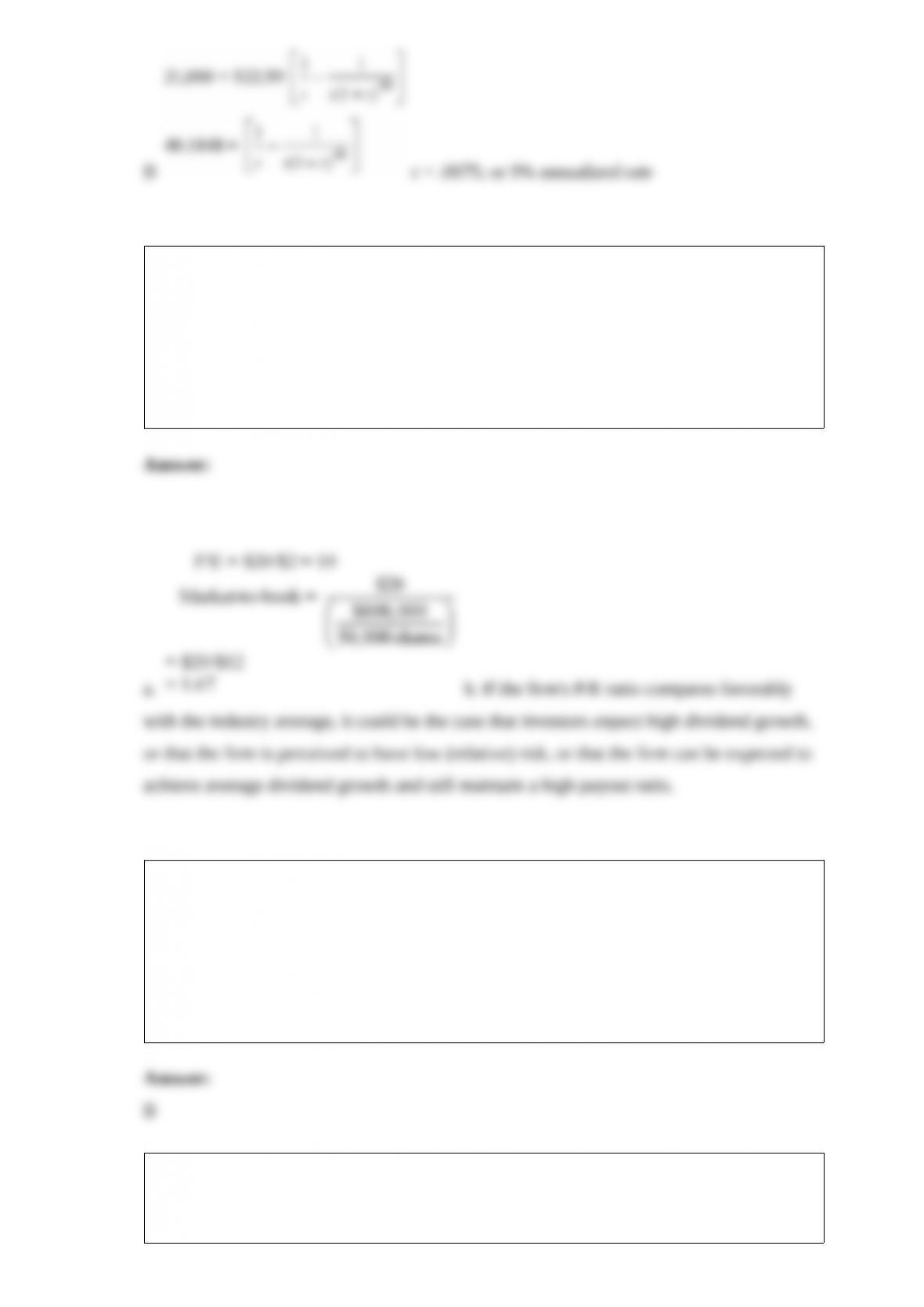
D.27.40%
7) Which of the following portfolios might be expected to exhibit less unique risk?
A.Five random stocks; portfolio beta = .8
B.Three random stocks; portfolio beta = 1.2
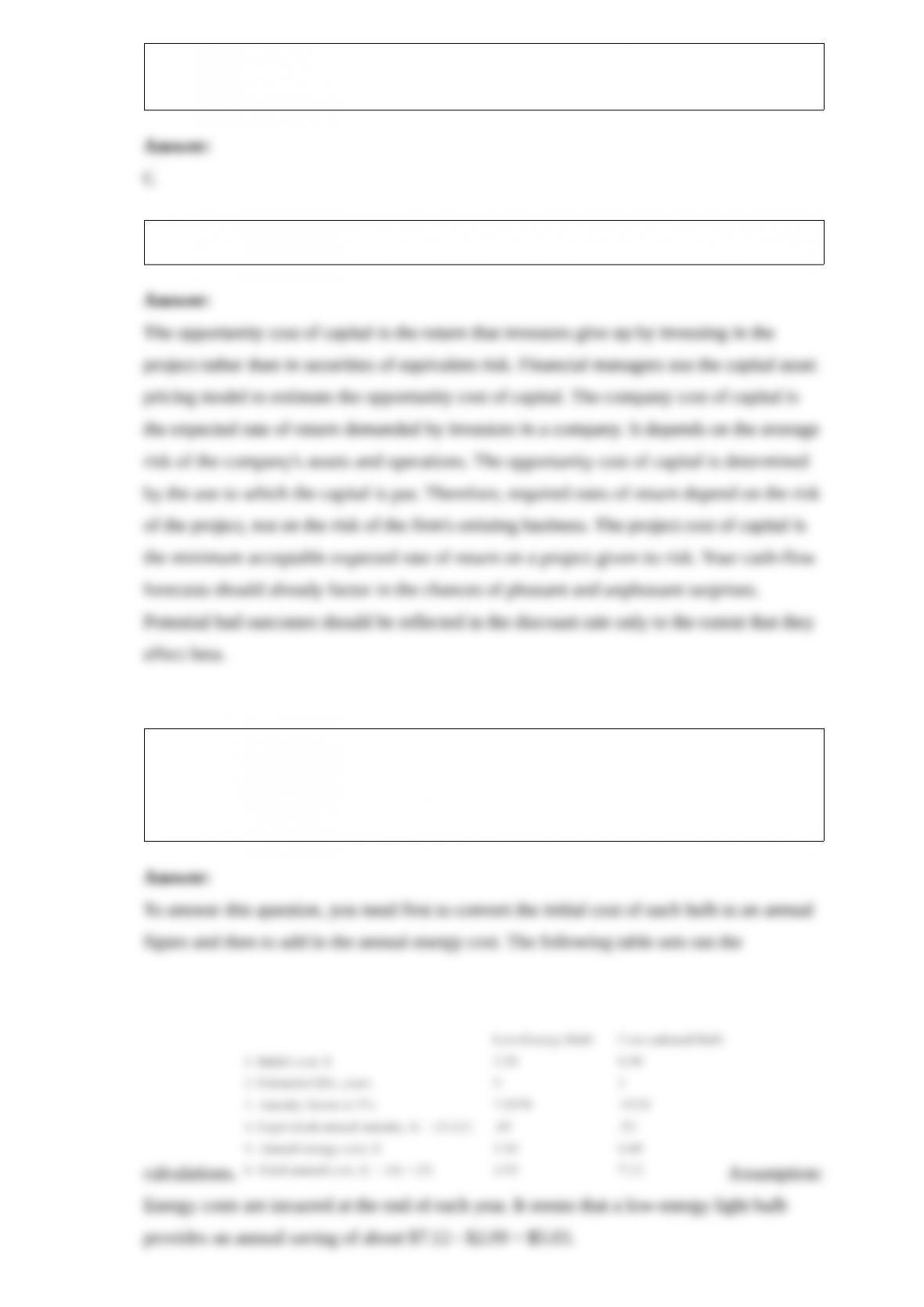
C.Ten random stocks; portfolio beta = 1.0
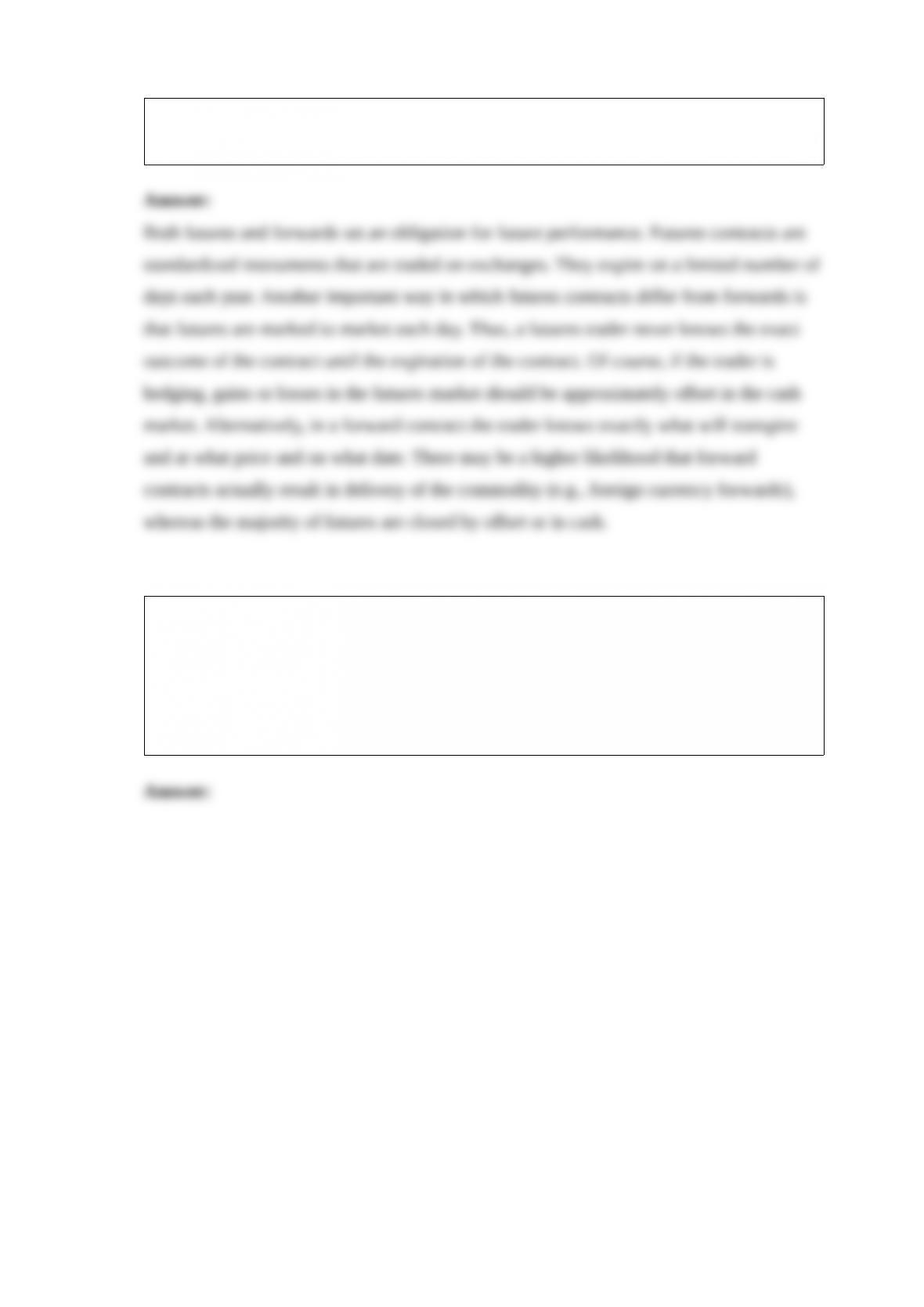
D.Twelve random stocks; portfolio beta unknown
8) Profit maximization is not a well-defined corporate objective because:
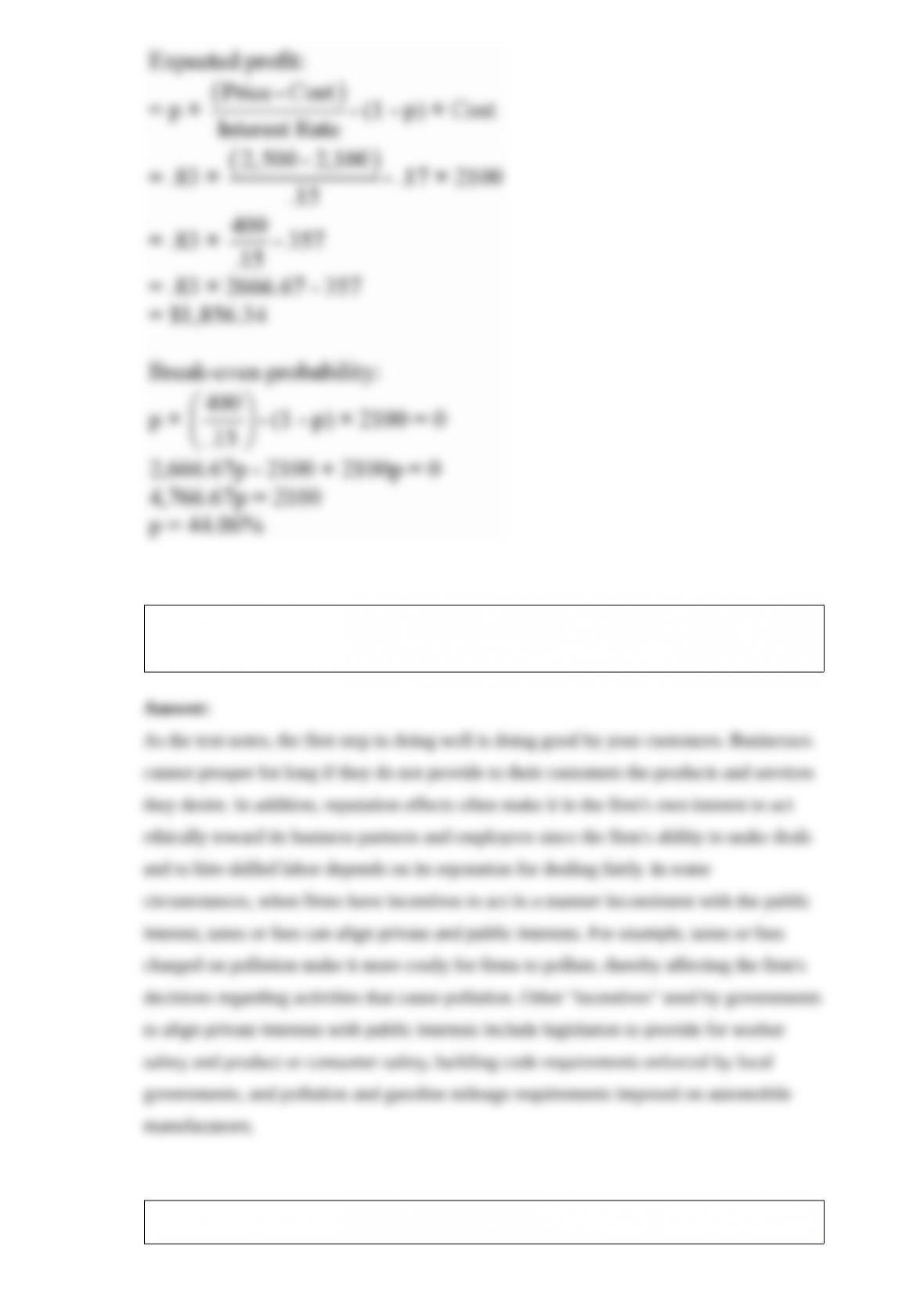
A.it leaves open the question of which year’s profits
B.higher profits does not necessarily mean a better rate of return
C.profits can be changed by using different accounting rules
D.all of these
9) The following information is for the month of January.
Find the ending accounts receivable for January.
A.$25 million
B.$55 million
C.$75 million
D.$265 million

10) Capital budgeting proposals should be evaluated as if the project were financed:
A.entirely by debt
B.entirely by equity
C.half by debt and half by equity
D.with the highest cost source of funds, to be safe
11) Which of the following changes in working capital will result in an increase in cash
flows?
A.Increase in accounts payable
B.Increase in inventories
C.Increase in accounts receivable
D.Decrease in other current liabilities
12) When a firm is said to have no spare capacity, it:
A.has no need for new employees
B.currently has no inventory available for sale
C.must issue new equity to grow
D.must increase fixed assets to increase sales
13) What is the approximate total debt ratio for a firm with a total debt to equity ratio of
.65?
A.35%
B.39%
C.54%
D.65%

14) Which of the following mutual funds have a tax advantage?
A.Balanced funds
B.Pension funds
C.Bond funds
D.Funds that invest in foreign countries
15) Net Corp. has an ROE of 30% and would like to see earnings grow at a 18% annual
rate. What percentage of earnings can it afford to pay out as dividends?
A.13.33%
B.25.00%
C.40.00%
D.75.00%
16) With $1.5 million in an account expected to earn 8% annually over the retiree’s 30
years of life expectancy, what annual annuity can be withdrawn, beginning today?
A.$112,150
B.$120,000
C.$123,371
D.$133,241
17) A proxy contest is typically one in which:
A.the Board attempts to gain control from the shareholders

B.management attempts to gain control from the Directors
C.outsiders attempt to gain control from management
D.the Board attempts to gain control from the Directors
18) What happens to the market value of a firm’s equity as the book value of the firm’s
equity increases?
A.It increases by the same amount
B.It decreases by the same amount
C.It remains constant
D.There is no set relationship to determine this outcome
19) The purpose of credit analysis is to:
A.reconcile the accounts receivable balance
B.modify the terms of trade credit
C.organize the right side of the balance sheet
D.decide whether or not to grant credit to a customer
20) Studies have shown that, on average, new security issues are:
A.subject to flotation costs of approximately 32%
B.overpriced by the amount of the spread
C.underpriced
D.overpriced to reward venture capitalists
21) Which of the following financial assets might be least likely to have an active
secondary market?
A.Common stock of a large firm
B.Bank loans made to smaller firms
C.Bonds of a major, multinational corporation
D.Debt issued by the U.S. Treasury

22) What level of management is responsible for originating capital budgeting
proposals?
A.Senior management
B.Divisional management
C.Lower management
D.All levels of management
23) When a corporation fails, the maximum that can be lost by an investor protected by
limited liability is:
A.the amount of the initial investment
B.the amount of the profit on the investment
C.the amount necessary to pay the corporation’s debts
D.the amount of the investor’s personal wealth
24) You are buying goods worth $75,000 from a firm that offers the credit terms of
2/10, net 30 . What will be the actual payment if you paid within 10 days?
A.$73,500
B.$74,250
C.$75,000
D.$76,500
25) Which of the following statements is correct concerning call options?
A.Value of a call option at expiration will be greater than the stock price
B.Value of a call option at expiration will be equal to the exercise price
C.Value of a call option at expiration will be equal to the difference between the stock
price and exercise price
D.Value of a call option at expiration will be equal to zero
26) What will be the change in net working capital if you observe the following
changes in current assets and current liabilities?

I. Current assets increase by $170,000.
II. Current liabilities decrease by $60,000.
A.Increase by $110,000
B.Increase by $230,000
C.Decrease by $110,000
D.Decrease by $230,000
27) Why is it not sufficient to state that a merger should occur simply because the
economic gains are positive?
A.Gains are typically of an accounting nature
B.Shareholders of the target may capture all gains
C.Merger cost should be negative after discounting
D.The merger’s gain must also exceed its NPV
28) In which of the following asset accounts are you least likely to find a difference
between market value and book value?
A.Cash
B.Inventory
C.Land
D.Shareholders’ equity
29) What rate of nominal growth is expected in sales if they are currently $1,000,000
and expected to reach $1,600,000 in 5 years?
A.3.20%
B.9.86%
C.12.00%
D.26.49%

30) Which of the following is least likely to be correct about the factoring of
receivables?
A.The selling firm bears the risk of default
B.The higher the perceived quality of the receivables, the lower the discount rate
C.The discount is paid by the selling firm in the form of reduced sales price
D.Factoring may be the cheapest method of avoiding a cash flow problem
31) If the announcement of a new equity offering causes current equity values to drop,
then signaling theory would predict that:
A.supply of equity will outstrip demand
B.management knows the issue to be overpriced
C.the firm has no attractive investment opportunities
D.underwriters charge too high a spread
32) Which of the following changes, if of a sufficient magnitude, could turn a negative
NPV project into a positive NPV project?
A.A decrease in the estimated annual sales
B.An increase in the discount rate
C.An increase in the initial investment
D.A decrease in the fixed costs
33) A car dealer offers payments of $522.59 per month for 48 months on a $25,000 car
after making a $4,000 down payment. What is the loan’s APR?
A.6%
B.9%
C.11%
D.12%
34) Value Corp. recently reported earnings of $2 per share and each of its 50,000 shares
is currently selling for $20. The firm’s book equity is $600,000. Given this information,
answer the following about the firm’s market-value ratios:
a. Calculate the firm’s price-to-earnings (P/E) and market-to-book ratios.
b. If the P/E ratio is said to compare favorably to that of the industry average, speculate
on what could account for this fact.
35) Which of the following statements is typically correct concerning the break-even
probability of collection for repeat sale customers?
A.Break-even probability is higher than for single sale customers
B.Break-even probability is lower than for single sale customers
C.The break-even probability does not change between single sale and repeat sale
customers
D.Sales should never be refused for customers offering the potential of repeat sales
36) Proxy fights are conducted in order to achieve a goal of:
A.changing the corporate charter
B.bringing about economies of scale
C.replacing the current board and management team
D.having a public tender offer
37) How can a manager calculate the opportunity cost of capital for a project?
38) Low-energy light bulbs typically cost $3.50, have a life of 9 years, and use about
$1.60 of electricity a year. Conventional light bulbs are cheaper to buy, for they cost
only $.50. On the other hand, they last only about a year and use about $6.60 of energy.
If the real discount rate is 5%, what is the relative cost of the two products?
39) Discuss similarities and differences between futures contracts and forward
contracts.
40) Smith Corp. produces a product that generates repeat orders on an annual basis. The
product has a current price of $2,500 and a current cost of $2,100. The company uses a
15% opportunity cost of capital. Due to the product’s high cost, there is a 17% chance
that each new customer will default on payment. If the customer does not default, then
business from that customer forms an infinite annuity income stream. What is the
expected profit and break-even probability from granting credit under these conditions?
41) Is there a conflict between “doing well” and “doing good”? When there are
conflicts, how may government regulations or laws tilt the firm toward doing good?
42) Small face-to-face purchases are commonly paid for in cash. What are some other
ways that you can pay your bills?
43) For a firm that expects earnings next year of $10.00 per share, has a plowback ratio
of 35%, a return on equity of 20%, and a required return of 15%, show the current stock
value and next year’s expected stock value, assuming that growth is to be constant.
44) Discuss the interrelationship between a firm’s financing and its capital structure
decisions.
45) How does the firm’s sources and uses of cash relate to its need for short-term
borrowing?
46) Preferred stock of financially strong firms sometimes sells at lower yields than the
bonds of those firms. For weaker firms, the preferred stock has a higher yield. What
might explain this pattern?