
The speculative demand for money may not exist because
A) banks now pay interest on some types of checkable deposits.
B) there are alternative riskless assets paying higher returns than the return on money.
C) the transactions demand can be shown to depend on interest rates.
D) government regulations have eliminated risk in the financial markets.
Excessive volatility refers to the fact that
A) stock returns display mean reversion.
B) stock prices can be slow to react to new information.
C) stock price tend to rise in the month of January.
D) stock prices fluctuate more than is justified by dividend fluctuations.
The regulatory agency responsible for regulating the activities of life insurance
companies is
A) the FDIC.
B) the Fed.
C) the FHLBS.
D) the appropriate state agency where the company is operating.
If the ________ curve is relatively more unstable than the ________ curve, a money
supply target is preferred.
A) IS; IS
B) IS; LM

C) LM; IS
D) LM; LM
A sales commission is charged for the purchase of
A) no-load mutual funds.
B) load mutual funds.
C) sinking mutual funds.
D) syndicated funds.
Recent research indicates that inflation performance (low inflation) has been found to
be best in countries with
A) the most independent central banks.
B) political control of monetary policy.
C) money financing of budget deficits.
D) a policy of always keeping interest rates low.
When a new depositor opens a checking account at the First National Bank, the bank’s
assets ________ and its liabilities ________.
A) increase; increase
B) increase; decrease
C) decrease; increase
D) decrease; decrease

To keep from running out of international reserves under the Bretton Woods system, a
country had to implement ________ monetary policy to ________ its currency.
A) expansionary; strengthen
B) expansionary; weaken
C) contractionary; strengthen
D) contractionary; weaken
Everything else held constant, when actual output exceeds the natural rate of output
________ aggregate supply ________.
A) short-run; decreases
B) short-run; increases
C) long-run; increases
D) long-run; decreases
The theory of rational expectations, when applied to financial markets, is known as
A) monetarism.
B) the efficient markets hypothesis.
C) the theory of strict liability.
D) the theory of impossibility.

In a barter economy the number of prices in an economy with N goods is
A) [N(N – 1)]/2.
B) N(N/2).
C) 2N.
D) N(N/2) – 1.
Everything else held constant, abolishing the individual income tax will
A) increase the interest rate on corporate bonds.
B) reduce the interest rate on municipal bonds.
C) increase the interest rate on municipal bonds.
D) increase the interest rate on Treasury bonds.
Keynes’s liquidity preference theory indicates that the demand for money
A) is purely a function of income, and interest rates have no effect on the demand for
money.
B) is purely a function of interest rates, and income has no effect on the demand for
money.
C) is a function of both income and interest rates.
D) is a function of both government spending and income.

Everything else held constant, an appreciation of the domestic currency will cause the
IS curve to shift to the ________ and aggregate demand will ________.
A) right; increase
B) right; decrease
C) left; increase
D) left; decrease
Movements of ________ interest rates indicate that, contrary to the early Keynesians’
beliefs, monetary policy was ________ during the Great Depression.
A) nominal; tight
B) nominal; easy
C) real; tight
D) real; easy
Money market mutual funds
A) function as interest-earning checking accounts.
B) are legally deposits.
C) are subject to reserve requirements.
D) have an interest-rate ceiling.
In the Keynesian liquidity preference framework, an increase in the interest rate causes
the demand curve for money to ________, everything else held constant.
A) shift right

B) shift left
C) stay where it is
D) invert
When we describe stock prices as following a random walk, we mean that future
changes in stock prices are
A) unpredictable.
B) increasing.
C) decreasing.
D) constant.
Examples of discount bonds include
A) U.S. Treasury bills.
B) corporate bonds.
C) U.S. Treasury notes.
D) municipal bonds.
Either a dual or hierarchial mandate is acceptable as long as ________ is the primary
goal in the ________.
A) price stability; short run
B) price stability; long run
C) reducing business-cycle fluctuations; short run
D) reducing business-cycle fluctuations; long run

A smart card is the equivalent of
A) cash.
B) savings bonds.
C) savings deposits.
D) certificates of deposit.
Everything else held constant, an increase in the required reserve ratio on checkable
deposits will cause
A) the money supply to rise.
B) the money supply to remain constant.
C) the money supply to fall.
D) checkable deposits to rise.
A decline in the money ________ shifts the LM curve to the ________, causing the
interest rate to rise and output to fall, everything else held constant.
A) demand; right
B) demand; left
C) supply; right
D) supply; left

A discount bond
A) pays the bondholder a fixed amount every period and the face value at maturity.
B) pays the bondholder the face value at maturity.
C) pays all interest and the face value at maturity.
D) pays the face value at maturity plus any capital gain.
When the growth rate of the money supply increases, interest rates end up being
permanently lower if
A) the liquidity effect is larger than the other effects.
B) there is fast adjustment of expected inflation.
C) there is slow adjustment of expected inflation.
D) the expected inflation effect is larger than the liquidity effect.
In investment banking, a conflict usually is present between the issuers of securities,
who ________, and investors, who ________.
A) benefit from unbiased auditing; desire unbiased consulting
B) desire unbiased research; benefit from optimistic research
C) benefit from optimistic research; desire unbiased research
D) desire unbiased consulting; benefit from unbiased auditing

The United States chooses to have ________ and ________ and therefore, cannot have
a fixed exchange rate at the same time.
A) capital control; an independent monetary policy
B) free capital mobility; an independent monetary policy
C) free capital mobility; no control of monetary policy
D) capital control; no control of monetary policy
The primary liabilities of depository institutions are
A) premiums from policies.
B) shares.
C) deposits.
D) bonds.
The Fed-Treasury Accord of March 1951 provided the Fed greater freedom to
A) let interest rates increase.
B) let unemployment increase.
C) let inflation accelerate.
D) let exchange rates increase.
If a bank has excess reserves of $4,000 and demand deposit liabilities of $100,000, and
if the reserve requirement is 15 percent, then the bank has actual reserves of
A) $17,000.
B) $19,000.

C) $24,000.
D) $29,000.
Only when budget deficits are financed by money creation does the increased
government spending lead to ________ in the ________.
A) a decrease; monetary base
B) an increase; monetary base
C) a decrease; money multiplier
D) an increase; money multiplier
In the simple deposit expansion model, if the banking system has excess reserves of
$75, and the required reserve ratio is 20%, the potential expansion of checkable
deposits is
A) $75.
B) $750.
C) $37.50.
D) $375.
If, for a $1000 premium, you buy a $100,000 call option on bond futures with a strike
price of 114, and at the expiration date the price is 110, your ________ is ________.
A) profit; $1000
B) loss; $1000
C) profit; $3000

D) loss; $3000
Over the next three years, the expected path of 1-year interest rates is 4, 1, and 1
percent. The expectations theory of the term structure predicts that the current interest
rate on 3-year bond is
A) 1 percent.
B) 2 percent.
C) 3 percent.
D) 4 percent.
Microprudential supervision focuses on the safety and soundness of
A) individual financial institutions.
B) the financial system as a whole.
C) the shadow banking system.
D) government credit agencies.
What two key factors trigger speculative attacks leading to currency cries in emerging
market countries?

Discuss three channels by which monetary policy affects stock prices and aggregate
spending.
Distinguish between direct finance and indirect finance. Which of these is the most
important source of funds for corporations in the United States?
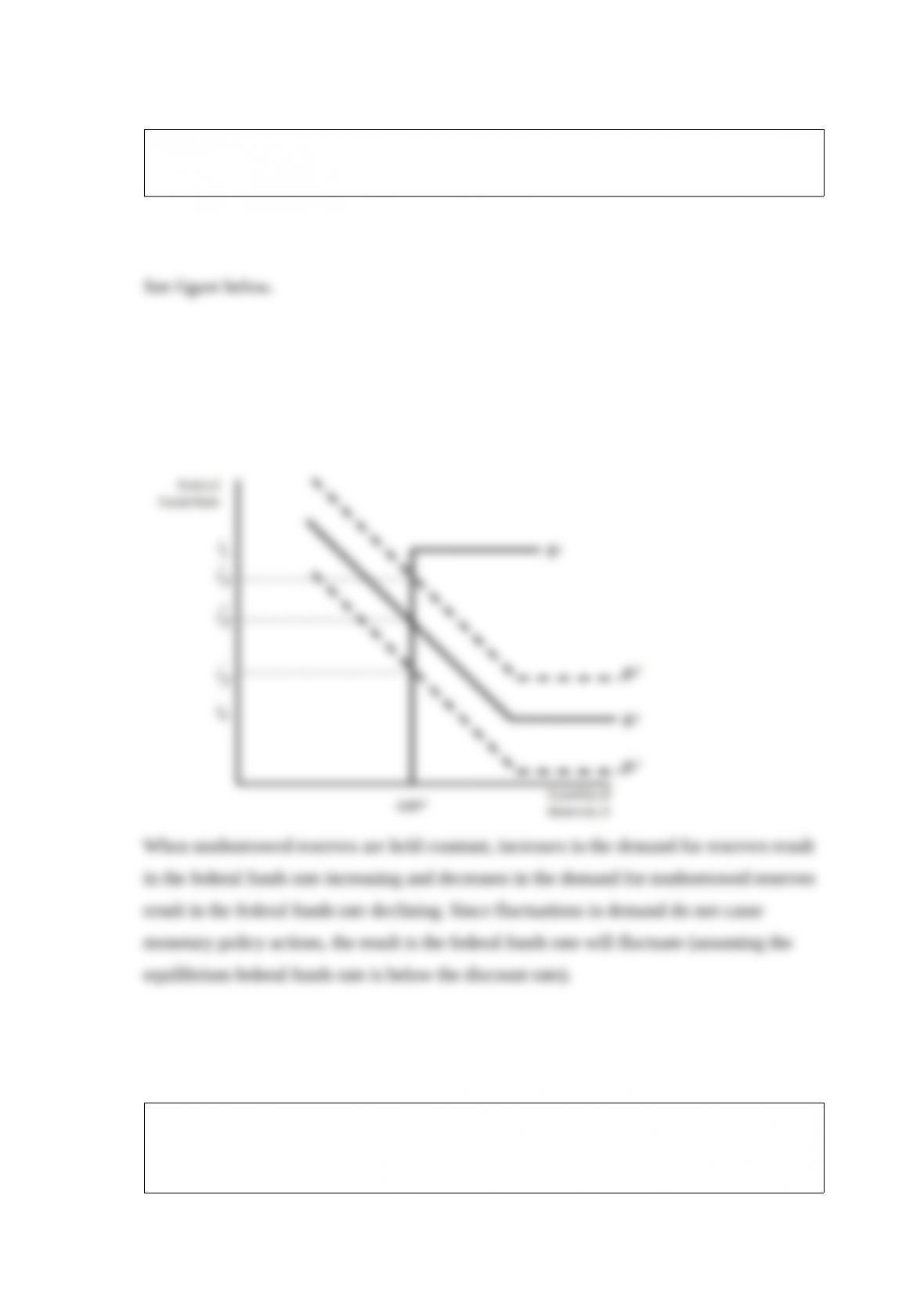
Explain and demonstrate graphically how targeting nonborrowed reserves can result in
federal funds rate instability.
What happens to economic growth and unemployment during a business cycle
recession? What is the relationship between the money growth rate and a business cycle
recession?

Distinguish between a foreign bond and a Eurobond.
What rights does ownership interest give stockholders?
How does a mutual fund lower transactions costs through economies of scale?

Using the ISLM model, explain the effects of a monetary expansion combined with a
fiscal contraction. How do the equilibrium level of output and interest rate change?
Describe what is meant by economies of scope and explain how financial institutions’
realizing economies of scope has led to an increase in conflicts of interest.
Your bank has the following balance sheet
Assets Liabilities
Rate-sensitive $100 million Rate-sensitive $75 million
Fixed-rate 100 million Fixed-rate 125 million
What would happen to bank profits if the interest rates in the economy go down? Is
there anything that you could do to keep your bank from being so vulnerable to interest
rate movements?

The spread between the interest rates on Baa corporate bonds and U.S. government
bonds is very large during the Great Depression years 1930-1933. Explain this
difference using the bond supply and demand analysis.
What factors determine the demand for money in the Baumol-Tobin analysis of
transactions demand for money? How does a change in each factor affect the quantity
of money demanded?
Typically, the economy recovers fairly quickly from a recession. Why did this NOT
happen in the United States during the Great Depression?
What financial innovations helped banks to get around the bank branching restrictions
of the McFadden Act?