Match the term with the statement that best defines it.
a.Accounting controls
b.Accounting system
c.Administrative controls
d.Audit committee
e.Board of directors
Consists of all methods and records used to accurately report an entity’s transactions.
The revenue recognition principle involves two factors: paid and incurred.
a.True
b.False
Match the inventory-related accounts to costs that may be included in inventories for
retailers and manufacturers.
a.Merchandise Inventory
b.Raw Materials
c.Work in Process
d.Finished Goods
e.Cost of Goods Sold
Cost of materials which are not yet entered into the production process.
For each item listed, select the section of the balance sheet in which the item would be
reported.
a.Current Assets
b.Property. Plant, and Equipment
c.Current Liabilities
d.Long-term Liabilities
e.Stockholders’ Equity
Land
Select the ratio that each statement below most properly satisfies.
a.Dividend yield ratio
b.Cash flow from operations to capital expenditures ratio
c.Debt service coverage ratio
d.Return on common stockholders’ equity ratio
e.Times interest earned ratio
f.Asset turnover ratio
g.Debt-to-equity ratio
h.Dividend payout ratio
i.Price/earnings ratio
A measure of the ability of a company to finance long-term asset acquisitions from cash
from operations
Use the following data to answer the question presented below for Raines Corp.’s
preparation of a bank reconciliation on October 31, 2014:
Bank statement balance $30,700
Raines’ book balance (before adjustments) ?
Outstanding checks 4,200
NSF checks 400
Service charges 300
Deposits in transit 3,100
Interest earned on checking account 100
What is the adjusted cash balance on October 31, 2014? a. $29,600
b. $30,100
c. $30,200
d. $30,700
Use the following codes to indicate how the cash flow effect, if any, of each transaction
or event would be reported on a statement of cash flows if the operating activities
section is prepared using the indirect method.
a.Operating activity-add to net income
b.Operating activity-deduct from net income
c.Inflow from investing activity
d.Outflow from investing activity
e.Inflow from financing activity
f.Outflow from financing activity
g.Noncash investing and financing activity
h.Not reported on statement of cash flows
Issued twenty-year bonds.
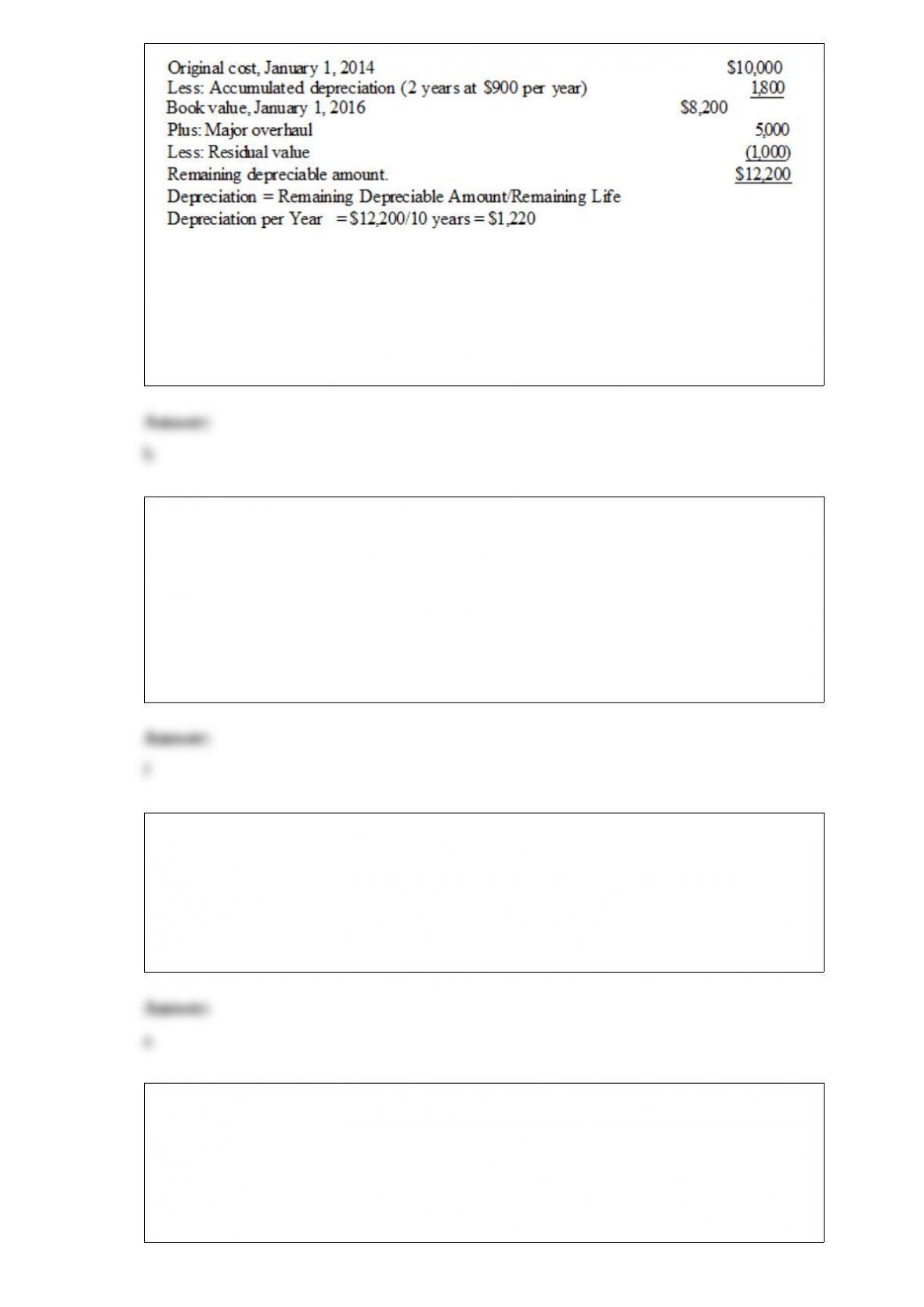
A machine with a cost of $100,000 and accumulated depreciation of $80,000 was sold
at a loss of $6,000. What amount of cash was received from the sale?
a. $26,000
b. $14,000.
c. $20,000.
d. $94,000.
Match the action with the category of internal control procedures
a.One department should check on another
b.Internal audit staff ensure all is working as intended
c.Accounting and cash collection is properly separated
d.Blank checks are locked at all times when not in use
e.Origination of initial entry into accounting system
f.Specific authority is given by management for the performance of activities.
Proper authorization
Match the costs that might be included as part of the cost of inventory to the listed
accounting treatment.
a.Add to inventory cost
b.Subtract from inventory cost
c.Not an inventory cost
Excise taxes paid on goods acquired
Match each of the following terms related to interest and time value of money
calculations to their appropriate definition.
a.Time value of money
b.Simple interest
c.Compound interest
d.Future value of a single amount
e.Present value of a single amount
f.Annuity
g.Future value of an annuity
h.Present value of an annuity
The amount that will be accumulated in the future when one amount is invested at the
present time and accrues interest until the future time.
The quality of accounting information that allows a user to compare two or more
accounting periods for a single company is known as consistency.
a.True
b.False
Match the selected items from a classified balance sheet and multiple-step income
statement to the section in which they would appear on the classified balance sheet or
the income statement.
a.Current Assets (balance sheet)
b.Property, Plant, & Equipment (balance sheet)
c.Current Liabilities (balance sheet)
d.Long-term Liabilities (balance sheet)
e.Stockholders’ Equity (balance sheet)
f.Operating Revenue (income statement)
g.Operating Expenses (income statement)
h.Other Revenue & Expenses (income statement)
i.Income Taxes (income statement)
Land
From the list of accounts below, determine whether the account would be a nominal
account or a real account.
a.nominal account
b.real account
Office Equipment
Identify which inventory costing method (LIFO or FIFO) achieves the effect listed in
the following items:
a.LIFO
b.FIFO
Prices are declining; gross margin is higher with this method
Choose from the following list of account titles the one that most accurately fits the
description of that account or is an example of that account. An account title may be
used more than once or not at all.
a.Cash
b.Prepaid Asset
c.Investments
d.Taxes Payable
e.Preferred Stock
f.Accounts Receivable
g.Land
h.Accounts Payable
i.Retained Earnings
j.Notes Receivable
k.Buildings
l.Notes Payable
m.Common Stock
Dividends
From the following list, identify whether the change in the account balance during the
year would be reported as an operating (O), an investing (I), or a financing (F) activity
or not separately reported on the statement of cash flows (N). Assume that the indirect
method is used to determine the cash flows from operating activities.
a.O – Operating
b.I – Investing
c.F – Financing
d.N – Not separately reported on the Statement of Cash Flows
Other accrued liabilities
Which one of the following best defines an internal event in terms of accounting?
a.Every type of transaction is an internal event.
b.An event recognized in a set of financial statements.
c.A happening of consequence to an entity.

d.An event occurring entirely within an entity.