
1) operating exposure measures
a.the extent to which the foreign currency value of the firm’s assets is affected by
unanticipated changes in exchange rates
b.the extent to which the firm’s operating cash flows will be affected by unexpected
changes in exchange rates
c.the affect of changes in exchange rates will have on the consolidated financial reports
of a mnc
d.the affect of unanticipated changes in exchange rates on the dollar value of
contractual obligations denominated in a foreign currency
2) many companies issue shares with differential voting rights, deviating from the
one-share one-vote principle.
a.by accumulating superior voting shares, investors can acquire cash flow rights
exceeding control rights
b.the price of the voting shares is usually twice the price of the voting shares
c.by accumulating superior voting shares, investors can acquire control rights exceeding
cash flow rights
d.none of the above
3) a dealer in british pounds who thinks that the pound is about to appreciate
a.may want to widen his bid-ask spread by raising his ask price
b.may want to lower his bid price
c.may want to lower his ask price
d.none of the above
4) find the debt-to-value ratio for a firm with a debt-to-equity ratio of 3.
a.3/4
b.7/9
c.4/5
d.9/11
e.5/6
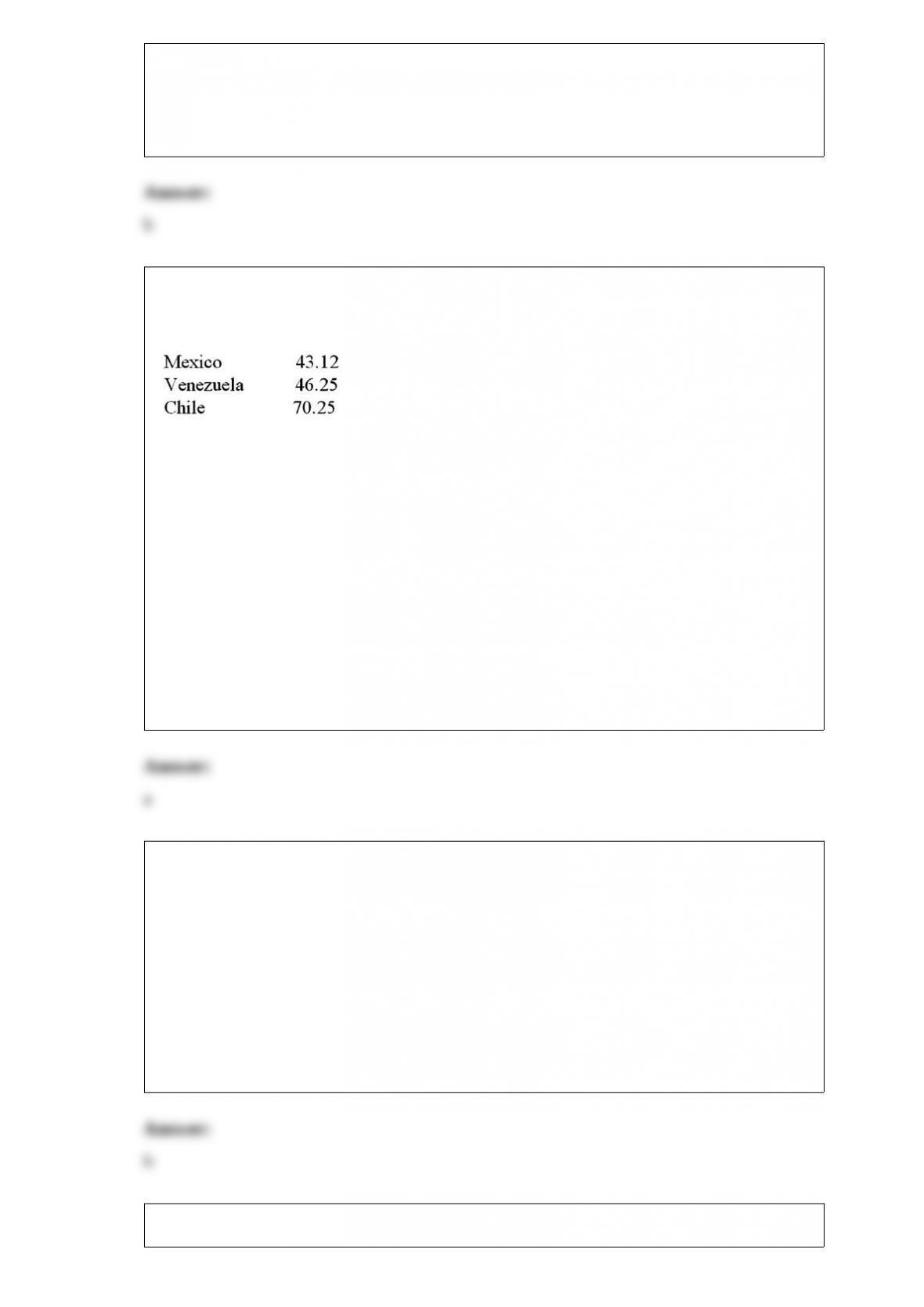
5) on september 10, 1990 the published prices (cents on the dollar) on latin american
bank debt was quoted as follows:
assume that the central banks of mexico, venezuela, and chile redeemed their debts at
50 percent, 85 percent, and 76 percent, respectively, of face value in a debt-for-equity
swap. if the three countries had equal political risk, based purely on financial
considerations, the cost of a $40,000,000 assembly plant investment in local currency
would be ranked (lowest to highest) in dollar cost as follows:
a.venezuela first, mexico second, chile third
b.venezuela first, chile second, mexico third
c.chile first, venezuela second, mexico third
d.mexico first, chile second, venezuela third
6) the key requirements of the cadbury code of best practice state that
a.the compensation, nominating, and audit committees to be entirely composed of
independent directors.
b.the positions of ceo and chairman of the board should not reside in the same
individual
c.listed companies to have boards of directors with a majority of independents
d.none of the above
7) your firm is a u.k.-based exporter of bicycles. you have sold an order to a swiss firm
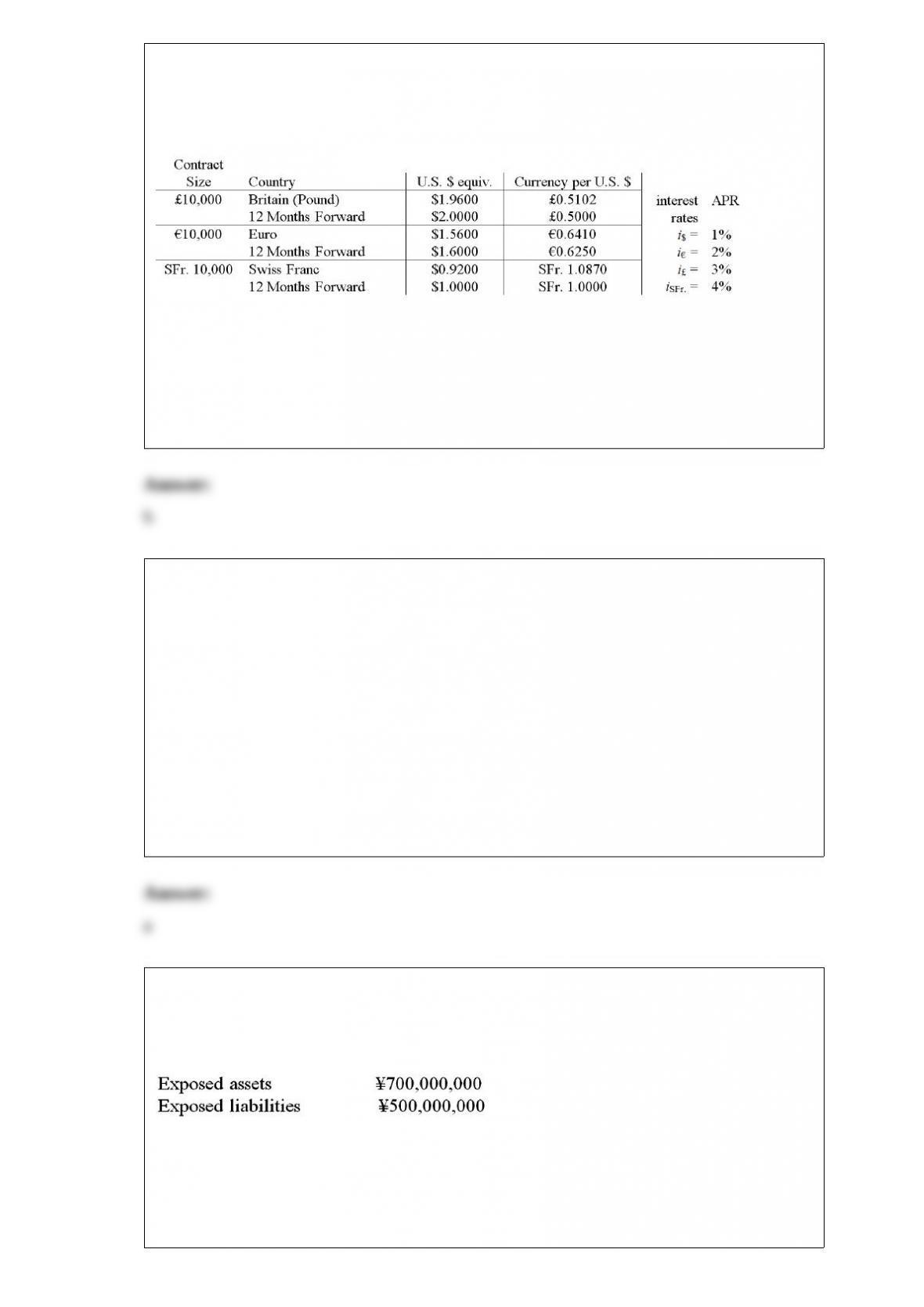
for sfr. 1,000,000 worth of bicycles. payment from the swiss firm (in swiss francs) is
due in 12 months. use a money market hedge to redenominate this one-year receivable
into a euro-denominated receivable with a one-year maturity.
the following were computed without rounding. select the answer closest to yours.
a.£500,000
b.£464,874.41
c.£446,730.77
d.£509,900.99
8) affiliate x sells 10,000 units to affiliate y per year. the marginal tax rates for x and y,
respectively, are 20 percent and 30 percent. the transfer price per unit is currently set at
$1,000, but it can go as high as $1,250.
calculate the increase in annual after-tax profits if the higher transfer price of $1,250 per
unit is used.
a.$250,000
b.$500,000
c.$1,000,000
d.$1,250,000
9) consider a u.s.-based mnc with manufacturing activities in japan. the result of a
change in the ¥-$ exchange rate on the assets and liabilities of the consolidated balance
sheet is:
ignoring transaction exposure in the yen, the translation exposure will indicate a
possible need for a “balance sheet hedge” of
a.¥200,000,000 more liabilities denominated in yen

b.¥200,000,000 less assets denominated in yen
c.both a or b
d.none of the above
10) a bank may establish a multinational operation for the reason of wholesale
defensive strategy. the underlying rationale being that
a.banks follow their multinational customers abroad to prevent the erosion of their
clientele to foreign banks seeking to service the multinational’s foreign subsidiaries
b.multinational banking operations help a bank prevent the erosion of its traveler’s
check, tourist, and foreign business markets from foreign bank competition
c.by maintaining foreign branches and foreign currency balances, banks may reduce
transaction costs and foreign exchange risk on currency conversion if government
controls can be circumvented
d.multinational banks are often not subject to the same regulations as domestic banks.
there may be reduced need to publish adequate financial information, lack of required
deposit insurance and reserve requirements on foreign currency deposits, and the
absence of territorial restrictions
11) some of the risks that a swap dealer confronts are “basis risk” and ‘sovereign risk.”
they are defined as
a.”basis risk” refers to the probability that a country will impose exchange restrictions
on a currency involved in a swap, and ‘sovereign risk” refers to a situation in which the
floating rates of the two counterparties are not pegged to the same index
b.”basis risk” refers to a situation in which the floating rates of the two counterparties
are not pegged to the same index and ‘sovereign risk” refers to the probability that a
country will impose exchange restrictions on a currency involved in a swap
c.”basis risk” refers to interest rate changing unfavorably before the swap bank can lay
off to an opposing counterparty the other side of an interest rate swap entered into with
a counterparty, and ‘sovereign risk” refers to the probability that a country will impose
exchange restrictions on a currency involved in a swap
d.”basis risk” refers to the risk of fluctuating exchange rates, and ‘sovereign risk” refers
to a situation in which the floating rates of the two counterparties are not pegged to the
same index

12) for question in this section, the notation is
y = gnp = national income
c = consumption
i = private investment
g = government spending
x = exports
m = imports
the difference between a country’s savings and investment is given by
a.s – i
b.i s
c.x – m
d.gnp – y
13) the financial manager’s responsibility involves
a.increasing the per share price of the company’s stock at any cost and by any means,
ways and fashion that is possible
b.the shareholder wealth maximization
c.which capital projects to select
d.both b and c
14) in may 1995 when the exchange rate was 80 yen per dollar, japan life insurance
company invested ¥800,000,000 (i.e., $10,000,000) in pure-discount u.s. bonds. the
investment was liquidated one year later when the exchange rate was 110 yen per dollar.
if the rate of return earned on this investment was 46% in terms of yen, calculate the
dollar amount that the bonds were sold at.
a.$10,618,000
b.$10,720,000
c.$14,600,000

d.none of the above
15) a zero-coupon british bond promises to pay £100,000 in five years. the current
exchange rate is $2.00 = £1.00 and inflation is forecast at 3% in the u.s. and 2% in the
u.k. per year for the next five years. the appropriate discount rate for a bond of this risk
would be 10% if it paid in dollars. what is the appropriate price of the bond?
a.£62,092.13 = $124,184.26
b.£65,196.13 = $130,392.26
c.none of the above
16) precautionary cash balances
a.are necessary in case the firm has underestimated the amount of cash need to cover
transactions
b.are necessary to cover scheduled outflows of funds during a cash budgeting period
c.both a and b
d.none of the above
17) if you think that the dollar is going to appreciate against the euro, you should
a.buy put options on the euro
b.sell call options on the euro
c.buy call options on the euro
d.none of the above
18) most exchange traded currency options

a.mature every month, with daily resettlement
b.have original maturities of 1, 2, and 3 years
c.have original maturities of 3, 6, 9, and 12 months
d.mature every month, without daily resettlement
19) trade barriers can arise naturally. which of the following are natural barriers to
trade?
a.transportation costs
b.quotas
c.tariffs
d.transactions costs